

 19 minutes read
Let's get one thing straight: the daily commute to a traditional law office is quickly becoming a relic. The good news for you? Law firms are finally catching on. They're realizing that top-tier legal support isn't tied to a specific zip code, and frankly, mortgaging the office ping-pong table for a downtown address is getting old. This isn't just some passing fad—it’s a fundamental shift in how the legal world operates, and it's cracking open incredible opportunities for anyone hunting for remote legal secretary jobs.
For decades, the legal profession was chained to the idea that real work could only happen inside wood-paneled, paper-stacked walls. We were all sold the story that collaboration, confidentiality, and raw productivity demanded everyone breathe the same filtered air.
Turns out, that was mostly a myth. The giant, unplanned remote work experiment of the early 2020s was a bucket of ice water to the face for the entire industry. Law firms, from overloaded solo practitioners to bustling mid-sized practices, learned something powerful: they could slash overhead without sacrificing talent.
Suddenly, paying a fortune for a prestigious address and a fancy espresso machine started to look a little ridiculous.

The calculation is refreshingly simple. Why sink a small fortune into thousands of square feet of office space when a distributed team can deliver the same, if not better, results? This isn't just about saving on rent; it's a complete rewiring of the business model.
The difference between the old way and the new way is night and day. It’s about more than location; it’s about efficiency, talent, and just a smarter way of working.
| Factor | Traditional On-Site Role | Modern Remote Role |
|---|---|---|
| Talent Pool | Limited to whoever lives nearby | Nationwide, best-fit talent |
| Overhead Costs | High (rent, utilities, sad office coffee) | Drastically reduced |
| Work-Life Balance | Rigid 9-to-5, plus commute | Flexible, focused on results |
| Productivity | Constant interruptions, office politics | Deep work, fewer distractions |
| Firm Scalability | Rigid, requires physical expansion | Agile, can scale support on demand |
This new model is a clear win-win. Firms get better talent and lower costs. You get the career you want, on your terms.
And this isn't just a theory. The demand for remote legal secretaries has exploded. A quick peek at job boards like Indeed.com reveals a flood of active listings across every practice area imaginable. This isn't a blip; it's the new standard.

The question is no longer "Can we make remote work happen?" It's "How can we afford not to?" For you, the job seeker, this is the best news you've had all year.
The market for your skills has officially broken free from geography. The old gatekeepers are gone. Opportunities are now based on your expertise, not your address. This is your moment.
Let’s be honest. If your job search strategy is just doom-scrolling through massive, generic job boards, you’re basically panning for gold in a river of mud. It's a fantastic recipe for burnout.
You’ll spend your days dodging spam, applying to “ghost jobs” that closed weeks ago, and competing with a thousand other people for the same handful of legit roles. Hope you enjoy spending your afternoons fact-checking resumes and running background checks on sketchy companies—because that’s now your full-time job.
There's a much smarter way to play this game. The best opportunities aren’t always where everyone else is looking. You need to know where the serious law firms—the ones who respect your skills and will actually pay you what you’re worth—are posting their openings.
Sure, you might stumble upon a gem on big sites like LinkedIn or Indeed. But they're needles in a very, very large haystack. The real action, especially for high-quality, pre-vetted roles, is happening on specialized platforms.
Think of it as the difference between shopping at a chaotic superstore versus a curated boutique. One gives you a headache; the other gives you exactly what you need.
These niche platforms do the grunt work for you. They’re built for the legal industry and often have direct relationships with firms that don't bother with the noise of the mainstream market.
The goal isn't just to find a remote legal secretary job; it's to find the right one without losing your mind. This means shifting your focus from quantity of applications to quality of opportunities.
So, where are these magical places? They fall into a few key categories.
This should be your first stop. Period. These sites are laser-focused on the legal profession, meaning the signal-to-noise ratio is infinitely better. Firms posting here are serious about finding experienced talent, not just harvesting resumes.
Even on the best platforms, you need a finely tuned B.S. detector. After sifting through thousands of these listings, I can tell you the red flags are usually hiding in plain sight. They practically scream, "We are a disorganized nightmare to work for!"
The Vague Job Description
If the post is a jumble of corporate buzzwords about being a "team player" but offers zero specifics on the practice area, required software, or actual duties, run. It means they haven’t thought through the role, and you'll be walking into chaos.
The "Always-On" Expectation
Watch for phrases like "must be available at all hours" or "flexible schedule required (including nights and weekends)." That isn’t flexibility; it’s a one-way ticket to burnout. A quality remote role has boundaries.
The Unicorn Hunt
Are they asking for 10 years of experience, a paralegal certificate, and expertise in five different practice areas for an entry-level salary? Classic sign of a firm that either doesn’t understand the market or doesn’t value its support staff. Don't waste your time.
Landing the best remote legal secretary jobs requires a scalpel, not a sledgehammer. Ditch the scattergun approach. Focus your energy on specialized platforms and learn to spot—and ignore—the listings that will only waste your time.
Let’s be honest: that generic, one-page resume template you’ve been using since college? It’s not going to cut it. For remote legal secretary jobs, hiring managers are scanning for a completely different set of signals. Your standard CV is probably getting tossed in the virtual trash bin in under six seconds.
They aren't just looking for someone who can manage a calendar. They’re looking for a self-starter, a tech-savvy pro, and a stellar communicator who thrives without a manager hovering over their shoulder. Your resume needs to scream, “I was built for this.”
If it doesn’t, you're just another PDF in a massive pile. Let’s fix that.
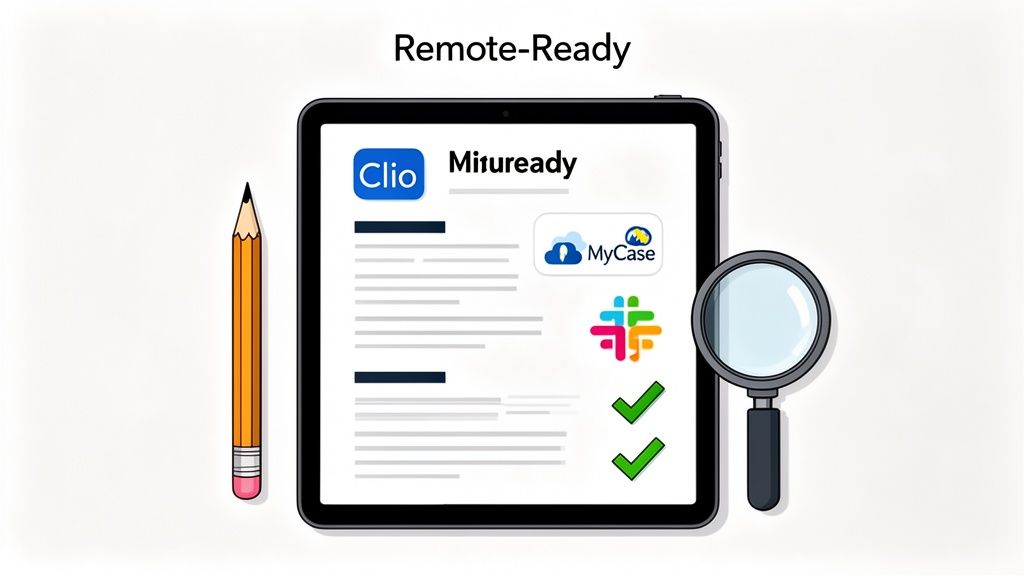
The most common mistake I see is a skills section that lists "Microsoft Office" and calls it a day. That’s like a chef listing "knows how to use a spoon." It’s the absolute bare minimum and tells a hiring manager nothing.
You have to get specific. The firm you're applying to lives and breathes in its software stack. Show them you can plug right in.
This isn't about padding your resume; it's about speaking the language that remote-first firms actually care about.
Saying you’re "highly organized" is meaningless. It’s filler text every applicant uses. You need to provide cold, hard evidence of your remote-readiness.
Let’s look at a quick before-and-after.
The "Before" Bullet Point (Vague & Forgettable):
The "After" Bullet Point (Specific & Impressive):
See the difference? The second version proves you can handle the unique logistics of remote work. It uses keywords (Clio, time zones) and quantifies your impact. To really nail this, you need to know what skills to put on a resume that are tailored for a remote legal role.
Your resume isn’t a list of duties. It’s a highlight reel of your accomplishments. Each bullet point should be a mini case study proving your value in a remote setting.
Please, for the love of all that is holy, delete that "Objective" statement. Nobody cares that your objective is to "obtain a challenging position." We already know you want a job—that’s why you applied.
Replace it with a sharp, 2-3 sentence Professional Summary that acts as your elevator pitch. This is your chance to grab their attention.
This summary immediately tells the reader who you are, what you’re good at, and why you’re a perfect fit for a remote role. While you're at it, brush up on the general requirements for paralegal jobs, as many core competencies overlap and can only strengthen your application.
Alright, let's talk about the two moments that decide whether you land that great remote legal secretary job: the virtual interview and the salary negotiation.
Nailing these can be the difference between a fantastic new role and being thrown back to the job board wolves.
The virtual interview is a whole different beast. No one cares about your shoes, but the angle of your webcam and the clarity of your mic are suddenly make-or-break. A barking dog or a choppy internet connection can kill your chances before you even answer the first question.
It's not just about looking professional; it's about projecting competence and reliability through a screen. You have to prove you’re the calm, organized force they need, even when you're hundreds of miles away.
Before you memorize a single answer, get your tech setup locked down. This is non-negotiable. If an interviewer says "I think you're frozen" more than once, they're already thinking about the next candidate.
Here’s a quick, no-nonsense checklist:
Once your tech is solid, it’s all about presence. Sit up straight, look into the camera lens (not at your own face), and speak clearly. For a deeper dive, our guide on common legal assistant interview questions is a great place to start.
Now for the part that makes everyone squirm: the salary conversation. Going in unprepared is the fastest way to leave thousands of dollars on the table.
Your first step? Know your worth.
Remote roles often have different pay structures. Here's a look at typical ranges to benchmark your expectations.
| Experience Level | Typical Hourly Rate (Contract) | Typical Annual Salary (Employee) |
|---|---|---|
| Entry-Level | $18 – $24 | $38,000 – $47,000 |
| Mid-Level (3-5+ years) | $25 – $32 | $48,000 – $59,000 |
| Senior/Specialist | $33 – $40+ | $60,000 – $70,000+ |
Data from sources like ZipRecruiter confirms these ranges, reporting an average annual pay of $48,215—or $23.18 per hour—for remote legal secretaries as of late 2025. With top earners hitting $66,500, you have a solid foundation to build your case.
When they ask for your salary expectations, don't just throw out a single number. State a well-researched range that reflects your experience and market data. It shows you’ve done your homework and gives you room to negotiate.
For instance, instead of, "I want $50,000," try: "Based on my extensive experience with Clio and my background in litigation support, I am targeting a salary in the range of $52,000 to $58,000." It’s confident, specific, and ties your value to your skills.
Beyond the base salary, knowing how to negotiate remote work in job offers is crucial. You can often negotiate for a home office stipend, guaranteed schedule flexibility, or professional development funds. Don’t be afraid to ask for what you’re worth. The right firm will respect you for it.
Congratulations, you got the job. Pop the champagne, then get ready—because the real work starts now. Landing one of these coveted remote legal secretary jobs is huge, but becoming truly indispensable is a whole different ballgame.
Your first 90 days are critical. This is your audition for becoming a long-term, mission-critical asset, not just a line item on their budget.
Let’s be blunt: when you're remote, out of sight can quickly become out of mind. Your goal is to make yourself so valuable that the attorneys you support can't imagine their workday without you.
You've navigated the interview gauntlet, from prep to negotiation. That's no small feat.
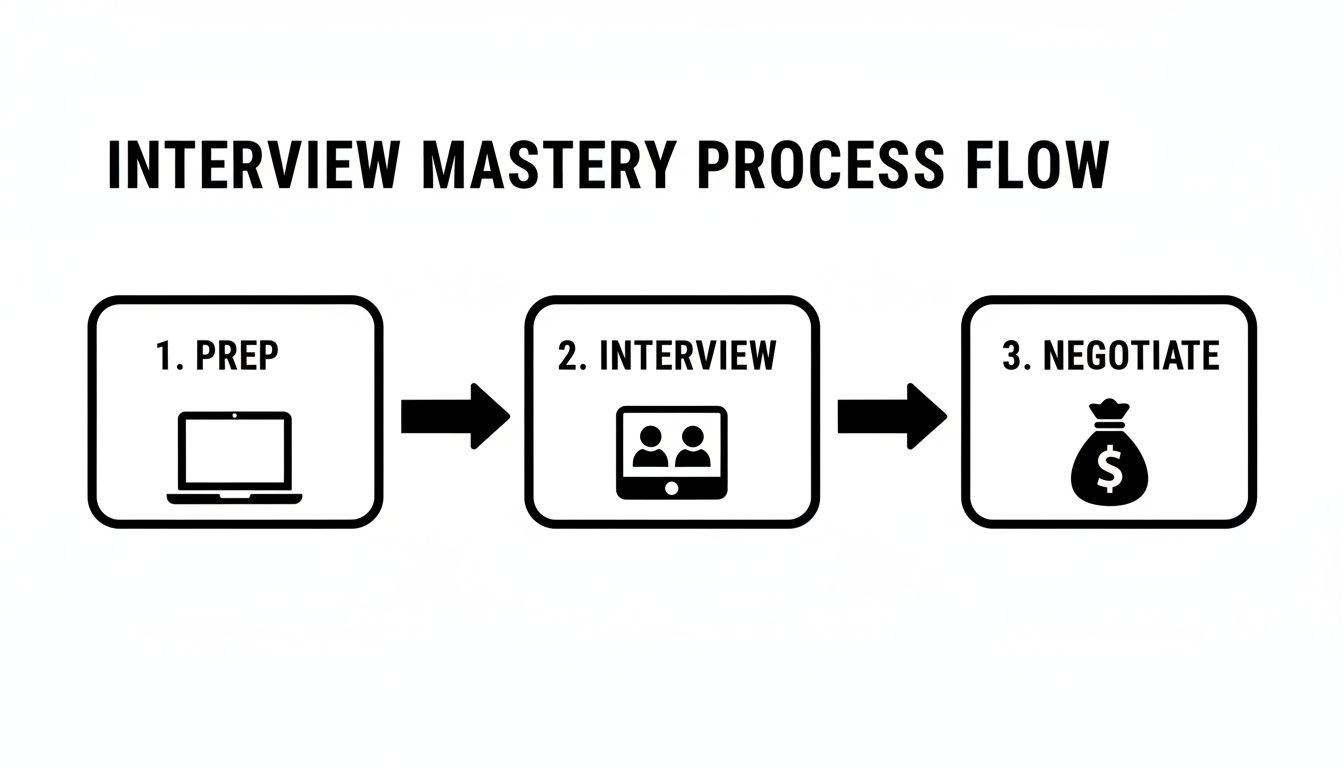
Now, the focus shifts from getting the job to absolutely crushing it.
Your first month is about observation and absorption. Your mission is to learn the firm’s rhythm, its people, its tech, and its unwritten rules. Don’t try to reinvent the wheel; first, you need to understand how the car works.
Okay, you've got the lay of the land. Now it’s time to start making small, impactful improvements. You're looking for friction points you can smooth out.
Your goal is to move from reactive to proactive. Don't wait to be told what to do; start anticipating what your attorneys will need before they ask.
If you notice scheduling depositions is a chaotic email mess, propose a simple system using a tool like Calendly. You’re not criticizing the old way; you’re offering a solution that makes everyone’s life easier. That's a win.
By day 61, you should be fully integrated. The final push is about cementing your position as a proactive partner. You're no longer just support; you're a strategic asset.
The first 90 days are a sprint. By following this framework, you're not just doing your job—you’re strategically building a reputation that sticks.
Alright, partners and hiring managers, let's have a chat. If your go-to strategy for finding remote legal staff still involves posting on Craigslist and praying, it's time for an intervention.
The market for skilled remote professionals is white-hot. That revolving door of support staff you're experiencing? It isn't bad luck; it’s a sign that your hiring strategy is broken. You're burning billable hours sifting through unqualified resumes and chasing down references. It’s an exhausting and inefficient way to run a business.
Here’s the thing: top-tier remote legal secretaries aren't hanging out on generic job boards anymore. They’re on specialized platforms where they know quality firms are recruiting.
The legal job market is constantly churning. Projections show around 39,300 paralegal and legal secretary openings popping up each year through 2034. That’s a 10% turnover of the entire workforce annually, as detailed in the paralegal job outlook from ParalegalEDU.org. The competition for proven talent is fierce.
Calculate the true cost of a bad hire. It’s not just the salary. It's the lost billable hours, the client mishaps, and the administrative nightmare of starting the search all over again.
Now, contrast that with getting a hand-picked list of pre-vetted, experienced professionals ready to hit the ground running. It’s a night-and-day difference.
The exceptional talent you're looking for is out there, but they won't find you by chance. They’re looking for firms that have embraced modern hiring. You need to be where the professionals are.
You've got questions, and I've heard them all. Let's cut through the noise and get you some straight answers.
Honestly? No. A paralegal certificate can look nice, but it’s rarely the make-or-break factor. What firms really care about is your practical, hands-on experience and your tech stack.
They need to know you're already fluent in legal software like Clio or PracticePanther. They want to see that you can jump into Slack or Asana without needing a manual. Your ability to manage digital files and communicate online is far more valuable than another piece of paper.
The bottom line: Your resume should scream "tech-savvy" and "experienced," not just "certified." That’s what gets you an interview.
It's a healthy mix, which is great news. You’ll find a ton of 1099 contract roles from agile firms that need expert help without the W-2 overhead. It's how they stay lean.
At the same time, more established firms are offering full-time, remote W-2 positions with benefits. It really comes down to what you want.
There’s no "better" option—just the one that fits your life. Decide what you want and filter your search accordingly.
Let me be blunt: it's not the work. It's the twin specters of isolation and communication breakdown. You can't just pop into an attorney's office with a quick question anymore.
To succeed, you have to become a master of proactive, organized communication. This means setting clear expectations on response times, using status updates so no one is ever guessing what you're doing, and getting really comfortable on video calls.
The other beast to tame is the "always-on" feeling. When your office is three feet from your bed, you must be disciplined about setting firm boundaries to avoid burnout. It's a skill you have to actively build.


