
 18 minutes read
Let's get one thing straight: the way most law firms hire is broken. It’s a slow, expensive relic that forces you to choose between two bad options: being massively overstaffed during lulls or desperately understaffed during a surge. This isn't just about efficiency; it's about plugging the financial leaks that are draining your firm's profitability.
Flexible staffing is the antidote. It’s about bringing on elite legal professionals exactly when you need them, without the dead weight of full-time overhead. Turns out there’s more than one way to scale your team without mortgaging your office ping-pong table.

Let's be brutally honest. That traditional hiring model you're clinging to? It’s a money pit. In either scenario—too much work or not enough—you're losing. You’re either paying for downtime or you're paying in burnout, grinding down your best people in the process. There’s no in-between.
We’ve all been there. You land a massive discovery project, and suddenly you need three more paralegals yesterday. This kicks off a frantic, months-long scramble to post jobs, sift through résumés, and conduct endless interviews—all while your existing team is completely drowning. Hope you enjoy spending your afternoons fact-checking resumes and running technical interviews—because that’s now your full-time job.
The base salary is just the tip of the iceberg. The real damage to your bottom line comes from the hidden costs that bleed your firm dry, one full-time hire at a time.
I'm talking about things like:
This isn't just a hunch; it’s a systemic shift. The global staffing market is projected to hit USD 650 billion by 2025, with the US market alone rocketing toward USD 198.3 billion. This isn't about finding temp workers anymore; it's a fundamental change in how smart businesses operate. You can explore more data on global staffing market trends to see the bigger picture.
Let's break down exactly what this looks like in practice. When you compare the true expenses, the numbers don't lie.
| Cost Factor | Traditional Full-Time Hire | Flexible Staffing Solution |
|---|---|---|
| Recruitment Costs | Job postings, recruiter fees, time spent on interviews (often 15-20% of first-year salary). | Minimal to none. The provider handles sourcing and vetting. |
| Salary & Benefits | Full salary + benefits (25-40% extra), 401(k), PTO, sick leave. | Hourly or project-based rate. No benefits, taxes, or insurance costs for you. |
| Onboarding & Training | Significant time and resources to integrate a new employee into firm culture and systems. | Streamlined onboarding focused on the specific project. They're expected to hit the ground running. |
| Downtime Costs | You pay a full salary even during slow periods when there isn't enough work. | You only pay for the hours worked. When the project is over, the cost stops. |
| Wrong Hire Risk | High. A bad hire can cost upwards of 30% of their annual salary in lost productivity and replacement costs. | Low. You can test talent on a project basis. If it's not a fit, you can switch providers with minimal disruption. |
| Administrative Overhead | Payroll processing, HR compliance, performance reviews, and other administrative burdens. | The provider handles all payroll, taxes, and compliance. You receive a single, simple invoice. |
The "sticker price" of a full-time salary is a lie. The flexible model strips away nearly all the ancillary costs, giving you a much clearer, more direct line between expense and output.

We’ve seen firms waste thousands on a single bad hire. They bring someone on full-time, invest in training, and six months later, realize it’s a poor fit. Flexible staffing lets you test-drive talent on real projects before making a long-term commitment. It's a try-before-you-buy model for your most valuable asset: your people.
It’s time to stop pretending the old way works. Flexible staffing isn’t some trendy buzzword; it’s a pragmatic survival strategy for the modern law firm. This is about building an agile team that scales with your caseload, not your payroll.
Alright, so you admit the old way is broken. Good. Now, let’s make sure you don't swap one set of problems for another. Jumping into flexible staffing solutions without a clear strategy is a surefire way to get the wrong help and blow through your budget.
This isn't just a list of definitions; it's a practical breakdown of the models we’ve seen in action—scars and all. Think of it like picking the right tool for the job. You wouldn't bring a sledgehammer to a delicate negotiation, would you?
This is the classic freelancer route. You have a single, high-stakes discovery project that needs to be wrapped up in six weeks, so you find an independent paralegal, sign a contract, and they get to work.
This is a huge step up. Instead of just hiring one person, you're partnering with an agency or a dedicated platform that maintains a pre-vetted pool of top-tier legal talent. You tell them what you need, and they deliver a shortlist of qualified candidates.
The real advantage here is offloading the entire headache of recruitment. A good agency handles the sourcing, the rigorous background checks, and often the payroll and compliance. It's a fundamental part of managing a modern contingent workforce, letting you gain agility without getting buried in admin.
Our Take: This approach is perfect for firms that need reliable, ongoing support but don't have the time to become full-time recruiters. You get the flexibility of a contractor with the quality control of a dedicated HR team. This is usually the sweet spot.
Finally, we have the fractional model. This is where you engage a remote paralegal or legal assistant for a set number of hours each month on a retainer. They become a consistent, deeply integrated part of your team, just without the W-2 commitment.
This isn’t for a one-off project. It’s built for the steady, recurring work that keeps a firm running—document management, client intake, or litigation support. Over time, this professional learns your firm's workflows, your attorneys' preferences, and your key clients. That deep integration is what makes this model so powerful.
If you’re leaning into this, understanding how to manage a non-permanent team is crucial. You can learn more in our deep dive on what contingent workforce management entails and the best ways to do it.
Ultimately, picking the right model boils down to one question: Are you trying to put out a short-term fire, or are you building a more resilient, scalable foundation for your firm's future?

Alright, let's talk about getting buy-in. You can have the best idea in the world, but if you can't convince the other partners, it's dead on arrival. Partners speak one language fluently: money. So, forget the fluffy talk about "synergy" and let's build a business case so painfully obvious they'll wonder why you didn't do this years ago.
You don't need a convoluted spreadsheet. A simple, back-of-the-napkin calculation is all it takes to prove the point.
First, start by identifying the tasks your expensive attorneys are doing that a skilled remote paralegal could handle for a fraction of the cost. Think about the time they spend on administrative work, document review, or initial case research.
Let's do some quick, painful math. Say you bill out an associate at $250/hour. They spend just four hours a week on tasks a $40/hour remote paralegal could easily manage.
That’s a $210/hour difference. Over a year, you’re lighting $43,680 on fire. For one attorney. Now multiply that across your firm. The number gets ugly, fast.
The Real Win: It's not just about cost savings. It's about opportunity cost. When your best legal minds are freed from administrative burdens, they can focus on high-value, billable work—bringing in more revenue and moving cases forward. It’s an immediate profitability boost.
The other critical metric is the "Cost of Delay"—the revenue you lose every single day a key role sits empty. A traditional hiring process can drag on for months, creating a productivity black hole. While you're busy interviewing, case progress slows, deadlines get pushed, and client satisfaction erodes.
With flexible staffing, you can often have a qualified professional ready to start in under 48 hours. This isn't just about filling a seat; it's about plugging a massive revenue leak, immediately. This trend is only growing; the global contingent staffing market is forecasted to hit USD 8.2 billion by 2035, driven by this exact need for speed.
When you're making your pitch, present an argument that isn't just compelling but financially undeniable. If you need more ammunition, there's a great resource that outlines 21 Reasons Why You Need A Virtual Assistant that can help frame the conversation.
Your case shouldn't be a plea; it should be a presentation of facts. Show them the math, highlight the lost revenue, and make the solution so clear that the only question left is, "How soon can we start?"
So, ready to bring on some flexible help? Great. Now for the hard part: picking the right partner.
The market is saturated with providers, and honestly, most of them are selling slick presentations with very little substance. It’s easy to get taken in by a polished sales pitch. We’ve been there. We've hired the "top-rated" agency only to get a paralegal who couldn't tell a deposition from a grocery list.
This is our field-tested guide for separating the real experts from the pretenders. It’s about asking tough, specific questions before you even think about signing a contract.
Anyone can put up a professional-looking website. Your job is to dig deeper. Forget their curated case studies and start asking questions that reveal whether they truly understand the legal industry.
Here are the must-ask questions to put them on the spot:
Tech Stack Fluency: Don't settle for "yes, we have e-discovery experience." Pin them down. Ask which platforms their people have used. Are we talking Relativity, Logikcull, or DISCO? If they can't give you specifics, they're bluffing.
Data Security Protocols: Get granular. Ask about their encryption standards, secure file transfer methods, and their NDA process. A vague response like "we take security seriously" is an immediate deal-breaker.
US Legal Standards Familiarity: This is non-negotiable. Do their candidates understand the Federal Rules of Civil Procedure? Are they proficient with Bluebook citations? A quality provider has a robust screening process for this, not just a checkbox on a resume.
We once had a provider tell us their talent pool was "globally sourced for value." The reality? They had zero understanding of US legal nuances, and we spent more time fixing their mistakes than it would have taken to do the work ourselves. A hard lesson learned.
Here is the single most valuable piece of advice I can offer: never commit to a long-term contract without a small, paid test run.
Don't onboard a new provider for a six-month project based on a few good Zoom calls. Give them a small, low-risk, but very real assignment. Think organizing a single document repository or drafting a basic set of discovery requests. Pay them for their time—it's a tiny investment for invaluable peace of mind.
This trial run isn’t just about the quality of the final deliverable. It’s about assessing the entire working relationship:
A small pilot project reveals everything a sales pitch hides. Many firms find that working with a specialized legal outsourcing company that encourages pilot projects is the best way to build trust and confirm capabilities right from the start. Consider it a try-before-you-buy.
Finding great talent is only half the battle. The other half—and this is where most firms stumble—is getting them plugged into your operations so they can add value from day one. A sloppy onboarding process is the fastest way to turn a smart investment into a frustrating waste of time.
You can't just email a new remote paralegal a login and hope for the best. That’s a recipe for confusion, missed deadlines, and work that has to be redone. Successful integration takes a deliberate, front-loaded effort.
This isn’t about a virtual welcome basket. It’s about arming them with the exact tools, access, and context they need to function as a seamless extension of your team.
Before any work begins, you have to get the foundational pieces right. Think of it as building the digital office they'll be working in.
Your pre-start checklist must include:
This process flow below simplifies our vetting approach, which directly informs how we build our onboarding.
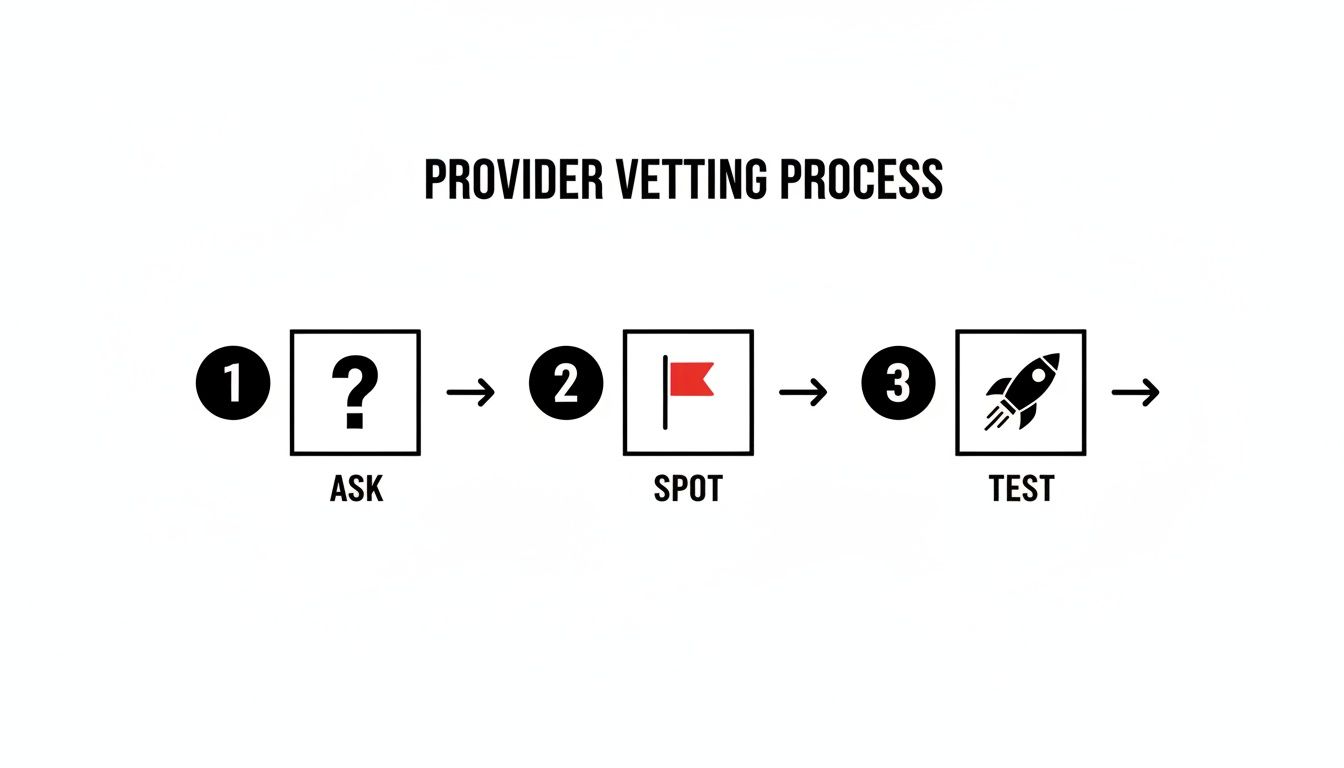
Using a simple Ask-Spot-Test framework helps you filter for professionals who are ready to integrate quickly, making your onboarding job far smoother.
Now for the secret weapon: for every project, create a "Single Source of Truth" document. This is a living brief that contains everything the remote team member needs to know, preventing those endless back-and-forth emails that kill productivity.
This document should be the first thing you share. It needs to include key players, deadlines, links to all relevant files, a clear statement of the objective, and examples of past work if available. The goal is to anticipate their questions and answer them in advance.
To help you stay on track, we’ve put together a checklist that covers the essentials.
| Category | Task Item | Status |
|---|---|---|
| Paperwork & Compliance | Signed Independent Contractor Agreement | ☐ Pending / ☑ Complete |
| Signed NDA | ☐ Pending / ☑ Complete | |
| Completed Conflict Check | ☐ Pending / ☑ Complete | |
| Form W-9 Submitted | ☐ Pending / ☑ Complete | |
| Systems & Technology | Case Management Software Access Created | ☐ Pending / ☑ Complete |
| Document Management System Access Created | ☐ Pending / ☑ Complete | |
| Firm Email/Alias Set Up | ☐ Pending / ☑ Complete | |
| Communication Platform (Slack/Teams) Invite Sent | ☐ Pending / ☑ Complete | |
| Project & Workflow | Project "Single Source of Truth" Document Shared | ☐ Pending / ☑ Complete |
| Initial Kick-off Call Scheduled | ☐ Pending / ☑ Complete | |
| Key Points of Contact Introduced | ☐ Pending / ☑ Complete | |
| First Task Clearly Assigned with Deadline | ☐ Pending / ☑ Complete |
This checklist isn't exhaustive, but it covers the core actions that prevent early missteps.
Mastering this is critical. If you’re looking for a more detailed walkthrough, our guide on how to onboard remote employees provides workflows you can implement immediately. By investing a little extra time upfront, you make your flexible staffing solutions truly effective.
Now, let’s talk about the unglamorous part—the compliance and risk management that can sink you if you get it wrong.
This isn't just administrative red tape. Mishandling compliance can quickly turn a smart staffing decision into a full-blown crisis. We've seen firms get so caught up in cost savings that they completely sidestep these critical issues. Don't be one of them.
First up is the classic landmine: worker misclassification. The line between a 1099 contractor and a W-2 employee might seem fuzzy, but you can bet the IRS sees it in black and white. One wrong move, and you're staring down a bill for back taxes, hefty penalties, and benefits you never budgeted for.
Let’s cut through the legalese. It really boils down to one thing: control.
If you're assigning a laptop, requiring them to be online from 9-to-5, and managing their every task, that's not a contractor. That's an employee. The penalties for getting this wrong can easily climb past $50,000 for a single worker. It’s a painfully expensive lesson.
We learned this the hard way years ago. Our rule now is crystal clear: define the deliverable, not the process. If you can't resist controlling the how, you need a W-2 employee, period.
The other major pitfall is data security. When a remote paralegal accesses sensitive client information, the ultimate responsibility for protecting that data still lands squarely on your firm. If a breach happens because your contractor was using unsecured coffee shop Wi-Fi, it’s still your breach.
This is where your contractor agreement becomes your most important line of defense. It needs to be an ironclad document with explicit clauses on data handling, secure network usage, and immediate breach notification protocols. This isn't just boilerplate—it's your primary shield.
A solid agreement must clearly outline:
Don’t skimp here. Have your own counsel draft or review your independent contractor agreements. A little due diligence now can save you from a world of sleepless nights later.
We get these questions all the time. Here are the straight answers.
This is the first question on every managing partner's mind. The solution is straightforward: process, not physical presence. We rely on ironclad Non-Disclosure Agreements (NDAs) from the very start.
From there, it's all about access control. A remote paralegal's access to your systems should be just as locked-down as anyone in-house. Think secure, dedicated communication channels, multi-factor authentication, and access granted only to the specific client files they need. Proximity doesn't create security; well-defined protocols do.
Let's be realistic: "fit" looks different in a remote context. It's less about joining the water-cooler chat and more about seamless workflow integration. The real measure of a good fit is whether they can plug into your processes without missing a beat.
A top-notch provider is looking for talent whose communication style, work ethic, and tech proficiency align with your firm's pace. The goal isn't to find a new lunch buddy; it's to find a professional who feels like a natural extension of your existing team from day one. When done right, they become a productive asset, not a distraction.