 21 minutes read
Let’s be real. Hiring a legal assistant isn’t about filling a seat; it’s about finding a force multiplier for your firm. The right person isn’t just an assistant—they're the one who keeps the chaos at bay so you can actually practice law. The wrong one? Well, they just create more work for you.

Most legal assistant job descriptions are a dumpster fire. They’re a laundry list of buzzwords that attract candidates who look great on paper but fold the second a real deadline hits. If you enjoy spending your afternoons re-doing work and micromanaging, by all means, keep using that same old template.
This guide is different. We’re cutting through the noise to focus on the real-world legal assistant requirements that actually predict who will thrive versus who will just survive. It's time to build a profile for someone who can wrangle a chaotic docket, so you can focus on work that actually makes you money.
To stop the cycle of bad hires, you have to start with an effective job description that clearly outlines what you actually need. It all boils down to defining your must-haves across four core pillars before you even think about posting the job.
Let's break down these foundational requirements. This is your new baseline for what "qualified" truly means.

The goal isn’t to find someone who checks every box on a generic list. It's about defining the right boxes for your firm—the ones that translate directly to increased efficiency, fewer errors, and a healthier bottom line.
By focusing on these core areas, you shift from simply filling a role to making a strategic investment in your firm's future. You can learn more about this approach in our guide to skills-based hiring. Let's dive in.
Let's tackle the question that trips up half the managing partners I talk to. Does your next legal assistant really need a four-year degree? I’ll give you the short answer: no. Clinging to that requirement is costing you incredible, often overlooked, talent.
Hope you enjoy spending your days sifting through résumés from fresh grads with zero practical skills, because that’s what a "bachelor's required" filter gets you. We’ve been conditioned to see a degree as the ultimate validator, but in the trenches of a busy law firm, it's often the least important line on a résumé. You're not hiring a legal scholar; you're hiring an organizational powerhouse.
It’s time to shift your mindset from credentials to competence.
A candidate with a nine-month paralegal certificate and two years of scrappy admin experience will almost always run circles around a recent graduate with a fancy diploma. Why? Because their training was tactical, not theoretical. They weren't writing essays on legal ethics; they were learning how to format a motion and manage a docket.
One of the biggest myths is that a degree is the only path to a successful legal career. In reality, a key requirement for legal assistants in the US is that a college degree isn't mandatory, which opens up opportunities for high school graduates with targeted training. According to recent data from ParalegalEdu.org, many successful legal assistants enter the field with just a high school diploma paired with certificate programs, though formal education can provide a competitive edge.
This isn't to say a bachelor's degree is worthless. It absolutely signals discipline and critical thinking skills. But you have to weigh it against the alternatives.
The bottom line is this: a degree proves someone can finish something they started. A certificate proves they learned how to do the actual job you’re hiring them to do. Don't automatically disqualify the latter.
So, how do you sort the contenders from the pretenders? Stop looking at the "Education" section as a pass/fail test. Instead, view it as a clue to a candidate's journey and practical abilities.
A certificate, especially, is a strong indicator of intent. Someone who actively sought out a specialized legal assistant or paralegal program is telling you they want to be in this field. They didn't just stumble into it after getting a history degree. For a deeper dive into what these credentials mean, check out our guide on paralegal certification requirements.
Think of it this way: education is just the foundation. You still need to build the house. The real question isn't "Where did you go to school?" but "What can you do for this firm right now?" If a candidate with a certificate can answer that question better than one with a degree, the choice is obvious. Don't let academic snobbery blind you to your next rockstar hire.
Alright, let's get down to brass tacks. A résumé full of fluff like "team player" and "good communicator" is nice, but it's the hard, measurable skills that keep the lights on. These are the day-one capabilities that separate the candidates who need constant hand-holding from the ones who can hit the ground running.
Think of this as the foundation—without it, everything else is just window dressing.
The journey into a legal support role isn't one-size-fits-all. As you can see below, practical certification is often just as valuable as a formal degree.
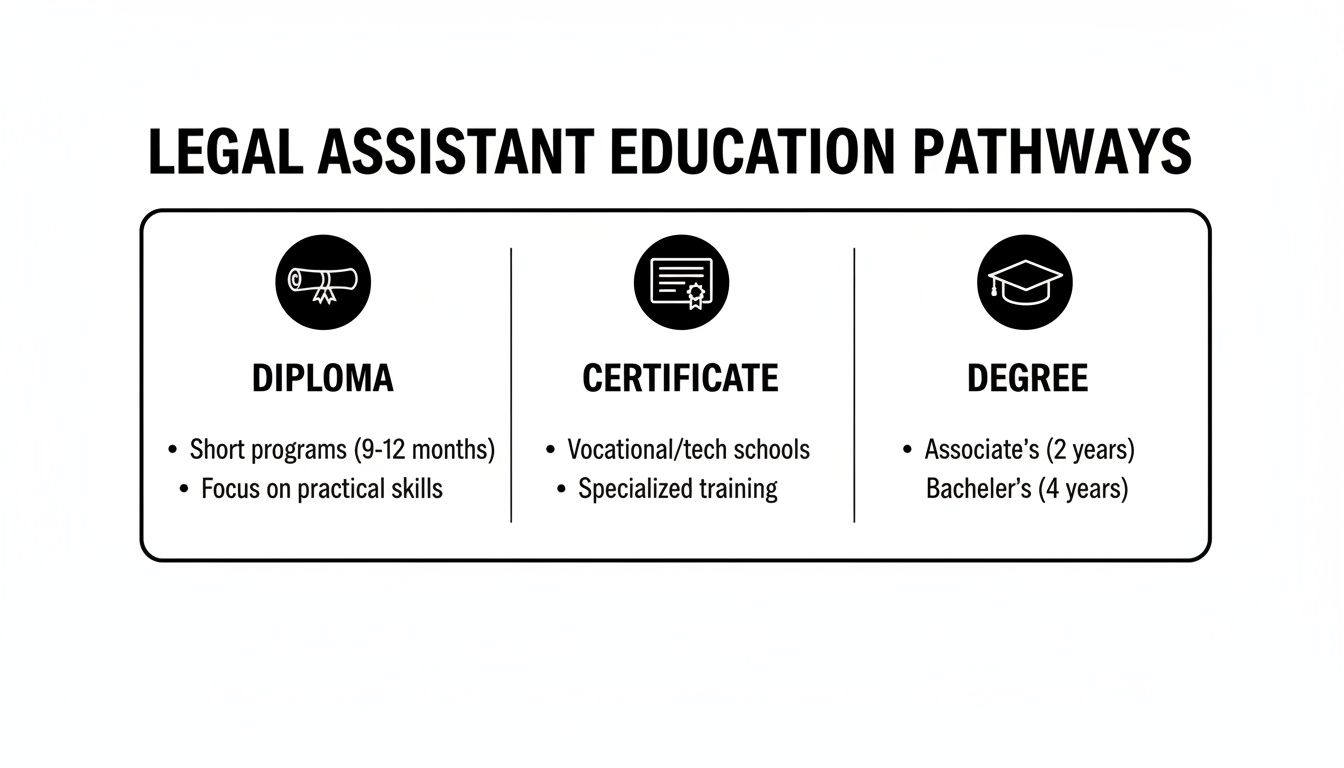
Ultimately, it’s not just the educational path that matters, but the practical skills a candidate brings to the table. Let’s break down the absolute must-haves.
In a modern law firm, a legal assistant who isn't tech-savvy is a liability. Full stop. Your practice runs on software, and if your assistant can't navigate it efficiently, they're slowing everyone down. This goes way beyond knowing how to use Microsoft Word.
A truly competent assistant needs hands-on experience with the tools that power your practice. This means proficiency in case management software like Clio, MyCase, or PracticePanther. They need to intuitively understand how to log billable hours, update client files, and manage deadlines within the system—without you looking over their shoulder.
Don't just take their word for it. Test them. A simple, practical question can reveal everything:
"Walk me through the steps you'd take in Clio to open a new matter for a client, upload the signed engagement letter, and create the first billing entry."
Their answer—or their hesitation—will tell you more than any line on their résumé. If they stumble, they’re not ready. It's that simple.
A law firm produces a staggering amount of documentation, and someone needs to be the master of that potential chaos. This isn't just about saving files in the right folder. It's about an almost obsessive command of document preparation, formatting, and e-filing.
Your legal assistant is the final line of defense against sloppy, unprofessional filings that could get rejected by the court or make your firm look amateurish. They must be able to:
Again, don't just ask, "Are you good with documents?" Give them a practical test. Hand them a poorly formatted draft and a clear set of instructions. Their ability to quickly transform it into a court-ready document is a direct measure of their value to your firm.
Finally, let's talk about what is arguably the single most critical function of a legal assistant: owning the calendar. A missed deadline is a law firm's worst nightmare, and a great assistant doesn't just add dates to a calendar—they strategically manage the entire docket.
This skill is a unique blend of organization, foresight, and a healthy dose of professional paranoia. They should be tracking statutes of limitations, discovery deadlines, and court appearances with ruthless efficiency. The best ones are proactive, reminding you of upcoming deadlines, not the other way around.
This means they understand the rules of civil procedure well enough to calculate deadlines correctly and anticipate the next steps in a case. They aren't just schedulers; they are the strategic gatekeepers of your firm's most valuable asset: time. If a candidate can't demonstrate an ironclad system for tracking dates, they are a risk you simply can’t afford to take.
Here’s a hard truth most firms learn by making a painful hiring mistake: a “generalist” legal assistant is a myth. Hiring someone without direct experience in your specific corner of the legal world is like asking a brilliant pastry chef to run your steakhouse. Sure, they know their way around a kitchen, but they’re going to burn a lot of expensive meat on your dime.
That fantastic litigation assistant who can prep for trial in their sleep? They’ll be completely lost trying to manage the due diligence for a corporate merger. And the corporate pro who navigates entity formation documents with ease? They wouldn’t know the first thing about preparing a witness for a deposition in a messy family law case.
You aren’t just hiring for a generic set of abilities. You’re hiring for a specific language, a unique rhythm, and a deep understanding of what's at stake in your practice area.
The requirements for a legal assistant at a high-volume personal injury firm are fundamentally different from those at a boutique intellectual property practice. It’s not about one being “better” than the other; it’s about precision. Your job description needs to reflect the unique universe your firm operates in.
Let’s get specific. Here’s what this looks like in the real world:
Hiring someone who already speaks your practice’s language isn’t a luxury—it’s a strategic necessity. The learning curve for a specialist is weeks, not months.
The goal is to hire someone who sees your urgent request and thinks, "I've done this a hundred times before," not "Okay, let me Google that." That confidence and prior experience are what you're paying for.
Stop thinking in terms of a generic job description. Instead, start building a profile for the candidate who can solve your specific problems. Instead of just listing "attention to detail," describe the actual tasks that demand it in your practice.
For example, instead of writing: "Seeking a motivated legal assistant…"
Try this for a litigation firm: "Seeking a litigation assistant who can manage a complex discovery calendar, prepare and serve subpoenas, and coordinate multi-party depositions without breaking a sweat."
See the difference? One attracts anyone with a pulse and a certificate. The other attracts a professional who knows exactly what they’re walking into and has the specialized skills to succeed from day one. This small shift in framing is critical for attracting candidates who don’t just meet the basic requirements but are tailor-made for your firm’s unique challenges.
Every job description seems to demand "5-7 years of experience," but let's be honest—what does that really tell you? It's often one of the most arbitrary metrics used in hiring. Are we seriously suggesting that five years at a quiet, low-volume real estate practice automatically trumps one year in the high-stakes trenches of a busy litigation firm? I doubt it.
When you fixate on a number, you risk overlooking hungry, adaptable candidates simply because you're counting years instead of achievements. The truth is, the quality and relevance of that experience matter far more than the raw number. It’s time to stop counting and start weighing what a candidate has actually done.
Instead of getting hung up on a specific number, look for evidence of real growth and capability. Think of a résumé as a story. Does it tell a tale of stagnation, or one of increasing responsibility and trust?
Here’s a quick guide to reading between the lines:
The most valuable experience isn't measured in time; it's measured in problems solved. Ask candidates to describe the most chaotic situation they ever managed at a previous firm. Their answer will tell you everything you need to know about the quality of their experience.
Here's an insider tip that might go against conventional wisdom: candidates with 2-3 years of solid, relevant experience are often your best hires. Forget the veteran who’s been doing things the same way since the fax machine was revolutionary. The candidate in this sweet spot often brings the perfect blend of proven capability and untapped potential.
They’re new enough to be hungry and eager to prove themselves, but experienced enough that you won't have to teach them the basics, like how to e-file a document. Crucially, they haven't been in the field so long that they're stuck in their ways, making them far more adaptable to your firm’s processes and technology.
This is especially true when you consider their educational background. The typical entry-level education for a legal assistant is an associate’s degree, which provides a strong, practical foundation. Candidates just a few years out of these focused programs are primed for fast-paced offices and ready to support lawyers effectively. While a high school diploma can be a starting point, the competitiveness of today's market often demands at least a two-year degree in paralegal studies, which many supplement with certifications. You can explore more about these educational pathways and what they signal for firms seeking competent support.
Ultimately, you need to decide what you’re really hiring for. Are you just looking to fill a seat with a résumé that checks a box? Or are you looking for a capable problem-solver who can grow right along with your firm? Stop obsessing over an arbitrary number of years and start looking for a track record of real-world accomplishments.
Alright, enough theory. You know what you need, you know which skills are non-negotiable, and you're no longer hung up on degrees. Now for the tough part: sifting through a mountain of applications.
Hope you enjoy spending your afternoons fact-checking résumés and running screening calls—because that’s now your full-time job.
Just kidding. I wouldn't do that to you.
Think of this as your hiring cheat sheet. It’s a practical, no-fluff checklist we’ve put together after making (and painfully learning from) every hiring mistake in the book. This isn’t about finding just any candidate; it’s about finding the right one, faster.
Before you waste a single minute on the phone, every résumé needs to pass this initial filter. This is a quick, five-minute process designed to weed out the 80% of applicants who are an immediate “no.”
You've got your shortlist. Now it's time to find out if the person on paper is the real deal. These aren't your typical interview questions; they’re designed to see how a candidate thinks and solves problems on the fly. For an even more robust set of questions, you can also check out our detailed guide on legal assistant interview questions.
The goal of the phone screen is simple: Can this person think on their feet? Anyone can memorize answers from a script. It’s how they handle a real-world problem that shows you who they really are.
While you're evaluating skills, don't forget the legal side of hiring. It’s crucial to stay compliant. For a comprehensive guide on Ensuring Compliance in the Hiring Process, this resource is a great way to protect your firm.
This is where you confirm your gut feelings. By this stage, it’s less about hard skills—you’ve already vetted those—and more about attitude and whether they’ll be a good fit for your team.
This entire process is designed to be a funnel, and frankly, it’s a lot of work. This is precisely why platforms like ours exist—we do all this heavy lifting for you. We handle the sourcing, the vetting, and the skills validation so you only meet with the top 2-3% of candidates. Toot, toot.
We’ve walked through the A-to-Z of finding a great legal assistant, but a few key questions always pop up. Let's tackle them head-on with the kind of straightforward advice you can actually use.
Easy. It's not typing speed or knowing a particular software. The most overlooked—and frankly, most valuable—trait is proactive problem-solving.
Anyone can follow a to-do list. What you need is someone who sees a potential scheduling conflict three weeks out and has it fixed before you even know it's a problem. They don't just take instructions; they anticipate your next move.
A truly great assistant flags a potential snag in a case file and suggests a solution before it becomes a fire drill. This is the difference between a simple administrative helper and a strategic partner who actively makes your practice run better.
Yes, one hundred percent. But don't just ask, "Are you proficient in Clio?" That's a throwaway question with an equally useless answer.
Instead, give them a brief, hands-on task. Ask them to properly format a sample pleading or set up a complex, multi-party deposition in a shared calendar. This simple five-minute exercise will reveal more about their real-world capabilities than an hour of them just telling you what they can do.
Don't hire someone's résumé; hire their demonstrated ability to do the job. A practical test is the quickest way to separate fact from well-written fiction.
It’s not an absolute deal-breaker for a truly stellar candidate, but it's a massive advantage that should be weighed heavily. Bringing on a legal assistant who already understands the language, critical deadlines, and document flow of your practice area—say, litigation versus real estate—is like starting a race halfway to the finish line.
Their learning curve will be dramatically shorter. They'll make fewer of those rookie mistakes that cost you time and money. If you're torn between two otherwise equal candidates, the one who already speaks your firm’s language should get the offer. Every time. Making this a priority will save you months of tedious training and frustration.