

 16 minutes read
Freelance lawyer jobs aren't just a trend; they're the escape hatch for firms drowning in overhead. This isn't about finding cheap help. It's about tapping into elite legal talent on-demand, letting you grow your firm without having to mortgage your office ping-pong table.
This model keeps you nimble. It's the difference between being a lumbering battleship and a fleet of agile speedboats, ready to pivot the second the market does.
Let's be real. The old-school partner track is broken. You're either burning out your team with impossible caseloads or carrying massive salaries for niche experts you only need twice a year. Both paths lead to the same place: a slow, painful death by overhead.
This isn't just a hunch; it's a market shift. The rigid model of hiring full-time associates is too slow, too expensive, and too clumsy for today's clients who want results, not billable fluff. Headcount doesn't equal profit. Never has, never will.
The old way is a trap. A huge case lands, you panic-hire a pricey associate, and when the dust settles, you're stuck feeding them billable hours just to justify their salary. It's a soul-crushing cycle of taking on mediocre cases just to keep the lights on.
It’s exhausting, inefficient, and a terrible way to build a practice focused on high-value, profitable work. It's time to get off the wheel.

The freelance movement is no joke. A wild 16% of America's freelancers now come from the legal field. That’s a tidal wave of attorneys ditching the 9-to-5 grind. This is part of the gig economy's insane growth, which is on track to become a $918 billion market by 2028, according to data from SpotDraft. This isn't a fad; it's the future.
Freelance lawyers offer a lifeline. A much smarter way to operate. You bring in seasoned attorneys for specific missions, and when the mission is over, they're gone. No strings, no drama, no lingering payroll.
The $500,000 Hello. That's what a senior associate can cost you when you factor in salary, benefits, and overhead. A freelance lawyer? You only pay for productive hours. The math isn't complicated.
Here's the upside, plain and simple:
This isn't about firing your core team. It’s about adding a flexible, strategic layer of talent that makes your firm bulletproof. Stop obsessing over headcount and start focusing on results.
So, what can you actually farm out to a freelance lawyer? If you're just thinking "overflow work," you're missing the point entirely. That’s like using a sledgehammer to crack a nut. The real magic is surgical precision—getting the exact expertise you need, right when you need it.
Forget the myth that freelance lawyer jobs are for low-level grunt work. We’re talking about everything from the soul-crushing document review that burns out your juniors to high-stakes contract negotiations that your current team just doesn't have the bandwidth for.
This approach lets you build a truly agile legal staffing model, blending your core team with on-demand snipers.
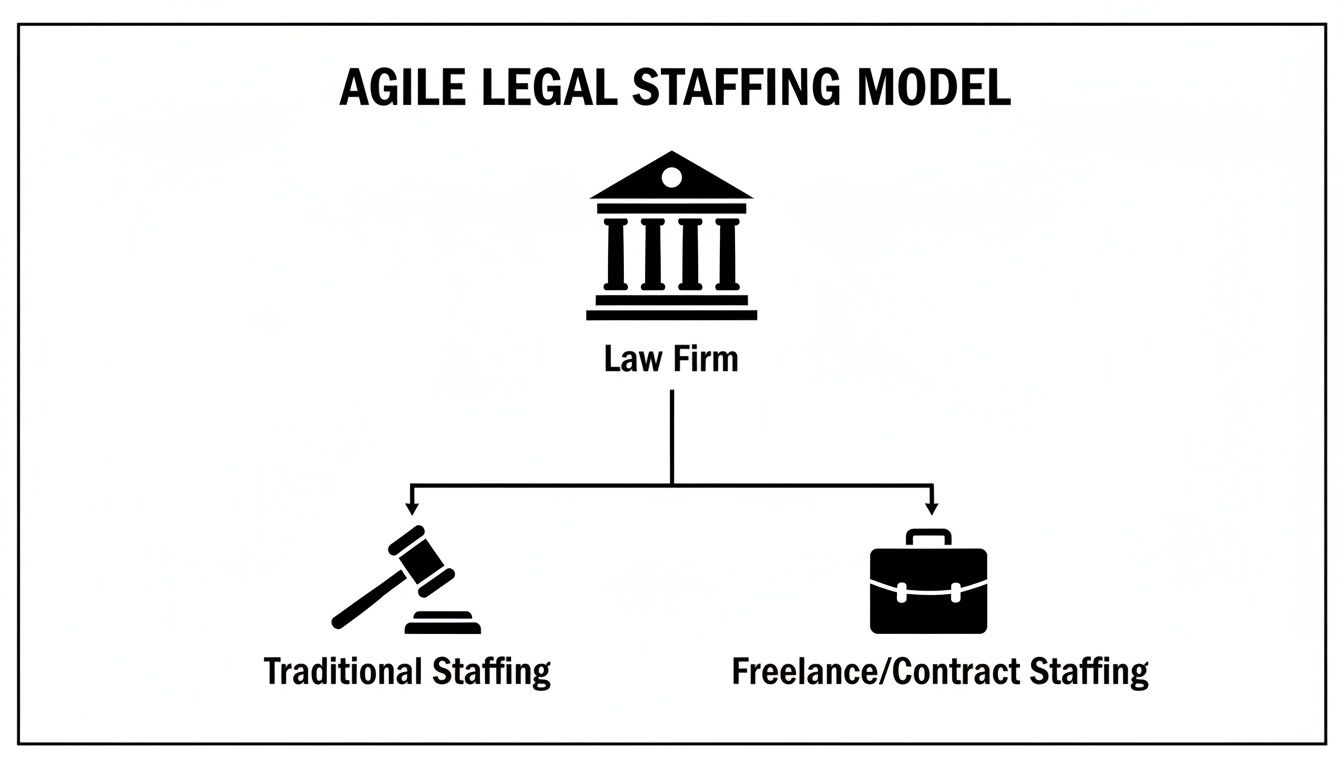
As you can see, a modern law firm isn't a pyramid; it's a network. Flexible, resilient, and built to last.
Let's get specific. You're a solo practitioner buried under a mountain of discovery. Instead of turning away new business, you bring in a freelance litigator for three months to run depositions and draft motions. They crush it, you keep the client happy, and your firm grows. Simple.
Or maybe your mid-sized firm just landed a client with a gnarly IP issue. Are you really going to roll the dice on a full-time IP attorney and their $200k+ salary? Hell no. You find a freelance IP specialist for that one project. Problem solved. Overhead dodged.
This isn't a local quirk; it's a global tsunami. The legal outsourcing market is set to hit a staggering $117 billion by 2030. The top outsourced tasks? Intellectual property management (69%), document review (57%), and e-discovery (55%). These aren't just numbers; they're a giant flashing sign telling you to get on board.
Here's a cheat sheet for where a freelance lawyer can make an immediate impact. Think of it as a menu of solutions for your biggest headaches.
| Type of Work | Best For (Firm Type) | Why You'd Outsource This | Key Skills to Vet |
|---|---|---|---|
| Document Review | Litigation boutiques, large firms | To crush massive discovery volumes without sacrificing your associates' will to live. | God-tier attention to detail, e-discovery software mastery, issue-spotting. |
| Legal Research & Memos | Solo practitioners, small firms | To get brilliant legal analysis without hitting pause on every other case you have. | Westlaw/Lexis wizardry, brutally concise writing, sharp analytical mind. |
| Contract Drafting & Negotiation | Corporate firms, in-house teams | For specialized agreements (SaaS, M&A) or to handle a firehose of contract volume. | Deep subject matter expertise, killer negotiation skills, business IQ. |
| Court Appearances & Depositions | Busy litigation firms | To cover routine hearings when your star litigators are double-booked. | Real courtroom presence, strong oral advocacy, local rule mastery. |
| Due Diligence | M&A and real estate firms | To accelerate deals by blitzing through the tedious financial and legal review. | Meticulous organization, financial literacy, spotting red flags from a mile away. |
| Intellectual Property | General practice & tech firms | For trademark filings, patent apps, or licensing deals on a project basis. | USPTO experience, tech background (for patents), IP strategy chops. |
This isn't an exhaustive list, but it's a hell of a start. The goal is to liberate your core team to do what they do best: build relationships and bring in business.
Of course, this all hinges on a rock-solid contract. Getting a grip on understanding what a service contract is is non-negotiable. It’s not just paperwork; it’s the blueprint for a successful project.
Alright, you're sold. So, where do you find these legal eagles? This is where most firms crash and burn, falling back on habits that are hopelessly outdated.
Hope you enjoy spending your afternoons fact-checking resumes and running technical interviews—because that’s now your full-time job.

The market for on-demand talent is crowded and noisy. You need a way to find the signal in all that static.
Let’s be brutally honest about the usual options. Most are designed to waste your time and money. I’ve tried them all, and they range from painful to downright infuriating.
Each of these paths forces you to do all the heavy lifting. It's a massive time suck that pulls you away from billable work.
After getting burned one too many times, I realized the problem wasn't the freelance model; it was the broken hiring process. The only sane way forward is a specialized, curated platform.
Think of it this way: would you hire a brain surgeon from a Craigslist ad? Of course not. You want someone who's been rigorously vetted by a trusted source. The same logic applies to finding freelance lawyer jobs for your firm.
A curated platform does the dirty work. They handle the sourcing, the interviews, the background checks, and the skills tests before a candidate ever lands in your inbox.
Instead of you drowning in a thousand resumes, you get a pre-vetted shortlist of three to five pros ready to start tomorrow. That’s the entire game.
This approach is taking over because it just works. Today, 46% of medium-sized law firms regularly use freelance attorneys. They're not doing it for fun; they're doing it to scale faster and crush their overhead.
The secret sauce is the vetting. A platform that doesn't pre-vet its talent isn't a solution; it's just another job board with a nicer font. A true talent partner knows their reputation is built on the quality of their screening.
This is the heart of smart, flexible staffing solutions. It’s about building a reliable talent pipeline you can trust on-demand. For firms that need to connect with top-tier freelance legal pros, some companies offer dedicated help; you can check out Shorepod's hiring services to see how they do it.
Ultimately, choosing a curated network isn't about convenience. It’s a strategic decision to slash risk, save hundreds of non-billable hours, and access a higher caliber of talent. Why on earth would you do it any other way?
So, you found someone who looks perfect on paper. Don't pop the champagne just yet. The next part—vetting and onboarding—is where a great hire becomes a seamless part of your team, or where it all falls apart in a dumpster fire of missed deadlines and ethical nightmares.
Get this wrong, and your brilliant hire becomes a constant source of stress. You're not just hiring a contractor; you're trusting them with your clients and your reputation. A slick resume isn't enough. You have to dig deeper.
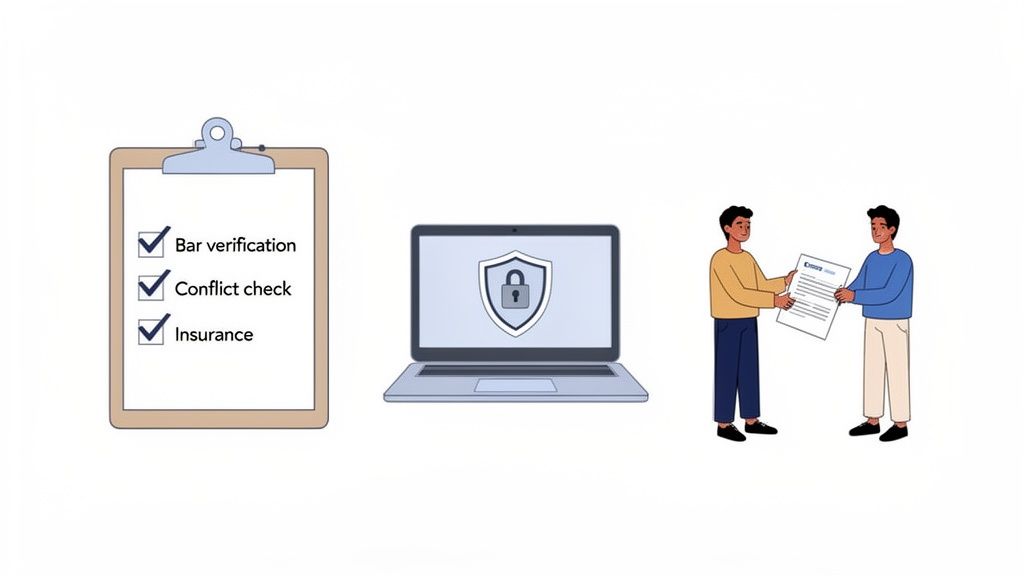
This is about building a secure, efficient foundation from day one. A sloppy onboarding process isn't just lazy; it's a massive liability.
Hope you enjoyed playing detective with those resumes, because that was just the warm-up. The real due diligence starts now. Before they see a single client file, you need to lock down these critical details. This isn't paranoia; it's just being a professional.
Here’s your no-nonsense checklist:
Once they're vetted, the clock is ticking. A chaotic onboarding wastes time and money. Your goal is to get them productive, fast. That means having a system. Stop winging it.
A killer onboarding process makes your freelance lawyer feel like part of the team from day one—minus the annoying HR paperwork. It’s all about clarity, security, and setting them up to win.
Create a simple onboarding kit. It should cover everything from tech access to your firm's communication rules. (Hint: 3 AM texts are not the answer).
Your onboarding absolutely must define:
For the small and solo firms we work with, this is a game-changer. It’s the same value you get from a curated platform that offers thousands of vetted pros, can cut hiring time to 24 hours, and slashes payroll costs by up to 80%. As shown in legal market trend reports, efficiency is survival. A solid onboarding process is your internal insurance policy.
Okay, full disclosure. We just walked you through the entire painful process of finding, vetting, and onboarding freelance lawyers. It's a ton of work—work that's pulling you away from your actual job.
But there's a shortcut.
This is where a dedicated platform like HireParalegals comes in. (Toot, toot!) We built it because we were sick of the old way. We designed it to cut through the crap and make the whole process ridiculously simple. Forget sifting through a sea of mediocrity on job boards. This is about giving your firm a real strategic weapon.
We've seen the disasters that happen when vetting is sloppy. It's a massive liability, and it’s why we are absolutely obsessed with our rigorous four-step vetting process. It's the engine that drives everything we do.
This isn't just checking a box. We get our hands dirty:
The result? You only see candidates who have already cleared an incredibly high bar. You’re not getting a random applicant; you’re getting a vetted pro who's ready to contribute immediately.
Let's be real: most "AI matching" is just a glorified keyword search. You ask for an IP litigator and get a hundred profiles that mentioned "patent" once in 2008. Useless.
Our system is different. We combine human legal expertise with smart AI that understands the nuances of legal practice areas. It connects you with freelance lawyers who have direct, hands-on experience in your niche. That precision is how we turn a week-long search into a successful hire in under 24 hours.
Think of it as the difference between screaming your order in a crowded stadium and having a concierge who already knows what you need. One is chaos; the other is efficiency.
This isn't just about making your life easier. It's about changing your firm's entire financial model. The legal services market is a beast, and small to medium-sized firms are leading the charge. Tapping into a pre-vetted, on-demand talent network gives you an insane competitive edge. You can see for yourself how the legal market is evolving.
Firms that use our platform often cut their payroll and hiring costs by up to 80%. No, that's not a typo. That’s what happens when you vaporize recruiter fees, slash overhead, and get access to elite global talent. It's more than a hiring tool; it's a blueprint for a more profitable, resilient law firm.
Alright, let's get down to brass tacks. Whenever firms start exploring the world of freelance lawyers, the same few questions always pop up. We're talking liability, ethics, and of course, getting paid.
These are the questions we hear every single day. Let's tackle them with some straight, no-BS answers.
This is the big one, and "maybe" is not an answer. Your firm's liability policy might cover contract attorneys, but hope is not a strategy. You need to call your provider and get a definitive "yes" or "no."
Many policies require freelancers to be specifically named. The smarter, safer play is to mandate that your freelance lawyers carry their own malpractice insurance. It’s a critical layer of protection for everyone. Bottom line: verify coverage—yours and theirs—before any work begins.
Treat a freelance conflict check with the same deadly seriousness as you would for a new partner. Before they see a single client document, you must run a thorough check against their entire client history, and they must do the same with your roster.
This is not a casual email exchange. It must be a formal, documented process. While some platforms help manage this, the buck stops with your firm. Your engagement agreement needs to spell out their absolute duty to disclose any potential conflict immediately. Anything less is professional malpractice waiting to happen.
There are a few solid payment models. The trick is matching the structure to the project to avoid any awkward money talks later.
Here are the most common setups:
Whatever you choose, get it in writing. Define the rate, payment schedule, and invoicing process. Or, better yet, use a managed platform that handles all the payroll and compliance headaches for you. For most firms, that’s the only sane way to go.


