

 17 minutes read
Let's cut the fluff. A conflict of interest in the legal world is what happens when your duty to one client gets tangled up with your duty to another, a former client, or—let's be honest—your own wallet. It’s a classic case of divided loyalties, where being a zealous advocate becomes a tightrope walk over a pit of malpractice claims.
If you think this is just some boring ethics exam topic, you're setting your firm up for a very expensive lesson.
Let's be blunt. "Conflict of interest" sounds like a dry, academic term you crammed for on the bar exam. In the real world, it’s a ticking time bomb that can detonate your biggest cases, torpedo your firm's reputation, and send your malpractice insurance premiums into orbit. Trust me, I’ve seen it happen.
At its core, a conflict is about being pulled in two directions at once. Imagine you're refereeing a soccer game, but your own kid is the star striker for one of the teams. Can you really be impartial? Of course not. That’s the essence of a conflict: your duty to Client A clashes with your duty to Client B—or worse, with your own financial interests.
This is about much more than a slap on the wrist from the state bar. Undisclosed conflicts have staggering, real-world financial consequences.

Federal law, specifically 18 U.S.C. § 208, forbids government employees from participating in matters where they have a personal financial stake. The rule is designed to prevent even the appearance of impropriety. When similar principles are ignored in the private sector, the fallout is massive. Undisclosed conflicts are estimated to contribute to $3 billion in excess finance industry profits each year—a hidden cost of $41 per U.S. household.
In corporate law, that ridiculously detailed M&A due diligence process isn't just for show. It's designed to uncover exactly these kinds of ticking time bombs—conflicts in customer contracts or shady executive relationships that can kill a deal.
For a law firm, a single, missed conflict is a train wreck in slow motion:
This guide will cut through the dense legalese to give you a practical, 'from the trenches' understanding of conflicts. We'll break down why "winging it" is a recipe for disaster, whether you're onboarding a new client or hiring talent from a contingent workforce. It’s time to get serious about your process.
Think you can spot a conflict of interest from a mile away? It’s rarely as obvious as representing both spouses in a messy divorce. The truth is, conflicts are sneaky. They creep into your practice in forms you won't recognize until you're trying to explain yourself to a disciplinary committee.
So, let's stop treating this like an abstract concept and start looking at it like a field guide. Knowing the different species of conflict is the first step to avoiding them in the wild.
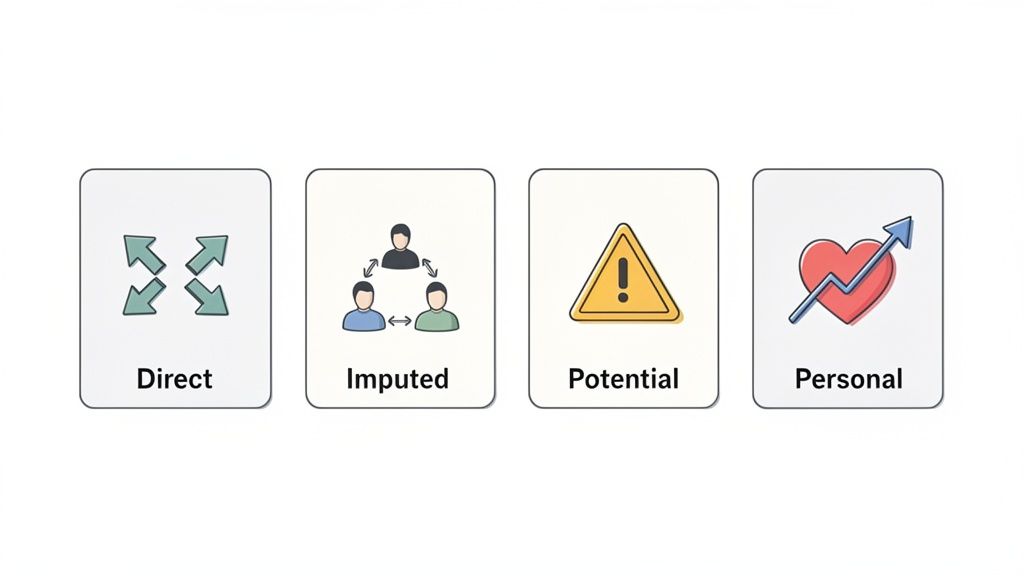
The most common conflicts fall into a few key buckets. You have your direct conflicts, which are usually easy to spot. This is the classic "representing clients with opposing interests" scenario. But then things get much, much trickier.
Enter the imputed conflict. This is the modern-day Trojan horse for law firms, especially those hiring remote talent. It’s when your new paralegal’s past work at another firm suddenly taints your entire practice. One person’s conflict becomes everyone’s problem, and pretending you didn't know is not a defense.
A conflict isn’t just about who you’ve worked for. It’s about who everyone on your team has worked for, past and present. This is where most firms drop the ball, and the consequences are brutal.
Then you have the subtle red flags waving from a distance. These potential conflicts are situations that could ripen into a full-blown issue down the road. Finally, there are the ever-present personal conflicts, where your own financial interests—like your stock portfolio cheering for a specific case outcome—cloud your professional judgment.
Telling these conflicts apart is crucial because the fallout varies dramatically. A personal conflict might just require you to recuse yourself, but an imputed conflict could get your whole firm booted from a case.
Here’s a breakdown of the common types, their typical scenarios, and the potential damage.
| Conflict Type | What It Looks Like (The 'Oh No' Moment) | Who It Affects | Potential Damage Level |
|---|---|---|---|
| Direct Conflict | You're suing a company that your firm also represents in an unrelated patent filing. | The specific lawyers involved and potentially the entire firm. | High: Often leads to immediate disqualification and loss of fees. |
| Imputed Conflict | Your new remote paralegal previously worked on the opposing side of your firm's biggest ongoing case. | The entire firm is now considered conflicted, even if the paralegal is walled off. | Catastrophic: Can lead to firm-wide disqualification and malpractice claims. |
| Potential Conflict | You represent a startup, and one of your existing corporate clients is considering acquiring them. | Initially, the lawyers involved. Can quickly escalate to the whole firm. | Medium: Requires careful management, disclosures, and waivers to proceed. |
| Personal Conflict | You own a significant amount of stock in the company your client is litigating against. | The individual lawyer with the conflict. | Low to High: Can be managed by disclosure and recusal, but can taint the case if undisclosed. |
Mapping it out like this helps build the muscle memory to recognize trouble before it becomes an ethical nightmare. The key isn't just knowing the rules; it's seeing how they play out in the real world.
Here’s a fact every lawyer needs tattooed on their brain: the ABA Model Rules are just that—models. The rulebook that actually matters, the one tied directly to your license, is whatever your state bar has decided. Get this wrong, and you’re not just looking at a minor penalty; you're risking your entire career.
Let's cut through the jargon of rules like 1.7 (Concurrent Conflicts), 1.8 (Specific Rules for Current Clients), and 1.9 (Duties to Former Clients). This isn't a law school lecture; it's a survival guide. Think of these rules as the guardrails keeping your duties of loyalty and confidentiality from careening off a cliff.
The ABA provides the blueprint, but every state adds its own unique, and sometimes maddening, spin. What does "directly adverse" really mean when a potential client sits across from you? When does a "material limitation," like your own financial stake in a transaction, cross the line? The only answer that matters is found in your jurisdiction's rules.
This gets especially dicey when you start hiring remote talent. That fantastic paralegal you just onboarded from another state? Their entire work history now falls under your state’s imputed conflict rules. It's a jurisdictional nightmare waiting to happen, and it's why knowing how to handle confidential information across state lines is so critical.
The core idea is simple: You can't serve two masters with opposing interests. But putting that into practice is like navigating a minefield of state-specific interpretations that trip up even the sharpest firms.
Some states are brutally precise. Maine law, for instance, has a "ten percent rule" for public officials, flagging a conflict if an official holds at least a 10% stake in a private corporation they're making decisions about. While that’s for public servants, it’s a great example of how rigid and unforgiving the rules can be. Learn more about how states define conflicts of interest.
Let's break down the key ABA rules that your state has almost certainly adopted in some form.
Rule 1.7 (Current Clients): This is the big one. You simply can't represent a client if their interests are directly opposed to another client's. The same goes if your ability to represent them would be "materially limited" by your obligations to someone else—another client, a former one, or even yourself.
Rule 1.8 (Specific Prohibitions): This rule gets personal. It's what stops you from entering a business deal with a client on sketchy terms or accepting a substantial gift from a client who isn't a close relative.
Rule 1.9 (Former Clients): This covers the ghosts of clients past. You are barred from representing a new client in a matter that is the same or "substantially related" to a case you handled for a former client, especially if their interests are materially adverse.
At the end of the day, these rules aren't just red tape. They are the foundation of client trust. In this profession, ignorance isn’t bliss—it’s malpractice.
Theory is great for passing the bar, but it’s the war stories that teach you how to survive. Textbooks explain what a conflict of interest in law is; getting disqualified from a seven-figure case because you dropped the ball shows you what it costs. These aren't just hypotheticals. They’re the real-world messes that keep managing partners awake at night.
Let's start with a classic. A promising mid-sized firm lands the case of a lifetime—complex commercial litigation, millions on the line. Months of work and countless billable hours fly by. Then…disaster. The opposing counsel files a motion to disqualify.
Why? A junior associate, hired six months prior, had worked on a tangentially related matter for the opposing party at her old firm. It was a minor task, buried deep in her work history. The firm’s conflict check was just a quick database search that missed it. The court didn’t care. The conflict was imputed, and they were booted from the case. All those fees? Gone. The client relationship? Torpedoed.
It’s not just big firms that get burned. Consider the solo practitioner with a passion for real estate investing. On the side, he was part of an LLC that owned a commercial property. When a long-time client came to him for help with a zoning appeal for a property a few blocks away, he didn't think twice.
Bad move. His LLC stood to benefit financially if the client’s appeal failed, as it would limit local competition. He never disclosed it, thinking it was a separate part of his life. When opposing counsel dug it up during discovery, the client’s case imploded. He faced not only a malpractice suit but also a public reprimand for violating his duty of loyalty.
These aren't just horror stories about sloppy paperwork. They are fundamental failures to protect the client, and they reveal a painful truth: a conflict you don't find is a bomb you've already planted.
Finally, let’s look at what happens inside corporate legal departments. A senior paralegal was married to an attorney at a firm her company was actively litigating against. A classic "adverse spouse" scenario. She was essential to the in-house team, with deep knowledge of the case strategy.
While she swore she never discussed the case at home, the appearance of impropriety was enough. The situation created a non-waivable conflict. The legal department faced sanctions, and the paralegal was ultimately terminated. The risk was simply too great.
These stories all share a common thread: a breakdown in process. They are the painful, expensive lessons that prove why the systems we’re about to discuss are completely non-negotiable.
Alright, let’s get tactical. Hope is not a compliance strategy. Crossing your fingers every time a new client calls is a fast track to a malpractice claim. You need a bulletproof, repeatable system for sniffing out conflicts before they can do any damage.
This isn’t about creating more paperwork. It's about building a systematic defense that protects your clients, your reputation, and your bottom line. A single missed check can be the first domino in a painful series of violations and financial losses.
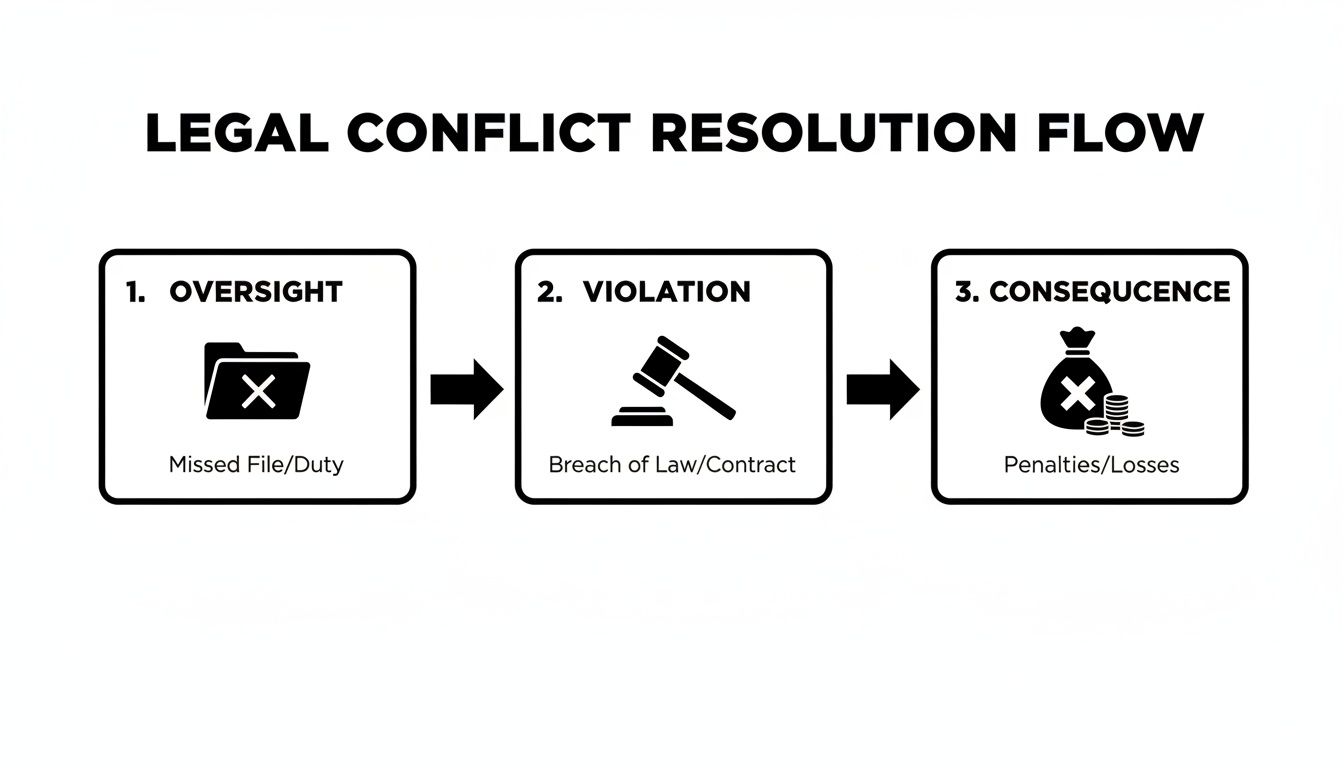
As you can see, a small oversight snowballs fast. The entire point of a good system is to catch problems at step one, not the last step.
The second a potential client calls—before you hear a single confidential detail—your conflict check must kick in. Your intake team has to be trained to gather specific data immediately. No exceptions.
Your checklist must nail down the basics:
This isn't just data entry; it's intelligence gathering. You're building a complete map of the key players to run against your internal database.
With the intake data, run it against a centralized database of every client, adverse party, and related entity your firm has ever touched. A "hit" doesn't automatically kill the deal, but it does mean you stop everything and escalate.
The rule is simple: a potential hit freezes the intake process. A designated partner or ethics committee—not the attorney drooling over a new case—must review the findings and make the final call. This takes bias out of the equation.
To get started on formalizing your procedures, reviewing various conflict of interest policy examples is a great first step.
Sure, sometimes you can move forward with a waiver or an ethical screen. But don't treat them like get-out-of-jail-free cards. A waiver is only valid if you get informed consent in writing, meaning you clearly explain the risks to all affected clients. If a disinterested lawyer wouldn't advise a client to sign it, it’s probably not going to hold up.
Ethical screens, or "firewalls," are even trickier, and their acceptance varies by state. This isn't just a pinky promise not to talk about a case; it requires formal separation of attorneys and strict confidentiality measures. This is about turning a reactive, anxiety-fueled scramble into a proactive, systematic defense.
So, you've found the perfect remote paralegal. Razor-sharp skills, available tomorrow, perfect rate. Hold on. Before you send that offer letter, have you done a deep dive into their complete work history?
Hiring remote talent is a great way to scale, but it opens up a whole new can of worms for imputed conflicts. It's an easy trap to fall into.
That one-off project your new hire did three years ago? It could be the very thing that gets your firm disqualified today. This isn’t a theoretical risk; it’s a real-world landmine. You absolutely cannot treat hiring remote staff like you're just bringing on another vendor. The ethical stakes are way higher.
Forget the welcome basket. The very first step—before they get system access, before they even see a client's name—is to run a conflict check as thorough as the one you'd run for a new lateral partner. This isn’t a suggestion; it’s a command.
Here’s exactly what you need to collect before day one:
This information goes straight into your firm’s central conflict database. Their professional history is now an extension of your firm's history.
A remote paralegal isn’t just a contractor; they are an imputed part of your firm from an ethics perspective. Their conflicts become your conflicts the moment they’re on your payroll. Let that sink in.
Once you have this data, run it against your firm's current and past client lists. Any potential match needs to be flagged and immediately reviewed by a partner or ethics counsel. For firms looking to bring on exceptional remote talent without the headache, you can find the perfect match with online legal jobs that fit your specific needs.
Don't let the convenience of hiring remotely lull you into a false sense of security. A smart hire is a safe hire. This checklist is your first line of defense.
We’ve covered a lot of ground, but a few tricky questions always pop up. Let's tackle the most common ones I hear so you can move forward with confidence.
In a word? No. A signed waiver isn't a "get out of jail free" card. While waivers are powerful, they have limits, and some conflicts are simply unwaivable.
Think of it this way: ABA Model Rule 1.7 draws hard lines. You can't get a waiver if the representation is flat-out prohibited by law. And you definitely can’t get one to represent two clients who are suing each other in the same litigation. That’s a fundamental breakdown of loyalty that no piece of paper can fix.
For a waiver to even be valid, you need informed consent, confirmed in writing. This isn’t a signature on a dotted line. It means you’ve laid out all the potential risks and alternatives in plain language, so the client truly gets it.
Here’s my gut check: if a reasonable, disinterested lawyer would advise the client against signing, you're dealing with an unwaivable conflict. Period.
Conflict checks are not a one-and-done task. They are an ongoing process. The first check is critical and must happen at intake—before any confidential information is shared.
But it doesn’t end there. You need a new check anytime a new party is added to an existing matter. And here’s the big one everyone forgets: you must run a thorough check before hiring any new employee. That goes for everyone—lateral partners, associates, paralegals, and support staff. Their history is about to become your liability.
An "ethical wall" or "screen" sounds strong, but it’s not an impenetrable fortress. Whether it's even allowed, and how it must be built, varies dramatically by jurisdiction.
A defensible screen is a formal, documented process, not just a casual "hey, don't talk about this case."
Before you even think about using a screen, check your state bar’s rules. Don't assume—verify.


