

 19 minutes read
Let's cut to the chase. Contingent Workforce Management (CWM) is your firm's game plan for finding, managing, paying, and eventually parting ways with your non-permanent crew. We're talking about the freelancers, independent contractors, and on-demand paralegals who are supposed to make you agile, not give you a migraine.
Think of it as the central operating system for your flexible talent—if you bother to install it.
Most firms don't decide to hire contractors; they just sort of… fall into it. One day, a partner needs an extra paralegal for a big case. Before you know it, you’ve got five different freelancers sending invoices in three different formats, and nobody's quite sure who still has access to sensitive client files.
Sound familiar? That mess is the polar opposite of contingent workforce management.
A real CWM strategy is about wrestling that ad-hoc chaos into a well-oiled machine. It’s a deliberate system for managing the entire lifecycle of your non-employee workforce, from the first "hello" to the final paycheck. This isn't just about plugging a temporary hole. It's about building a reliable, on-demand talent engine that can scale up or down with your caseload, without everything catching fire.
Let's be blunt: that "we'll just figure it out" approach is costing you. Every minute a partner spends vetting a freelance paralegal or your finance team wastes chasing down a missing W-9 is a minute they aren’t billing. This is about more than organization—it's about clawing back lost productivity and dodging risks you probably haven’t even considered.
A proper CWM program answers critical questions before they become five-alarm fires:

The goal isn’t to drown your firm in enterprise-level bureaucracy. It’s about taking one smart step away from chaos and toward control. It's knowing you can bring in elite talent quickly, safely, and without the usual headaches.
To see the difference, let’s put the chaotic, reactive approach side-by-side with a strategic CWM mindset. One is a constant source of friction; the other is a genuine competitive edge.
| Pain Point | The Old Way (Chaos) | The Smart Way (Strategic CWM) |
|---|---|---|
| Hiring Speed | Weeks of searching, interviewing, and praying they're any good. | Access a pre-vetted talent pool; hire in days, not months. |
| Cost Control | A mess of rates, surprise invoices, and zero budget oversight. | Standardized rates and a crystal-clear view of total spend. |
| Compliance | "I'm sure the paperwork is fine." (Narrator: It was not fine.) | Centralized onboarding and classification to keep the lawyers away. |
| Quality | A total coin flip. Every hire is a brand-new gamble. | Consistent quality from a curated network of proven pros. |
Moving from the "chaos" column to the "strategic" one isn't just an operational upgrade; it's a fundamental shift in how your firm leverages talent to win.
So, you're sold. Winging it with freelancers isn't a strategy. Good. But what does a real contingent workforce management program look like? It sounds intimidating, like something that requires a team of consultants and a six-figure software budget.
It’s not.
After years in the trenches, I can tell you that a successful CWM program boils down to five core pillars. Get these right, and you're golden. Get them wrong, and you'll find yourself drowning in a sea of inconsistent invoices, unhappy contractors, and maybe even a friendly letter from the Department of Labor.
Let’s break them down.
This hierarchy shows the distinct roles that make up your contingent workforce—each requiring a slightly different management approach.
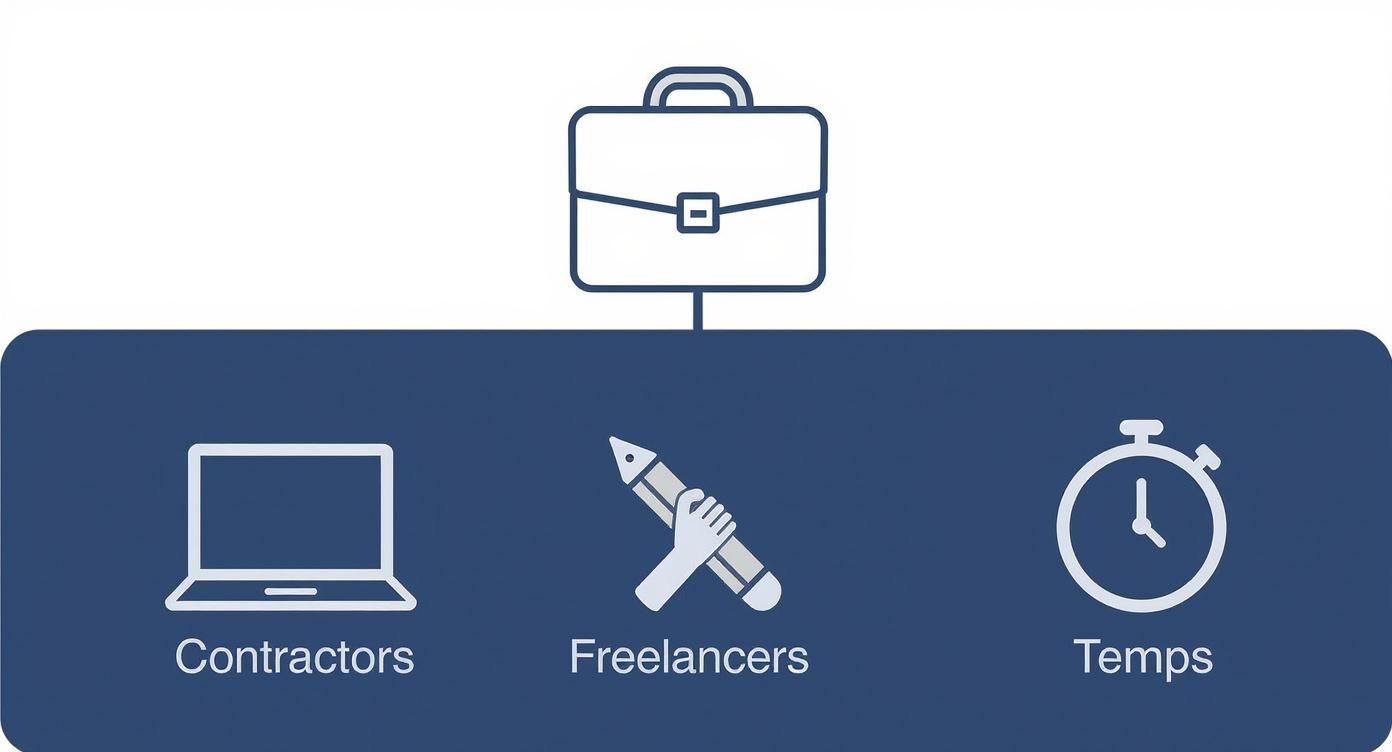
The key takeaway? Not all non-employees are the same. Your CWM strategy needs the flexibility to handle the unique compliance, payment, and engagement needs of each category.
This is your first impression, and it’s where most homegrown systems implode. Sourcing isn’t just finding a warm body; it’s about finding the right talent, fast. Onboarding is more than a welcome email; it’s about making that person productive from day one.
A solid process means:
Botch this part, and you’re just re-running a chaotic hiring process every single time you need help.
Welcome to the least sexy—but most critical—pillar. This is where you keep the firm out of hot water. Worker misclassification is the kind of expensive, headline-grabbing mistake that can haunt a business for years.
Are they a 1099 independent contractor or should they be a W-2 employee? Guessing is not a strategy. The IRS has very specific, very boring rules about this, and pleading ignorance won’t save you.
This pillar is all about a repeatable, defensible process for classifying every contractor. It involves signed agreements, clear statements of work, and ensuring you’re not treating your freelancers like employees you just don’t want to give benefits to.
Just because they aren't on your full-time payroll doesn't mean you can throw work over the wall and hope for the best. You hired them to deliver. Performance management for contractors isn't micromanagement; it's setting clear expectations and having a consistent feedback loop.
Did they hit their deadlines? Was the work any good? This isn’t just about judging them; it's about knowing who your A-players are. The best contractors are in high demand. If you create a frustrating, disorganized experience, they simply won't work with you again. Good engagement turns a one-off project into a long-term relationship with top talent.
Nothing sours a relationship faster than messing with someone's money. A chaotic payment process is a flashing neon sign that your firm is a mess. Your finance team shouldn't have to chase invoices in ten different formats, and your contractors shouldn't have to wait 90 days to get paid.
This pillar is about one streamlined process:
This isn’t just good manners; it's smart business. A reputation for paying on time, every time, makes you a client of choice for the best freelancers out there.
The project is over. Now what? In a chaotic system, the answer is "nothing." That former contractor might still have access to your Google Drive, your internal chat, or worse, sensitive client files.
Proper offboarding is the clean exit. It’s a formal process to revoke all system access, retrieve any company assets, and conduct a final review. This isn't paranoia; it's basic data security. When managed correctly, this entire lifecycle becomes a strategic asset, a core benefit of adopting legal managed services.
Ignoring this final step is like leaving the back door of your office wide open. It's a risk you just can't afford.
That scrappy, "we'll figure it out" approach to hiring contractors works beautifully for your first hire. By the tenth, it’s a liability. Hope you enjoy spending your afternoons fact-checking invoices and running background checks—because that’s now your full-time job.
This is your wake-up call. Ignoring a formal approach to contingent workforce management isn't just messy; it’s a slow-motion disaster. Every ad-hoc hire chips away at your efficiency, introduces new risks, and quietly drains your budget.

Let’s talk real costs. It starts with what I call the "$500 Hello"—the hours you and your team waste vetting, interviewing, and onboarding a contractor who turns out to be a terrible fit. That's time you could have spent on billable work. Instead, you spent it realizing you hired the wrong person.
Multiply that by a few bad hires a year, and the financial drain is obvious. But the direct costs are just the tip of the iceberg. The real damage is happening beneath the surface.
Decentralized, scrappy hiring leads to a few predictable outcomes:
This isn’t just about being disorganized. It’s about running your law firm like a leaky bucket, where time and money are constantly seeping out. You can learn more about how legal outsourcing services can plug the holes.
If the operational chaos doesn't scare you, the legal risks should. Every time you bring on a freelancer without a proper classification check, you're rolling the dice with the IRS and the Department of Labor. Misclassifying an independent contractor can result in massive fines, back taxes, and legal fees.
Pleading ignorance is not a legal defense. Regulators assume you know the rules, and they have very little sympathy for firms that cut corners.
A proper contingent workforce management strategy isn't about adding bureaucracy; it’s about installing guardrails. It's the system that protects your firm from itself as it grows.
Alright, let's talk tech. The moment you Google "contingent workforce management," you're hit with a firehose of acronyms. VMS, FMS, EOR—it’s an alphabet soup designed to make you feel like you need to mortgage your office ping-pong table for a platform you don’t understand.
I've tested, broken, and paid for a lot of these tools. Here’s the unfiltered truth: you don’t need most of them. What you do need is a smart stack that fits where your business is today, not where some enterprise salesperson thinks you’ll be in a decade.
Let's cut through the noise.

First up are the Vendor Management Systems (VMS). Think of these as the giant, all-in-one ERP systems for contingent labor, built for corporations juggling thousands of contractors. They’re powerful, complex, and carry a price tag to match.
Frankly, if you're a small or mid-sized firm, a VMS is like buying a freight train to pick up your groceries. It’s total overkill. You’ll spend more time in implementation meetings than you will actually using the thing.
Unless you have a dedicated procurement team and a seven-figure budget for this, just nod politely and move on.
This is where things get interesting. Freelancer Management Systems (FMS) are built for companies that hire independent contractors directly. They’re nimbler, more intuitive, and focus on the core pillars we just talked about: onboarding, compliance, and payments.
An FMS is your single source of truth. It’s where you:
These platforms are designed for agility. They get that you’re not managing a faceless army of temps; you’re building relationships with skilled professionals. A good FMS makes that process clean and professional.
Now for the acronym you absolutely need to know: Employer of Record (EOR). An EOR isn't just software; it's a service that legally employs a worker on your behalf.
Why do you need this? Simple. Let’s say you find a rockstar paralegal in another state or country. You want them full-time, but you don't have a legal entity there. An EOR handles all the local payroll, taxes, benefits, and compliance headaches.
Think of an EOR as your compliance shield. It lets you hire the best person for the job, regardless of their zip code, without you having to become an expert in international labor law overnight.
The rise of contingent workforce management is increasingly defined by automation. That’s why 80% of large enterprises have adopted hybrid models, blending full-timers with contractors. This trend is driving the need for EORs to handle everything from onboarding and payroll to compliance screening across borders—tasks that are impossible to manage manually. As you build your team, understanding these workforce management trends will be key. Read the full research about these CWM developments on asanify.com.
So, when do you need an EOR? The minute you want to engage a worker in a way that feels like employment—especially across state or national lines—it's time to call in an EOR. Don’t wing it. The risks are too high.
"If you can't measure it, you can't manage it." We've all heard that. But when it comes to a contingent workforce, the real trap isn't a lack of data—it's getting lost in the wrong data. Tracking vanity metrics just distracts you from what’s working and what’s broken.
Let's cut the noise. Here are the KPIs that give you an unfiltered look at the health of your program. Knowing your total contractor spend is one thing. Knowing the return on that spend? That’s everything.
Most firms stop at tracking total spend. It's a start, but it tells you almost nothing. To get a real handle on things, you need a simple dashboard—something even a partner who hates spreadsheets can glance at to make smarter decisions.
Here’s what I focus on. No fluff.
Think of these as your operational vitals. They tell you if you're fast, slow, expensive, or lean.
Now for the metrics that separate a cost center from a strategic advantage.
Quality of Hire: This is the big one. After the project, was the work actually excellent? You don't need a complex system; a simple 1-5 rating from the hiring manager is all it takes. If your average score dips below a 4, your vetting process is broken.
Just as critical is Contractor Satisfaction. Was it a good experience for them? Did they get paid on time? A quick exit survey can tell you if top-tier talent will ever want to work with you again. In a tight talent market, being the client everyone wants to work with is a massive edge.
Right now, the contingent workforce makes up about 30-35% of the total labor market in the U.S., and some projections show it could hit 60% by 2050. As this happens, the competition for elite, on-demand talent is only getting more intense. You can explore more of these contingent workforce statistics on conexisvmssoftware.com.
Ultimately, your metrics should answer one question: "Is our contingent workforce making us faster, more agile, and more profitable?" If you can’t answer with a confident "yes" backed by a few key numbers, it's time to rethink your approach.
Alright, let's land the plane. We've talked pillars, tech, and metrics, but the only question that matters is: are you ready to do something about it? Moving from scattered hiring to a real contingent workforce management strategy is a big move.
This isn't just a summary; it's a gut check. I want you to take a hard look at how you're operating. By the end of this, you’ll know exactly where your firm stands and what your next move should be.
Forget complex frameworks. Just ask yourself these brutally honest questions. If you answer "no" or "I have no idea" to more than a couple, you’re not just ready for a CWM strategy—you’re overdue.
If that list made you sweat, good. It means you’re seeing the gaps. Acknowledging the chaos is the first step toward controlling it.
Stop trying to boil the ocean. You don’t need a six-figure software suite to make a difference. The single most impactful thing you can do today is centralize your process.
That’s it. Pick one person or one simple tool to be the single point of entry for all contingent hires. No more partners hiring their cousin’s kid on a whim. Every request, every contract, and every invoice flows through one predictable channel.
This one change forces visibility where there was none. It’s the first, most critical step in building a system that scales with you instead of collapsing under its own weight. This is a core principle behind effective workforce planning strategies that turn reactive hiring into a proactive advantage.
The goal isn't perfection; it's progress. Take one step away from the chaos. Start today.
We've covered a lot, but you probably still have some questions. Let's tackle the ones I hear most from firm leaders dipping their toes into a real contingent workforce strategy.
Not even close. Confusing the two is a common and costly mistake.
A staffing agency is a vendor. Their job is to find you a person to fill a role. They offer a tactical fix for an immediate problem.
Contingent workforce management, on the other hand, is a comprehensive system. It's your firm's internal game plan for handling the entire lifecycle of your non-employee talent—sourcing, compliance, performance, and payments. Think of it as building a scalable talent engine, not just making a one-off hire. One is a transaction; the other is a strategic advantage.
It’s less of a single blow and more like death by a thousand paper cuts. But if I have to name one, it's uncontrolled compliance risk.
When you go from five contractors to twenty-five, the chances of misclassifying someone shoot through the roof. It only takes one unhappy contractor to file a complaint, triggering an audit that could bury your firm in back taxes, fines, and legal bills. Flying without a CWM strategy is like navigating a minefield blindfolded—it’s not a question of if you'll hit something, but when.
The chaos of ad-hoc hiring will eventually catch up to you. A solid CWM strategy is a guardrail that protects your firm from its own well-meaning but risky decisions.
Don't buy expensive software. The first, most critical step is shockingly simple: Create a single source of truth.
This can be a spreadsheet, a simple project board, or an entry-level freelancer management system. The tool matters less than the discipline of using it.
Track this for every single contractor:
This one action forces you to centralize your information, which is the foundational step toward getting a grip on the chaos. It shifts you from firefighting to actually building a strategy.


