

 21 minutes read
Forget the dusty, textbook definition for a second. An education lawyer is a key player—more like a strategic advisor—inside the entire educational ecosystem. You're navigating the messy, complicated web of everything from student rights to institutional compliance. This role is way less about dramatic courtroom speeches (though that can happen) and much more about solving intricate, human-centric problems inside schools and universities.
If you think being an education lawyer is just defending school districts from slip-and-fall lawsuits, you’ve got the wrong picture. That’s like saying a chef just boils water. The job is a fascinating, often chaotic, and deeply impactful blend of counselor, crisis manager, and legal strategist.
You're not just interpreting statutes in a quiet office; you're actively shaping the environment where the next generation learns. The stakes are sky-high, and the problems you’re asked to solve are rarely black and white. One day you’re drafting a policy on student social media use, and the next you're mediating a tense dispute over a special education placement. It’s a trip.
Let's get into the weeds. Hope you like variety, because your to-do list will look different every single week. "Predictable" is not in the job description. The core of most education lawyer jobs is putting out fires you never saw coming.
Here’s a taste of what your days will actually be filled with:

This isn't a job for someone who wants to sit in an office reviewing contracts from 9 to 5. It demands a unique mix of legal precision and genuine empathy for the students, faculty, and administrators caught in the middle.
Ultimately, your role is to be an architect of a legally sound educational environment. You're not just a defender; you're a builder. You help create fair policies, guide administrators toward ethical decisions, and try to resolve conflicts before they explode into full-blown litigation.
You’re constantly balancing individual rights against the operational realities of a massive, complex institution. It's a tightrope walk, and you're holding the balancing pole. If that sounds more compelling than endless document review, you just might be in the right place. Welcome to the controlled chaos.
Let's get one thing straight: the most rewarding education lawyer jobs aren't just going to fall into your lap from a massive, generic job board. If you’re just blasting your resume out everywhere, you're going to spend a lot of time sifting through roles that are a terrible fit. You need a strategy, not a shotgun.
Finding the right opportunity means knowing where the real action is and understanding the unique ecosystems where these roles thrive. The landscape is incredibly diverse—from sprawling public school districts to nimble non-profits. The culture, the pay, and the daily grind are worlds apart depending on where you land.
First, let's map out the territory. The title "Education Lawyer" means very different things depending on who’s signing your paycheck. You really have to ask yourself what kind of problems you want to solve—and how you want to solve them.
Your main options will generally fall into one of these buckets:
This illustration gives a great visual breakdown of the key areas where an education lawyer's expertise comes into play, whether you're serving students, faculty, or the institution itself.
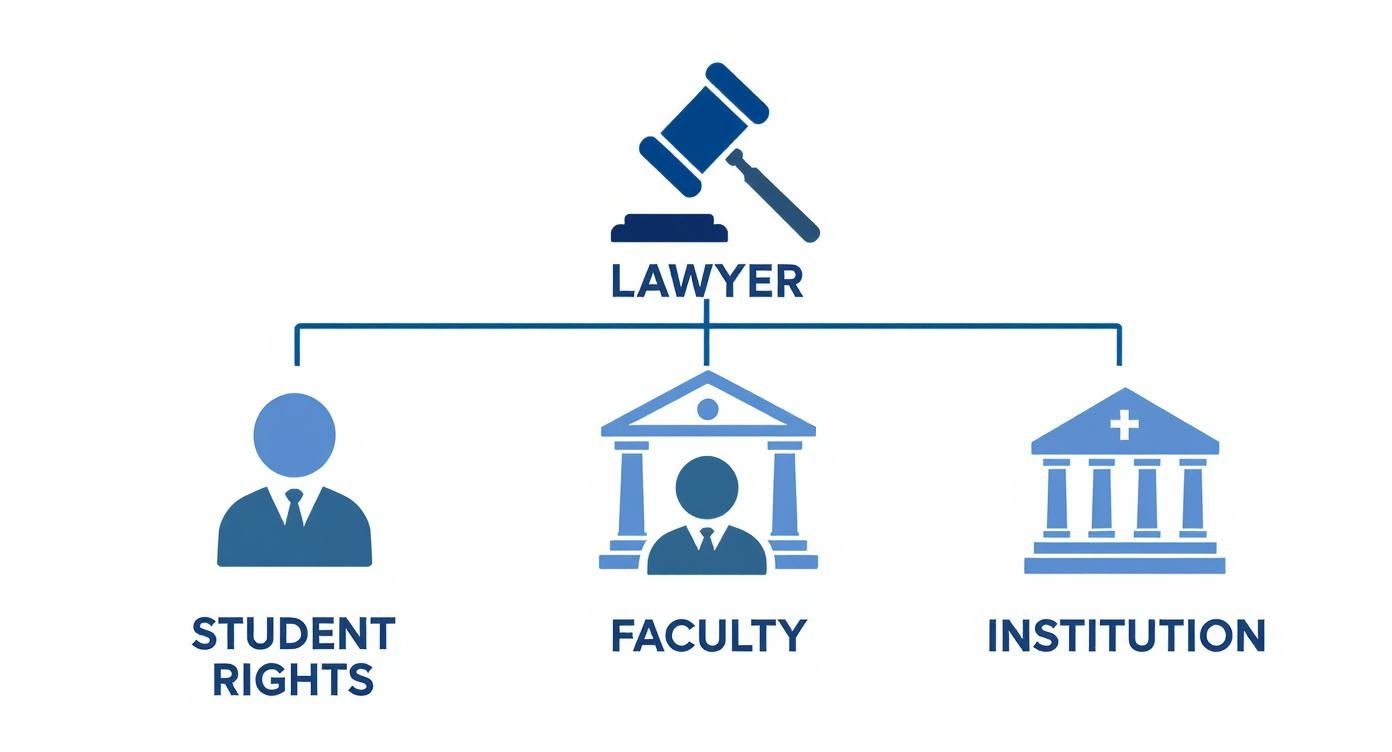
As you can see, whether you're defending institutional policies or advocating for an individual's rights, your work is critical to the legal health and function of our education system.
To help you figure out where you might fit best, this table breaks down what you can expect in different settings. It’s a no-fluff look at everything from the daily grind to what your career path might look like.
| Practice Setting | Typical Role and Responsibilities | Pros | Cons |
|---|---|---|---|
| School District | In-house counsel managing IDEA compliance, student discipline, employment law, and board governance. | Direct community impact, predictable hours, strong sense of mission. | Lower pay than private practice, bureaucracy, high-stakes local politics. |
| University | General counsel advising on Title IX, research grants, intellectual property, and institutional risk. | Intellectually stimulating environment, great benefits, more stable work-life balance. | Slower decision-making, navigating academic politics, salary caps. |
| Law Firm | Outside counsel representing multiple clients in litigation, negotiations, or specialized compliance. | Higher earning potential, diverse casework, faster career progression. | Demanding billable hour requirements, high-pressure environment. |
| Non-Profit/Gov't | Policy advocate or counsel focused on systemic reform, civil rights, or legislative issues. | Opportunity to drive major policy changes, deeply mission-focused work. | Often the lowest-paying sector, funding can be unstable. |
Ultimately, choosing a path is less about which one is "better" and more about which one aligns with your actual goals.
So what’s the real difference between working for a university and representing one from a law firm? It's a huge distinction, and it really comes down to whether you want to be a specialist or a generalist firefighter.
When you work in-house, you are completely immersed in a single client's world. You know the institutional history, the key players, and you can see problems coming a mile away. Your job becomes as much about proactive risk management as it is about reacting to legal threats. The tradeoff? The pay might not match big law, and you'll have to be a jack-of-all-trades.
As outside counsel, you're the hired gun. A school brings you in for your deep knowledge in a specific, high-stakes area, like a major lawsuit. The pay is often significantly better, but so is the pressure of meeting billable hour targets. You'll serve many clients, giving you broader exposure but less of a long-term stake in any single institution.
Ask yourself this: Do I want to help build the ship, or do I want to be the expert they call when the ship is steering toward an iceberg? Your honest answer will tell you which path is the right fit.
For anyone looking to explore, some of the best legal staffing agencies can provide a shortcut to temp or permanent roles. It’s a fantastic way to test the waters in both in-house and firm environments before committing.
Alright, let's get down to brass tacks. What can you actually make as an education lawyer? If anyone gives you one simple number, run. The truth is, compensation is all over the map, and it’s almost entirely dictated by who you work for and where you live.
Your salary is a mix of three key ingredients: employer type, geographic location, and years of experience. A seasoned in-house counsel for a major private university in Boston will have a completely different financial reality than a new lawyer representing a rural school district in Mississippi. It's just how the market works.
Don’t let anyone tell you all education lawyer jobs pay the same—they absolutely do not.
The biggest factor in your paycheck will be whether you go public sector or private practice. This is the classic choice between a public service mission and a profit-driven one.
Public Sector Roles (School Districts, Universities, Government): Working in the public sector often means trading a higher salary for other perks. We're talking better work-life balance (no billable hours!), great health insurance, and often a solid pension plan. The pay is steady and respectable, but you’re probably not buying a yacht on this income.
Private Practice (Law Firms): This is where the big money is. Firms representing well-funded universities or specializing in high-stakes litigation can offer serious compensation. The catch? Your life will be governed by the billable hour. The pressure is higher, the days are longer, but the financial ceiling is much, much higher.
It really boils down to what you prioritize. Do you want to be home to coach your kid’s soccer team? Or are you aiming for the financial freedom that comes with being available to clients 24/7? There's no right answer, but you have to be brutally honest with yourself.
While education law is a niche, it doesn’t exist in a vacuum. The overall demand for legal work is healthy. According to the U.S. Bureau of Labor Statistics (BLS), the legal field is projected to grow steadily, with around 83,800 job openings expected each year.
With the median pay for all lawyers sitting at about $151,160 annually, it’s clear a legal career is still a solid financial bet. Your task is to carve out your niche in the most promising parts of this market.
Here's some advice I give every lawyer: specialization is how you maximize your earning potential. Generalists are always needed, but true specialists in high-demand areas can practically name their price. In education law, a few sub-fields are particularly hot right now.
For example, lawyers who are genuine experts in special education litigation, particularly with the Individuals with Disabilities Education Act (IDEA) and Section 504, are always in high demand. Both school districts and parents desperately need skilled attorneys for these complex and emotionally charged cases.
Another booming area is Title IX compliance. As federal regulations get stricter and public scrutiny intensifies, colleges are willing to pay a premium for lawyers who can conduct investigations and keep them out of legal trouble. If you can become the go-to person for a high-stakes problem that keeps administrators up at night, you can write your own ticket. It’s as simple as that.

Let's be brutally honest. Your J.D. and bar admission are just the price of entry. They get you in the door, but they won’t land you the job—at least not the good ones. The world of education is evolving at a breakneck pace, and the skills that made a great lawyer ten years ago are now just the baseline.
Hiring managers are looking for a hybrid professional: part legal scholar, part crisis manager, and part tech guru. They need someone who can litigate a special education case in the morning and advise on a data breach in the afternoon. If your skill set is stuck in an analog world, you’re going to get left behind.
Your traditional legal toolkit—case law analysis, statutory interpretation, razor-sharp writing—is still critical. Don't get me wrong. But to land top-tier education lawyer jobs today, you have to show mastery in areas that barely existed a decade ago.
Think about the modern school. It’s a complex web of third-party software, cloud-based student records, and online learning platforms. Every single one of those systems is a potential legal landmine.
The most valuable education lawyers are no longer just legal experts; they are strategic advisors who understand the intersection of law, technology, and institutional risk. They see around corners.
So, what does this "modern" skill set actually look like? It’s less about memorizing statutes and more about applying legal principles to messy, real-world problems. Employers are hungry for candidates who have genuine expertise in these key areas:
Being able to pull up relevant case law is one thing. To do it efficiently, you need to be a power user of the best legal research databases that give you an edge. This kind of tech fluency is a huge differentiator.
The phrase "lifelong learning" is such a cliché. But in this field, it’s not a buzzword—it’s a survival tactic. The legal profession is being reshaped by major tech shifts, and education law is at the center of it all.
The World Economic Forum's Future of Jobs Report highlights that legal roles are changing, demanding expertise in digital fluency as industries evolve. This means ongoing education, way beyond your initial law school training, is essential just to stay relevant.
This isn’t about cramming your CLE credits in at the last minute. It's about proactively seeking knowledge in emerging fields. Are you reading up on cybersecurity threats targeting schools? Are you following the debate around AI in the classroom? If not, someone else is, and they're the one who's going to get the job you want. The game has changed.
Ready to spend your afternoons scrolling through endless job listings? I didn't think so. The old "spray and pray" method of blasting your resume into the digital ether is a fantastic way to burn out and question all your life choices. Finding a great education lawyer job calls for a more targeted, surgical strategy.
This isn't just about landing a job; it's about finding the right one. That means stepping away from the massive, generic job boards where your application is just one in a sea of thousands. Your time is too valuable to be lost in the noise.
First things first: get off the giant job aggregators. Sure, set up an alert or two, but don't make them your primary hunting ground. The real gems—the roles that truly fit your expertise—are posted on specialized job boards.
It’s about working smarter, not harder. Here’s where you should focus your energy:
This focused approach gets your resume in front of people who actually understand what you do. It's the difference between shouting into a hurricane and having a direct conversation.
Let's talk networking. Most people dread it because they do it all wrong. It's not about awkwardly cornering strangers and asking for a job. It's about building genuine connections with people already in the roles you want.
Find attorneys on LinkedIn or through your alumni network who work for institutions you admire. Send a short, respectful message. Don't say, "Can you get me a job?" Try this instead: "I'm really fascinated by your work in Title IX compliance at XYZ University. I'd love to learn more about your path if you ever have 15 minutes for a quick virtual coffee."
The goal isn't to ask for a favor; it's to gather intelligence. You'll get priceless insights into an organization's culture, its challenges, and maybe even learn about openings that haven't been advertised yet. People are much more willing to help someone who shows genuine curiosity than someone who just wants a handout.
Think of it as a reconnaissance mission. Because it is.
Your resume and cover letter are your personal marketing documents. Their one job is to scream, "I solve the exact problems you're facing." Vague clichés like "detail-oriented team player" are a one-way ticket to the trash bin.
Your resume bullets need to show impact, not just list duties.
See the difference? The first is passive; the second is active, quantified, and shows a tangible result. For more specialized advice, a guide on how to write a winning lawyer resume can give you a serious leg up. This isn't the time for modesty—it's time to clearly articulate your value.
Your cover letter is where you connect the dots. Don't just rehash your resume. Pick one or two key achievements and tell a brief story around them that aligns directly with the job description. Show them you've done your homework on their organization and can hit the ground running. It proves you’re not just looking for any education law job—you’re looking for this one.

So you landed the interview. Great. Now the real work begins. This is the moment you have to prove you’re more than just a well-written resume. For education lawyers, the interview is less about reciting statutes and more about demonstrating sound judgment and a gut-level grasp of academic culture.
Hiring managers need to know you can handle the pressure. Can you field a call from a panicked principal at 7 a.m. about a First Amendment issue going viral? Can you mediate a tense faculty tenure dispute without making it worse? This is where you prove your worth.
Forget the easy questions. Interviews for serious education lawyer jobs will throw you into the fire with complex scenarios pulled straight from the headlines.
They aren't just testing your knowledge of IDEA or Title IX. They're looking for a strategic partner.
The best candidates don’t just give the "legally correct" answer. They explain the practical implications, weigh the institutional risks, and articulate a clear path forward that considers the human element—the students, the teachers, the parents.
What they really want is to see how you think on your feet. It's one thing to know the law; it's another to balance legal obligations with a school’s mission and public perception. That’s the true test.
An interview is a two-way street. Showing up with no questions is a huge red flag. It says you're either not curious or not that interested.
This is your chance to interview them. Skip the generic stuff about "company culture" and dig into the specifics.
Here are a few sharp questions to have ready:
These questions show you're already thinking like an in-house counselor, not just a candidate. For a broader sense of what to expect, reviewing common legal assistant interview questions can also be helpful, as many core competencies overlap.
More and more, legal departments use behavioral questions to see how you actually operate. They don't want to know what you would do; they want to hear what you have done.
To nail this, get familiar with competency-based interview questions. Practice framing your responses using the STAR method (Situation, Task, Action, Result) to provide clear, compelling examples of your past wins.
This is your chance to bring your resume to life with stories that highlight your ability to negotiate, de-escalate conflict, and deliver solid advice when it matters most. Walk in ready to prove your value, and you’ll walk out with an offer.
As you start exploring, the same questions tend to pop up. Let's tackle the most common ones I hear from aspiring education lawyers.
Nope. There's no "Certified Education Lawyer" exam. Your Juris Doctor (J.D.) and a state bar license are the only formal credentials you need to pursue education lawyer jobs.
That said, what really makes you stand out is relevant experience. Your law degree gets you in the door, but an internship with a school district's legal department or volunteer work with an education non-profit gets you the job. It shows you're not just qualified on paper, but genuinely committed to the field.
The honest answer is the classic lawyerly one: it depends. The vision of a 9-to-5 legal job can be a reality here, but it all comes down to where you work.
You have to decide what’s most important to you at this stage in your career.
Absolutely, and it happens all the time. In fact, attorneys from fields like labor and employment, administrative law, or civil litigation often bring a valuable perspective. Those skills are directly applicable to the challenges schools face every day.
If you're making the switch, the key is to frame your experience effectively. Show them how your background in contract negotiation, for example, is a perfect fit for handling vendor agreements for a school district. It’s not about where you came from, but about the skills you bring to the table today.


