

 18 minutes read
Let's cut to the chase: contract attorney hourly rates live somewhere between $75 and $350 per hour. But that's a massive range, isn't it? The final number on your invoice is a cocktail of the lawyer's experience, the mess you need them to clean up, and where they happen to be located.
Think of it less like buying a product off the shelf and more like calling a plumber at 2 a.m.—the variables are everything.
Trying to nail down a fair price for a contract attorney can feel like a casino game where the house always wins. You'll see rates that are suspiciously cheap and others that are eye-wateringly expensive. Is that $75/hour lawyer a hidden gem, or are you about to pay them to learn on your dime? Is the $350/hour specialist truly worth it, or are you just funding their next yacht?
Nobody wants to overpay. But let’s be real—going cheap on legal support is often the most expensive mistake you can make. The goal isn't to find the lowest bidder. It’s to understand the market so you can stop guessing and start making a smart investment.
To give you a cheat sheet, here’s a rough breakdown of what you can generally expect to pay based on the job and the attorney's battle scars.
| Role / Task Complexity | Typical Experience Level | Common Hourly Rate Range (USD) |
|---|---|---|
| Document Review | 1-3 years | $75 – $125 |
| Legal Research & Writing | 3-7 years | $125 – $225 |
| Specialized Litigation Support | 7+ years | $200 – $350+ |
| Niche Practice Area Expert | 10+ years (e.g., IP, SEC) | $250 – $400+ |
Use this table to gut-check the quotes you're getting. If something feels way off, it probably is.
The market for contract attorneys has gone wild in the last decade. It used to be predictable. Now, the range has exploded. You can find someone for basic doc review for pennies on the dollar, while a seasoned specialist in a hot area can command rates that make law firm partners blush.
This chart gives you a visual of how the rates stack up.
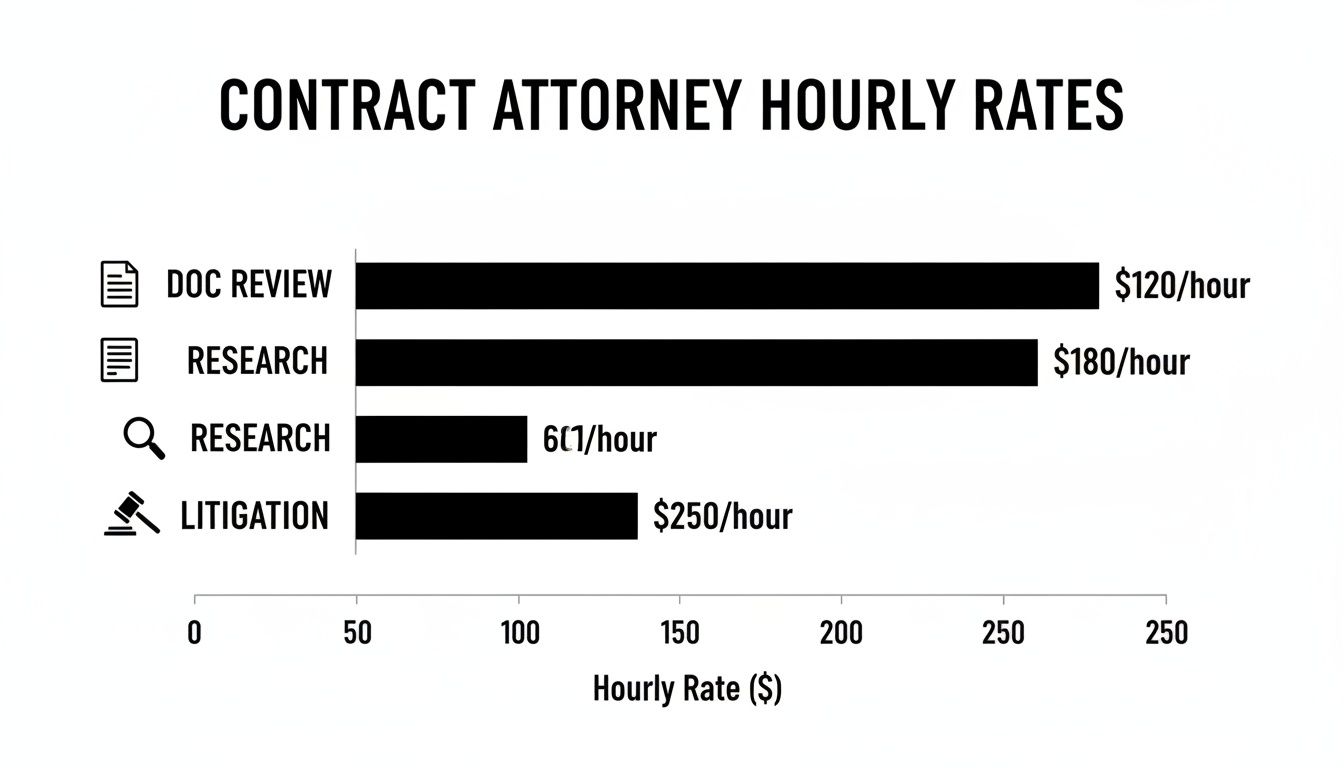
No surprise here: the more repetitive the work, the lower the rate. Specialized work like litigation support costs more because, well, you're paying for the experience that might just save your company's hide.

The goal isn't just a "good" hourly rate. The real win is getting the right outcome without mortgaging your office ping-pong table. It's about value, not cost.
As you navigate this, you'll also run into different billing structures. While hourly is king, you should get familiar with retainer agreements for legal services to understand how you might lock in dedicated help. Think of this guide as your decoder ring for making sure you're getting the right talent at a fair price.

Ever get a legal quote that made you choke on your coffee? You’re not alone. That sticker shock is a rite of passage for founders. But those numbers aren't just pulled from thin air. They’re the direct result of a few key factors that can either send your bill to the moon or keep it surprisingly grounded.
Let's dissect the four horsemen of legal billing. Once you understand them, you become a much smarter buyer, capable of sniffing out a bad deal before it blows up your budget.
This one seems obvious, but people consistently mess it up. You're not just paying for a law degree; you're paying for a decade of seeing every trick, trap, and loophole in the book. A junior attorney fresh out of law school might quote a tempting $85/hour, but they could easily spend ten hours fumbling through a contract that a seasoned veteran could nail in two.
So, who really costs less?
Hiring a grizzled, 20-year M&A specialist for your funding round is going to be expensive. Their rate reflects a career where a misplaced comma could cost millions. But using that same high-powered attorney for a routine NDA is like hiring a Michelin-star chef to make you a grilled cheese. Total overkill.
The secret to cost control is matching the right experience to the right task. You don't always need the best lawyer in the city; you need the best lawyer for this specific job.
This is your first and most powerful lever. Use it.
Not all legal work is created equal. Asking an attorney to review a standard vendor agreement is a world away from asking them to navigate a multi-state data privacy audit. The more specialized knowledge, niche expertise, or sheer brainpower required, the higher the contract attorney hourly rates will climb.
Think of it like this:
I once needed an attorney licensed in three specific states for a tricky compliance issue. The talent pool shrank instantly. That niche requirement alone added a 30% premium to the hourly rate. The weirder your request, the more you should expect to pay.
Urgency is the most expensive word in business, especially in legal. Show up with a "drop everything" emergency, and get ready to pay for it. A rush job means your attorney has to push other paying clients aside and work all night, fueled by caffeine and spite.
That convenience comes at a steep price.
I learned this the hard way on a deal that needed to close in 48 hours. The "rush fee" tacked a straight 50% surcharge onto the invoice. Was it worth it? Yes. Could I have avoided it with better planning? Absolutely. Give a reasonable timeline and you’ll avoid this entirely avoidable tax.
Finally, where your attorney parks their car matters. A lot. An attorney paying for an office in Manhattan or San Francisco has astronomical overhead compared to one working from a home office in Omaha. That cost gets baked right into their hourly rate.
A top-tier litigator in New York might command $400/hour for the exact same skillset that would cost you $250/hour from an equally talented lawyer in a lower-cost state. Remote work has blown this wide open. Unless you need someone to physically show up in a local court, looking outside the major legal hubs can unlock massive savings without sacrificing an ounce of quality.
Alright, let's talk strategy. You know what drives contract attorney hourly rates, but that doesn't tell you when to pay up versus when you're just lighting money on fire. This is the million-dollar question—sometimes literally.
I’ve made both mistakes. I once hired a budget attorney for a critical contract and paid double to clean up the mess later. I've also paid a top-tier litigator a small fortune for work that, in hindsight, a sharp paralegal could have crushed. The real skill isn't just cutting costs; it's making smart spending decisions.
It all comes down to matching the talent to the task.
Some situations are too important to bargain-hunt. When you're in one of these scenarios, your only job is to find the best expert you can afford and pay their rate. Agonizing over an extra $75 an hour here is a classic case of being "penny wise and pound foolish."
These are the "break glass in case of emergency" moments:
In these situations, the cost of an expert is a rounding error compared to the cost of a mistake. You're not just paying for their time; you're paying for their judgment.
On the other hand, plenty of legal work is essential but doesn't require a legal virtuoso. Paying top-tier rates for these tasks is like hiring a Formula 1 driver to deliver pizzas—a massive waste of horsepower.
This is where you can be ruthlessly smart and find massive savings.
You’re probably overpaying if you’re using a high-cost attorney for:
This is precisely where understanding different tiers of legal support becomes your superpower. Comparing the costs in our guide to virtual paralegal rates can show you just how much you can save by delegating effectively. It’s not about finding the cheapest person; it's about paying the right price for the specific task at hand.
Ever wonder what you’re really paying for when your law firm brings in a contract attorney? Spoiler: it’s not just their legal work. You're paying for the firm's business model, which is built to turn that attorney's time into a fat profit.
The $75 Hello.
Think of the firm as a general contractor. They find a specialist—the contract attorney—for a task, mark up that specialist's fee by an obscene amount, and then pass the inflated bill to you. It's a great model for them. For your budget? Not so much.
The calculation is painfully simple. A law firm might hire a skilled contract litigator for $75 per hour. That same firm will then bill that attorney's time out to you, the client, at $225 to $250 per hour.
That’s a 67–70% gross margin that goes straight into the firm’s pocket, essentially for acting as a middleman.
While this isn't some shady conspiracy, it’s also not something firms advertise. It's the financial engine that has powered the traditional legal staffing model for decades.
A law firm isn't just selling you legal expertise. They're selling access and administrative bloat. You're paying a huge premium for them to find and vet talent—a task you can now handle more efficiently yourself.
The market data doesn't lie. On average, U.S. contract attorneys earn around $57.30 per hour, yet firms can bill that time out for upwards of $500 per hour. That enormous gap is pure profit. For a deeper dive, you can explore more contract attorney salary data and see for yourself.
So, are you stuck paying a 70% premium just to get legal help?
Absolutely not. That old-school model worked when finding legal pros was a difficult, opaque process. The firm held all the cards because they had the connections.
That world is dead.
Modern platforms that connect businesses directly with pre-vetted legal talent are blowing up this system. By cutting out the costly intermediary, you can work with the exact same high-caliber attorneys without footing the bill for the punishing markup.
It’s a shift from a system based on arbitrage to one centered on direct access. Instead of paying a firm to play matchmaker, you build your own flexible, on-demand legal team. This move doesn't just lower your contract attorney hourly rates; it gives you transparency, control, and a direct line to the person actually doing the work.
Alright, you’ve seen the numbers. You get how rates balloon, and you know the difference between paying for a legal surgeon and just burning cash on a band-aid.
So what's the move? Do you just grit your teeth and accept that those contract attorney hourly rates are a cost of doing business?
I don't think so. There’s a much smarter way to play this game.
A huge chunk of the work you’d typically hand off to a contract attorney doesn't actually require a lawyer billing you in the triple digits. Document review, legal research, drafting standard motions, managing case files—this is the engine room of legal practice.
These tasks demand precision and experience. What they don't require is a Juris Doctor degree and the mountain of student debt that comes with it.
For that foundational work, what you really need is a highly skilled, experienced paralegal. And here’s the kicker: they definitely don't need to be sitting in a high-rent office in your city.
Toot, toot! This is where we come in. At HireParalegals, we connect founders and law firms with top-tier remote paralegals for a fraction of what a domestic attorney charges.
We’re not talking about a small discount. We're talking about slashing your legal support costs by up to 80%.
This isn't about being cheap; it’s about being ruthlessly efficient. It's about paying for the exact skill set a task requires—nothing more. Stop paying attorney rates for paralegal work.
This is the ultimate form of legal leverage. You get elite, vetted talent handling the critical, time-consuming tasks. This frees up your expensive attorneys (when you need them) to focus on high-value, strategic work. It’s how you build a lean, powerful legal function that doesn’t drain your bank account.
Let's get specific. What can a top-tier remote paralegal actually take off your plate? Probably more than you think. They aren't just organizers; they are force multipliers.
To see how this works, let's compare who does what and at what cost.
| Factor | US Contract Attorney | HireParalegals Remote Paralegal |
|---|---|---|
| Typical Hourly Rate | $125 – $350+ | $15 – $40 |
| Document Review | Efficient but costly. Overkill for routine reviews. | Core competency. Handles high-volume review with precision for a fraction of the cost. |
| Legal Research | Excellent for complex, novel legal questions. | Perfect for statutory research, case law retrieval, and summarizing precedents. |
| Contract Drafting | Drafts and negotiates high-stakes, bespoke agreements. | Drafts standard contracts (NDAs, vendor agreements) from templates; manages contract lifecycle. |
| Case Management | Oversees strategy and makes key legal decisions. | Manages deadlines, organizes case files, communicates with clients, and prepares for hearings. |
| Best Use Case | Strategic advice, court appearances, complex negotiations. | The 80% of foundational legal work that supports the high-level strategy. |
Looking at this side-by-side, the path is obvious. You use attorneys for strategy and paralegals for execution. When you structure your workflow this way, your legal spend becomes radically more efficient. Exploring the full range of legal outsourcing services can really open your eyes to how much work can be delegated effectively.
Hiring remotely is no longer just a cost-saving tactic; it's a strategic advantage. It gives you access to a global talent pool, letting you find the perfect skill set without being limited by geography.
Why does this model work so well?
This isn’t about replacing your attorneys. It’s about building a smarter, more flexible legal team around them. It's about finally getting your contract attorney hourly rates under control by allocating resources where they generate the most value.
So, you're ready to hire some legal help. Not so fast. Diving in without a clear plan is the #1 way founders overspend. This isn't just about finding someone with a law degree; it's about running a tight process that protects your time, your focus, and your bank account.
Let's get tactical. Think of this as your pre-flight checklist, built from hard-won lessons—the kind you learn after getting an invoice that makes your eyes water.
The most common mistake? A vague project scope. "I need help with some contracts" is a recipe for disaster. That’s how you get scope creep, endless back-and-forth, and a bill that looks nothing like your estimate.
You need to get crystal clear. Before you even think about posting a job, write a simple one-page brief detailing:
A tight scope is your best defense against budget creep. It turns a vague arrangement into a defined project with a clear finish line. If you can’t define the project on a single page, you’re not ready to hire for it.
Hope you enjoy spending your afternoons fact-checking resumes—because that’s now your full-time job if you don't vet properly. Skip the generic "tell me about your weaknesses" fluff. You need questions that reveal how someone thinks under pressure.
Try these instead:
This isn’t just about credentials; it's about finding a partner who gets the pressure of a growing business. When you find that talent, you might want more flexible arrangements. Our guide on finding great lawyers on demand can show you how to build that agility into your team.
And don't forget the boring stuff. You need to nail the administrative side of hiring contractors, especially tax reporting. Knowing the IRS deadlines for issuing 1099 forms ensures you stay compliant and avoid massive headaches later. It’s a small detail that saves a world of stress.
You've got questions, we've got answers. Here are some of the most common things people wonder about.
This is the big one, isn't it? A "reasonable" rate is a moving target, but you can generally expect to see them fall between $75 and $350 per hour.
The trick is to match the rate to the work. For straightforward tasks like document review, you'll be on the lower end, maybe $75 to $125. But if you need a specialist with deep expertise, the rate will naturally climb, often to $200 to $350 or more.
Ultimately, a reasonable rate isn't the lowest number. It's the right price for the specific expertise your project demands.
Absolutely. In fact, you should. Most rates aren't set in stone, and there’s often room for discussion, especially for a larger or long-term project.
Go into the conversation with a well-defined scope and a clear budget. Your best leverage is showing you've done your homework. Offering a steady stream of work is a great way to secure a better rate than a one-off, last-minute panic project.
Yes, and this is where you can get really smart. The biggest "a-ha" moment for most businesses is realizing that a huge chunk of legal work doesn't actually require a licensed attorney.
Tasks like legal research, document management, and drafting routine agreements can be handled by a skilled remote paralegal—often for up to 80% less than an attorney's rate.
The secret to controlling legal spend is to stop paying attorney rates for paralegal work. By delegating foundational tasks, you free up capital and let your high-cost experts focus only on high-value strategic issues.


