
 18 minutes read
Let’s be blunt: you need to know what a legal administrative assistant will cost. The internet will tell you the national average is around $53,753 a year, or roughly $25 an hour. You could just plug that number into your budget and call it a day, but that would be a classic rookie mistake. And you're no rookie.
So you've got that neat, tidy average salary. It feels solid, predictable, and looks great in a spreadsheet. But here’s the hard truth I’ve learned from years of building legal teams from the ground up: that "average" is a mirage. The real cost comes with a whole menu of expensive à la carte items you haven’t even thought about yet.
Think of that number as the starting gun, not the finish line. It’s a baseline pulled from national data that completely ignores the messy reality of hiring. Is your firm in San Francisco or New York? Hope you enjoy the “location tax.” Looking for someone with niche experience in patent litigation? Ka-ching. Before you know it, your clean budget is a sea of red ink.
Before we get into the stuff that really matters, let’s get the official stats out of the way. Think of these as a blurry, wide-angle photo—helpful for getting the general vibe, but useless for seeing the details.
Here’s a quick rundown of what the big data aggregators are saying about legal administrative assistant salaries.
| Data Source | Average Annual Salary | Approximate Hourly Rate | Key Takeaway |
|---|---|---|---|
| Industry Composite | $53,753 | $25.84 | A decent national average, but about as useful as a chocolate teapot in a real-world hiring scenario. |
| Entry-Level (Bottom 10%) | $38,500 | $18.50 | What you'll pay for fresh talent with zero real-world battle scars. |
| Senior-Level (Top 11%) | $61,000+ | $29.30+ | The price tag for seasoned pros who’ve seen it all—and expect to be paid accordingly. |
| Robert Half Legal | Varies by City | Varies | The giant, flashing neon sign that screams "GEOGRAPHY MATTERS." |
As you can see, the range is massive. Sticking to a single "average" is like trying to navigate Manhattan with a map of the United States. The real story isn't the number; it’s the dozen or so factors that are about to stretch that number until it's barely recognizable.
This is exactly where most firm owners get it wrong. They see "average pay" and treat it as a fixed cost. It’s anything but.

We’re talking about the silent killers of your payroll budget: geographic pay premiums, the "experience" tax, and the soul-crushing overhead that comes standard with every traditional W-2 employee.
This isn't just about the paycheck you cut every two weeks. It's about the total, all-in, no-kidding cost of putting someone on your team. That average salary is just the tip of the iceberg, and we're about to dive into the massive, budget-sinking block of ice hiding just below the surface.
Ever get that sinking feeling your office address is silently siphoning money from your bank account? You’re not imagining it. When you hire a legal administrative assistant in a major city, you're not just paying for their skills—you're subsidizing their rent, their $18 salad, and the privilege of living in a high-demand zip code.
This is the geographic pay trap. It’s the brutal reality that a candidate’s location can inflate their salary expectations by 20-30% or more. It’s an unspoken "location tax" that punishes firms in major legal hubs. You’re essentially paying a premium for proximity, even when the work could be done just as effectively from anywhere.
Let's ditch the hypotheticals and look at the cold, hard numbers. The difference in legal administrative assistant pay between a major coastal city and a smaller inland market isn't a small gap; it's a chasm.
Firms in New York or Los Angeles are in a constant bidding war for talent. They're competing not just with other law practices but with every other industry in a high-cost-of-living area. The talent pool might seem large, but the price tag is even larger. This forces you into a corner: pay the premium or settle for B-players.
Think about it: are you really getting a 30% more productive assistant, or are you just paying 30% more for their address? For most firms, the answer is painfully obvious.
This geographic pay disparity is one of the biggest, yet most accepted, inefficiencies in the legal industry. It's a relic from a time when talent had to be within commuting distance. But today, clinging to that model is a choice—and a damn expensive one.
The chart below shows the general salary spread.
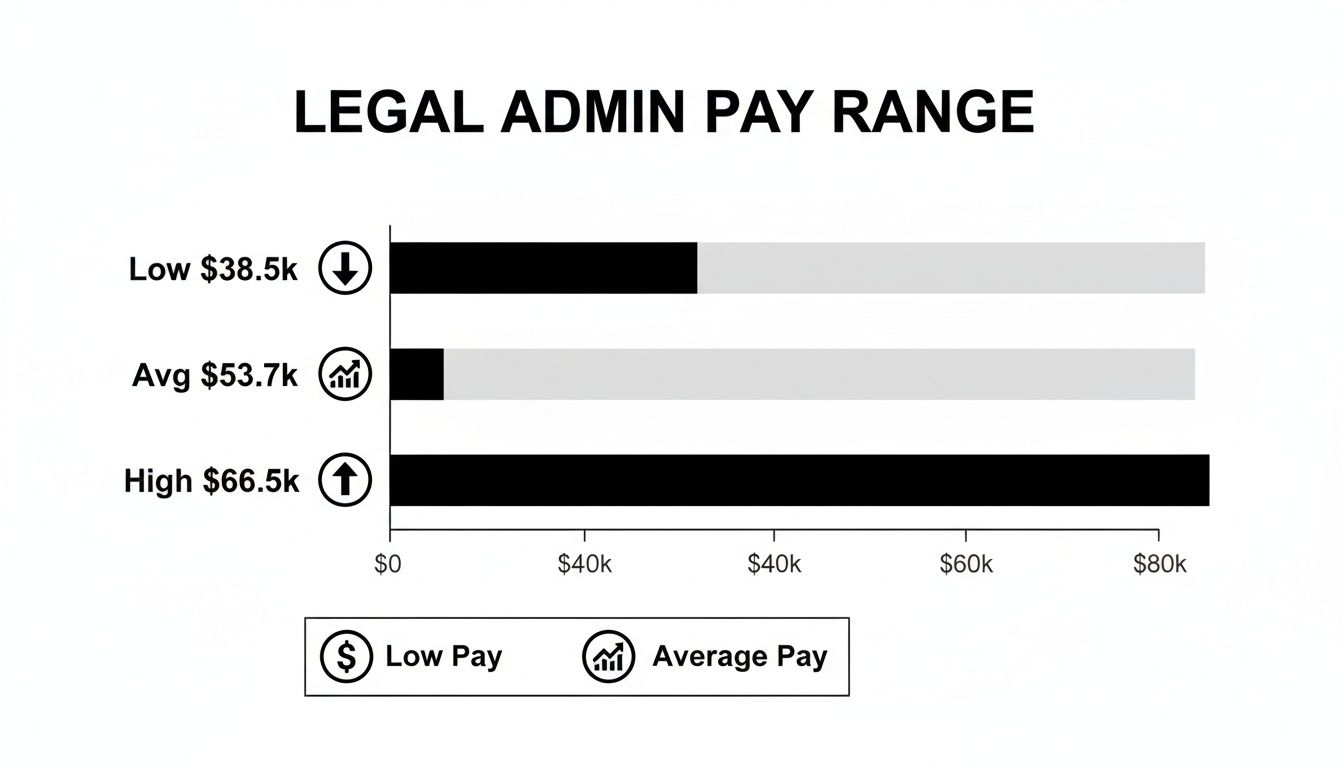
That nearly $30,000 gap between the low and high ends? A huge chunk of that is just paying for real estate.
The data doesn't lie. Major legal markets command salaries that can make a small firm partner's eyes water. The average pay for a legal administrative assistant in the New York-Newark-Jersey City area hovers around $68,550. Los Angeles-Long Beach-Anaheim isn't far behind at $64,790. You can explore more salary data on ZipRecruiter to see just how stark these differences are.
Over a few years, that location premium adds up to the cost of another employee, a major tech upgrade, or a much-needed marketing budget. The critical question isn't whether talent in these cities is good—it often is. The question is whether it's so uniquely superior that it justifies the massive cost increase.
I've built teams with talent from all over the country, and I can tell you this: skill, dedication, and expertise are not confined to a handful of expensive zip codes. By insisting on local-only hires, you're fishing in a smaller, more competitive, and far more expensive pond. It’s a self-imposed limitation that directly hits your bottom line.
Let’s get brutally honest. When you see a resume boasting “ten years of experience,” what are you actually paying for? A decade of evolving skills and increasing value? Or one year of experience repeated ten times?
This is the expensive trap that catches countless law firms. We've been taught to equate seniority with competence, but rewarding "years in the seat" without scrutinizing the actual skills is a surefire way to overpay. It’s a lazy shortcut for gauging talent, and it's costing you a fortune.
The salary ladder climbs fast. Entry-level talent starts around $43,250 and jumps to $48,190 in just a few years. Seasoned pros can clear $87,000. You can see more details on how experience impacts legal administrative assistant pay scales on PayScale.com. But is that top-tier salary justified by top-tier skills, or just by time served?
I’ve seen this movie more times than I can count: a firm hires a legal admin with 15 years on their resume, pays top dollar, and thinks they’ve landed an expert. A year later, they realize their “expert” is still using workflows from 2005, fumbles with new case management software, and hasn’t learned a new skill since the BlackBerry was cool.
That’s the stagnation tax. It’s the extra money you shell out for a long timeline instead of a demonstrated skillset. You end up with a costly employee who is comfortable, but not necessarily capable.
The most expensive hire isn’t the one with the highest salary; it’s the one who stops adding value but keeps cashing bigger checks. Don’t pay for tenure. Pay for talent.
It's time for a mental shift. Instead of asking, "How many years have you been doing this?" the real question should be, "What can you do for my firm right now that will make us more efficient and profitable?"
Breaking free from the "years-in-seat" model means zeroing in on what actually drives results: tangible abilities. This is the foundation of skills-based hiring. You can get a better handle on this from our guide on what is skills-based hiring, but the gist is simple.
This approach forces you to define exactly what you need.
When you hire for specific skills, you get immediate value. You’re not paying for someone to get up to speed; you’re paying for them to hit the ground running. It’s the difference between buying the exact tool you need for a job and buying a whole toolbox hoping the right one is in there somewhere. One is a strategic investment; the other is a gamble.
Let's be honest. The titles in a law firm can get blurrier than a contract written in disappearing ink. Is that person you’re about to hire a “Legal Administrative Assistant,” a “Legal Secretary,” or a junior “Paralegal” who just doesn’t know it yet?
More importantly, are you about to pay a paralegal’s salary for an admin’s workload?
This isn’t just about semantics. It’s a strategic blunder that quietly inflates your payroll. I’ve seen it dozens of times: a firm writes a vague job description, slaps a fancy title on it, and ends up paying a premium for a role they never clearly defined. You end up with someone whose responsibilities are a messy hybrid of scheduling meetings and conducting preliminary case research. The problem? Their paycheck reflects the most expensive parts of that job, not the average.
The confusion usually starts because these roles have some natural overlap. The trouble begins when you pay for the exception, not the rule.
The core distinction really comes down to one thing: administrative support vs. substantive legal work.
A Legal Administrative Assistant or Secretary manages the business of the law firm. A Paralegal, under attorney supervision, assists with the practice of law. Mixing them up is like paying a chef’s salary to someone who only butters the toast.
If you don't nail this down before you post a job, you're inviting candidates with wildly different skill sets and salary expectations to apply for the same position. It’s a hiring mess that's entirely avoidable.
Before you even think about writing a job description, define what your firm actually needs. Are you drowning in paperwork, or are you bottlenecked by legal research? Your answer dictates who you hire and what you should pay.
Our guide on the difference between a legal secretary and a paralegal offers a much deeper dive, but this table should give you a quick reality check.
| Job Title | Core Responsibilities | Typical Annual Pay Range | When to Hire This Role |
|---|---|---|---|
| Legal Secretary | Answering phones, scheduling, managing correspondence. The firm's organizational backbone. | $45,000 – $65,000 | Hire when your attorneys are buried in admin and client communication is slipping. |
| Legal Admin Assistant | A hybrid role: admin duties plus light paralegal support like organizing case files and client intake. | $50,000 – $70,000 | Hire when you need more than a secretary but aren't ready for a full-time paralegal. |
| Paralegal | Legal research, drafting documents, trial prep, managing discovery. Substantive, billable-support work. | $55,000 – $85,000+ | Hire when your attorneys need direct support on casework to free them up for high-level strategy. |
This isn't about being cheap; it's about being precise. Defining the role with absolute clarity ensures you attract the right candidates at the right price point. It’s the first—and most important—step to building a lean, effective team.
So, you’ve budgeted for that $60,000 legal administrative assistant pay. Feels manageable, right? Well, I hate to be the one to break it to you, but that number is a fantasy. It’s the sticker price on a car before the dealer adds taxes, fees, and that ridiculously overpriced "protection package."
The base salary is just the tip of a very expensive iceberg. The real cost—the number that actually hits your P&L—is hiding below the surface, quietly sinking your budget. Welcome to the wonderful world of fully loaded employee costs, where the actual expense is often 1.5 to 2 times the salary.
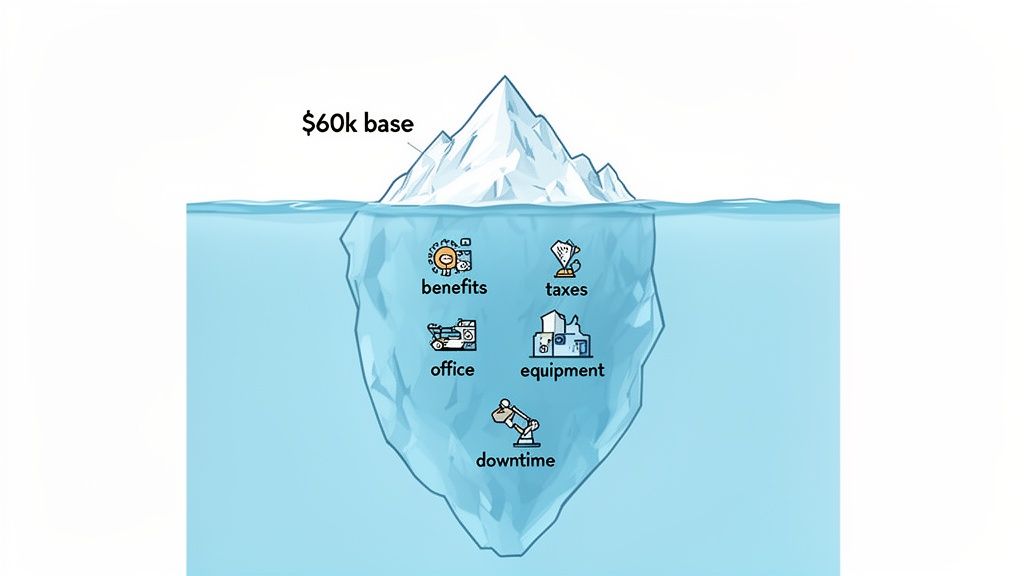
Let’s pull back the curtain. These aren't minor expenses; they are substantial, recurring costs that turn a reasonable salary into a financial nightmare.
Your true cost per hire includes a whole buffet of expenses you're now on the hook for:
And that’s just the direct stuff.
Oh, the costs don't stop there. That would be too easy. Now you get to fund the entire infrastructure to support this new employee.
You’re not just hiring a person; you’re funding a workstation. That means office space, a new computer, software licenses, a phone, and even the electricity they use. Hope you enjoy managing HR compliance, because that's now part of your job too.
Think about the unproductive time you're paying for—the slow afternoons, the time between projects, the "admin" hours that don't directly contribute to billable work. It all adds up. Things like billing can become a huge drain without the right systems. Exploring tools like dedicated time tracking software for lawyers is one way to claw back some efficiency, but it doesn't solve the core problem.
When you add it all up, that $60,000 assistant is really a $90,000 investment. Suddenly, the math doesn't look so good, does it?
If you're a law firm owner, you've felt the sting of high payroll. The pressure to compete for local talent can feel like a trap, and the hidden expenses of an in-house hire add up fast. So, what's the alternative? Just accept that a bloated payroll is the price of doing business?
Hell no. Turns out there’s more than one way to hire elite legal support without mortgaging your office ping-pong table. Let's talk about the solution: tapping into a global network of on-demand, remote legal professionals. This isn't about rolling the dice on a random freelancer. It's a strategic move to access a pre-vetted talent pool that can deliver exceptional work for a fraction of the cost.
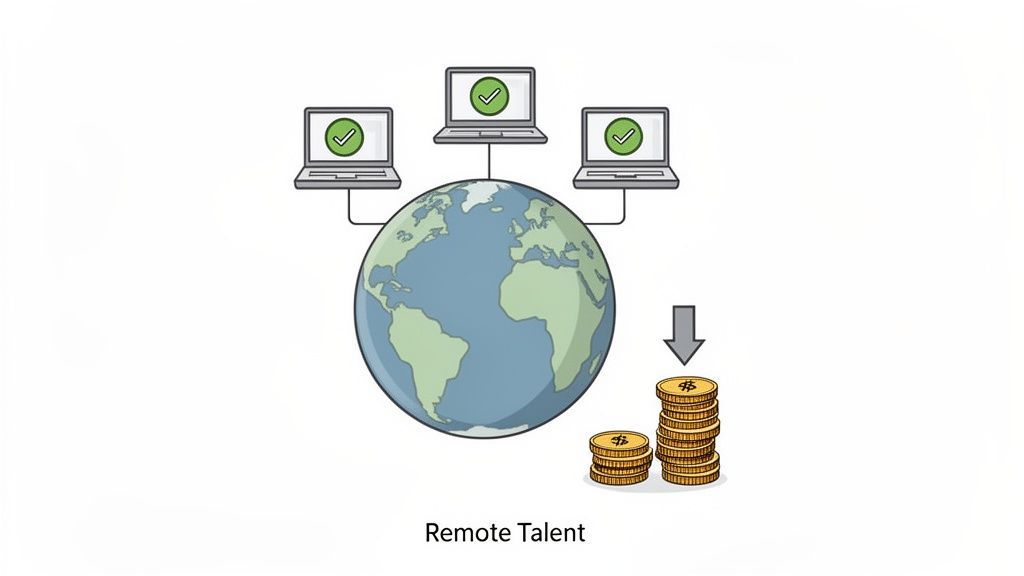
Let's get down to the numbers, because they're a knockout punch. A domestic legal administrative assistant can easily run you $90,000+ per year once you factor in the fully loaded costs.
What if you could hire someone with the same, or even better, expertise for $25,000? That’s not a typo.
This is the advantage of a global talent market. You're no longer held hostage by the cost of living in your city. Instead, you're accessing pros in places where your budget stretches three or four times further.
This isn't about finding a bargain; it's about executing a smarter financial strategy. You're arbitraging geography to your firm's advantage, getting A-level talent without the A-list price tag.
By ditching the traditional W-2 employee for this role, you sidestep a whole host of expenses. No payroll taxes, no 401(k) matches, no health insurance premiums, and no paying for unproductive downtime. You pay a predictable rate for the work you need done. Simple.
I know what you're thinking: "Remote talent? Sounds like a logistical nightmare." A decade ago, you’d have been right. But today, specialized platforms have made the process seamless.
This is a world away from the clunky, old-school outsourcing that gave everyone nightmares. It’s a curated, on-demand approach.
This entire system is built to give you the benefits of a top-tier hire without the crushing financial weight. To see how it works in practice, explore the real-world advantages of a remote legal assistant.
Ultimately, this is about transforming your administrative support from a massive cost center into a lean, efficient engine for growth. That $65,000 you just saved? That’s capital you can reinvest into marketing, tech, or a well-deserved partner bonus.
While finding a suitable recruitment agency is one option, on-demand platforms often provide even greater flexibility and cost-efficiency. The bottom line is simple: clinging to the old way of hiring is a competitive disadvantage. While your competition is stuck battling for overpriced local talent, you can be building a world-class team that powers your firm's growth without draining its bank account.
Alright, let's tackle the questions still bouncing around in your head. I get it. Shifting from the old-school model can feel like a huge leap. But most of those doubts are built on outdated assumptions.
This is the big one, right? The short answer: yes—if you use a reputable, specialized platform. This isn't about plucking a random name off a generic freelance website.
On a platform like HireParalegals, every single candidate has to run a gauntlet. They undergo a brutal vetting process that scrutinizes their background, skills, and professional experience. We're talking a screening system so tough it filters out 99% of applicants.
Frankly, it can be even safer than a local hire. You're bringing on a professional who has been meticulously screened for proven legal expertise, not just someone who interviewed well and lives nearby.
The savings here are dramatic, not incremental. When you hire remotely through a curated network, you can genuinely expect to cut payroll expenses by up to 80%. No, that’s not a typo.
By sidestepping the inflated salaries of major metro areas and eliminating that mountain of overhead—benefits, payroll taxes, office space—you radically reduce your spend. That $90,000 all-in cost for a domestic hire can realistically shrink to a $25,000 annual expense for an equally (or more) qualified professional.
Absolutely. The best platforms aren't offering cookie-cutter admins. They're focused on matching you with professionals who have direct experience in your specific practice area, whether that's litigation, family law, or IP filings.
They already know the terminology, the workflows, and the deadlines. They’re not just answering your phone; they're equipped to actively support your legal work from day one.