
 19 minutes read
Let's be honest. The old way you fill legal administrative jobs is a slow, expensive leak that's sinking your firm's productivity. You post an ad, drown in mediocre resumes, slog through interviews, and cross your fingers the person you hire isn't a total disaster. This isn't just about filling a desk; it's about plugging a massive hole in your operations.
And hope you enjoy spending your afternoons fact-checking resumes—because that’s now your full-time job.

While you're trapped in that hiring hamster wheel, your attorneys are stuck doing work that makes you zero money. They’re drowning in admin instead of focusing on what they’re actually good at: practicing law. The latest numbers are grim, showing lawyers spend a pathetic 2.9 hours a day on billable work. That stings. The rest of their time vanishes into a black hole of scheduling, filing, and chasing clients.
This isn't a time management problem; it's a direct hit to your revenue. Every hour a partner spends on non-billable nonsense is an hour you can’t bill for. Get this hire wrong, and your overhead balloons while productivity grinds to a halt. But get it right—and do it smartly—and you unlock real, scalable growth.
Hiring is so much more than a salary. The true cost of the wrong person is a painful cocktail of wasted time, recruitment fees, and a total loss of momentum. Let's get real about what’s at stake:

We’ve seen firms lose thousands of dollars on a single bad hire. It's the expensive, frustrating mistake that nobody wants to admit they keep making.
Then there's the salary itself. The national average for a legal assistant is over $50,000 a year—and that's before you even think about benefits, payroll taxes, and all the other fun overhead. For a more detailed breakdown, you can see how legal administrative assistant pay can spiral out of control.
This guide isn't another generic checklist. It’s a battle-tested playbook for finding elite remote legal support without having to mortgage your office ping-pong table. It's time to stop the bleeding.
Let’s get one thing straight: the classic image of a legal secretary drowning in a sea of manila folders is officially dead. If you’re still picturing someone chained to a Dictaphone, you’re about a decade behind. Today’s legal administrative jobs are less about paperwork and more about being the strategic backbone of a modern law firm.
These roles now demand a potent mix of legal knowledge, serious tech fluency, and the kind of business savvy that keeps a practice humming. The market for this talent is on fire. In fact, the legal sector just hit a record 1,208,100 jobs—a massive surge proving just how desperate firms are for skilled professionals.
This isn’t about filling seats; it’s about finding people who can think on their feet and act decisively in a fast-paced, remote-first world.
The lines between roles have blurred, and you need to know exactly who you're looking for. A Legal Assistant isn't just a cheaper Paralegal, and a Legal Secretary isn’t just an assistant. Getting this wrong is like hiring a plumber to do your electrical work—it’s going to end badly.
Understanding these distinctions is your first step to building a support team that actually works. Here’s the cheat sheet.
This table is a snapshot of the core responsibilities and essential skills for today's most common legal admin roles. No fluff.
| Role | Core Responsibilities | Essential Skills |
|---|---|---|
| Paralegal | Conducting legal research, drafting substantive legal documents (motions, pleadings), managing e-discovery, preparing for trial, and assisting attorneys with case strategy. | Deep legal knowledge, analytical and research skills, proficiency in case management software (e.g., Clio, MyCase), and e-discovery platforms. |
| Legal Assistant | Acting as the firm's operational hub. Managing calendars and deadlines, client communication, billing and invoicing, and general administrative tasks. | Exceptional organization, strong communication skills, client service mindset, and proficiency in practice management and billing software. |
| Legal Secretary | Specializing in complex document preparation. Formatting and proofreading legal documents, e-filing with courts, transcription, and ensuring adherence to court rules and procedures. | Meticulous attention to detail, mastery of legal formatting and citation, expertise in court e-filing systems, and excellent typing/transcription skills. |
The key takeaway? Each role requires a unique skillset. Stop trying to find a unicorn who does it all and hire the right person for the right job.
A critical piece of this modern landscape is embracing tools like legal document automation software that empower your team to work smarter, not just harder.
The real differentiator in today's market isn't a certificate on the wall. It’s the proven ability to use technology to drive efficiency and deliver results without constant hand-holding.
In a world of virtual courts and digital client files, a candidate who isn't comfortable with technology is a liability. You’re not just hiring for today; you’re hiring for where your firm needs to be in two years. This means finding someone who doesn't just tolerate new tech but actively seeks it out to make things better.
They should be fluent in the language of Clio, MyCase, and other practice management systems. They need to understand secure file sharing, video conferencing, and how to troubleshoot their own basic IT issues. This isn’t a "nice-to-have" anymore. It's the baseline.
Spoiler alert: a fancy degree looks great on paper, but it tells you next to nothing about whether someone can actually do the job. In the remote world of legal administrative jobs, practical skills and tech fluency are everything. It’s time to stop looking at what their diploma says and start focusing on what they can do.
We've all been burned by the candidate who talks a great game but folds under pressure. They nail the interview, charm your partners, and then you spend the next three months cleaning up their messes. That’s a costly lesson nobody has time for.
This is about more than "proficient in Microsoft Office." Frankly, that's the bare minimum—like expecting a surgeon to know how to hold a scalpel. You need someone who can plug directly into your firm’s tech stack and start adding value from day one.
Let’s get specific. Your ideal candidate doesn't just know about legal tech; they live and breathe it. Their expertise should be a given, not a "willing to learn" bullet point.
Here's the real checklist you should be using:
A candidate who asks, "What's Clio?" during an interview is an immediate red flag. It’s the equivalent of a chef asking you what a whisk is. Don't just walk away—run.
The ground is shifting so fast that tech fluency has become the ultimate differentiator. The demand for AI-savvy administrative talent has skyrocketed, with the number of pros using AI in their roles doubling in a single year. This isn't a trend; it's the new reality. Firms know that team members with applied AI skills boost efficiency and slash costs. You can find more administrative hiring trends on addisongroup.com.
So, how do you spot the real deal before you send an offer letter? Crossing your fingers isn't a strategy. You need a practical vetting process that cuts through the BS.
Stop asking cute brain teasers and start testing real-world abilities. Here’s a framework that actually works:
This isn’t about being difficult; it’s about being diligent. Taking these extra steps is the single best way to protect your firm from the soul-crushing cost of a bad hire.
Still posting on the same old job boards and hoping for the best? It’s time for an upgrade. Top talent for legal administrative jobs isn't just looking for a paycheck; they're looking for flexibility, modern tools, and a firm that actually gets it.
If your hiring process is stuck in 2003, you’re not just missing out on great candidates—you’re actively repelling them. You’ll end up drowning in resumes and pointless interviews instead of practicing law.
It's time to hire smarter, not harder.
Your job description is a sales pitch, not a legal filing. It’s their first impression of your firm. If it’s stuffed with stale corporate jargon, they'll assume your firm is just as boring.
Stop listing duties and start selling the opportunity. Instead of, "Manages attorney calendars," try, "Become the operational backbone that keeps our litigation team two steps ahead." One is a chore; the other is a mission.
Be brutally honest about what you need, but also paint a picture of what they’ll gain. Talk about your tech, your clients, and your culture. If you’re a remote-first firm, lead with that—it’s your biggest selling point.
The days of relying solely on Indeed or LinkedIn are over. The best remote legal pros hang out in curated talent marketplaces and specialized networks, not scrolling through giant, generic job boards.
Here's where to look:
The goal isn't more applicants; it's the right applicants. Casting a wide net just means you catch a lot of junk. A targeted approach saves everyone’s time.
Finding the right person can feel daunting, but a proven strategy makes it way more efficient. For a deeper look, check out our guide on the legal assistant hiring process.
Once you have a shortlist, the real work begins. The interview and vetting process is where you separate performers from pretenders. It needs to be sharp, practical, and incredibly revealing.
This infographic breaks down our battle-tested, three-step process for vetting critical legal skills.
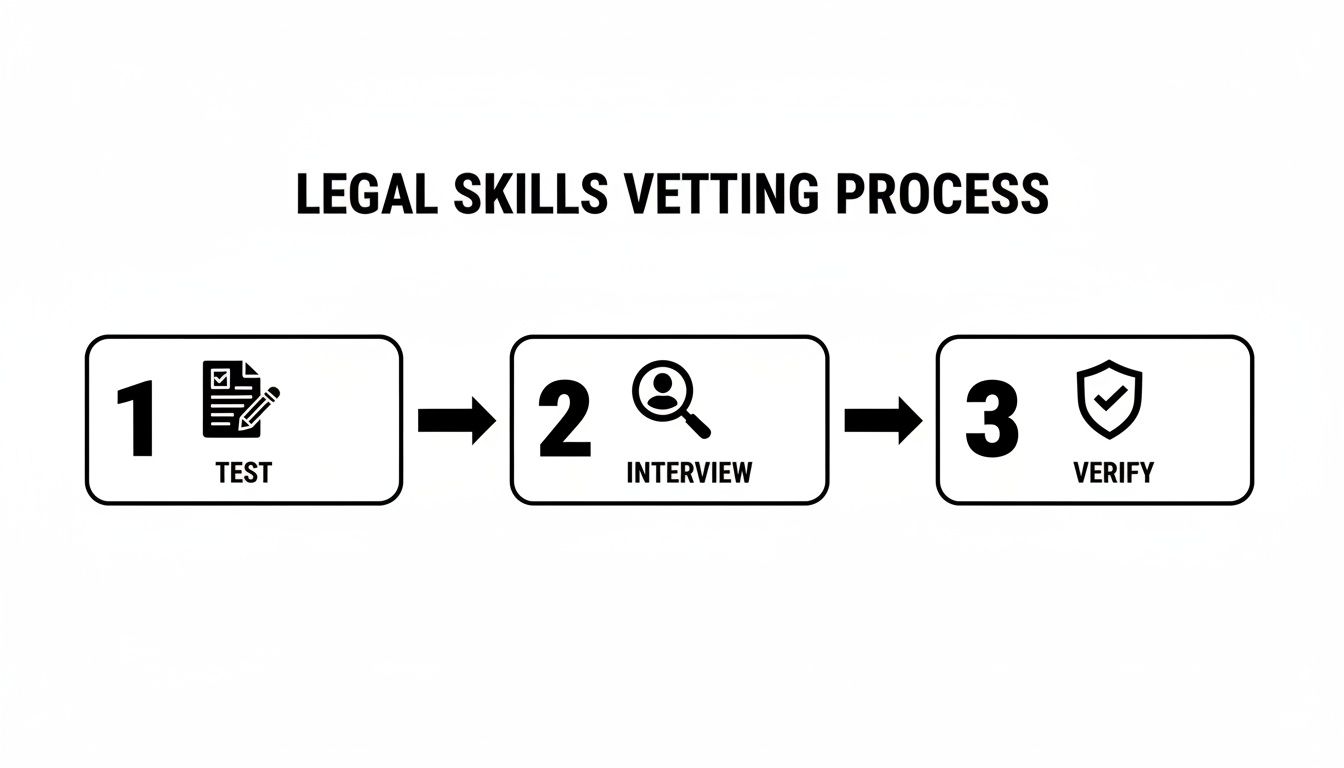
This structured approach goes beyond resume fluff to confirm a candidate can actually deliver.
The $500 Hello
We are huge fans of the paid skills test. Give your top two or three candidates a small, real-world project and pay them for their time—say, $100-$500. This could be anything from drafting a motion from a template, organizing messy discovery documents, or triaging a chaotic inbox.
Their output tells you everything. Did they follow instructions? Was the work clean? Did they ask smart questions? This single step is the most accurate predictor of on-the-job performance we've ever found.
Hiring remote talent opens up a world of possibilities, but it also brings up valid security concerns. How do you protect client data when your team is spread out everywhere?
First, get your tech in order. Cloud-based practice management software with role-based permissions is non-negotiable. This lets you grant access only to the specific files a remote team member needs—nothing more.
Next, establish crystal-clear security protocols:
Building a world-class remote team isn't about luck. It's about having a modern playbook that attracts, vets, and secures top-tier talent, no matter where they are.
Let's talk money. It's the one thing that keeps every firm owner up at night. How much should you really budget for top-tier legal administrative support? Probably a lot less than you think, especially once you stop looking in your own backyard.
This isn’t about being cheap. It’s about being strategic and realizing the legal market has gone global. For too long, we've been stuck on the myth that a local hire, paid a premium local salary, is the only path to quality. It’s an expensive myth.
When you hire a full-time, in-house employee, that base salary is just the opening bid. You're not just paying their wage; you're covering a whole ecosystem of hidden costs.
Let’s peel back the layers:
Suddenly, your $60,000 legal assistant is actually costing your firm closer to $80,000 a year. And that’s before you factor in the catastrophic cost of a bad hire, which can easily double that.
The old model forces you to pay a premium based on a candidate's location, not their skill. It’s an inefficient system that rewards geography over ability.
Now, let's compare that bloated cost structure with a streamlined, remote professional. You're not paying for their office space, their health insurance, or their coffee. You are paying for one thing: high-quality, focused work.
This is where the numbers get really interesting. Recent data on legal salary trends shows a market that's still highly competitive for pros with tech skills. But here's the kicker: a staggering 78% of legal leaders are being pushed to adopt AI without any extra budget. This immense pressure to cut costs while modernizing is the perfect storm for embracing cost-effective remote staffing. You can find more insights into legal salary trends and budgetary pressures on roberthalf.com.
By tapping into a global talent pool of pre-vetted professionals, you can often find elite talent for up to 80% less than a comparable local hire.
Think about it: for the true, all-in cost of one in-house assistant in a major city, you could build an entire remote support team. That’s not a small adjustment; it’s a fundamental shift in how you scale your practice.
So, you did it. You found the perfect candidate. Don't pop the champagne just yet. The hardest part is still ahead.
Hiring a great remote employee and then fumbling the onboarding is like drafting a star quarterback and then forgetting to give them a playbook. The first 90 days are everything, and a sloppy process is the fastest way to kill productivity and make your brilliant new hire start polishing their LinkedIn profile.
This isn't about sending over a W-9 and a laptop. It's about systematically integrating a human being into your firm—all through a screen. Get it right, and they’ll be contributing from week one. Get it wrong, and you’ll spend the next six months answering the same basic questions over and over.
Forget the welcome basket. The first thing your new remote hire needs is frictionless access to their digital workspace. Nothing screams "we're disorganized" like a new person who can't log into their email.
Your Day One goal is zero tech frustration. This means preparing everything before they start:
A smooth tech setup isn’t just a logistical step; it’s a powerful first impression. It tells your new hire you value their time. A rocky start signals chaos.
In an office, people absorb culture through osmosis. Remotely, you have to be painfully explicit. Assuming your new hire will just "figure it out" is a path to failure. You need a written-down, single source of truth.
This "rulebook" or internal wiki is their go-to guide. It’s not just HR policies; it’s the unwritten rules of how your firm operates. If you're lost, our guide on how to onboard remote employees offers a solid framework.
Key things to document:
For a deeper dive, explore these employee onboarding best practices which offer fantastic, actionable steps.
The final piece is setting crystal-clear expectations and engineering opportunities for early wins. Your new hire is eager to prove their worth; give them a clear path to do it.
In their first week, assign a small but meaningful project they can own from start to finish. It could be organizing a case file, drafting a standard client communication template, or researching a procedural question. The goal is to build their confidence and give them a tangible win.
This isn’t about throwing them in the deep end. It’s about giving them a defined, manageable task that lets them learn your systems and show their skills. That first completed project is a powerful psychological boost that sets the tone for their entire tenure.
You could follow every step in this guide. You could spend the next three months becoming an expert in sourcing candidates for legal administrative jobs. If you enjoy spending your afternoons fact-checking resumes, that's now your full-time job.
Or, you could just skip the line.
We’ve already done the heavy lifting. Frankly, we got tired of watching great firms make the same costly hiring mistakes over and over. So we built the shortcut. (Toot, toot!)
At HireParalegals, our entire business is built on a simple idea: you shouldn’t have to dig through a mountain of resumes to find one gem. We do the digging for you, surfacing only the top 1% of legal support talent.
Our process is ridiculously thorough, and that's by design. We don’t just glance at a CV. We put every candidate through a brutal four-step vetting gauntlet:
The result? You get a custom shortlist of elite, pre-vetted legal professionals who are ready to contribute from day one. Often within 24 hours.
We handle the sourcing, the vetting, the background checks, and even the complexities of international payroll. Your job is simple: interview a few of the best candidates we find and get back to winning cases.
This is how modern law firms scale—without the headaches, the overhead, or the risk of a catastrophic bad hire. It isn’t magic; it’s just a smarter way to build your team.