
 20 minutes read
Let's be real. The traditional hiring model for law firms is broken. You’re either drowning in resumes from people who are a terrible fit or mortgaging your office ping-pong table to afford experienced lawyers. There’s a better way to build your team, and it’s not some fancy new AI—it’s the remote legal internship. This is how smaller firms punch above their weight and get a serious talent advantage without the soul-crushing overhead.
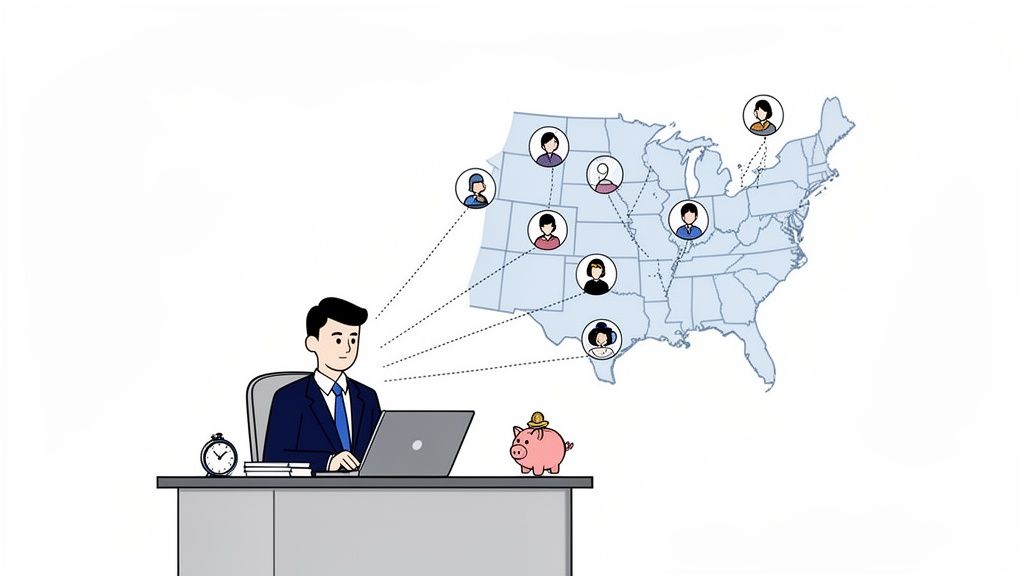
Think about the last time you tried to hire someone. How many hours did you burn sifting through candidates who lived too far away, wanted a salary you couldn't touch, or just didn't have that one niche skill you desperately needed? It’s a miserable, expensive merry-go-round.
The old way forces you to fight every other firm within a 30-mile radius for the same handful of people. It’s a system designed to keep small and mid-sized firms in their place.
This is where remote legal internships flip the entire board. Instead of being stuck with your local talent pool, you suddenly get a VIP pass to a nationwide pipeline of ambitious, brilliant law students.
Imagine finding a top-tier student who geeks out on that obscure corner of intellectual property your firm is getting into. Or a paralegal student who’s already a wizard at managing discovery for complex litigation. When your intern is remote, their zip code becomes completely irrelevant.

The real power move isn't just saving a few bucks—it's gaining access to specialized talent you could never find locally. You're not just hiring help; you're importing expertise on demand.
Let's talk numbers, because that’s what actually pays the bills. A remote internship program slashes the overhead that quietly bleeds law firms dry. You can stop stressing about the costs of:
This isn’t about being cheap; it's about being smart. You’re reallocating money from fixed costs and pouring it directly into billable work. It’s the first step to building a leaner, meaner, more modern legal team.
To really hammer it home, let's put the two models head-to-head.
| Factor | Traditional In-Office Hire | Remote Legal Intern |
|---|---|---|
| Talent Pool | Limited to your local commuting hellscape. | Access to a nationwide pool of students. |
| Hiring Timeline | Slow. Often takes 2-3 months of your life you'll never get back. | Fast. Find and onboard a candidate in a few weeks. |
| Overhead Costs | High (office space, equipment, benefits, insurance). | Minimal (no new desk, computer, or coffee runs). |
| Flexibility | Rigid. Locked into a full-time, long-term commitment. | Flexible. Project-based or part-time work fits like a glove. |
| Recruitment Cost | Expensive. Job board fees and recruiter commissions add up. | Low cost. Often sourced through free university channels. |
| Specialized Skills | Nearly impossible to find locally and costs a fortune when you do. | Easier to find niche skills from a national talent base. |
The advantages are immediate and obvious. For a firm that wants to grow without going broke, a remote internship program isn't a "nice-to-have"—it's an absolute necessity for staying in the game.
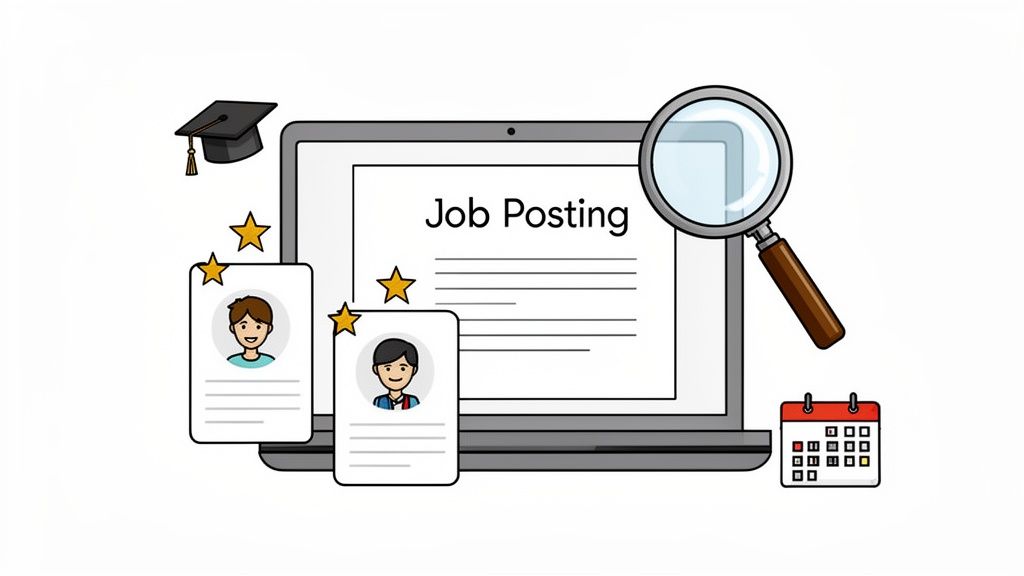
Alright, you’re sold on the idea. Now for the fun part: finding these legal eagles. Hope you enjoy spending your afternoons fact-checking resumes and running interviews—because that’s now your full-time job.
Kidding. Mostly.
Sourcing talent for remote legal internships is a different beast. You can't just toss an ad on a generic job board and pray. That’s how you get a digital mountain of applications from people who think “legal research” means binge-watching Suits.
This isn't about casting the widest net. It’s about using the right bait, in the right pond, to build a repeatable system that brings you quality candidates, not just a high body count.
Your first instinct will be to plaster your opening on every major job site. Don’t. You’ll just get swamped by unqualified applicants, which means you’ll waste hours you don’t have. Your best sources are way more targeted.
Focus your energy where the actual talent lives.
This approach flips the script. Instead of you sifting through hundreds of applicants, you’re getting a curated stream of candidates who are already interested in what you do.
Once you know where to look, you need to write a description that attracts ambition, not apathy. Generic posts get generic candidates. You need to sell the experience, not just list the duties.
A killer job post for a remote legal internship isn't a laundry list of demands. It's a pitch.
Your job description is a marketing document for your firm's culture. It should make a top student feel like they’d be an idiot not to apply.
Forget the corporate nonsense. Be direct, be clear, and focus on what a law student actually gives a damn about:
Ultimately, your search for legal talent might go beyond internships. Many firms find huge success hiring remote paralegals for more experienced support, building a powerful, blended remote team. For more insider tips, check out our guide on talent acquisition best practices.
So, you found a star candidate. Now what? Just email them a login, point to a shared drive, and hope for the best? That's how you end up with a ghost intern who logs three hours a week and produces nothing.
Setting up a remote legal internship can feel like a logistical nightmare, but it doesn’t have to be. The secret isn't a virtual happy hour; it’s a rock-solid, repeatable process. A great remote program is never an accident. It’s intentionally designed with clear expectations, meaningful work, and consistent communication.
Get this right, and you'll have a system that practically runs itself and adds real, tangible value to your firm.
The first two days make or break the entire internship. A chaotic start screams, "We don't have our act together." A structured, thoughtful onboarding shows you’re a pro who respects their time.
The goal is simple: get them productive, fast.
A solid remote onboarding checklist looks like this:
This structured approach eliminates that awkward "What am I supposed to be doing?" phase that kills momentum. For a deeper dive, check out our blueprint on how to onboard remote employees effectively.
The biggest mistake you can make is giving interns the digital equivalent of fetching coffee. Busywork doesn't teach them anything, and it doesn't help you. You hired them for their brain—so use it.
A great remote internship is built on well-defined, project-based tasks. The intern should always know what "done" looks like.
Instead of vague instructions, create specific assignments with crystal-clear deliverables.
See the difference? The second example gives them everything they need to succeed without constant hand-holding. This approach also lets you tap into an enormous talent pool. With over 155,487 law interns currently in the U.S., there’s a massive pool of skilled people ready for real work. You can find more insights on the growing law intern demographic on Zippia.com.
"How can I supervise them if I can't see them?" It's a fair question, but it's the wrong one. Supervision isn't surveillance; it's connection and accountability.
Your communication rhythm has to be predictable. I’ve found this simple structure works every time:
This framework creates an environment where interns feel connected and confident, not isolated and ignored. It shows them they’re part of the team, even if they're hundreds of miles away.
Let's get to the part everyone tries to ignore: the money. The idea of an unpaid intern is tempting, a relic from an era when "experience" was payment enough. But let’s be brutally honest—navigating the rules for unpaid remote legal internships is like defusing a bomb while blindfolded. Get it wrong, and it’s going to blow up in your face.
This isn’t just about being nice; it’s about being smart. The best candidates—the ones with real hustle—can't afford to work for free. By offering a competitive wage, you’re not just following the law; you're dramatically expanding your talent pool to include the best, not just the wealthiest.
The Department of Labor (DOL) has a charming little thing called the "seven-factor test" for unpaid internships. It’s not a casual checklist; it's a set of rigid criteria, and you have to meet all of them. Screw up just one, and that "free" help turns into a very expensive wage claim.
The rule of thumb is simple: the intern must be the primary beneficiary of the arrangement. If your firm is getting more out of it than they are, you have to pay them. End of story.
The second an intern’s work starts replacing what a paid employee would do—even boring admin tasks—you've crossed a very bright line. The DOL does not have a sense of humor about this.
Here’s a no-BS summary of the test:
Looking at that list, it’s painfully obvious that most of the valuable work you want an intern to do fails this test. That’s why paying them is always the smarter, safer move.
This decision tree shows the basic flow for getting a program off the ground, starting with clear goals.
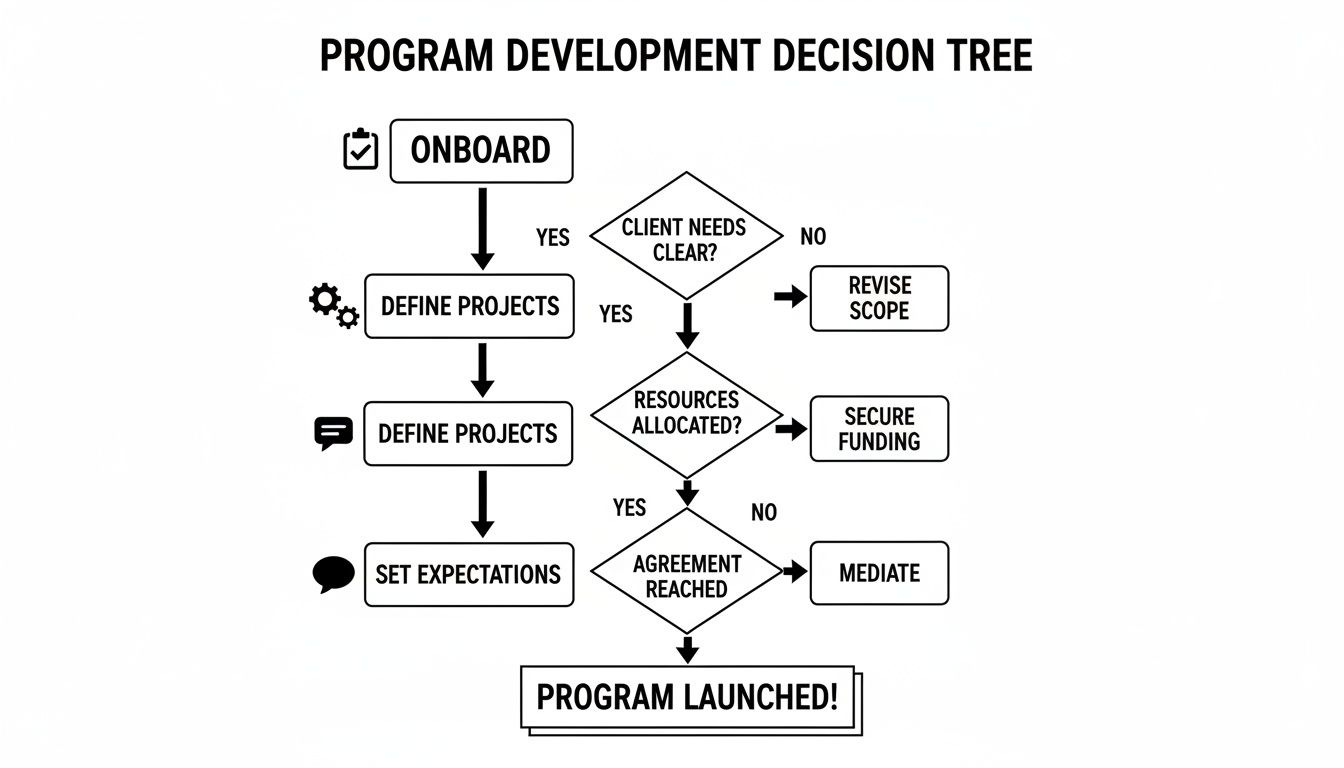
This illustrates that a successful program is built on deliberate steps, from onboarding to defining projects and setting clear expectations.
So, what's a fair wage? For remote legal interns, a competitive rate usually lands between $15 and $25 per hour. The exact number depends on their year in law school and how complex the work is.
And don’t sleep on state-by-state labor laws. What’s fine in one state could be a massive violation in another, especially in places like California and New York. This is a critical part of running a remote team. To get the full picture, learn more about what payroll compliance actually entails and why it’s so vital for protecting your firm.
Paying your interns isn't just an expense. It's an investment in quality, a shield against legal risk, and a clear sign you value their work. Don't be penny-wise and pound-foolish here.

Let’s be honest. An internship shouldn't just be a 10-week test drive. It's your single best pipeline for future talent. You've already invested time and money training them on your systems, your processes, and your firm’s culture. Letting all that knowledge walk out the door is just plain stupid.
The real prize isn't getting some cheap help for a summer; it's finding your next indispensable team member. A successful conversion is the ultimate ROI for your remote legal internship program, turning a small bet into a massive win.
So, how do you turn a promising intern into a permanent fixture? It starts by looking beyond the task list.
Evaluating a remote intern isn't about counting how many hours they were logged into Slack. That’s a rookie mistake. You need to measure what actually moves the needle.
Here’s what you should be tracking:
These aren't just intern metrics; they're the vital signs of a future star.
The ultimate test is simple: Does this person make my life easier? If the answer is a consistent "hell yes," you've found someone worth keeping.
Giving feedback remotely can feel awkward. You can’t just pop by their desk. But without direct, constructive criticism, they’ll never grow into the role you need them to fill.
Forget that "feedback sandwich" garbage. Be direct, be specific, and be human.
This constant feedback loop is how you actively mold an intern into the employee you want to hire.
When do you talk about a full-time offer? Not on their last day. That’s just awkward. If you see real potential, start dropping hints around the halfway point.
This signals your interest early. A casual, "Have you thought about what you want to do after graduation? We've been really impressed," is a great, low-pressure way to open the door.
This strategy is catching on. Remote legal internships are proving to be a highly effective path to full-time roles. Data shows a projected intern-to-employee conversion rate of 66.9%, meaning millions are securing permanent jobs after proving their worth. You can dig into the trends in the full internship statistics report from StandOut CV.
By making a timely offer, you lock in top talent before your competitors even know they're on the market. It’s the smartest, most cost-effective recruiting you'll ever do.
Alright, enough talk. We’ve covered the why, the how, and the what-ifs. Now it's time to actually get it done. This is your practical, step-by-step game plan to turn the idea of a remote legal internship program into a reality that adds real value.
No more theory. This is the condensed version you can print out and stick on your wall.
Before you even think about writing a job post, get your own house in order. A little prep work here saves a world of pain later. Seriously, don’t skip this.
With your foundation set, it’s time to find your star. A targeted approach is everything.
A successful launch isn't about finding some mythical "perfect" candidate. It's about having a process that consistently attracts and identifies the right candidate for your firm.
You hired someone. Congrats! Now the real work begins. A structured first week sets the tone for everything.
Let's be honest—the idea of hiring someone you won't see in person can be a little unnerving. I've heard every question in the book. Let's tackle the big ones head-on so you can move forward with confidence.
Stop thinking about supervision as surveillance. The secret is a solid framework built on clear communication and trust, not watching a green dot on Slack.
First, invest in a real onboarding. Walk them through your procedures, software, and communication style. Use a simple project manager like Asana or Trello to assign tasks with clear instructions and deadlines. This saves your sanity, not just theirs.
Then, schedule two mandatory video check-ins a week. These are your non-negotiable touchpoints. Finally, give them a day-to-day mentor—a paralegal or junior associate is perfect. This frees you from micromanaging and gives the intern a lifeline.
Let’s kill this myth right now. If your firm can send an email and use Zoom, you have all the tech you need. This has nothing to do with fancy software and everything to do with solid processes.
The real barrier to entry for a remote internship isn't your IT budget. It's your willingness to communicate clearly.
The essential tools are things you’re probably already paying for: a way to share documents (Dropbox), a place to chat (Slack or Microsoft Teams), and a video platform (Zoom or Google Meet). A flexible mindset is infinitely more valuable than the latest gadget.
Whatever you do, don't just give them digital busywork. You’re hiring an aspiring lawyer—put their brain to use.
The sweet spot is discrete, project-based work with a clear beginning and end. Here are a few that work perfectly:
The trick is to provide detailed instructions and a clear picture of what "done" looks like. When you do that, they learn valuable skills, and you get high-quality work in return. It’s a win-win.