 21 minutes read
Let's be blunt. Figuring out what to pay a contract attorney can feel like a high-stakes guessing game where you’re either about to score a massive bargain or light a pile of cash on fire. The reality is, rates swing wildly—from a "too-good-to-be-true" $20 an hour for basic doc review to well over $200 for the kind of specialized expertise that can actually save your company.
So, how do you budget for elite legal talent without needing a Wharton MBA just to decipher the invoice?
You know you need legal firepower, but you're terrified of overpaying—or worse, getting exactly what you paid for. It's time to cut through the noise and dissect the entire financial picture of hiring a contract attorney. This isn’t just about tossing numbers around; it’s about understanding the "why" behind them so you don't get taken for a ride.
The goal is simple: build a realistic budget and find killer talent. It’s entirely possible, but you have to know where to look and, more importantly, what to look out for.
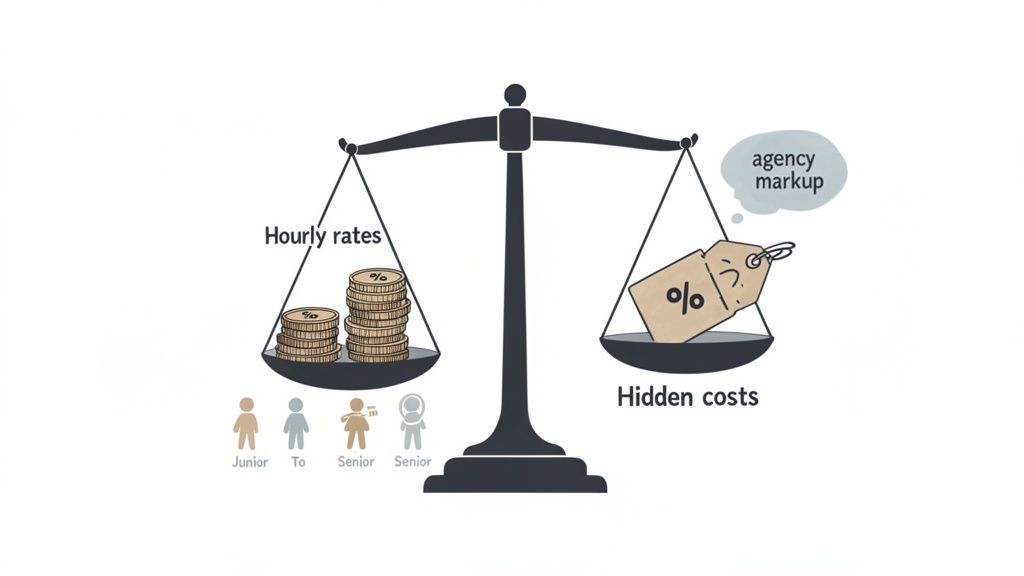
That hourly rate you see advertised? It's rarely the full story. Think of it like a car's MSRP—it’s a nice starting point for a conversation you're about to lose. The real cost is often buried in the fine print, especially when you’re dealing with traditional staffing agencies.
They’re the middlemen who promise convenience but often deliver a brutal, soul-crushing markup. While contract attorneys are a flexible and cost-effective alternative to full-time hires, agencies can tack on a hefty 30-50% markup for independent contractors. For W-2 employees they place, that markup can be an eye-watering 65-100%, pushing your total costs straight into the stratosphere.
This hidden cost is where smart founders find their edge. By sidestepping the old-school agency model, you can redirect that markup straight into hiring better talent or, you know, just keeping your cash.
So, why does one attorney command $250/hour while another is perfectly happy with $75? It's a cocktail of experience, geography, and specialization that creates this massive spread in contract attorney pay.
Here’s a quick breakdown of what moves the needle:

The biggest mistake I see founders make is focusing solely on the hourly rate. A cheaper attorney who needs constant hand-holding will cost you far more in wasted time and corrections than a seasoned pro who costs twice as much but gets it right the first time. Every. Single. Time.
Understanding these dynamics is your first step toward making smarter hiring decisions. It’s not about finding the cheapest option; it's about finding the best value. As you budget, think about the complexity of the work and the level of autonomy required. This is a critical part of a broader strategy, which we cover in our founder's guide to on-demand legal services.

Ever get that quote for $75 an hour and think you’ve hit the jackpot, only to see another attorney asking for $400 and scoff? I get it. The sticker shock is real. But let’s have a frank conversation about what you’re actually buying.
The single biggest lever on a contract attorney's pay isn't a fancy law school degree or a slick resume—it's experience. And I’m not just talking about years on paper. I mean the kind of hard-won wisdom that can smell a disastrous contract clause from a mile away or knows the exact motion to file to shut down a frivolous claim, saving you tens of thousands of dollars in the process.
Hiring a junior attorney feels like a steal until you realize their learning curve is on your dime. Suddenly, you’re not just a client; you’re a mentor, manager, and editor, spending your own valuable hours cleaning up mistakes that a seasoned pro would have never made in the first place.
When you’re staring down a complex legal issue, do you want someone who’s reading the playbook for the first time, or someone who’s already won the game a dozen times?
A veteran attorney doesn't just bill hours; they solve problems. They bring a level of efficiency and strategic foresight that a less experienced lawyer simply can't replicate.
Think of it this way: you’re paying for the thousands of hours they’ve already spent becoming an expert, so you don’t have to pay for them to learn on your project.
The numbers don't lie. The gap in contract attorney pay based on experience isn't just a gap; it's a chasm. Research from major U.S. markets shows a dramatic premium for proven expertise. Lawyers with 20-30 years of experience command an average hourly rate of $511-$606. In stark contrast, those with under four years of experience typically bill between $182-$212. You can find more data on how lawyer rates vary by state.
That’s a nearly 3x difference. It seems massive until you factor in the cost of a single missed deadline, a poorly drafted contract, or a botched legal strategy. Suddenly, that "expensive" veteran looks like the biggest bargain in town.
The key is to match the talent to the task. Of course, you don’t need a senior M&A attorney to handle basic document review. But when the stakes are high and the margin for error is zero, investing in a battle-tested professional isn’t a cost—it’s insurance.
So how do you find the right balance between cost and competence? It starts with being brutally honest about the complexity of your legal needs.
Don’t just look at the years on a resume. Look for specific, relevant experience that mirrors your project. An attorney with ten years in general practice might be less effective for your niche intellectual property issue than a lawyer with just five years of dedicated IP experience.
The ultimate goal isn’t to find the cheapest hourly rate. It’s to find the person who can deliver the best possible outcome in the least amount of time, minimizing your total cost and risk. That’s the kind of strategic investment that pays dividends long after the final invoice is paid.
Ever wonder why an attorney in Manhattan costs a fortune compared to one in Omaha? It’s not always about skill—it's often about their rent. Welcome to the "zip code tax," one of the most frustrating, unspoken truths in legal hiring.
This is an invisible surcharge slapped on your bill simply because your attorney works in a high-cost-of-living area. I’ve seen it countless times: a firm in San Francisco hires a local contract attorney and pays a premium, believing that’s just the market rate. They’re right about the local market, but they’re completely missing the bigger picture. In today's world, paying that premium is a choice, not a necessity.
When most legal work can be done from anywhere with a secure internet connection, getting stuck paying for geography is a rookie mistake.
The difference in contract attorney pay from one state to another isn't just a few bucks—it's a chasm. We’re talking about potentially paying double or even triple for the same level of expertise, all because of a state line. The data is enough to make any budget-conscious managing partner wince.
For instance, hiring a contract attorney in the District of Columbia will set you back an average of $462 per hour. Not far behind are states like Delaware ($423), New York ($398), and California ($391). But look across the country, and you can find exceptional legal talent in West Virginia for a much more reasonable $162-$168 per hour. As these average attorney fees by state show, the numbers don't lie.
That’s a potential $300-per-hour difference for the exact same work. Let that sink in for a moment. For every single hour billed, you could be saving the cost of a nice client dinner just by looking beyond your own city limits.
This isn’t about a race to the bottom to find "cheap" labor. It's about smart arbitrage. The sky-high rates in major metro hubs are fueled by insane overhead and fierce local competition for talent. That's their problem, not yours.
This is where remote work becomes a game-changer. It's the modern law firm's secret weapon against bloated legal bills. Why pay a New York City rate when you can hire an equally qualified, U.S.-based attorney from a state with a lower cost of living?
The simple answer is, you shouldn't.
Tapping into a national talent pool gives you access to top-tier skills without the big-city price tag. You get attorneys with the same credentials, the same drive, and the same dedication to quality, but at a rate that reflects their local economy, not yours.
This strategy unlocks several powerful advantages:
Hiring remote legal professionals isn't just a passing trend; it's a fundamental shift in how smart firms operate. It's a strategic move that turns a major expense into a real competitive advantage. The same logic holds true for other legal roles, as you can see in our guide on paralegal salaries and regional differences. It’s time to stop paying for your attorney’s zip code and start paying for their expertise.
Deciding how to pay a contract attorney isn’t just a simple accounting task. The model you choose—whether it's hourly, a flat fee, or something in between—is a strategic move. It tells the attorney what you truly value. Get it wrong, and you could be paying for inefficiency. But get it right, and you perfectly align everyone’s goals toward a fast, successful outcome.
So, how do you make the right call? Let’s forget the jargon and talk about what really works. I’ve seen just about every model in action, and the best one always comes down to the specific job you need done.
This decision tree breaks down a major factor we covered earlier—geography—and how it pushes rates up or down.
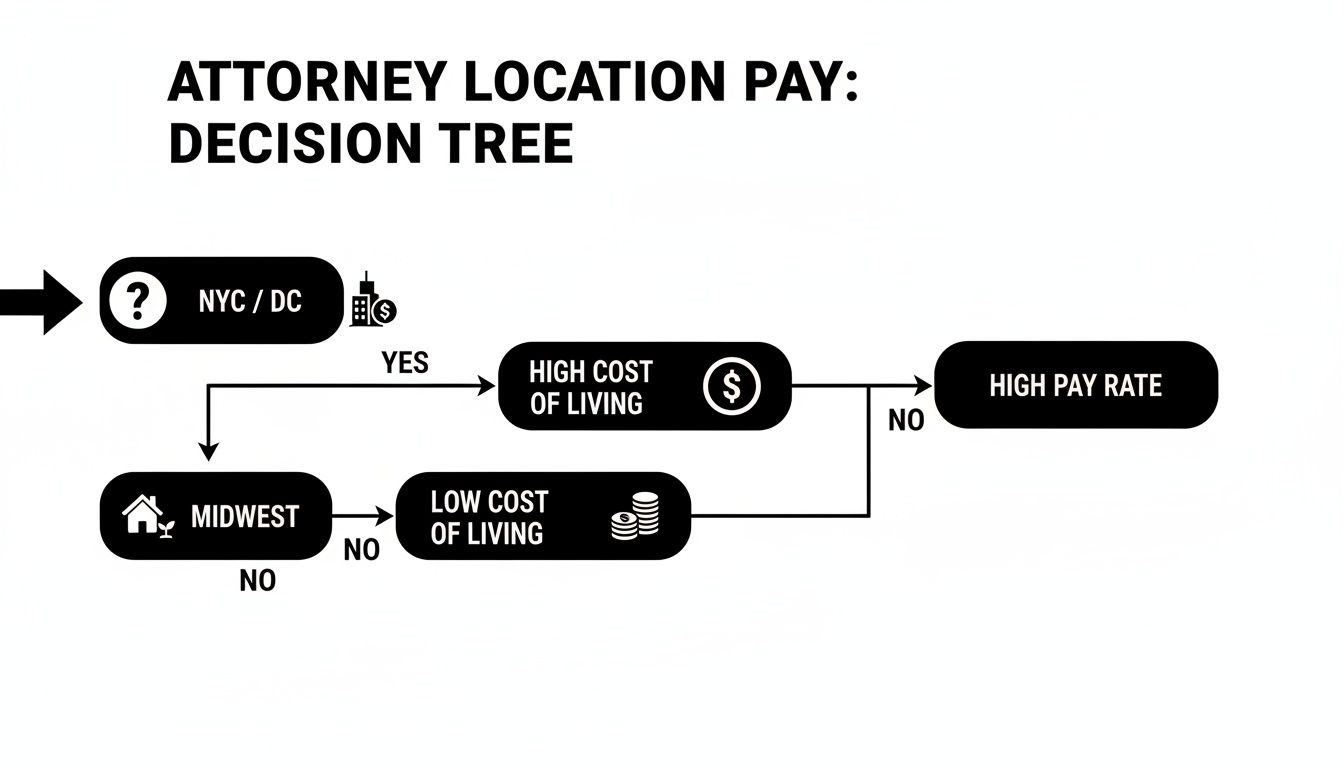
As you can see, hiring an attorney in a high-cost city like New York or San Francisco will naturally command higher pay. On the flip side, tapping into legal talent from lower-cost regions can deliver some serious savings.
The hourly rate is the old standby for a reason: it's straightforward and flexible. It makes the most sense when a project's scope is all over the place—think of messy litigation or a complex negotiation that keeps evolving. You pay for the actual time spent, and the attorney gets compensated for every unexpected twist and turn.
But here’s the catch: it can create a terrible incentive structure. You're paying for time, not results. An attorney who takes 20 hours to do what an expert could finish in five ends up with a bigger paycheck. That puts the burden on you to be the timekeeper, which is the last thing you need on your plate.
Use it for:
The blunt truth about hourly billing is that it rewards activity, not progress. It’s a necessary evil if you can't clearly define the project's finish line. Otherwise, you’re just inviting scope creep to come in and make itself at home.
For most projects, this is my absolute favorite. A flat fee, also called a per-project rate, aligns everyone’s incentives beautifully. You define a crystal-clear scope of work—like reviewing a batch of 50 contracts, drafting a standard SaaS agreement, or handling a trademark filing—and agree on one single price.
Suddenly, the attorney is motivated to be incredibly efficient. They get paid the same amount whether the work takes them 10 hours or 20, so you know they won’t be dragging their feet. This model gives you what every business owner dreams of: budget certainty. No more clock-watching or sweating over surprise invoices.
When you're weighing your options, understanding various pricing models is key to making a smart decision. It helps you propose a flat fee that is both fair for the attorney and strategic for your business.
Of course, sometimes a project doesn't fit neatly into one box. That’s where hybrid models come in. They are a bit less common for contract work but can be incredibly effective when you need a blend of predictability and flexibility.
Choosing the right pay model is more than just an administrative step; it’s your first move in managing the project for success. Always start by defining the scope. If it's rock-solid and clear, go flat. If it’s a moving target, hourly might be your only real choice.
So, you’ve figured out the budget. Great. Now comes the part everyone dreads: actually finding the right person without losing your entire week to resume sorting, awkward interviews, and candidates who ghost you right before the offer.
Hope you enjoy spending your afternoons fact-checking resumes and chasing down references—because that’s now your full-time job.
This isn’t just about filling a role; it’s a strategic move to get the help you need without the usual administrative drag. The traditional hiring path is a slow, painful grind. Fortunately, there’s a much smarter way to do it.
Think about the standard hiring process for a minute. You post a job on a general board and get buried in a flood of applications, 90% of which are from people who are completely unqualified. You can burn days just filtering, screening, and scheduling, only to discover the "perfect" candidate has zero relevant experience.
It's a costly process, and not just in money. You're losing momentum. Every hour you spend wading through resumes is an hour you aren't serving clients or growing your business.
But what if you could bypass that whole circus? Modern talent platforms (toot, toot!) were designed to do the heavy lifting for you, turning the old, inefficient model on its head.
The real cost of a bad hire isn’t just their salary. It’s the wasted time, the missed deadlines, and the demoralizing effect it has on your team. Getting it right the first time isn’t a luxury; it’s a competitive necessity.
These platforms aren't just job boards; they're curated networks. The legwork of vetting, interviewing, and verifying credentials for every single professional has already been done. That means when you need to hire, you’re not starting from scratch. You’re starting near the finish line.
To really see the difference, let's put them side-by-side. This isn't a small improvement; it's a completely different philosophy.
| Hiring Aspect | Traditional Method (Job Boards or Agencies) | Modern Talent Platform |
|---|---|---|
| Time to Hire | 4-8 weeks (if you're lucky) | 24-72 hours |
| Candidate Quality | A lottery of unscreened applicants | Pre-vetted, US-experienced professionals |
| Your Time Invested | Dozens of hours in screening and interviews | 1-2 hours reviewing a curated shortlist |
| Hidden Costs | Agency markups, lost billable hours | Transparent pricing, no hidden fees |
| Risk Factor | High risk of a bad fit, requiring a do-over | Low risk due to rigorous vetting and matching |
The contrast is stark. One path is a manual, frustrating slog. The other is a focused, tech-enabled process designed to bring top-tier talent directly to you. If you want to truly leave hiring headaches behind, it pays to formalize your strategy. Taking some time to improve your recruiting process can make all the difference in finding the best legal professionals efficiently.
The real magic isn't just having a pool of great candidates; it's about matching the right candidate to your specific needs, fast. This is done with a mix of human expertise and smart technology that understands the nuances of your firm and the project at hand.
Need a litigation paralegal with five years of experience in Texas state court? No problem. Looking for a junior attorney who’s a wizard with SaaS contracts and available for 15 hours a week? They’re already in the network.
This goes way beyond simple keyword searches. It's about a deeper understanding of skills, experience levels, and even work styles to create a shortlist of professionals who can start contributing from day one. This is how you change hiring from a bottleneck into a strategic advantage—getting the exact expertise you need, right when you need it.
We’ve covered a lot of ground—rates, experience, geography, and different hiring models. But even with all that information, there are usually a few specific questions that pop up right when you’re ready to move forward.
Let's get those sorted out right now. Here are direct, no-fluff answers to the most common questions we get about paying and working with contract attorneys.
Yes, you can—and often should. But this isn't a flea market. A negotiation isn't about seeing how low you can get them to go. Top-tier contract attorneys know their market value, and trying to lowball them is a surefire way to get ghosted.
Instead of haggling over the number, have a strategic conversation. Could you offer a longer-term engagement in exchange for a slightly reduced rate? Is the scope of work so clearly defined that it makes their job simpler? That’s the kind of negotiation that builds a solid partnership, not resentment.
Think of it this way: You’re not just negotiating a rate; you’re setting the tone for the entire working relationship. A fair, respectful discussion signals that you value their expertise, which is exactly what makes the best talent want to work with you.
If their rate is firm, respect it. The best attorneys often have other options on the table. If their rate feels high, go back to the ROI. Is their efficiency and specialized knowledge worth the premium? In many cases, the answer is a clear yes.
The hourly rate is still king, especially for unpredictable work like ongoing litigation support or projects where the scope might change. It’s the default for a reason: it's straightforward to track and gives both sides flexibility when the workload ebbs and flows.
That said, we’re seeing a huge move toward flat-fee or per-project billing. For any task with a defined beginning and end—like drafting a set of employee handbooks or managing a trademark filing—a flat fee is a win-win. You get cost certainty for your budget, and it incentivizes the attorney to work efficiently, not just run up the clock.
Here’s how it usually breaks down in practice:
Typically, no. This is one of the single biggest financial perks of hiring a contract attorney. When you bring them on as a 1099 independent contractor, they are running their own business. That means they're responsible for their own taxes, health insurance, retirement planning, and other benefits.
This saves you a significant amount of money. You're not just avoiding the direct cost of a benefits package, but also the administrative headache of payroll taxes, workers' comp, and unemployment insurance. Your payment to them is a clean operational expense, which simplifies your accounting and lowers your overall liability.
The trade-off, of course, is that you can't treat them like a W-2 employee. You don’t get to dictate their specific work hours or control the "how" of their process. You're paying for a result, not an employee's time.
This is where the traditional job board model completely falls apart. Posting an ad for a "biotech patent lawyer with CRISPR experience" on a general legal site is like yelling into the wind. You’ll be buried under a hundred résumés from people who don't even know what you're talking about.
The smart move is to use specialized legal talent platforms. We might be a bit biased, but this is genuinely the most efficient way to find a specialist. These curated networks are built to solve this exact problem. They do the heavy lifting of sourcing, vetting, and categorizing legal professionals by their specific, niche skills.
Instead of you spending weeks hunting for a needle in a haystack, a good platform presents you with a pre-vetted shortlist of needles. It turns what could be a month-long search into a 24-hour process. You get direct access to experts in everything from SaaS contracts to international tax law without having to become a full-time recruiter yourself.