
 24 minutes read
A remote legal assistant is far more than a virtual receptionist. Think of them as the operational backbone of your firm—a skilled professional handling everything from client intake and document prep to case management and billing, all without the overhead of an in-house hire. They work from their own location, plugging directly into your firm's workflow.
Let's be blunt. The traditional model for hiring in-house legal support is slow, expensive, and fundamentally broken. You’re not just paying a salary; you're funding benefits, office space, and equipment, all while hoping the person you just spent months finding doesn't leave in a year. Suddenly, you're spending your afternoons sifting through résumés instead of focusing on billable work. Hope you enjoy that, because it's now your full-time job.

This isn't just about the obvious expenses. The real financial drain comes from the hidden costs you're probably not even tracking. Every wasted billable hour you spend on recruiting, the cost of that empty desk, and the lost productivity during onboarding—it all adds up to a slow, silent bleed on your firm's profitability.
We're talking about far more than payroll taxes and health insurance. Every minute an attorney spends sifting through a stack of unqualified candidates is a minute they aren't billing. Many firms also completely overlook The Hidden Cost Of Typing, where inefficient administrative work silently chips away at the bottom line day after day.
This old way of thinking forces firms into a tough spot, making them choose between being understaffed and overworked or overleveraged and financially strained. Turns out, there's a third option.

A staggering 78% of U.S. law firms now depend on virtual legal assistants for essential tasks like document review and case management. This pivot allows firms to cut payroll costs by up to 80% while slashing hiring timelines.
When you put the numbers side-by-side, the traditional hiring model starts to look like a relic. It's a marathon of interviews, background checks, and onboarding, all before you see a single minute of productive work. Contrast that with the speed and efficiency of engaging a pre-vetted remote professional.
| Factor | Traditional In-House Hire | Remote Legal Assistant (Via Platform) |
|---|---|---|
| Hiring Timeline | 1-3 months (sourcing, interviewing, vetting) | 1-3 days (access pre-vetted talent pool) |
| Onboarding | Weeks to months of training and integration | Hours to days of system access & workflow review |
| Overhead Costs | High: office space, equipment, benefits, insurance | Zero: no extra office, tech, or benefit costs |
| Hidden Costs | Lost billable hours on recruiting, paid ads | None. You pay only for productive hours. |
| Flexibility | Low: locked into full-time commitment | High: scale up or down based on caseload |
The table makes it clear: the remote model isn’t just cheaper, it's a fundamentally more agile and efficient way to build a team.
The shift to a remote legal assistant isn't just a trend; it's a strategic move that converts fixed liabilities into flexible, on-demand assets. Instead of taking on another massive full-time salary, you can access elite, pre-vetted talent ready to contribute from day one.
This approach stops the financial bleeding and allows you to build a more nimble, profitable practice. You get the support you need, precisely when you need it, without the long-term commitment and crippling overhead. It’s time to rethink the true cost of support.
Let's clear the air. A remote legal assistant isn't some glorified answering service. Think of them as a highly skilled professional who plugs directly into your firm’s operations, with one primary goal: to reclaim your most valuable asset—your billable hours.
This isn’t just about lightening your load; it’s about strategic delegation. It’s about handing off the critical, time-consuming tasks that keep your practice afloat but don’t actually require a JD to execute. After all, you didn't go to law school to spend three hours formatting pleadings or chasing down client signatures.
A great remote legal assistant operates across three key areas of your practice: administrative management, client coordination, and direct case support. They’re the engine humming in the background, keeping everything moving so you can stay focused on strategy, advocacy, and bringing in new business.
Their role is so much more than data entry. For a deeper look at how the position has evolved, understanding the modern lawyer virtual assistant shows just how specialized these professionals have become. They are, without a doubt, integral members of the team.
Here’s a no-fluff breakdown of what they actually do day-to-day:
You’re not hiring someone to answer phones. You’re hiring a specialist to run the operational systems of your practice so you can focus on being a lawyer. This simple shift in mindset changes everything.
The value of a remote legal assistant isn't some abstract concept; it’s tangible and looks different depending on your practice area. They aren't just generalists—the best ones are specialists who get the unique rhythm and demands of your field.
For a Litigation Firm:
Your remote assistant is deep in the trenches of case prep. They’re calendaring court deadlines, managing e-filing, organizing discovery documents, and preparing exhibits. When you're juggling multiple cases on tight timelines, they’re the ones making sure nothing falls through the cracks.
For a Corporate or Transactional Practice:
Here, they act as your diligence and closing coordinators. They manage closing checklists, proofread contracts for consistency, organize signature pages, and handle corporate filings. This is precision work that’s absolutely critical but doesn't need to be on your plate.
For a Family Law Practice:
The emotional weight of family law demands a support professional who is both empathetic and ruthlessly organized. Your remote assistant can manage client communication with genuine care, draft financial affidavits, and prepare initial disclosure documents, letting you focus on your client's complex legal needs.
At the end of the day, a remote legal assistant does the work that allows your firm to scale. They create the systems and handle the daily execution that turns a chaotic solo practice into a smooth-running legal machine. They don't just complete tasks; they create capacity.
So, you're sold. A remote legal assistant is exactly what your firm needs. Now what? The next step is finding the right person, and this is where most firms go wrong.
You essentially have three options. Think of them like getting around town: you can try to build a car from spare parts, call a ridiculously expensive town car service, or simply get the keys to a reliable vehicle that's ready to go.
This is the "build-it-yourself" approach. You post a job description on a massive freelance site like Upwork or Fiverr, hold your breath, and wait for the deluge of applications.
Sure, the hourly rates look tempting. But the real cost is your time. You suddenly become a full-time recruiter, HR manager, and background investigator, trying to vet dozens of candidates who list "legal experience" because they binge-watched Suits.
The odds of stumbling upon a true professional who understands the intricacies of e-filing and client confidentiality on a platform built for logo designers are, to put it mildly, not in your favor. It's a volume game that attorneys rarely have the time or patience to win.
This is your classic, old-school town car service. Traditional recruiting agencies have been around for decades, and their pricing models feel like it. They promise a "perfect fit" candidate, and they might even find one—after a few months and an invoice that will make your jaw drop.
These agencies are notoriously slow and incredibly expensive, often charging a fee of 20-30% of the candidate's first-year salary. For a role that’s meant to improve efficiency and save money, that kind of upfront cost is a non-starter.
You're paying a premium for a service model designed for a pre-internet era. By the time they finally send you a shortlist of candidates, your caseload has already piled up even higher. It’s a classic case of paying for a legacy brand name, not for speed or results.
For most firms hitting a growth spurt, the decision-making process looks a lot like this.
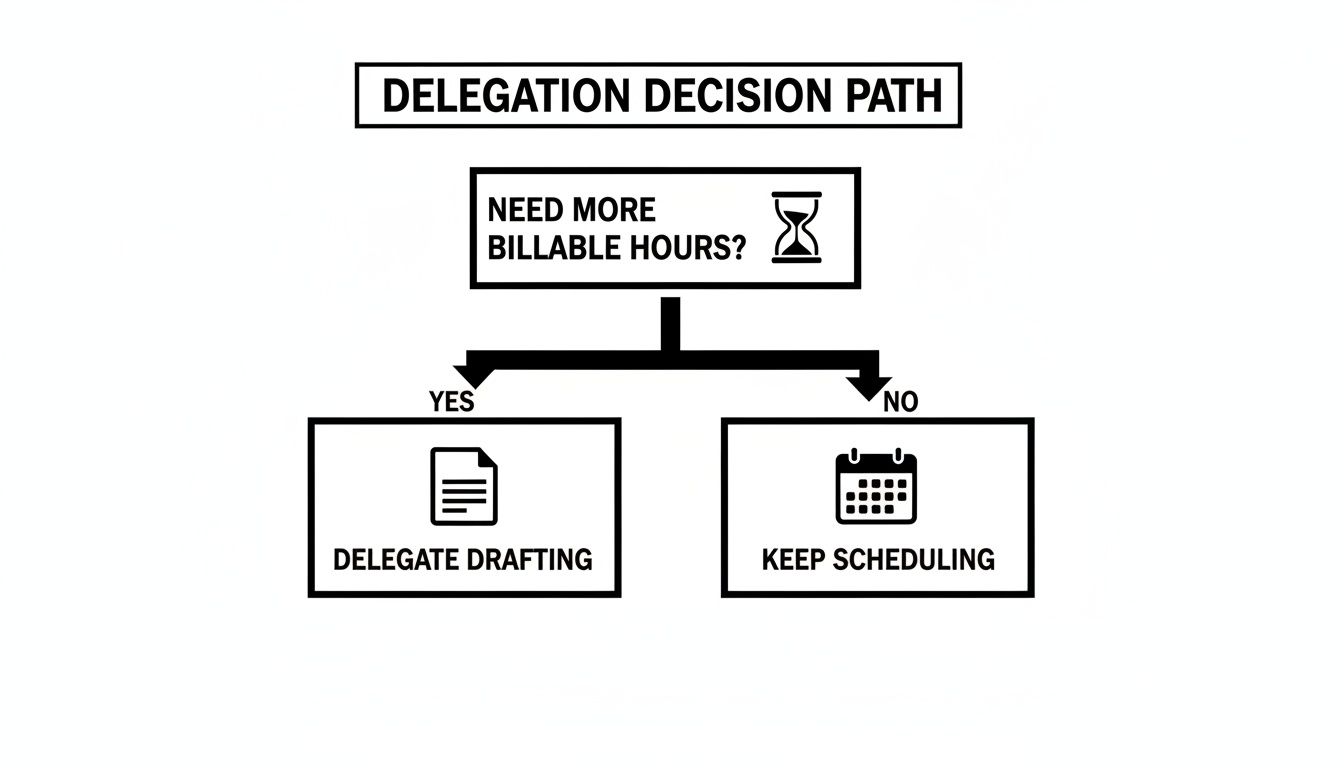
This flowchart nails it: when growing billable hours is the goal, effective delegation is non-negotiable.
And then there's the third way—the one where someone just hands you the keys. A specialized talent platform built only for the legal industry is the most logical path for any modern law firm. Think of it as a curated network of pre-vetted professionals where all the heavy lifting is already done. (Toot, toot! Yes, that's us.)
Platforms like HireParalegals are more than just a list of names. We've built a dedicated talent pipeline. Before a candidate ever reaches you, we've already:
The Bureau of Labor Statistics projects around 39,300 paralegal job openings annually, thanks to a steady 10% churn rate from retirements and career moves. This creates a huge talent pool, but finding the truly exceptional remote candidates requires a focused system. A dedicated platform cuts through the noise, reducing hiring time to as little as 24 hours and payroll costs by up to 80%. You can dig deeper into these professional trends at ParalegalEdu.org.
This approach isn’t about finding any remote legal assistant; it's about finding the right remote legal assistant for your firm. By using a specialized platform, you get to skip the HR headaches and jump straight to interviewing a small group of elite, well-matched professionals.
You don't build the car from scratch or overpay for the town car. You just get in and start driving.
So, how do we find you an elite, pre-vetted remote legal assistant in about the time it takes for your morning coffee to get cold? It’s not magic. It’s a painstaking, four-step process we’ve honed from years of being in the trenches. We don’t just match keywords on a resume; we’re matching deep experience, time-zone alignment, and professional temperament.
You could spend your afternoons fact-checking resumes and running skills tests—or you could let us do it. We’ve made it our full-time job so it doesn’t have to be yours. Here’s a peek behind the curtain.
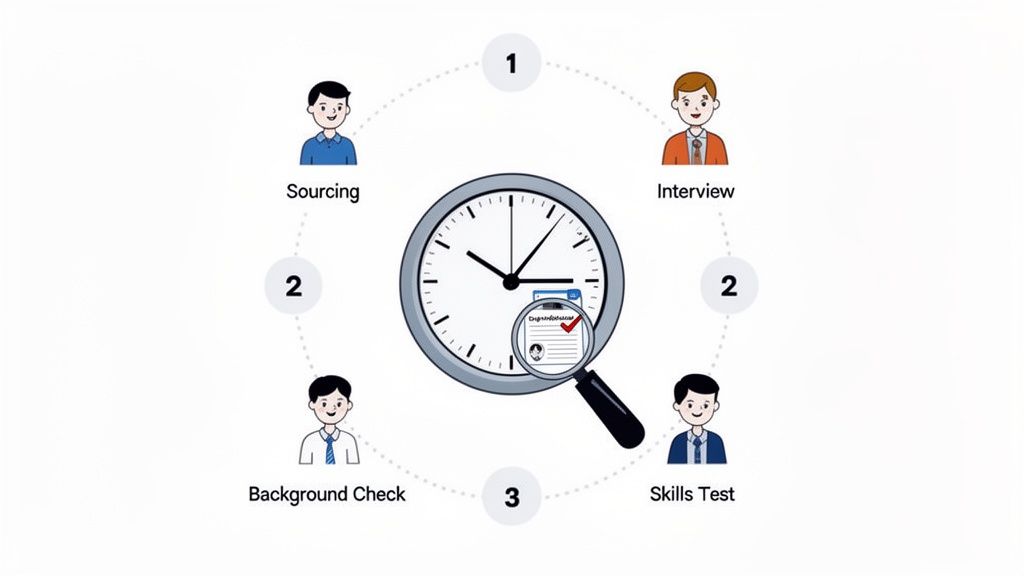
We don’t just post a vague job description on a massive freelance board and cross our fingers. That's a recipe for a flooded inbox and wasted time. Instead, we tap into our curated, private networks of legal professionals—primarily across Latin America—who are specifically seeking long-term remote roles with US law firms.
These aren’t gig workers looking for a quick project. They are career-minded professionals with proven track records. By sourcing from these exclusive talent pools, we start with a much higher caliber of candidate right out of the gate.
Once we’ve identified promising candidates, we put them through their paces. Our interview process is designed to separate the talkers from the doers. It’s a multi-stage evaluation that goes far beyond a simple phone screen.
We challenge them on their legal knowledge, testing their understanding of core concepts relevant to specific US practice areas. We also assess their professional English fluency and communication skills—it’s not just about speaking the language, but communicating with the precision and clarity required in a legal setting.
This isn’t a quick screening call. It’s a comprehensive interview designed to answer one critical question: can this person step into a demanding US law firm and add value from day one?
A resume can say anything it wants. We prefer to trust, but verify. Every remote legal assistant in our network must pass a series of practical skills assessments that mirror the real-world demands of a busy law practice. We’re not talking about simple multiple-choice quizzes.
Here’s what our validation process covers:
This step means that when we say someone is proficient, we have hard data to back it up. No guesswork, just measured performance. We're not saying we're perfect, just more accurate more often.
Finally, for your peace of mind and ours, we conduct thorough background checks on every candidate who reaches the final stage. In the legal world, trust and confidentiality are everything, and we take that responsibility seriously.
This includes verifying their professional history, confirming their credentials, and conducting criminal background checks. It’s the final layer of security that ensures you’re not just hiring a skilled remote legal assistant, but a trustworthy one.
By the time a candidate’s profile lands in your inbox, they’ve already been sourced, interviewed, tested, and vetted. It’s a meticulous process, and frankly, it’s why we can deliver a top-tier shortlist in 24 hours. We’ve already done the 99% of the work that drains your billable hours. All that’s left for you is to choose the best of the best.
Alright, let's get down to brass tacks. The interview is where the rubber meets the road. Forget those tired, old questions like "What's your biggest weakness?" unless you really enjoy hearing rehearsed answers about being "too organized." You need questions that reveal how a candidate actually thinks under pressure.
When you're bringing a remote legal assistant on board, you're not just filling a seat—you're entrusting someone with confidential client data and the operational pulse of your entire firm. A bad hire isn't just an inconvenience; they are a genuine liability. These five questions are designed to cut through the fluff and tell you what you really need to know.
The Question: "Imagine you discover a significant error in a document I drafted, just an hour before a critical filing deadline. What are the exact steps you take?"
This isn't really a test of their legal knowledge. It's a pressure test for their judgment, communication skills, and diplomacy. You’re looking for someone who won't just panic, and more importantly, won't blindly file a flawed document just to meet a deadline.
A great answer involves immediate, calm communication. The candidate should say they'd flag the error to you instantly via the most direct channel (phone, direct message), clearly explain the issue, and perhaps even suggest a quick solution while awaiting your final say-so. A major red flag is someone who says they'd fix it themselves without telling you (overstepping) or just file it anyway (catastrophic).
The Question: "Your internet connection goes down unexpectedly, and you have three urgent tasks due in the next two hours. What do you do?"
Remote work isn’t always a seamless paradise of productivity. This question tests a candidate's resourcefulness and proactivity. Hope is not a strategy. What you need is a remote legal assistant who has a backup plan for their backup plan.
The green-flag answer should sound something like this: "First, I’d immediately switch to my mobile hotspot to send you a quick message letting you know about the outage and that I'm working on it. Then, I'd either continue working off the hotspot for the most critical tasks or head to my pre-identified backup location with reliable Wi-Fi, like a local library or a co-working space." A candidate who just shrugs and says they'd "wait for the internet to come back" is an absolute non-starter.
The Question: "Describe a time you had to handle highly sensitive information. What specific measures did you take to ensure its security, especially in a remote setting?"
This one is completely non-negotiable. You need to hear specific, practical security habits. Vague answers about "being careful" are a massive red flag and should end the interview right there.
A top-tier remote legal assistant should be able to talk fluently about their security protocols. They should mention using a VPN, password managers like 1Password, two-factor authentication, and ensuring their home network is secure. This isn't just about trust; it’s about having a system.
A strong candidate will detail their process, demonstrating a deep-seated understanding of their ethical duty to protect client data. If you're looking for more guidance on what to ask, we've compiled some other essential legal assistant interview questions that can help you dig deeper.
The Question: "Walk me through your system for managing competing priorities from multiple attorneys or on multiple cases. How do you decide what gets done first?"
Let's face it, every law firm is a controlled chaotic environment. This question reveals their organizational mindset. You're not looking for someone who just "works well under pressure"—you're looking for someone whose systems work well under pressure.
A great answer will involve specific tools and methods. They might mention using a project management tool like Asana or Trello, time-blocking their calendar, or using a simple but effective priority matrix. They must be able to explain why they prioritize certain tasks over others (e.g., court deadlines always come first). The red flag is a generic, "I just make a to-do list." That's not a system; that's wishful thinking.
The Question: "Looking at what you know about our firm's practice areas, what do you anticipate being the most challenging part of this role for you, and what would be the most rewarding?"
This final question accomplishes two critical things. First, it shows if they've actually done their homework on your firm. Second, it tests their self-awareness and honesty.
An impressive candidate will mention a specific challenge related to your practice area and explain how their skills are a good match to meet it. They'll also connect the rewarding part to a genuine interest in your work. A weak answer is just generic praise about your firm's "great reputation" and a vague challenge like "learning new systems." You need someone who has thought critically about the role, not just blindly applied to another job posting.
To get the most out of these questions, you need to know what you're listening for. It's not just about the words they say, but what those words reveal about their work ethic, problem-solving skills, and reliability. This table breaks down what a great answer—and a problematic one—looks like for each of our key questions.
| Question | What It Tests | Green Flag Answer | Red Flag Answer |
|---|---|---|---|
| The Curveball Scenario | Judgment & Communication | Immediately flags the issue, explains the problem clearly, and offers a solution while waiting for final approval. | Either "fixes" it without telling you (overstepping) or files it as-is to meet the deadline (negligence). |
| The Tech Meltdown | Resourcefulness & Proactivity | Describes a multi-step backup plan: mobile hotspot, communicates the issue, and has a secondary work location. | "I'd wait for my internet to come back on." or "I'm not sure, I guess I'd text you." |
| The Confidentiality Test | Security Awareness & Ethics | Details specific security measures: VPN, password manager, 2FA, secured network, and understands client privilege. | Vague statements like "I'm very careful with data" or has no concrete security protocols to share. |
| The Juggling Act | Organization & Prioritization | Explains a clear system (e.g., task manager, time-blocking) and a logical framework for prioritization (deadlines first). | "I make a to-do list" with no further detail on how they manage competing urgent tasks. |
| The "Why Us" Reality Check | Due Diligence & Self-Awareness | Connects their skills to a specific challenge in your practice area and shows genuine, researched interest in your firm. | Gives a generic answer about your "reputation" and mentions a non-specific challenge like "learning new software." |
Ultimately, a candidate's answers to these questions will paint a clear picture of how they'll perform when no one is looking over their shoulder. The green flag answers show a proactive, responsible, and systems-oriented professional—exactly who you want on your team.
Let’s be honest. You can find the most brilliant remote legal assistant on the planet, but if you throw them into the deep end with a lousy onboarding process, they’re set up to fail. And that’s on you. Hiring is just the first step; successful integration is where the real work begins.

This isn’t about just sending a welcome email and a password. It’s about intentionally building a seamless, long-term professional relationship from day one. A great onboarding experience is something you design, not something that just happens.
That first week sets the tone for everything. Your goal isn't to immediately bury them in casework. It's to get them oriented, connected, and confident in how your firm operates. If you mess this up, you’ll spend the next six months answering basic questions that should have been covered right at the start.
Here’s a no-fluff checklist for that critical first week:
The biggest mistake firms make is treating onboarding as a one-day event. It’s a process. Think of the first week as an investment in future productivity. A few focused hours now will save you hundreds of hours of frustration later.
If you don’t define what success looks like, you’ll get ambiguity. It’s that simple. A great remote legal assistant needs a clear target to aim for, which means moving beyond vague instructions and establishing concrete goals and metrics.
You’re making a significant investment, so you should see a clear return. While the cost savings are immediate, the real value comes from increased efficiency. Projections for remote legal salaries in 2026 already average $130,000 annually, showing the premium placed on virtual expertise. For a fraction of that, you're getting a professional who should be freeing up your billable hours. See how the numbers stack up in the full salary analysis for remote legal roles.
Finally, you need a simple system for ongoing management. This isn’t about micromanagement; it's about creating a feedback loop that keeps everyone aligned and fosters improvement. Don't wait for a six-month review to tell them they’re doing something wrong.
Regular, informal feedback is the key. A simple weekly check-in where you both discuss wins, roadblocks, and priorities for the coming week is often all it takes. This approach builds trust and ensures small issues get resolved before they become big problems. For a more detailed guide, you can check out our guide on how to onboard remote employees. At the end of the day, this is about building a partnership, not just delegating tasks.
We get it. The idea of bringing a remote legal assistant into your practice probably sparks a few questions. Let's tackle the big ones head-on.
This is non-negotiable, and rightfully so. Any platform worth its salt makes this a priority. While our vetting process includes rigorous background checks, the real lock and key are your firm's own systems and protocols.
Think of it this way: security starts with you. You need to implement clear rules of the road. That means using secure, cloud-based practice management software with role-based permissions, mandating the use of a VPN for all remote access, and, of course, having your remote assistant sign a rock-solid NDA.
The name of the game is controlled access. Your remote assistant should only be able to see and touch the specific files they need to do their job—nothing more. It's less about where they are and more about how robust your firm's digital security is.
The savings are substantial, and they go far beyond just the base salary. When you hire an in-house employee, you're also paying for payroll taxes, insurance, benefits, and office space. All that overhead can easily tack on an extra 30-40% to their salary.
A remote legal assistant, on the other hand, is typically an independent contractor. You pay a simple, flat rate for the work performed.
This one change fundamentally shifts the expense from a long-term liability to a predictable operational cost. You can cut your support staff budget by up to 80%, slash payroll headaches, and forget about benefits administration. It’s not just a cheaper option; it's a smarter way to manage your firm's finances.
Let's flip that question around: In today's world, what tasks truly have to be done "in-office"? The vast majority of legal support work is already digital. We're talking about document management, e-filing, client emails, legal research, and calendar management—all happening on a screen.
By giving them secure cloud access to your firm's software, a remote assistant can handle over 95% of the duties of a traditional, in-house paralegal or assistant. And for that rare occasion when you need a physical hand—like dropping off a courtesy copy at the local courthouse—a courier service is far more cost-effective than a full-time salary. You stop paying for physical presence and start paying for actual work.