 23 minutes read
A legal secretary handles the administrative side of a law firm, but let's be blunt: the classic legal secretary job role is a fossil. The old-school duties of typing up dictation and juggling a switchboard are about as relevant today as a fax machine.
Today’s version of this role is something else entirely—a tech-savvy, proactive legal operator who drives efficiency, not just reacts to a to-do list. If you're still hiring for the 1995 model, you're not just behind the times; you're actively choosing to be less profitable.
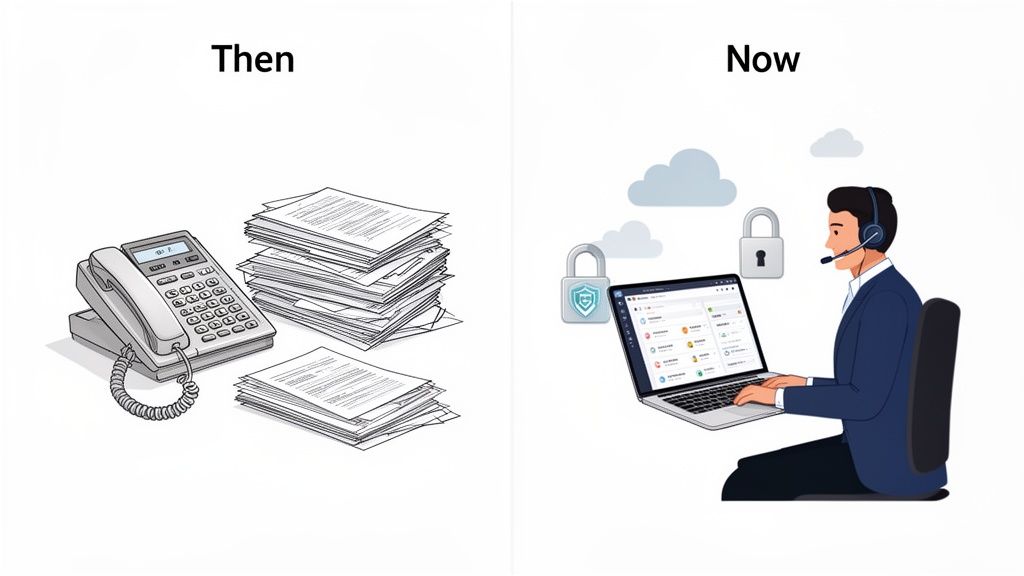
I'll say it louder for the people in the back. If your job description for a legal secretary looks the same as it did ten, or even just five, years ago, you’re not just old-fashioned—you're deliberately building inefficiency into your firm. That classic image of a secretary tethered to a desk, managing a multi-line phone and taking shorthand, is a ghost from another era.
Technology hasn't just tweaked the legal secretary's duties; it has completely bulldozed and rebuilt the role from the ground up. Sticking to a job description centered on manual dictation and paper filing is like insisting on a horse and buggy while everyone else is driving a Tesla. It's not just slow, it's a massive strategic blunder.
The data paints a pretty grim picture for the traditional version of this job. The U.S. Bureau of Labor Statistics projects a massive -21.8% decline in employment for legal secretaries between 2022 and 2032.
That's a loss of roughly 29,700 jobs over the decade, a decline fueled by the widespread adoption of legal tech and automation. The message couldn't be clearer: adapt or get left behind.
This change isn't about replacing people with robots. It’s about recognizing where the real value is now. The routine, repetitive work that once defined the role is now being handled better, faster, and cheaper by software.

Your firm’s survival doesn't depend on finding someone to answer the phones. It hinges on finding a professional who can manage the digital workflows that are the firm.
The modern legal support professional isn't a gatekeeper; they're an operator. They aren't just taking notes; they're managing projects, wrangling case management software, and ensuring the digital backbone of your practice runs without a hitch. They are proactive problem-solvers, not just reactive task-doers.
Think about the tools available today. To really grasp this evolution, consider the impact an AI legal assistant can have on daily tasks and the practice as a whole. This isn't science fiction; it’s the new baseline for a high-performing firm.
The table below breaks down just how dramatically the core functions have shifted.
| Core Function | Traditional Secretary (The Past) | Modern Legal Professional (The Future) |
|---|---|---|
| Document Management | Typing from dictation, manual filing, photocopying | E-filing with courts, managing document management systems (DMS), ensuring version control |
| Communication | Answering phones, taking messages, managing physical mail | Managing attorney calendars, scheduling via digital tools, handling client intake software, triaging emails |
| Case Support | Organizing physical case files, manually tracking deadlines | Updating case management software (e.g., Clio, MyCase), tracking deadlines with automated alerts |
| Technology Use | Basic word processing (WordPerfect, early MS Word) | Proficiency in cloud-based legal tech, e-discovery platforms, billing software, and video conferencing |
| Value Proposition | Reactive administrative support | Proactive operational management and tech optimization |
This evolution demands a complete rethink of who you're hiring and why. It's not about slapping a new title on an old job. It’s a fundamental shift in expectations that directly impacts your firm's efficiency, profitability, and ability to compete. Clinging to the old model isn’t just nostalgic; it’s a business liability.
Let’s be honest. If a resume listing "Proficient in Microsoft Word" still gets your attention, you’re hiring for a role that went extinct around 2005. That’s not a skill anymore; it’s a baseline expectation, like knowing how to use a microwave. It's time to stop wasting energy on candidates who think that’s a feature worth mentioning.
To build an efficient, modern law firm, you have to filter for professionals who bring real operational firepower to the table. The legal secretary's world has moved far beyond basic office tasks. You need someone who can navigate the digital chaos of a contemporary practice without needing their hand held every step of the way.
Forget about typing speed and shorthand—those are relics. Your new checklist should be all about software and systems fluency. If you hire someone who isn't already comfortable here, I hope you enjoy spending your afternoons manually updating case files, because that's your new full-time job.
A truly valuable legal support professional must be proficient in:
Of course, mastering software is only half the battle. The other half is about mindset and autonomy—the so-called "soft skills" that are anything but soft in practice. When you're trying to identify the core skills that truly matter, adopting the principles of skills-based hiring can dramatically sharpen your recruitment process. It forces you to look past credentials and focus on what a candidate can actually do.
This means you should be prioritizing qualities like:
It’s also worth noting the current market dynamics for this role. Demographic data shows the legal secretary field is overwhelmingly female-dominated, with women making up 90% of the workforce. While entry-level salaries range from $42,000 to $54,000, the overall median pay is around $37,230, which lags behind paralegals. For US firms seeking top-tier talent without breaking the bank, this highlights a clear opportunity to find incredible value, especially when looking at remote professionals.
The goal isn't to find someone who can follow a checklist. It's to hire a professional who can anticipate needs, solve problems with the tools at hand, and keep the operational engine of your firm running smoothly.
Ultimately, your hiring process should be a filter for these modern competencies. You can discover more about the essential legal secretary job requirements in our detailed guide. It's time to stop hiring for the past and start building a team that's ready for the future.
If you’re still using the terms ‘Legal Secretary,’ ‘Legal Assistant,’ and ‘Paralegal’ interchangeably, you’re setting your firm up for a hiring disaster. It’s an innocent mistake, but it’s the kind that ends with you paying paralegal rates for someone who spends their day scheduling meetings. Let’s draw some bright, unmissable lines in the sand.
Think of it like building a house. You wouldn’t hire a plumber to frame the walls or an electrician to pour the foundation. Each role has a distinct, critical function. Getting it wrong doesn't just look unprofessional—it cripples your firm's workflow and torches your budget.
A true legal secretary is the administrative bedrock of your practice. Their world revolves around managing the flow of information and keeping the operational gears turning smoothly. They are the masters of scheduling, correspondence, and ensuring that attorneys can actually be attorneys instead of getting bogged down in administrative muck.
They handle the front lines of communication, manage complex calendars, and maintain the kind of meticulous organization that prevents the firm from descending into chaos. Their value is in creating a stable, predictable environment where legal work can happen efficiently. Without this foundation, everything else wobbles.
The legal assistant builds on that foundation. They handle all the core administrative tasks of a secretary but often take a step further into case-related support. Think of them as a hybrid role, bridging the gap between pure administration and substantive legal work.
They might assist with drafting routine documents, proofreading briefs, or organizing evidence for a paralegal to review. They’re essentially the versatile utility player on the team, capable of supporting both the administrative and the legal sides of the practice. Legal assistants provide the connective tissue that holds the entire support structure together.
Then you have the paralegal. This is a different beast entirely. A paralegal dives headfirst into the substantive, billable work that an attorney would otherwise have to handle. We're talking legal research, drafting complex pleadings, managing discovery, and preparing for trials.
They aren't just supporting the work; they are doing a significant portion of the legal work under an attorney's supervision. Hiring a paralegal is a direct investment in increasing your firm's capacity for billable work. Confusing this role with a legal secretary is like confusing a scalpel with a butter knife—both are tools, but you really don't want to mix up their applications.
Understanding these distinctions isn’t just a boring HR exercise. It’s fundamental to building a lean, effective, and profitable team. You hire a secretary for stability, an assistant for versatility, and a paralegal for leverage.
To make these differences crystal clear, here’s a quick breakdown of who does what in a typical law firm.
| Aspect | Legal Secretary | Legal Assistant | Paralegal |
|---|---|---|---|
| Primary Focus | Administrative & operational efficiency | A blend of administrative support and basic legal tasks | Substantive, billable legal work under attorney supervision |
| Key Duties | Answering phones, scheduling, filing, managing mail, client intake | All secretary duties plus drafting simple correspondence, proofreading, document organization | Legal research, drafting complex legal documents, case management, discovery |
| Skill Set | Master of organization, communication, and office software | Strong administrative skills plus a foundational understanding of legal procedures | Deep knowledge of legal principles, research databases, and procedural rules |
| Strategic Impact | Creates a stable, organized environment for legal work to be done | Provides versatile support, freeing up both attorneys and paralegals | Directly increases the firm's billable capacity and legal output |
| Qualifications | High school diploma; specialized training or certification is a plus | Often an associate's degree or certificate in paralegal studies; may have prior secretarial experience | Associate's or bachelor's degree in paralegal studies; often requires certification (e.g., ABA-approved) |
Getting these roles right from the start means everyone knows their lane, your workflow is smooth, and you're not overpaying for administrative tasks.
The infographic below visualizes how these skills build on one another, from foundational administrative work to the advanced legal strategy that these roles support.
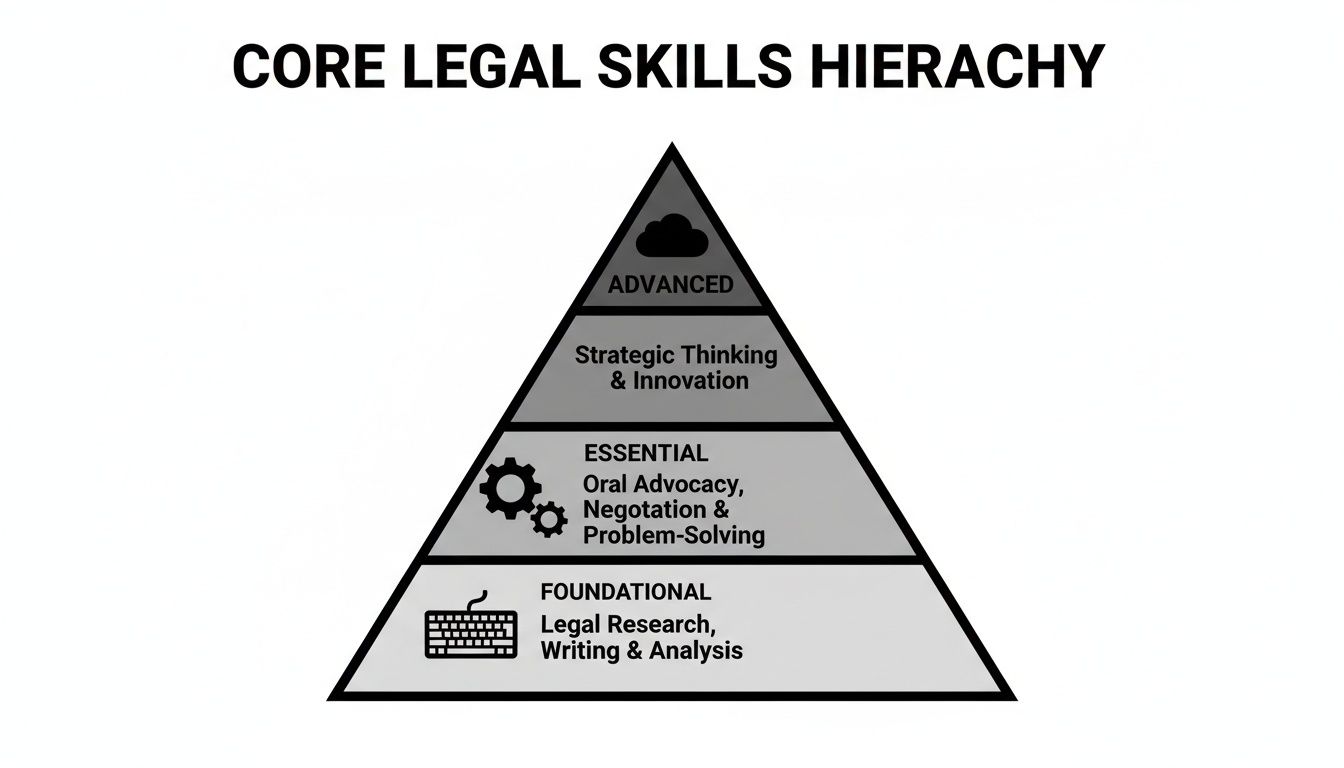
As you can see, each level builds upon the last, showing how foundational administrative skills are essential before more advanced, substantive tasks can be handled effectively. For a deeper dive, you can learn more about the difference between legal secretaries and paralegals in our dedicated guide. Getting this right is the first step toward building a support team that actually supports your bottom line.
Let’s get real. That generic, copy-pasted job description you've been using? It's a magnet for mediocre candidates. It’s a beige wall of text that screams, “We’re an uninspired firm just looking for someone to fill a seat.” If you’re serious about attracting high-performers, you need to stop writing descriptions that sound like they were drafted by a committee in 1998.
This isn't just about listing duties—it’s about selling a mission. You have to frame the legal secretary role not as a subservient administrative function, but as a critical piece of your firm's operational engine. Your goal is to make the best candidates out there feel like they’d be foolish not to apply.
Nobody gets excited about a bulleted list of chores. “Answering phones,” “managing calendars,” and “filing documents” are the absolute minimum requirements, not compelling selling points. Instead of just listing what they will do, shift your focus to the impact they will have.
For example, instead of this:
Try something like this:
See the difference? One is a simple task. The other is a mission. You’re not hiring a robot to check boxes; you’re hiring a strategic partner who will actively make the firm more efficient.
The best talent wants to work for forward-thinking firms, not digital dinosaurs. Your job description is your first, and best, chance to prove you aren’t stuck in the past. Be upfront and explicit about the tools and culture that truly set you apart.
Your job description is an advertisement. If it reads like an instruction manual for a lawnmower, don’t be surprised when you get candidates who are just as uninspired.
Here’s a basic framework to get you started. Notice how it’s all about contribution and culture, not just a dry list of responsibilities.
Job Title: Legal Operations Specialist (or Modern Legal Assistant)
About Us:
[A punchy, one-paragraph snapshot of your firm. Focus on your mission and what makes you different. Cut the corporate jargon.]
The Opportunity:
We’re not looking for a traditional legal secretary. We’re looking for an operational expert to be the backbone of our litigation team, enabling our attorneys to focus entirely on winning cases. You will be instrumental in managing the flow of information, optimizing our digital workflows, and ensuring our practice runs like a well-oiled machine.
What You'll Achieve:
What We're Looking For:
By structuring your job description this way, you shift the focus from menial tasks to meaningful contribution. This approach naturally filters out the clock-punchers and attracts the high-achievers who want to be part of building something successful. For more insights on this, our guide on crafting a compelling paralegal jobs description has some great tips that can be adapted for any legal support role.
Let's be honest. If you ask, "What are your biggest weaknesses?" you deserve to hear the beautifully rehearsed nonsense you're about to get. "I'm just too organized," or "I care too much about my work." It's a total waste of time for everyone involved.
To hire a truly competent legal support professional, you have to ditch the softball questions. The goal is to pressure-test their actual skills, not see if they’ve memorized the "right" answers. You need to see how their brain works when faced with the kind of low-grade chaos that defines any given Tuesday at a busy law firm. This is how you separate the people who can talk about the work from the people who can actually do it.
Forget abstract questions. Your interview needs to be grounded in the messy reality of what a legal secretary does day-in and day-out. We're talking about real-world friction points that require more than just a positive attitude to resolve.
Here are a few questions designed to cut through the fluff and reveal genuine problem-solving skills, tech fluency, and good old-fashioned common sense.
Scenario 1: The Inevitable Calendar Collision
"Walk me through, step-by-step, how you would handle this: two senior partners have just sent you conflicting virtual meeting requests for the exact same time slot. Both have marked their requests as 'urgent'."
Why this works: This isn't just a scheduling question; it's a test of diplomacy, prioritization, and grace under pressure. A weak answer is, "I'd ask them to figure it out." A strong answer involves checking calendars for any sliver of flexibility, quickly trying to understand the context of each meeting, communicating clearly with both partners (or their assistants), and proposing concrete solutions without throwing anyone under the bus.
Scenario 2: The Digital Document Dump
"A new client has just sent over a link to a cloud folder. It's a complete mess, with hundreds of unsorted digital files for a new case. Describe your process for getting this ingested, organized, and properly tracked within our case management system."
Why this works: This gets right to the heart of their digital organization skills. Can they create order from chaos? A great candidate won’t just say they’ll organize it. They'll talk about their system: creating a logical folder structure, using consistent naming conventions, checking for duplicates, and flagging mission-critical documents for the attorney to review first. They’re demonstrating a process, not just a willingness to click and drag files around.
The best candidates won't just answer; they'll ask clarifying questions. They’ll want to know what case management software you use or if the firm has a standard protocol for file naming. That's a huge green flag. It shows they think systemically.
Software proficiency on a resume is one thing; applying it to solve actual problems is another entirely. These questions dig into their practical, on-the-ground tech skills.
Question: The Software Puzzle
"Tell me about a time you had to learn a new piece of legal software with little to no formal training. What was the software, and what steps did you take to get up to speed on your own?"
Why this works: This reveals their resourcefulness and ability to learn independently. Are they the type to sit and wait for a formal training session? Or will they dive into the help articles, watch a few tutorials, and experiment until they figure it out? The modern legal field moves too fast for team members who require constant hand-holding with new tech.
Question: The Vague Email Test
"It’s late on a Friday afternoon, and an attorney sends you a vague, one-line email asking for help. How do you make sure you have all the information you need to get the task done right, without a ton of back-and-forth emails or waiting until Monday?"
Why this works: This is a fantastic test of their communication efficiency and professional judgment. The ideal answer involves a few key steps: quickly acknowledging the request, asking a few specific and bundled questions to get clarity, and then using their best judgment to start on any parts that are already clear. It shows they respect the attorney’s time while still taking full ownership of the outcome.
These questions aren't about trying to trick anyone. They’re about giving candidates a genuine opportunity to show you how they think on their feet. Their answers—the good, the bad, and the truly baffling—will tell you far more about their future performance than any polished resume ever could.
Let’s be real. Hiring top-tier legal support is expensive and painfully slow. The traditional way of doing things is broken—it’s a time-sucking vortex of sifting through endless resumes, conducting round after round of interviews, and then dealing with the administrative headaches of payroll, benefits, and onboarding.
You’re not just paying a salary. You're also paying for the recruiter’s time, background checks, pricey job board listings, and weeks of lost productivity while you hope the right person magically appears. Hope you enjoy spending your afternoons fact-checking resumes and running interviews—because that’s now your full-time job.
Turns out there’s a better way to hire elite legal support without mortgaging your office ping-pong table.
The old-school approach forces you to fish in a very small, very expensive pond. You're stuck with local talent, which means you’re competing with every other firm in your city and paying a premium for the privilege. This geographic boundary is an artificial barrier that needlessly drives up costs and shrinks your talent pool.
And don't forget the hidden costs. A bad hire can set you back tens of thousands of dollars in wasted salary, recruiting fees, and the sheer chaos they can create. A slow hiring process means your attorneys are bogged down with administrative work, bleeding billable hours while the search drags on. It’s a model built for a pre-internet world, and it’s holding modern law firms back.
You're not just hiring an employee; you're taking on a massive administrative and financial burden before they’ve even logged their first hour. It's an outdated system that favors friction over efficiency.
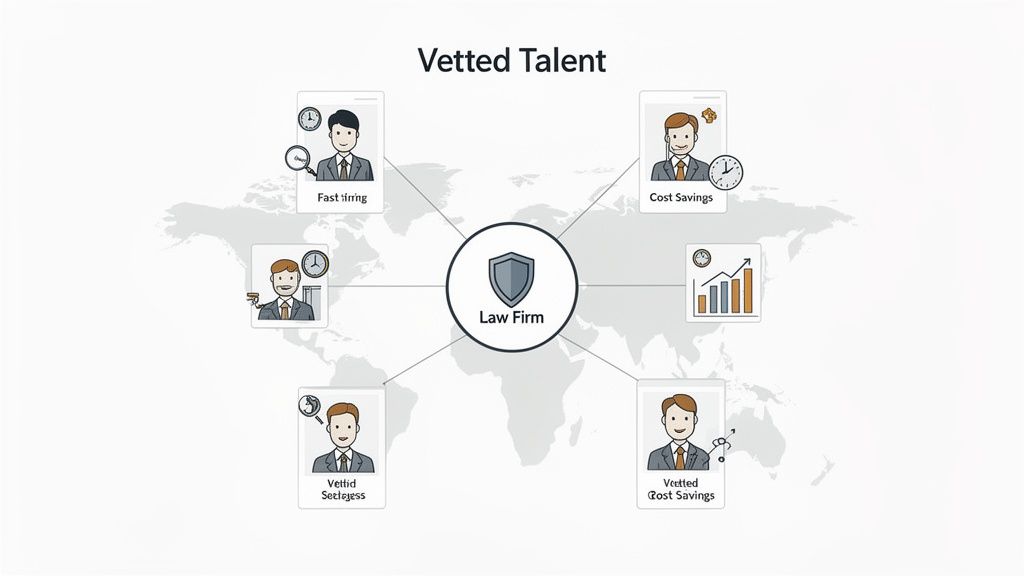
So, what’s the alternative? Instead of trying to own the talent, you access it. The smart move is to tap into a curated network of pre-vetted, remote legal professionals. This isn't about finding a random freelancer on a gig site; it's about using a dedicated service that does all the heavy lifting for you. (Toot, toot! Yeah, that's what we do.)
Here’s how this model completely flips the script on how you fill the legal secretary role:
This isn't just outsourcing. It’s about rightsizing your support staff with experienced professionals who are ready to go. It’s about building a nimble, cost-effective team that can scale up or down as your caseload demands. You get all the expertise without the overhead of another full-time hire.
Let's cut through the noise and tackle some common questions I hear all the time. Over the years, I've seen these same points of confusion trip up even the most seasoned managing partners. Here are some straight answers.
This is a classic "yes, but actually no" situation. The old-school, exclusively administrative version of the job—the one centered on dictation, typing pools, and physically managing file cabinets—is absolutely on its deathbed. If that’s all you’re looking for, you’re trying to hire for a bygone era.
But the role itself isn't vanishing; it's transforming. A modern legal secretary is evolving into a tech-savvy legal support specialist. They're expected to navigate complex software, manage digital workflows, and act more like an operational hub for their attorneys. Think less typist, more legal tech coordinator.
It's less about a single skill and more about a core competency: adaptability fueled by tech fluency. Honestly, give me a candidate who can get up to speed on new case management software in a few days over someone who has 20 years of experience with outdated processes.
The most valuable asset anyone in this role can have today is the ability to learn, master, and troubleshoot the digital tools your firm relies on. Everything else can be taught, but that proactive, tech-forward mindset is gold.
For the vast majority of law firms, the answer is a resounding "yes." When you get down to the brass tacks of what moves a case forward, a skilled remote legal assistant or paralegal can handle scheduling, e-filing, client communication, and document management just as effectively—often more so.
The physical act of sitting in an office chair is quickly becoming the least important part of the job. What truly matters is their digital competence and ability to keep the operational side of your practice running smoothly.
A well-vetted remote professional isn't just a replacement; they're a strategic move to boost efficiency. The trick is to find someone who is already proven to work well in an autonomous, remote setting.