 17 minutes read
At its core, a legal document review job is about sifting through documents to find what’s relevant, what’s privileged, and what’s critical in a legal case. Most people think of it as a souped-up reading assignment. They’re wrong.
Think of it as being a digital detective. You’re handed a mountain of data—a chaotic mess of emails, texts, and spreadsheets—and told to find the evidence that will make or break a multi-million dollar case.
Let's be honest, the title "legal document reviewer" doesn't exactly scream excitement. The job descriptions are usually dry as toast, which completely misses the point.
This isn't just about scanning emails. It's the engine room of modern litigation. It’s where cases are won or lost long before anyone sets foot in a courtroom. Forget the dusty paralegal stereotype; this is a high-stakes intelligence mission. Your job is to dive into a massive, messy collection of electronically stored information (ESI) and find the smoking gun.
You’re the first line of both defense and offense. You’re the one who tags a seemingly innocent email as “hot” or flags sensitive board meeting minutes as “privileged.” The stakes are absurdly high. One mistake—like miscoding a single document—could waive attorney-client privilege and torpedo an entire case. No pressure, right?
The actual workflow is more straightforward than it sounds. It breaks down into three phases.
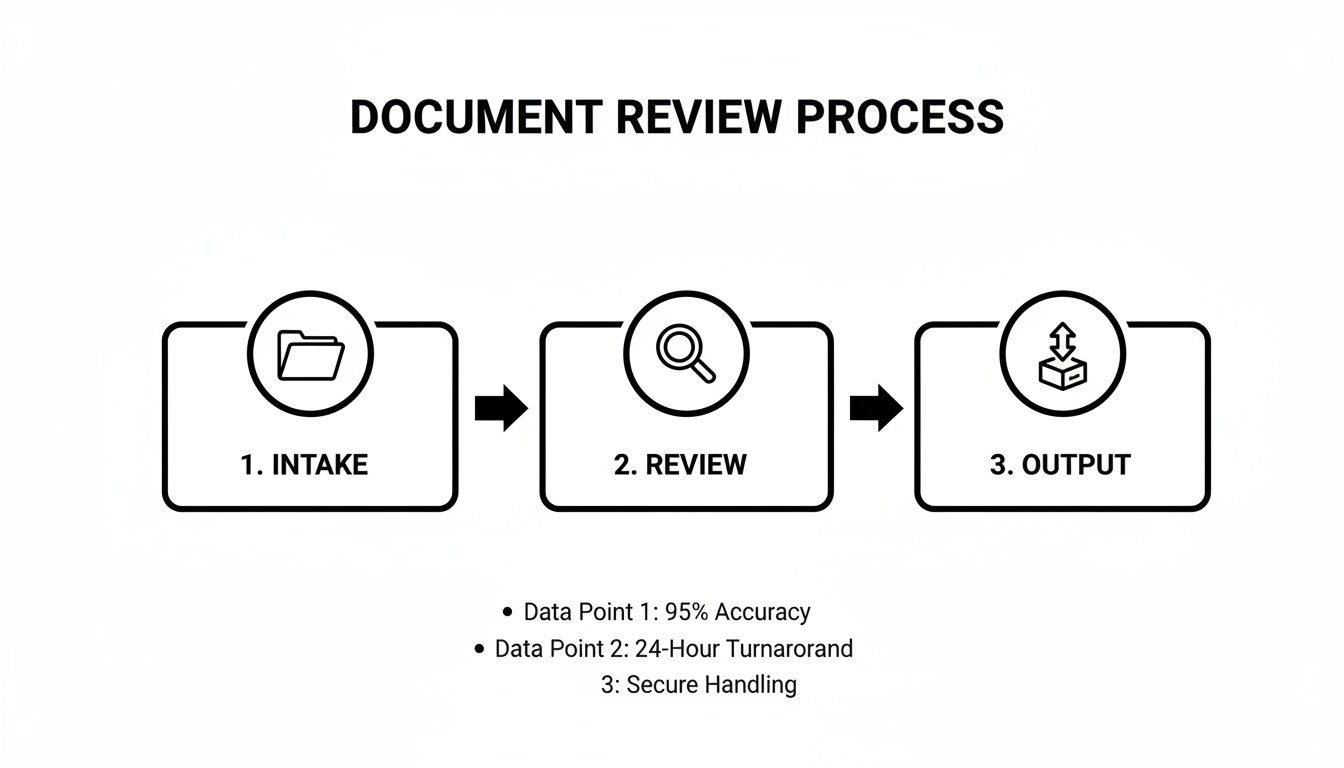
This process is how raw, chaotic data gets collected, analyzed by reviewers like you, and turned into a clean, usable set of evidence for the legal team. Simple in theory, messy in practice.
It’s easy to feel like a small cog in a giant machine. But let's look at the numbers, because they tell a very different story. In high-stakes U.S. litigation, document review isn't just part of the budget—it is the budget. It accounts for over 80% of total litigation spending. That's a mind-boggling $42 billion a year. This isn't some rounding error; it’s the primary beast legal teams are trying to tame. You can find more data on this stuff on sites like Attorney at Work.

A good document reviewer is a cost-saving weapon. By being fast and ridiculously accurate, you directly impact the bottom line. You turn a massive expense into a strategic advantage.
That’s why firms are willing to pay for this. They aren’t just buying your time; they’re investing in your judgment and your obsessive attention to detail. It’s all about your ability to find that one critical file buried in a sea of a million.
So, what does it actually take to do this job well? A law degree is a great start, but in today's world, your tech skills and keen eye for detail are just as critical. This role is less about courtroom speeches and more about digital endurance and precision.
You'll spend your days inside sophisticated software, making snap judgments on thousands of documents. It's a blend of legal analysis and high-stakes data processing where speed and accuracy are everything.
If you're not comfortable working meticulously in a digital environment for hours on end, this probably isn't for you. But for those who are, it can be a surprisingly rewarding and flexible way to use your legal training.
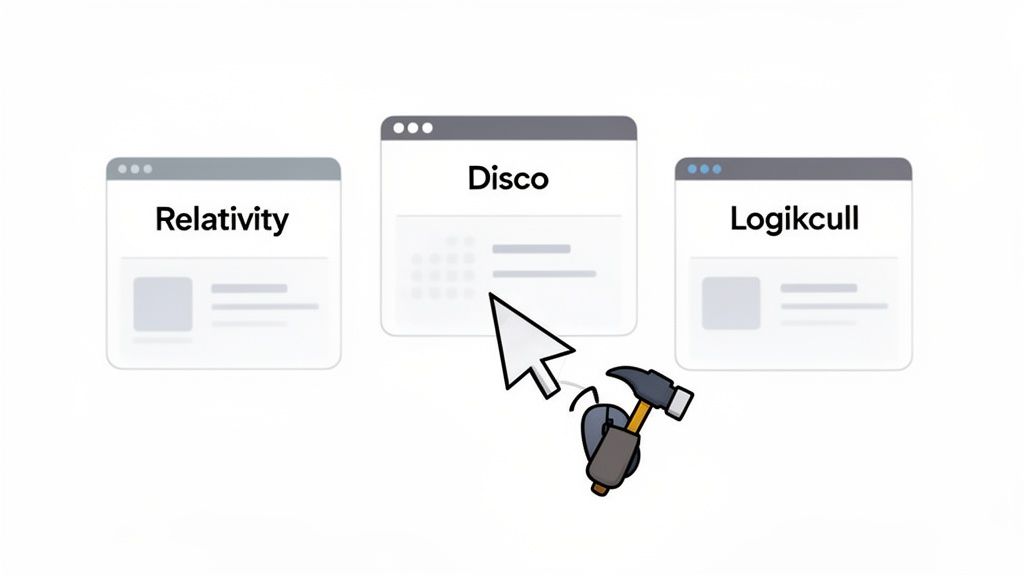
You simply cannot get a modern document review job without knowing the industry’s core eDiscovery platforms. Think of them as the price of admission. Listing them on your resume isn’t a bonus; it’s the bare minimum.
While these are the big players, the core skills are transferable. The key is proving you can adapt to new software and apply review instructions consistently, no matter what the interface looks like. For a broader look at legal tech, check out our guide on the best document management software for law firms.
Beyond the software, certain "human" skills separate a good reviewer from a great one—the person who gets called back for every single project. No amount of tech can replace these.
The single most valuable skill in document review isn't speed; it's consistency. Making the same judgment call on document #1 as you do on document #10,001 is what makes you reliable—and therefore, employable.
Here’s what you really need:
Master the software to get in the door. Master these skills to build a career.
Let’s get one thing straight: the robots are not coming for your legal document review job. At least, not yet. Anyone who tells you AI will make human reviewers obsolete is either misunderstanding the tech or trying to sell you something.
The real story is way more interesting. AI is absolutely changing the game, but think of it less as a replacement and more as a ridiculously powerful—and slightly clumsy—assistant. We’ve been in the trenches with this tech. We know where it shines and where it falls flat on its face.
AI-powered tools, especially Technology Assisted Review (TAR), are like the world’s best intern for grunt work. They can tear through millions of documents in the time it takes you to make coffee, handling a fantastic first pass.
AI excels at:
But here’s the reality check: AI has zero common sense. It completely fumbles nuance, context, and intent—the very things at the heart of legal analysis. Asking an AI to make a final call on privilege is like asking your Roomba to file your taxes. It just doesn't have the judgment.
This is where you, the human reviewer, become more valuable than ever. Smart firms aren't firing their review teams; they're arming them with AI. The future is a hybrid model that uses AI-powered knowledge management to make sense of massive data sets.
The new workflow is simple: let the machines do the heavy lifting, then bring in sharp human reviewers for the critical thinking. You’re no longer just a reviewer; you’re an AI supervisor.
This evolution is creating a demand for reviewers who not only spot a hot doc but also know how to work alongside this tech. We’re seeing a massive shift toward this model. AI adoption is predicted to double from 13% in 2024 to 26% by 2025, with 77% of law firms viewing it as the most impactful trend on the horizon.
So, is AI a threat? Not if you adapt. It's a massive opportunity to become a more efficient, valuable part of the legal team. Learn to work with the robots, and you’ll be the one left standing.
Alright, let's talk tactics. How do you actually land a legal document review job? Spoiler: blasting your resume into the void is a terrible strategy. You need a playbook, not a prayer.

The hiring process isn't about your charming personality. It's about proving you can be a consistent, accurate, reliable engine. This is a numbers game, and firms need people who won't buckle under the pressure of a million documents. Let’s get you ready.
First, your resume. It needs to immediately signal that you can handle high-volume, detail-oriented work with near-perfect accuracy. Forget the fluff about being a "team player." Get straight to the point.
Here’s what gets your resume to the top of the pile:
And get this: a human might not even see your resume first. That’s why you need to understand why resumes fail ATS (Applicant Tracking Systems). These robots are the gatekeepers.
This is the make-or-break moment. The review test is a simulation designed to see if you can follow complex instructions without going rogue. It’s not a test of your legal genius; it’s a test of your discipline.
You’ll get a small batch of documents and a "coding protocol"—the rulebook for how to tag each one (e.g., Relevant, Privileged). Your only job is to apply those rules perfectly. Expect curveballs: ambiguous emails, confusing attachments, and documents designed to trip you up.
The secret to passing isn’t speed; it’s meticulousness. Read the protocol three times before you even look at the first document. If something feels like a trick question, it probably is. Go back to the rules, find the answer, and trust the process.
This test is your entire audition. Nail it, and you're in. For more practice on this kind of thinking, review common legal assistant interview questions. Bomb the test, and your resume goes into the digital shredder. No second chances.
Alright, let's talk money. What does a document review job actually pay? If you're looking for a simple answer, you're out of luck. The real answer is, "it depends."
The pay scale is a huge spectrum. A licensed attorney on a high-stakes antitrust case in New York could command $60-$70+ per hour. On the other hand, a non-attorney reviewer on a standard commercial dispute in a lower-cost area might see $25-$35 per hour.
The vast majority of these jobs are contract-based. This gives you incredible flexibility, but it also means you're running your own small business. You handle your own taxes, health insurance, and the fun fact that you don't get paid for holidays or sick days.
Full-time, salaried positions exist, but they're the unicorns of the industry. They offer a lower effective hourly rate but come with the stability of benefits, paid time off, and a predictable paycheck.
The way you're paid varies wildly. A staffing agency has a different model than a law firm hiring directly. Here’s a quick breakdown.
| Role Type | Common Pay Structure | Typical Rate Range (USD) | Pros & Cons |
|---|---|---|---|
| Contract Attorney (Agency) | W-2 or 1099 Hourly | $45 – $75+ | Pros: High hourly rates, flexibility. Cons: No benefits, inconsistent work, self-employment taxes (1099). |
| Contract Paralegal/Specialist | W-2 or 1099 Hourly | $25 – $45 | Pros: Good entry point, flexible schedule. Cons: Lower pay ceiling than attorneys, work can be sporadic. |
| Full-Time Employee (Law Firm/Vendor) | Salaried (Exempt) | $55,000 – $90,000+ (annual) | Pros: Stability, benefits, paid time off, career path. Cons: Lower hourly equivalent, less flexibility. |
| Foreign Language Reviewer | W-2 or 1099 Hourly | $60 – $120+ | Pros: Very high hourly rates due to specialized skill. Cons: Niche demand, requires fluency and verification. |
There's no single "best" option—it all comes down to your need for stability versus your desire for flexibility and a higher hourly rate.
The blunt truth is that the hourly rate is only half the story. A six-month project at $40/hour is far more valuable than a two-week gig at $50/hour followed by a month of unemployment.
And don't forget, specialized skills command premium rates. Need someone fluent in Japanese to review financial records? That’s a huge value-add. Case requires a Ph.D. in biochemistry for a patent dispute? Expect to pay (or be paid) accordingly. You can get a better sense of how these roles stack up by exploring trends for paralegal hourly rates.
Now for the million-dollar question: is document review a career black hole? Honestly, it’s a black hole only if you let it be. If your plan is to just log in, click buttons, and log out, then yes, it’s a temporary gig.
But if you're smart, this role is an incredible launchpad. You are getting paid to learn the intricate machinery of litigation from the inside out. You're seeing firsthand what makes a case strong or weak.
Use that. Don't just learn the review platform—master it. Ask intelligent questions. Network with the project managers and senior attorneys. The experience you gain can lead directly to more senior, strategic roles like:
Think of it as a paid apprenticeship. The skills you develop are your ticket to a more secure and better-paying career. You just have to cash it in.
If you’re a hiring manager, I have a question: how much of your day is spent sifting through résumés? Feels like a full-time job, right? Turns out there’s a better way to staff your next legal document review project without mortgaging your office ping-pong table.
The old model is broken. You know the one—renting a sterile office, filling it with temps, and hoping for the best. We’ve been there. It’s a logistical nightmare fueled by lukewarm coffee and wasted billable hours. The real cost isn’t the rent; it's the painfully slow hiring and the opportunity cost of pulling your senior staff into the weeds of vetting candidates.
Let's be blunt: agility is the only thing that matters in today's legal market. When demand can spike overnight, you can't afford to waste three weeks trying to find one qualified person. You need a reliable bench of talent you can deploy at a moment's notice.
This is where on-demand platforms come in. Instead of scrambling for office space, you tap into a global network of pre-vetted professionals. This isn't just about saving money on overhead; it's about the power to scale your team up or down instantly.
The modern firm doesn't build a permanent army for a temporary war. It assembles a flexible, elite special forces team that can be deployed on demand. It’s the pragmatic approach that’s helping firms thrive.
Legal work surged by 2.5% last year, but client budgets sure didn't. General counsel are under more pressure than ever to keep costs down. This reality is forcing firms to rethink document-heavy tasks.
On-demand models are built for this new environment. They let firms bring on vetted, remote professionals in under 24 hours and can slash payroll costs by as much as 80%. When you dive deeper into the shifting legal market dynamics, it’s clear why this approach is becoming the new standard.
This isn’t about outsourcing to save a buck at the expense of quality. It’s about insourcing efficiency. By tapping into a curated talent pool, you get top-tier expertise without the crushing overhead of traditional hiring. You get to focus on winning, not on managing a bloated payroll. It’s not just smart—it’s the only way to stay competitive.
Alright, let's tackle a few common questions. No fluff, just the straight scoop based on what I've seen in the trenches.
It depends, but the short answer is: not always. This surprises people.
If the project requires making judgment calls on attorney-client privilege, then yes, a JD and an active bar license are mandatory. No way around it.
However, a huge chunk of "first-level review" is just about applying a set of rules—tagging documents based on a clear protocol. For that, firms are increasingly turning to sharp, experienced paralegals. They're realizing it's more efficient to match the task to the right skill set, opening up a lot of doors for non-lawyers.
It’s not being slow. It’s not fumbling with the software. The single biggest mistake is inconsistency.
We call it "reviewer drift." It's that subtle shift in judgment that happens between the first document you code and the 5,000th. Your interpretation of "responsive" might change slightly over a few weeks, and that tiny change can poison the whole project.
The best reviewers are masters of consistency. They follow the coding manual to the letter and, crucially, they ask questions immediately when they hit a gray area. They don't guess. Your job isn't to be a creative interpreter; it's to be a precise, reliable extension of the legal team's strategy.
The goal isn’t to be the fastest clicker in the West. It's to be the most reliable. Consistency is the only metric that truly matters in a legal document review job.
Without a doubt. Not only is it realistic, it's the industry standard now. The old model of renting a massive, drab office and packing it with contract attorneys is dead.
Forward-thinking firms figured out that remote review slashes overhead and gives them access to a global talent pool. As long as you have a secure, private workspace and a solid internet connection, you can build a career from home. This isn't a temporary trend; it's just how the business works now.