 15 minutes read
You know the scene. A partner is billing like a lawyer but working like an overcaffeinated file clerk. Medical records are piled up. Clients are calling twice because nobody called them first. Demand packages are half-finished. Discovery responses are lurking in a folder named “final_final_REAL.”
That isn’t a growth problem. It’s a staffing problem.
And in personal injury paralegal jobs, the gap between “support staff” and “revenue engine” is enormous. A mediocre PI paralegal keeps the lights on. A great one keeps cases moving, clients calmer, deadlines intact, and lawyers out of the weeds. In a PI practice, that’s not a nice-to-have. That’s operational oxygen.
Most PI firms don’t break because they lack cases. They break because the attorneys become the backup system for everything. If a client intake note is sloppy, the lawyer fixes it. If records haven’t arrived, the lawyer chases them. If deadlines aren’t tracked properly, the lawyer becomes the calendar police. That’s a rotten way to run a practice.
The industry keeps growing, and that pressure lands right on firm operations. The U.S. personal injury lawyers industry reached $61.7 billion in 2025 after expanding at a 2.5% CAGR from 2020 to 2025, according to IBISWorld’s personal injury lawyers and attorneys industry data. More cases and more firms don’t magically create order. They create more opportunities for chaos if your backend is flimsy.
A lot of lawyers confuse proximity with control. If they’re personally touching every file, they feel in charge. In reality, they’re usually clogging the system.
A strong PI paralegal fixes that by owning the middle of the case lifecycle. Not the glamorous courtroom moments. The work that determines whether a file advances or stalls.
That’s why firms that finally get serious about process often end up talking about legal operations, not just hiring. If you want a cleaner handoff between legal strategy and daily execution, legal project management in law firms is worth understanding.

Practical rule: If your attorneys are spending prime hours chasing records, scheduling updates, and cleaning up file disorder, the firm doesn’t need more hustle. It needs a better PI paralegal function.
The best personal injury paralegals don’t usually announce themselves. They’re the ones whose files are ready, whose calendars are right, and whose clients aren’t angry. They reduce friction. That sounds boring until you’ve lived without it.
And if you’re hiring for personal injury paralegal jobs right now, that’s the lens to use. Don’t hire for “help.” Hire for case velocity.
If your mental picture of a PI paralegal is “answers phones, files papers, maybe drafts a letter,” you’re hiring too low and thinking too small.
A good PI paralegal is half workflow operator, half fact-builder. They keep the record clean enough to strengthen their position and the timeline tight enough for settlement pressure. That’s where the money is.

Here’s the part firm owners routinely underestimate. A core responsibility for PI paralegals, comprising 30% to 50% of daily tasks, is obtaining and decoding medical records, and that requires mastery of 150+ medical abbreviations, based on personal injury paralegal job postings in the Washington, DC market.
That’s not clerical busywork. That’s case value.
A paralegal who can read a chart properly can spot treatment gaps, flag pre-existing conditions, organize chronology, and give the attorney a summary that doesn’t require a second translation pass. A paralegal who can’t do that gives you a messy demand and a weaker negotiating position.
Some days skew toward pre-lit. Some skew toward litigation support. But the core pattern is familiar.
For firms handling depositions, one quiet landmine is the record itself. If testimony is garbled, translated poorly, or transcribed inaccurately, you can lose your advantage quickly. That’s why guidance on avoiding inaccurate legal deposition transcripts is practical reading, especially when a paralegal is coordinating multilingual witnesses or deposition logistics.
A PI paralegal earns their keep when they turn scattered facts into a usable case story before the lawyer ever touches the file.
Smaller firms often get sloppy. They act as if “litigation support” starts once the complaint is filed. It doesn’t. The discipline starts much earlier.
A sharp PI paralegal drafts, organizes, and anticipates. They know what documents need to exist before someone asks for them. They know which missing records will delay review. They know a half-baked chronology will come back to haunt the lawyer during mediation or deposition prep.
If you want a clearer picture of how that overlaps with formal litigation support, this breakdown of what a litigation paralegal does is a useful reference.
When the paralegal function is strong, lawyers spend more time valuing cases, developing strategy, and negotiating. When it’s weak, lawyers become expensive processors.
That’s why I’m opinionated about personal injury paralegal jobs. The role is not overhead. In a PI firm, it is part of production.
Forget “detail-oriented.” Every resume says that. So does every person who forgets to calendar a deadline.
In PI work, a handful of skills matter so much that I’d treat them as gatekeeping criteria. If a candidate doesn’t have them, you’re not hiring a paralegal. You’re hiring a future problem.

The most dangerous PI paralegal is the one who sounds polished but treats deadlines casually.
Expert personal injury paralegals must internalize jurisdiction-specific statutes of limitations, and missing those deadlines nullifies an estimated 25% to 35% of viable claims, directly causing six-figure annual revenue losses for mid-sized firms, based on the cited personal injury paralegal training source.
That should end the debate. If they can’t speak confidently about limitations periods, tolling issues, intake timing, and calendaring discipline, they are not ready.
Here’s what I want to hear in an interview:
A candidate can have “litigation experience” and still be useless in PI if they can’t work through dense medical records.
Can they identify what matters in an orthopedic file? Can they summarize treatment in plain English? Can they spot the issue the defense will weaponize? That’s the actual test.
Short version: if they need the attorney to decode every chart note, they’re not helping much.
PI clients are injured, stressed, and often overwhelmed. They need warmth. They also need structure. The best paralegals can do both.
They know how to calm a frantic client without promising legal outcomes. They know how to push for missing documents without turning the relationship adversarial. They know when “I’m just checking in” needs to become “I need this today or your case stalls.”
Hire for someone who can be kind and firm in the same phone call. That combination is rarer than firms admit.
If I were screening personal injury paralegal jobs today, I’d focus less on generic office polish and more on transferable proof. That lines up with broader hiring advice around skills for the global job market, but in PI the bar is narrower and tougher.
Use this quick filter:
| Skill area | What a pro sounds like | What an amateur sounds like |
|---|---|---|
| Deadline management | Talks in dates, triggers, and escalation | Says they’re “organized” |
| Medical record work | Explains chronology and record issues clearly | Calls records “paperwork” |
| Client handling | Balances empathy and control | Either too soft or too abrasive |
| Case ownership | Anticipates next steps | Waits to be told everything |
If you’re writing job ads or refining your screen, requirements for paralegal jobs can help frame the basics. Just don’t stop at basics. PI demands more.
Let’s talk money, because law firms get weird about it.
They’ll lose sleep over paying a strong paralegal properly, then casually burn attorney hours on work that should never reach a lawyer’s desk. That math is backwards.
The verified market data is clear enough on one point. The national median wage for paralegals is around $61,010, while those specializing in personal injury average $68,243, and top markets like California reach $79,210, according to the University of Cincinnati’s paralegal outlook guide. Specialized PI skill carries a premium. It should.

Most firms treat paralegal growth like a fog bank. “Do good work and maybe someday you’ll be senior.” That’s lazy management.
A better way is to define value by scope and independence.
Entry-level paralegal
They handle intake support, records requests, document organization, and routine follow-up under close supervision. I’d anchor compensation below the national median, then increase only if they can work files without constant correction.
Mid-level paralegal
The role's utility becomes evident. They can manage routine PI files, prepare demand support, communicate with clients and providers confidently, and keep deadlines under control with light attorney oversight. In many firms, this is the make-or-break layer.
Senior or lead PI paralegal
This person makes the practice calmer. They handle complex records, train junior staff, support litigation prep, and catch problems before they become partner emergencies. If they consistently protect attorney time and improve file readiness, they deserve pay above generic paralegal benchmarks.
Paralegal manager or director
Not every firm needs one. But if you have multiple support staff, someone needs to own workflow standards, training, quality control, and operational consistency. Otherwise every file becomes a folk art project.
I’m not going to invent tidy salary bands because the market doesn’t support that kind of fake precision. What I will say is this: use the verified benchmarks as anchors, then pay based on proven PI complexity, not generic tenure.
A decent framework:
| Role level | Pay approach |
|---|---|
| Entry level | Usually below the national median until they show reliable file ownership |
| Mid level | Often around or above the national median if they can independently manage PI workflows |
| Senior PI specialist | Frequently justifies the PI average or better when they handle complex cases and reduce attorney drag |
| Top market talent | Expect higher compensation in markets such as California |
My rule of thumb: Pay for independence, judgment, and error prevention. Don’t pay extra because somebody knows how to format a PDF and smile in an interview.
Sometimes. Not automatically.
A certification can signal discipline and baseline legal knowledge. It does not prove the person can manage a PI file, work up medical records, or protect your deadlines. I’d rather hire an uncertified PI paralegal with battle-tested case instincts than a certified candidate who needs hand-holding every afternoon.
If a credential comes with obvious writing skill, litigation discipline, or stronger issue-spotting, sure, pay for that. If it’s just resume jewelry, save your money.
Hiring for personal injury paralegal jobs is miserable when the firm doesn’t know its true needs.
The usual posting asks for “detail-oriented support,” “excellent communication,” and “ability to multitask in a fast-paced environment.” Translation: you will receive a pile of resumes from people who once answered phones near a courthouse.

The market doesn’t help. The personal injury paralegal job market suffers from a lack of standardized compensation data, with job postings emphasizing experience but rarely outlining clear advancement paths or how specialization impacts earning potential, creating friction for firms trying to set competitive remote rates, according to the referenced Glassdoor market gap source.
So firms guess. Candidates guess. Everybody wastes time.
Bad postings focus on tasks anyone can copy from the internet. Good postings define consequences.
Don’t say:
Say what the role owns:
That wording filters in people who understand PI and filters out tourists.
The worst interviews in legal hiring sound like awkward brunch. “Tell me about your strengths.” “How do you stay organized?” Nobody learns anything.
Ask ugly, realistic questions instead.
The good candidates answer with sequence, judgment, and escalation logic. The weak ones answer with personality.
If a candidate can’t explain how they think under pressure, don’t let a polished resume fool you. PI work punishes vagueness.
I’ve watched firms make the same hiring mistakes on repeat.
Treat the role like a business-critical position, because it is. Define outcomes, test real scenarios, and stop pretending your office needs a unicorn who can do everything for bargain pay.
That unicorn does not exist. Or if they do, they already work for your competitor.
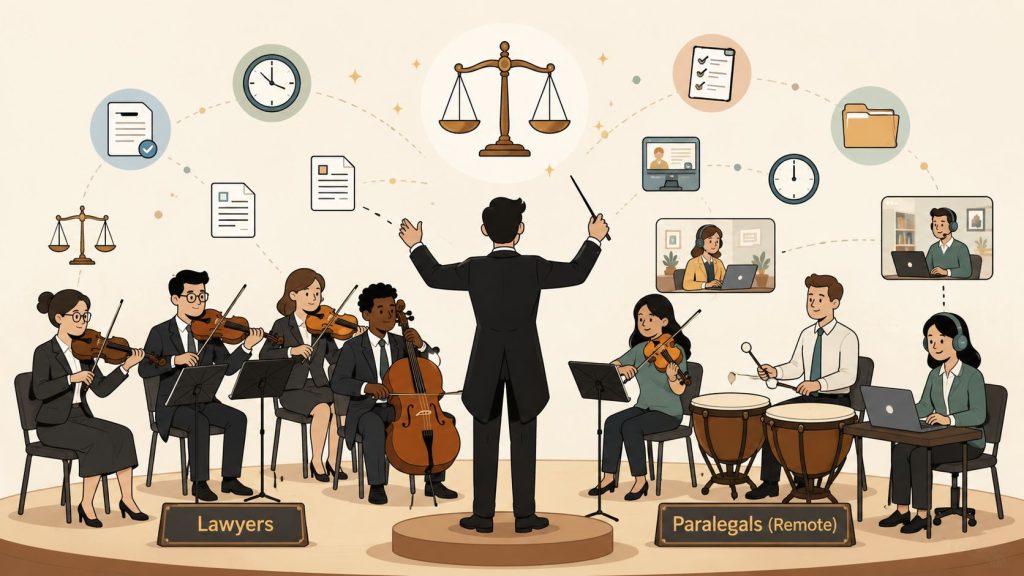
Remote hiring for PI work makes some lawyers nervous. Fair enough. Personal injury is deadline-heavy, document-heavy, and client-heavy. If your systems are sloppy, remote staffing will expose that fast.
But the objection I hear most often is outdated: “This work is too hands-on to do remotely.” No. Badly managed work is too messy to do remotely. That’s different.
Operational discipline is the core issue. The source material around remote personal injury paralegal jobs notes that content rarely addresses practical concerns like securely handling confidential case files or managing court deadlines remotely, which is exactly why firms hesitate, as noted in Indeed’s remote personal injury paralegal job landscape.
Remote PI hiring works when the firm sets rules instead of relying on hallway osmosis.
This is the part where founders and partners waste absurd amounts of time. They read resumes, run interviews, compare notes, second-guess rate expectations, then settle for “good enough” because trial prep is calling.
There are cleaner ways to do it. Some firms build their own remote recruiting pipeline. Others use specialized legal staffing partners. For example, HireParalegals is an on-demand platform for U.S. law firms that provides pre-vetted remote legal talent and also supports payroll and compliance for Latin American hires. That kind of model is useful when you want role-specific screening without turning a partner into a full-time recruiter.
The smartest hiring move is usually the one that returns lawyers to lawyer work fastest.
If you need someone to own records, control deadlines, support demands, and steady client communication, don’t wait until your current team is melting down. Hire before the bottleneck becomes the culture.
That’s the whole game with personal injury paralegal jobs. The right person isn’t a compromise. They're an advantage.
If your PI practice feels noisier than it should, start by fixing the role that sits in the middle of everything. Not with another vague posting. With sharper standards, better vetting, and less magical thinking.