 15 minutes read
You're probably in the same spot I was. Too much prosecution admin, too many reminders flying around, and too many hours spent inside USPTO systems doing work that plainly shouldn't be done by the person whose hourly rate makes clients blink.
That's the trap in patent practice. Smart lawyers keep telling themselves they'll “just handle the filings this week” or “clean up the docket after this response goes out.” Then the week disappears. Again.
I finally stopped pretending this was a discipline problem. It was a staffing problem. More specifically, it was a patent law paralegal problem. Once I treated that role as a force multiplier instead of overhead, the math got a lot less sentimental.
If you're spending your morning renaming PDFs, checking filing receipts, chasing inventor signatures, and worrying whether a deadline was entered twice or not at all, you're not practicing at the top of your license. You're babysitting process.
That's expensive. It's also boring, and bored lawyers make sloppy lawyers.
A strong patent law paralegal takes the procedural load off your plate so you can focus on claim strategy, examiner interviews, client counseling, and the work clients think they're paying for. The role isn't “support” in the soft, vague sense. It's operational control for a practice that can go sideways on one missed deadline or one botched filing package.
I used to think I could patch the problem with better checklists, one more calendar, and a bit of tech. Tech helps. Of course it does. If you want to streamline legal research with AI, use it. You should. But AI won't own your docket, coordinate inventors, or notice that a foreign associate's email created a practical problem that needs human follow-through.
That's where the specialist comes in.
A good one becomes your co-pilot. They know what needs to move, who needs to answer, what has been filed, what is still pending, and where the friction sits before it becomes your evening problem.

Practical rule: If a lawyer is repeatedly doing process work that a trained IP professional can do faster and more consistently, the firm has built the wrong workflow.
A lot of firms treat prosecution admin like weather. Annoying, unavoidable, and somehow nobody's fault. Nonsense. It's a system issue. If you need extra capacity for research-heavy support while you build the rest of the function, legal research outsourcing options can help relieve pressure, but that still doesn't replace a dedicated patent operations brain.
Because the pain isn't just volume. It's sequencing.
Patent work rewards people who can keep dozens of moving parts aligned without dropping tone, timing, or technical accuracy. That's why a patent law paralegal is one of the best hires an IP practice can make. Not glamorous. Very profitable. And frankly, much better for your blood pressure.
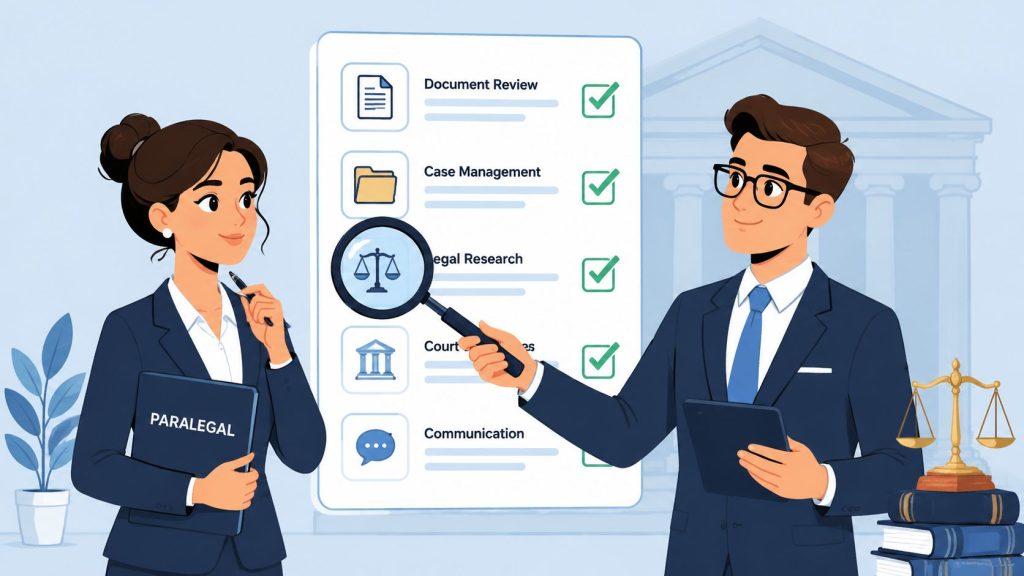
The easiest way to understand the role is this. Your patent law paralegal is the air traffic controller of the portfolio. Attorneys fly the plane. The paralegal makes sure nothing collides, nothing lands in the wrong place, and nobody forgets which runway they were supposed to use.
That distinction matters, because firms often hire for “admin support” and then act surprised when the person can't run prosecution flow. Patent work doesn't forgive vague job design.
Here's the role in one view:

According to LHH's description of the role, the day-to-day responsibilities of an IP paralegal include initial client intake, drafting applications for patents, trademarks, and copyrights, managing appeals, responding to examiner requests, and generating docket and status reports for attorneys, all of which require specialist knowledge beyond general paralegal duties, as outlined in LHH's IP paralegal job description.
That's the clean version. In practice, the work usually looks like this:
The best patent paralegals save lawyers from context switching. That's the hidden tax in an IP practice. Not just time spent on admin, but the constant mental gear change between legal analysis and procedural housekeeping.
A strong paralegal also makes your client communication better. Status updates go out on time. Filing confirmations are documented. Questions get routed before they sit for three days making the client wonder whether their matter has gone missing.
A patent practice feels bigger, calmer, and more competent when the paralegal owns the operational rhythm.
If you're hiring one, give them ownership over process, not scraps. Don't make them a glorified inbox sorter. Put them in charge of the parts of the lifecycle where precision wins:
| Workstream | Attorney leads | Patent paralegal leads |
|---|---|---|
| Claim strategy | Yes | No |
| Filing logistics | Reviews final | Yes |
| Deadline tracking | Oversees | Yes |
| Examiner correspondence prep | Directs substance | Yes |
| Client status reporting | Reviews key issues | Yes |
That's the value. Not cheaper labor. Better allocation of legal judgment.
Firms often get themselves into trouble by posting a generic opening, attracting a wave of decent-looking legal resumes, and convincing themselves a bright generalist can “grow into patent.” Sometimes they can. Usually you'll pay for that optimism in avoidable mistakes.
Patent prosecution has too many procedural habits, too much terminology, and too many timing issues for casual onboarding. You do not want your training plan to be “let's see what happens.”

The market has a ridiculous bottleneck. The gap between entry-level availability and the 18 to 36 month experience requirement remains a critical barrier, and nearly every job posting asks for 3 to 5 years of patent-specific experience, as discussed in this patent paralegal hiring thread.
That sounds unreasonable until you've had to clean up after someone who didn't know what they didn't know.
A general litigation or corporate paralegal may be excellent. But if they haven't lived inside patent workflows, they'll need substantial supervision before they become net positive. That's not snobbery. That's scar tissue.
I'd screen for evidence, not adjectives. “Detail-oriented” belongs in the bin with “team player.”
Look for things like:
Hire for procedural judgment, not just task familiarity. A true specialist knows what to escalate, what to handle, and what can wait until morning.
The certification conversation is muddled. Generic paralegal credentials aren't useless, but they don't automatically signal patent competence. Industry-specific qualifications matter more. Many job ads now ask for candidates who completed the CIPA introductory course, a credential that broad career guides often skip, as noted in this overview of paralegal certification requirements.
So my view is simple:
This is not the role for hopeful improvisation.
Most patent paralegal job ads are useless. They read like they were assembled by committee, then disinfected by HR until nothing meaningful survived. “Fast-paced environment.” “Excellent communication skills.” “Ability to multitask.” Terrific. That'll attract half the internet and tell you almost nothing.
If you want qualified applicants, write a job ad that makes the unqualified ones self-select out.
Start with the truth. You need someone who can own process in a patent prosecution practice without being handheld through every routine task. Then say what that means in plain English.
Here's a practical structure:
If you want a baseline format to adapt, use a solid paralegal job description template and then make it narrower, sharper, and much less corporate.
Lazy job ads create avoidable noise, leading to widespread confusion around whether patent paralegals need formal certification or industry-recognized qualifications. Many job postings now require candidates who completed the CIPA introductory course, while generic guides often miss that distinction, which is why I'd mention that requirement explicitly when it fits your practice, based on this discussion of CIPA-related credential expectations.
In other words, don't ask for “a certificate.” Ask for the right kind of evidence.
Skip the personality quiz nonsense and test operational thinking.
Try these:
Good candidates answer with sequence, not slogans. Weak ones drift into generalities. You'll know fast.
Let's talk money, because here firms either make a grown-up decision or keep pretending the old model is fine.
A patent paralegal in the United States earns an average annual salary of $96,682, with pay ranging up to $130,816, while the median annual wage for all paralegals is $61,010, according to this breakdown of patent paralegal salary data. That premium exists for a reason. The work is specialized, deadline-sensitive, and hard to fake.
So yes, good talent costs real money.
The bad move is not paying for expertise. The bad move is paying top-dollar for a full in-house hire when your workload, geography, or growth stage doesn't justify doing it the hard way.
Once you add benefits, taxes, equipment, office overhead, management time, and the cost of a hiring miss, the salary line is only the beginning. That's before you factor in the delightful joy of reading resumes at 10:30 p.m. because no serious candidate can interview before next Thursday.
If you can get experienced remote support, aligned to your workflow and supervised properly, that is usually the smarter operating decision.
| Cost Factor | In-House (US-Based) | Remote (via HireParalegals) |
|---|---|---|
| Base compensation | High six-figure-adjacent total employment cost in many markets | Lower than equivalent US employment cost |
| Benefits | Typically required | Often reduced or handled differently |
| Payroll taxes | Employer-paid | Lower administrative burden |
| Equipment and workspace | Firm covers setup and overhead | Usually lighter overhead |
| Hiring risk | Full exposure if the fit is wrong | Lower commitment and more flexibility |
| Scalability | Slower to adjust | Easier to scale up or down |
If you have nonstop prosecution volume and strong internal infrastructure, a full in-house specialist can make sense.
If you're trying to scale efficiently, protect margin, and avoid bloating fixed payroll, remote is the founder's move. You still get expertise. You just stop paying for the expensive theater around expertise.
A bad hire is costly. A slow hire is also costly. Remote hiring, done well, reduces both problems at once.
And yes, this is the point where some firms cling to the romance of the office. Fine. Keep the ping-pong table if you must. I'd rather have cleaner dockets.
The moment you mention remote legal support, someone raises the same three worries. Unauthorized practice. Confidentiality. Supervision. Fair enough. Those are real issues. They're also manageable if you act like a law firm instead of a group chat.
The key is remembering what a patent law paralegal is there to do. They support legal work. They do not replace legal judgment, set strategy, or practice law. If that line is clear in your systems, your training, and your supervision, you're already ahead of a surprising number of firms.
IP paralegals with specific intellectual property expertise earn 10 to 15% more than generalist paralegals, reinforcing that they're treated as specialists with a higher degree of trust and responsibility, according to this review of IP paralegal salary and specialization.
That premium isn't just about talent scarcity. It reflects the fact that these professionals often handle sensitive workflows where precision, confidentiality, and escalation judgment matter.
This is the practical version I'd hand a partner before onboarding a remote paralegal:
The firms that get nervous about remote support usually have a process problem, not a geography problem. If you couldn't explain your delegation model to a bar investigator with a straight face, the office lease won't save you.
Remote works when supervision is deliberate. Give the paralegal structured workflows, clean escalation rules, and secure tools. Then hold them to the same professional standard you'd expect from someone sitting twenty feet away pretending not to hear your call with the impossible inventor.
That is the actual compliance posture. Clear authority, clean systems, and no ambiguity about who owns legal judgment.
Traditional hiring for a patent law paralegal is miserable. You lose weeks posting jobs, screening people who are “interested in IP,” and trying to decode whether “assisted with filings” means they did the work themselves or once watched someone else do it from across the room.
Meanwhile the docket keeps moving. Of course it does.
This is why I finally stopped treating hiring like a side project. A bad hire in this role creates risk. An empty seat creates drag. Neither is acceptable if your patent practice is busy.
You want a process that pre-filters for real legal support talent, screens for communication, and narrows the field before your team burns time on first-round interviews.
That's the appeal of a specialist platform. Instead of sourcing from the whole internet and hoping for a miracle, you start with candidates who have already been screened for legal experience, communication, and practical fit. Then you do what lawyers are good at. Evaluate judgment.
Here's the kind of interface that makes that process feel sane again:

If you're still trying to hire this role through broad job boards alone, you're doing extra work for no prize. Use a channel that understands legal staffing, especially IP-adjacent workflows, and get to the shortlist faster.
And when you do get to interviews, don't waste them. Ask practical questions, test sequencing, and listen for ownership. Candidates who also know how to impress interviewers with smart questions usually reveal more maturity than the ones who just wait to be assessed.
Toot, toot. This is the part where I admit the shortcut is better than the heroic version.
HireParalegals is built for exactly this problem. The platform focuses on remote legal talent for law firms, with pre-vetted candidates, shortlists, and a process designed to reduce the usual hiring mess. If your choice is between spending another month sifting resumes or interviewing a handful of qualified people tomorrow, that's not much of a choice.
Stop asking, “Where do I even find a patent paralegal?”
Start asking, “Which one of these strong candidates do I want to meet first?”
If your patent practice is drowning in admin, the answer usually isn't another late night. It's a better operator. A great patent law paralegal gives you an advantage, cleaner execution, and fewer avoidable headaches. That's the business case. And it's strong enough that I finally stopped resisting it.