

 17 minutes read
Let's be real—you went to law school to practice law, not to moonlight as a recruiter. But if you’re trying to fill administrative legal assistant jobs, that's probably what your life looks like right now: drowning in a sea of resumes from people who think "legal experience" means watching Suits.
The old way of hiring is a notorious time-suck and, frankly, a money pit. You deserve better.

You know the routine. You post a job opening, get buried in applications, and then waste precious billable hours weeding out candidates who might look perfect on paper but can't draft a basic motion to save their life.
Hope you enjoy spending your afternoons fact-checking resumes and running dead-end interviews—because that’s now your full-time job. It's maddening.
The cost isn't just the salary you eventually offer. The real damage is done in the margins—the lost productivity, the pushed client deadlines, and the sheer frustration of pouring weeks into a process that often yields nothing.
And the headache doesn't end when you finally make an offer. Next comes the training, the constant hand-holding, and that sinking feeling you get when you realize your new hire needs more supervision than a toddler with a permanent marker. The best-case scenario is they're up to speed in a few months.
The worst-case? They make costly errors, burn out, or quit within six months, throwing you right back to square one. You're stuck in a frustrating loop of hiring, training, and losing people.
This churn is a massive drag on your firm's operations. It kills momentum and pulls your focus away from practicing law to put out administrative fires.

Let's put it bluntly: every hour you spend recruiting is an hour you're not billing. The opportunity cost alone is staggering, easily running into thousands of dollars for a single hire.
It’s not just a financial drain; it’s an energy drain. You need someone who can hit the ground running and contribute from day one, not another person to manage. The traditional approach to filling administrative legal assistant jobs is broken. It’s time for a smarter way.
Forget the old stereotype of a legal secretary glued to a typewriter. Today’s administrative legal assistant is the operational powerhouse of a modern law practice. The difference between a good one and a great one? It's the difference between chaos and billable hours.
This role isn't about fetching coffee. It’s about owning the administrative workflow so lawyers can focus on practicing law. Think of them as part air traffic controller for hectic schedules, part document specialist for complex e-filing, and part client relations expert.
They are the firm’s central nervous system. When a deadline is looming or a client is on edge, the administrative legal assistant is the one steering everything in the right direction.
A top-tier administrative legal assistant doesn’t just follow instructions; they anticipate needs. They aren't just managing one attorney's calendar—they're juggling discovery timelines, court dates, and client meetings for the entire team, spotting potential conflicts before they become problems.
This is the person who knows that Judge Smith’s court always runs 30 minutes late or that a particular opposing counsel is notorious for filing motions at the last possible minute. This deep, practical knowledge is what makes them invaluable.
The role demands fluency in legal tech. They need to confidently navigate case management software like Clio or MyCase to ensure every document is perfectly organized and every deadline is tracked. For example, knowing the ins and outs of liability release form essentials isn't just a random task—it's a critical duty that protects the entire firm.
The real value isn't their typing speed; it's their processing speed. They connect the dots between a client call, a court filing, and an attorney's schedule before anyone else even sees the pieces.
So, what separates an indispensable assistant from a merely adequate one? It comes down to a few core duties where perfection is the baseline.
Let’s be honest. A fancy degree looks great on paper, but it tells you very little about a candidate’s ability to actually thrive in the pressure cooker of a modern law firm. When you're trying to fill administrative legal assistant jobs, your goal is to cut through the noise and pinpoint the skills that will make an immediate impact.
You'll need to put on your detective hat. Most resumes are written to hide weaknesses, not highlight true strengths. Your job is to spot the difference between someone who simply lists a skill and someone who has genuinely mastered it in a real-world legal setting. That distinction is everything.
Some technical skills are just non-negotiable. A candidate who needs a tutorial on basic legal software is already behind, costing you time and money from day one.
The modern administrative assistant juggles scheduling, document management, and technology all at once. It's a true hybrid role.
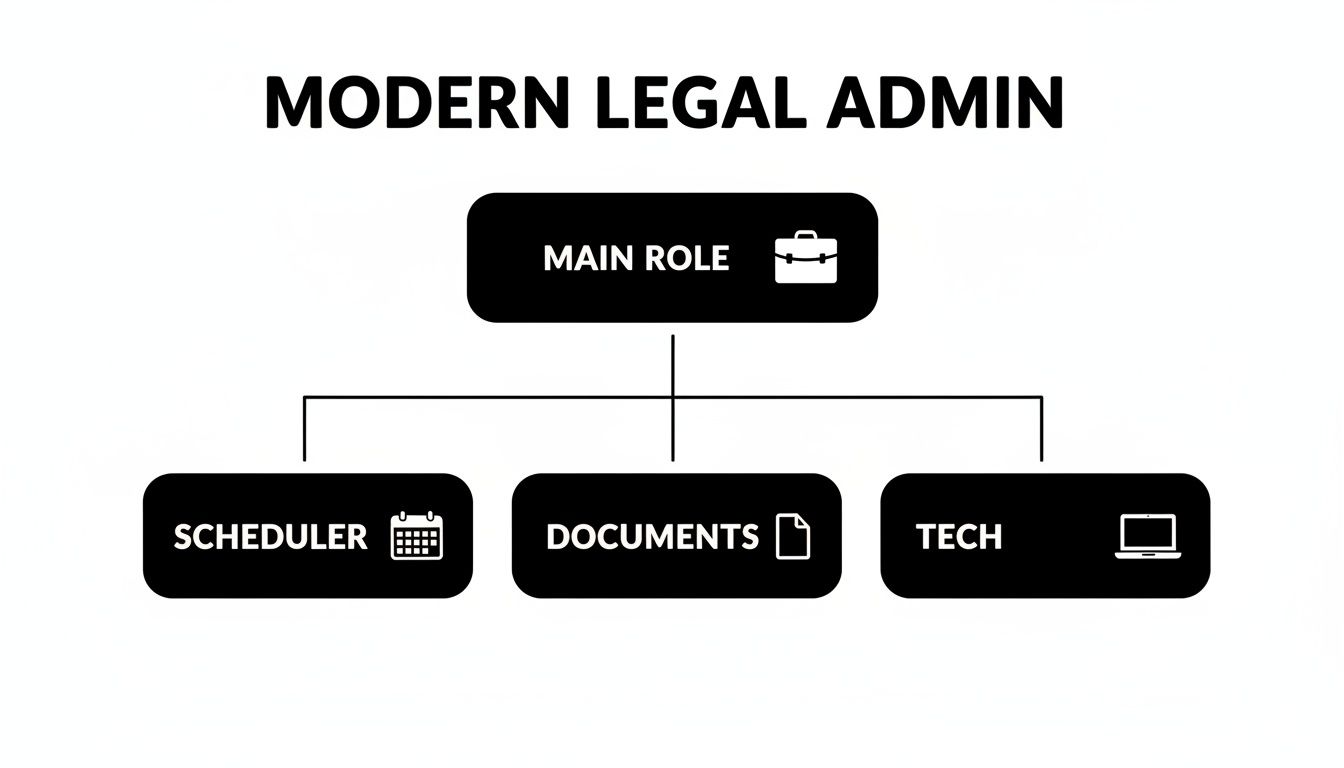
The main takeaway here is that these aren't isolated tasks. A top-tier assistant manages these interconnected functions seamlessly.
While you can test for hard skills, it’s the soft skills that truly separate a good hire from a great one. These are trickier to screen for, but they are what will ultimately determine a person's success and longevity at your firm.
The most dangerous candidate isn't the one who lacks skills; it's the one who lacks self-awareness. They don't know what they don't know, and that misplaced confidence can be incredibly costly.
Look for signs of proactive communication, an obsessive attention to detail, and an almost uncanny ability to stay organized when things get chaotic. These traits often come from experience, but not all experience is created equal. Five years at a quiet real estate firm won't prepare someone for the high-stakes environment of a busy litigation practice.
You have to dig deeper into the type of work they’ve done, not just how long they’ve done it. This is where a skills-based hiring approach can save you a world of hurt by shifting the focus from paper credentials to proven capabilities—which is exactly where it should be.
While the core legal skills remain constant, the demands of a remote role introduce a new set of critical competencies. Here’s a look at how the must-have skills differ.
| Skill Category | Must-Have For On-Premise Assistants | Critical For Remote Assistants |
|---|---|---|
| Communication | Clear in-person and phone etiquette. Ability to relay messages accurately. | Proactive, asynchronous communication. Mastery of messaging platforms (Slack/Teams). |
| Tech Savviness | Proficient with standard office software and legal platforms (e.g., Clio). | Advanced proficiency in cloud-based tools, VPNs, and troubleshooting basic IT issues. |
| Autonomy | Follows instructions and manages tasks with moderate supervision. | Highly self-motivated and disciplined. Manages entire workflows with minimal oversight. |
| Time Management | Manages deadlines and priorities within a structured office day. | Expert at self-structuring their day, blocking distractions, and managing time zones. |
Ultimately, a successful remote assistant needs to be a self-starter in a way that an in-office employee doesn’t. Their ability to work independently and communicate without physical cues is what makes them a valuable asset to a distributed legal team.
Let's talk money. It's the tightrope walk every firm owner knows all too well. Overpay, and you’re torching your budget. But if you underpay? You might as well hang a neon sign inviting bottom-of-the-barrel talent, and their inevitable mistakes will cost you far more than a competitive salary ever would.
Figuring out the "right" number for administrative legal assistant jobs can feel like trying to hit a moving target. You see a dozen different figures online, and none of them seem to quite match the reality of your local market or what your firm actually needs.
So, what's the real story? As of early 2026, data from ZipRecruiter pegs the national average salary for a legal administrative assistant at $53,753 annually. PayScale offers a slightly higher figure of $61,697 on average, with entry-level pros pulling in around $43,250 in total compensation. Top earners, especially those in high-cost-of-living areas, can reach up to $87,000 per year.
Of course, these numbers are just a starting point. It’s crucial to understand the real impact of compensation in employee retention. Getting it wrong doesn't just hurt your wallet in the short term; it fuels that frustrating, expensive cycle of turnover we talked about earlier.
Here’s the secret most firms miss: you don’t have to mortgage your office ping-pong table to afford elite talent. You can breathe a sigh of relief now, because this is where things get interesting. The old model of only hiring locally is quickly becoming obsolete, especially when you can tap into a global talent pool.
This isn’t about outsourcing to the lowest bidder. It’s about strategic hiring.
We’re talking about finding pre-vetted, experienced remote administrative legal assistants from global talent pools. These aren't entry-level candidates; they often have 4+ years of experience and are ready to hit the ground running from day one.
Platforms like HireParalegals connect US law firms with this very talent, effectively slashing payroll costs by up to 80% without sacrificing an ounce of quality. You get the skills and experience of a senior-level assistant at a fraction of what a local hire would cost.
Think about it: you can sidestep the sky-high salaries of major US cities while still accessing professionals who are genuine experts in their field. For solo practitioners and mid-sized firms, this isn't just a nice-to-have; it’s a total game-changer for your bottom line. Check out our complete guide to legal administrative assistant pay to see exactly how the numbers stack up.
If you've glanced at the official reports showing flat growth for legal assistants and thought, "Great, hiring should be a breeze," I need you to stop right there. That data is one of the most deceptive metrics in our industry, and it's lulling law firms into a dangerous sense of security.
Those numbers just don't paint the full picture. While the total job count might not be skyrocketing, the demand for truly skilled, tech-forward assistants—the kind who can actually make a difference—is through the roof. You’re not just filling a role; you're competing for a critical operational asset.
I hope you're ready for a bidding war, because that's what you're facing when you post an opening for an administrative legal assistant. The Bureau of Labor Statistics might project slow overall growth, but it also predicts a massive 39,300 annual openings. This isn't from new jobs being created; it's from a constant churn of people retiring or switching careers.
This is far from a buyer's market. It’s a talent war. The unemployment rate for paralegals and legal assistants is sitting at an almost unbelievable 2.0%—that's less than half the national average. Let that sink in. The best people are already working, and they aren't desperately scrolling through job boards waiting for your call. You can get a closer look at these numbers in this deep dive into legal hiring trends.
It's no surprise that 61% of legal leaders report that finding skilled talent is much harder today than it was just a year ago. The pool of qualified, available professionals is shrinking just as the need for them is getting more intense.
For solo attorneys and mid-sized firms, this high-demand, low-supply reality means one thing: persistent, painful vacancies. You're going head-to-head with big firms that have bigger budgets and fancier perks. You can't win by playing their game.
So, how do you compete without breaking the bank? You stop trying to catch fish in the same overfished, overpriced local pond.
This is where a dedicated hiring platform becomes your secret weapon. Instead of fighting over the handful of available candidates in your city, you can tap into a global network of vetted professionals. A platform like HireParalegals can slash your hiring time to as little as 24 hours by connecting you directly with a pool of over 10,000 remote experts. This isn't just about filling a seat—it's about getting an immediate competitive edge.
Alright, let's stop talking about the problem and focus on the solution. Instead of sifting through the same local talent pool, what if you could bypass that entire headache? Imagine tapping into a curated network of over 10,000 pre-vetted legal professionals who can be ready to start in as little as 24 hours.
This isn't some far-off dream. It's how savvy firms are filling their administrative legal assistant jobs right now. Full disclosure (toot, toot!), this is exactly why we built HireParalegals. We were fed up with seeing great firms get stuck in terrible hiring cycles and knew there had to be a better way than spending weeks on a process that should take a day.
We don't just fling a stack of resumes your way and cross our fingers. Hope is not a hiring strategy. Every single candidate who enters our network has to run a rigorous four-step gauntlet before their profile ever lands in front of you.
What this means for you is simple. By the time a candidate makes it to your shortlist, they’ve already been thoroughly vetted for skill, experience, and professionalism. The days of playing detective with a CV are officially over.

Our platform lets you browse detailed profiles and watch video introductions, making it easy to find someone who’s the perfect match. You can quickly see if a candidate has the right background for your firm's specific needs, whether that’s litigation, immigration, or corporate law.
This is how you stop being a full-time recruiter and get back to being a lawyer. Learn more about how to hire a top-tier remote legal assistant without all the usual headaches.
We understand. Bringing someone into your firm remotely, especially in a legal setting, can feel like a big leap. You've probably got a few questions, so let's get right to the most common ones we hear from law firms just like yours.
This is always the first question, and for good reason. Client confidentiality is non-negotiable.
Reputable remote hiring platforms aren't just posting jobs online; they're actively vetting talent. At HireParalegals, for example, our process is built on a foundation of trust. We use comprehensive NDAs, secure communication channels, and run thorough background checks on every single candidate we present.
We screen for more than just skills—we screen for integrity. The professionals we connect you with understand that your sensitive client data must be handled with the same discretion and care as if they were sitting in the office next to you. There's simply no other way to do it.
It’s a practical question: how does a remote assistant handle a stack of mail? While they can't physically be in your mailroom, this is rarely the dealbreaker it seems to be.
Your remote administrative legal assistant will own all the digital work—e-filing, scheduling, drafting correspondence, and managing electronic documents—which easily makes up 95% of the administrative workload in a modern firm. For the small amount of physical mail, most firms find a simple workaround, like using a local courier service or having an on-site junior staff member scan and digitize incoming documents. This hybrid model delivers high-level support for the bulk of the work, saving you significant costs.
The point isn't to perfectly replicate your old office setup in a remote environment. It's to build a smarter, more efficient system that frees up your attorneys to focus on practicing law.
If you're picturing weeks of intensive training, think again. Onboarding a pre-vetted remote professional is incredibly straightforward.
It usually starts with a simple video call. You'll walk them through your firm's specific workflows, introduce them to the team, and grant them access to your core software (like your case management system and email). Because these assistants are seasoned professionals who are already tech-savvy, they hit the ground running. They get up to speed in days, not weeks.
Essentially, we handle the heavy lifting of vetting and skills assessment upfront. Your part is less about training and more about a quick orientation to your firm's unique way of doing things.


