 15 minutes read
You're probably here because one of two things is happening.
Either your construction docket has started breeding overnight, and every matter now comes with a landfill of subcontracts, RFIs, change orders, payment applications, schedules, specs, and angry emails. Or you already hired “a solid paralegal,” then discovered that being good at general litigation is not the same as being useful when a dispute turns on a notice provision buried in a subcontract exhibit and a mislabeled drawing revision.
I've made that mistake. More than once.
A construction law paralegal is not admin support with better formatting. This is the person who keeps your lawyers from wasting billable brainpower on document archaeology, deadline traps, and technical messes that should never reach partner level. Hire the right one and your cases move cleaner. Hire the wrong one and you become the project manager of your own legal team, which is a terrible use of a license.
Last time I saw a partner try to “just handle it” without specialized support, he spent half a week buried in a defect case that looked simple until it wasn't. By day three, the conference room table had vanished under drawings, consultant reports, photos, and chain emails about site conditions. By day four, he was arguing about sequence of work with the confidence of a man who had skimmed one geotechnical report and regretted all his life choices.
That's the point where firms usually realize they don't need another generic helper. They need someone who understands the language of construction disputes before the attorney starts bleeding time.
A good construction law paralegal doesn't merely organize files. They sort noise from signal. They know why a notice letter matters, where the bond issue is hiding, and which version of the subcontract controls. If you handle contractor disputes regularly, that distinction shows up fast in your workflow. Firms dealing with these matters often benefit from reviewing a practical overview of an attorney for contractor dispute setup because it highlights just how document-heavy and detail-sensitive these files become.
This is not an easy role to fill. The paralegal field is projected to have about 39,300 job openings each year from 2024 to 2034, driven by replacement needs and the push for cost-effective legal support, according to paralegal job prospects data. In plain English, good people have options.
That matters even more in construction law, where the files are ugly, the facts are technical, and the clients are paying you to be right the first time.

Practical rule: If your attorneys are spending their afternoons hunting down contract exhibits, checking lien deadlines, or reconciling drawing sets, you don't have a workload problem. You have a specialization problem.
A lot of firms think they need this role only when a case blows up. Wrong. The need often starts earlier, when contract administration is sloppy and payment security issues get ignored. For firms serving contractors in New Jersey, these valuable insights for NJ contractors are worth a look because bond and payment protection issues tend to become legal emergencies only after someone failed to track them properly on the front end.
That's why I treat this role like a force multiplier. Not a luxury. Not a nice-to-have. A force multiplier.
Forget the sleepy job description that says “assists attorneys.” That tells you nothing. A strong construction law paralegal is part librarian, part detective, and part engineer's worst nightmare, in the best possible sense.
Here's the visual version, because this role makes more sense when you see the moving parts together.

Construction files are not normal files. They come with layered contracts, versions of versions, consultant reports, meeting minutes, schedules, permits, and email threads no sane person would print but everyone somehow does.
Their first job is to impose order.
If your team wants to understand the broader litigation function behind this work, this breakdown of what a litigation paralegal does is useful context. In construction matters, that baseline work becomes far more technical.
The role gets much more serious once the dispute matures. Critical tasks include reviewing and drafting construction contracts, managing legal documents for disputes such as motions, pleadings, and claims, and supporting mediation and arbitration involving defects, torts, and bond claims to help avoid costly litigation, as outlined in this construction attorney job description reference.
That translates into real work like this:
| Function | What the paralegal handles | Why it matters |
|---|---|---|
| Pre-dispute contract work | Redlines, clause checks, notice tracking | Prevents avoidable fights |
| Active litigation support | Pleadings support, discovery coordination, chronology building | Cuts attorney time spent on mechanics |
| Resolution support | Arbitration prep, mediation binders, claim packages | Sharpens leverage |
A generalist sees “construction dispute.” A specialist sees lien rights, bond exposure, notice defects, delay evidence, and three places the other side is already vulnerable.
Here, the great ones separate themselves.
They don't just collect facts. They turn them into case strategy support. That can mean building a timeline from scattered emails, tagging key documents for attorney review, or spotting that the pay application doesn't line up with the approved change order trail.
And yes, they help with writing too. If your team is trying to speed up legal brief drafting, that only works when someone upstream has already organized the record cleanly. Brief drafting gets faster when the factual file stops behaving like a junk drawer.
I don't care how polished the resume looks. If the candidate can't handle construction-specific complexity, you are hiring future rework.
This role demands more than legal formatting and a cheerful attitude on Zoom. The best candidates understand how contract language, project records, and technical evidence collide. They can work through discovery without drowning. They can read enough of the project documentation to know when a lawyer needs to care.
Hiring a strong real estate or employment paralegal into construction law because “they're smart and can learn” is a lovely theory. It's also how firms end up paying partner rates for cleanup.
Top-tier roles in this niche typically require a college degree and at least 5 years of experience in construction management, engineering, or corporate construction legal support, according to this construction paralegal role profile. That same source notes the general median annual wage for paralegals and legal assistants was $61,010 in May 2024, while a paralegal at a major construction law firm earns about $84,775 annually, a 39% to 41% premium.
That premium exists for a reason. You are paying for fewer mistakes, faster issue-spotting, and less attorney babysitting.
When I vet candidates, I want proof of these skills:
For firms moving toward a sharper hiring process, a skills-based hiring approach is the right lens here. This role is a textbook example of why pedigree alone is not enough.
My bias: I'd rather hire the less charming candidate who can explain a notice issue in a subcontract than the smoother one who says they're “detail-oriented” six times and never proves it.
A certificate is nice. Relevant scars are better.
Ask for writing samples that involve chronology building, contract review notes, or dispute support. Ask how they organize a file with multiple drawing revisions. Ask what they do when project records conflict. If the answers stay generic, move on.
You are not filling a seat. You are acquiring strategic advantage.
Most firms start with a vague job ad, get a pile of irrelevant resumes, then hold interviews where candidates say they're organized, proactive, and passionate about law. Terrific. So is every other applicant with a LinkedIn account and a ring light.
You need acid tests.
First, here's the hiring playbook in visual form.

A useful job description is specific enough to scare off the wrong people. Good. That's the point.
Use language like this:
We need a construction law paralegal who has supported disputes involving contracts, payment issues, lien or bond-related claims, defects, delay, or arbitration. You must be comfortable organizing project records, preparing pleadings support, managing discovery, and tracking notice-driven deadlines. Experience with contractors, owners, developers, or construction-focused firms is preferred.
Short. Sharp. No poetry.
Then add your actual tools, file expectations, and communication cadence. If your team lives in Outlook, Word, Excel, shared drives, and a case management platform, say so. If attorneys expect same-day issue summaries, say so. If the role is remote and requires timezone overlap, put that in bold.
Don't ask, “Tell me about yourself.” That question has wasted more law firm hours than broken scanners.
Ask these instead:
The right candidate won't answer with buzzwords. They'll give you sequence, judgment, and examples.
I want to see candidates do the job, even in miniature.
A simple test works:
You are looking for clarity, prioritization, and accuracy. Fancy vocabulary is not a skill.
“Organized” is not a trait until I can see the folder structure.
Reference checks should not sound like hostage negotiations where everyone whispers nice things.
Ask former supervisors:
Listen for hesitation. It's usually doing more work than the actual answer.
Let's talk money, the point at which firms become either practical or sentimental.
If you want specialized construction support, stop budgeting like you're hiring a generic administrative role. In major markets like New York City, an experienced litigation paralegal at a construction law firm with 3 to 7 years of experience can earn $60,000 to $90,000 annually, reflecting demand for technical skill in e-discovery and case timeline management, based on this New York litigation paralegal listing.
That range should not shock you. Bad support costs more than good support.
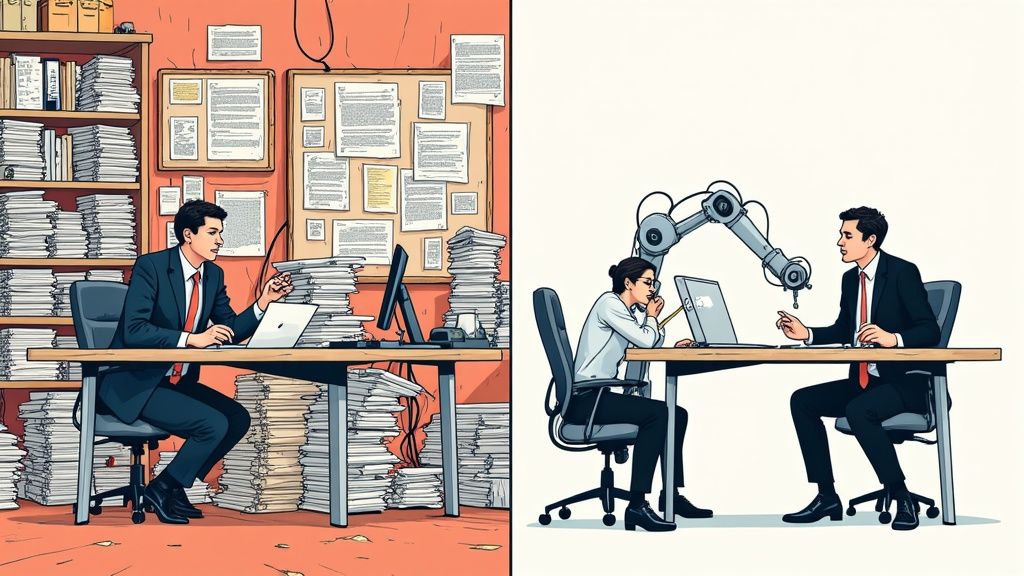
Here's the comparison visual.

The old model assumes you need a full-time employee, in your market, on your payroll, with benefits, equipment, management time, and a desk nobody uses consistently anyway.
Sometimes that makes sense. Often it doesn't.
If your need is uneven, a full-time hire can become an expensive workaround for a workflow design problem. Construction disputes surge, settle, stall, then surge again. Your staffing model should reflect that reality instead of pretending every month looks the same.
This is the part many firms resist for emotional reasons. They like seeing people in seats. Fine. You can also enjoy spending your afternoons supervising tasks a specialist could have handled independently from day one.
A remote or on-demand construction law paralegal setup gives you room to scale around actual case volume. You can get specialized support for contract review, discovery pushes, arbitration prep, or deadline-heavy periods without building permanent overhead around temporary spikes.
Here's the blunt comparison:
| Model | Best for | Weak spot |
|---|---|---|
| Full-time in-house | Consistent high-volume work, heavy internal coordination | Fixed overhead and slower scaling |
| Remote dedicated support | Ongoing work with flexibility and broader talent access | Requires tighter process discipline |
| On-demand support | Bursty litigation, special projects, overflow | Needs clear scoping and handoff rules |
If you need 25 hours a week of sharp construction support, hiring a full-time local employee can be the legal staffing equivalent of buying a cement mixer to hang one shelf.
A specialist who works remotely and clears attorney bottlenecks is more valuable than a mediocre in-office hire who asks where the bond file lives every other day.
That's the core budget question. Not “What salary can we get away with?” Try this instead: “What level of expertise keeps lawyers doing lawyer work?”
That question leads to much better hiring decisions.
A strong hire can still flop if onboarding is lazy. “Here's your login, good luck” is not onboarding. That's abandonment with a password reset email.
Use the first month to create momentum, not confusion.

Start with systems, not busywork. They need access to your matter templates, naming conventions, filing expectations, privilege protocol, communication rules, and sample work product.
If your firm wants a general framework for smoother ramp-up, these ideas on HubEngage for onboarding success are useful. The legal version is stricter. You are not onboarding someone to “the culture.” You are onboarding them to risk control.
Give them these deliverables in the first stretch:
Don't keep them in sandbox mode too long. Put them on one active matter and one contained task.
Here are two workflows that work well.
Workflow one. Review and summarize a large document set for a delay claim
Workflow two. Support initial pleadings and discovery for a subcontractor dispute
Give one lawyer final review authority. If three attorneys start “helping,” your new paralegal will spend a week reconciling style preferences instead of moving the case.
Here's the insider move most firms miss. Use your construction law paralegal to help improve future contracts, not just react to bad old ones.
A critical but often overlooked task is drafting specific arbitrator qualifications into construction agreements, such as requiring a licensed lawyer with 10+ years of construction experience. That step matters more now because construction arbitration filings increased 22% in major US markets over the last 12 months, according to this industry training discussion on arbitrator qualifications.
That is not theoretical. It is operational gold.
Ask your paralegal to review your standard dispute resolution language and propose upgrades. If they can help your firm lock in smarter arbitrator criteria before the next dispute starts, they're already paying for themselves.
The most common hiring mistake is simple. Firms hire a capable paralegal from another practice area and assume intelligence will close the gap. Sometimes it does. Usually it just creates slower files and more attorney intervention.
The second mistake is vagueness. Vague role, vague tests, vague onboarding. Then everyone acts surprised when the hire underperforms. That's not a talent problem. That's management malpractice.
The third mistake is treating remote support casually. Remote can work beautifully, but only if you define reporting lines, deadlines, document protocols, and compliance responsibilities clearly. If you get sloppy about worker classification or process control, you've created a different kind of legal headache. Congratulations.
A construction law paralegal is a strategic hire. Treat the role that way. Screen for specialization. Pay for judgment. Onboard with discipline. Build around outcomes, not office furniture.
If you want a faster way to find vetted remote legal support without doing the entire hiring circus yourself, HireParalegals is built for US law firms that need specialized, on-demand paralegal talent.