

 15 minutes read
Let's get one thing straight. The difference between a paralegal and a legal assistant isn't just semantics—it's the difference between hiring a specialist who generates revenue and an organizer who stops you from losing it to chaos.
Confusing the two is a classic, costly mistake. It's like hiring a world-class chef to answer your phones. Sure, they can probably do it, but you're burning cash and wasting talent.
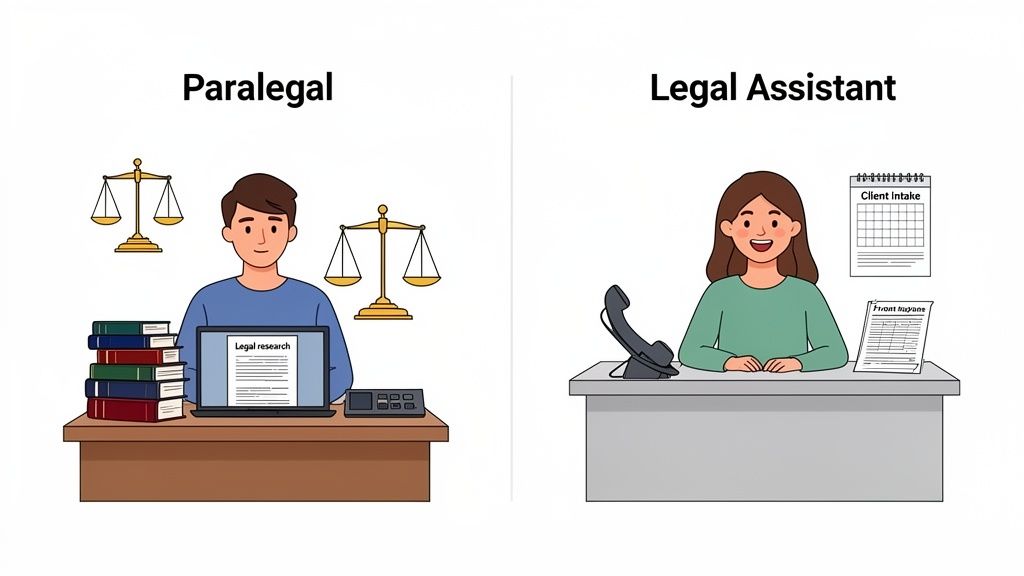
You’re drowning in work. I get it. The temptation is to just hire someone with "legal" in their title and hope for the best. Big mistake.
I’ve watched too many firms hire a paralegal when what they desperately needed was an administrator, and vice versa. The titles might sound similar, and yes, the lines are blurring, but their core functions are worlds apart. You can see a similar breakdown in our article comparing legal secretaries and paralegal.
The real-world impact on your wallet is significant, too. While U.S. Bureau of Labor Statistics data lumps them together with a median annual wage around $61,010, paralegals consistently command higher salaries. Why? Because they have specialized training and—this is the important part—they perform billable tasks.
Let's cut the fluff and get down to what you're actually paying for.
This isn't a textbook definition. This is the down-and-dirty breakdown of who does what, and why it matters to your bottom line.
| Attribute | Paralegal (The Specialist) | Legal Assistant (The Organizer) |
|---|---|---|
| Primary Focus | Substantive legal work | Administrative & clerical tasks |
| Core Duties | Legal research, drafting motions, discovery management | Scheduling, client intake, file management, billing |
| Strategic Value | Directly supports billable legal services | Optimizes firm operations and attorney efficiency |
| Typical Background | Formal paralegal education, certification | Administrative experience, optional legal training |
| Billable Work | Hell yes. This is their superpower. | Nope. This is operational overhead. |
One role directly generates revenue. The other builds the operational foundation that makes that revenue possible. Knowing which one you need is the first step to making a hire that actually moves the needle.
Alright, let's get down to brass tacks. Hiring the wrong person isn't just a minor setback; it's a direct hit to your firm's productivity and wallet. The difference between a paralegal and a legal assistant isn't just about job titles—it’s the fundamental split between substantive legal work and administrative support.
One role is your legal force multiplier. The other is your firm's command center. Confusing them is like trying to use a screwdriver as a hammer. It gets ugly, fast.
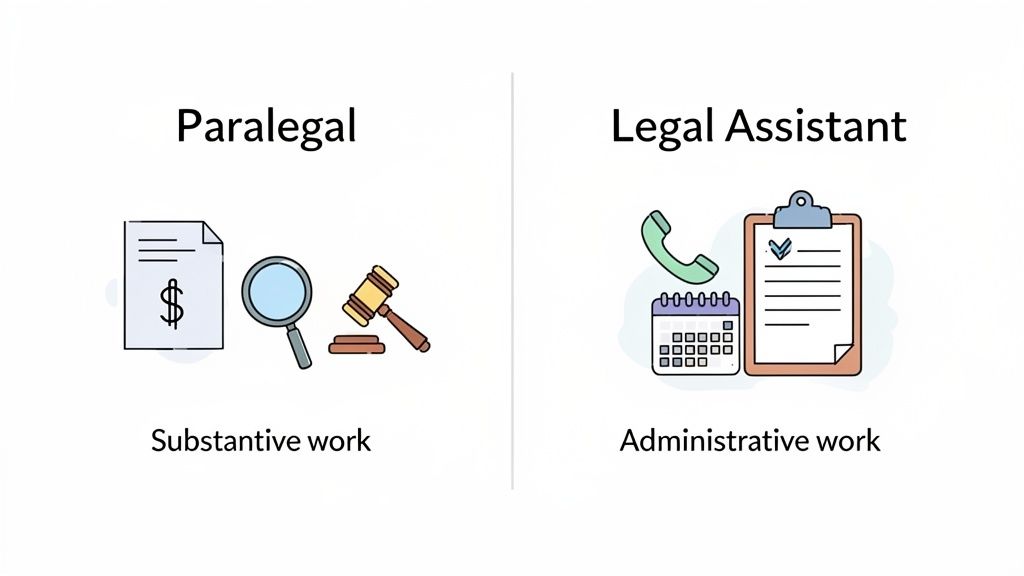
Think of a paralegal as your secret weapon. They're in the trenches drafting motions, managing discovery, and conducting the kind of detailed legal research that frees up your attorneys to focus on high-level strategy. Crucially, their work is often billable.
A legal assistant, on the other hand, is your firm’s air traffic controller. They're managing calendars, handling client intake, filing documents, and making sure invoices get paid. They prevent the operational chaos that grinds a firm to a halt.

The Litmus Test: Could you ethically bill this task to a client? If yes, it's paralegal work. If it's about keeping the office from catching fire, it's a job for a legal assistant.
Here’s where the paths really diverge. You can't just hand paralegal duties to an admin and hope they figure it out. Most qualified paralegals have completed formal training—an ABA-approved associate’s degree or a post-baccalaureate certificate. This isn't just a piece of paper; it’s specialized education in legal ethics, research, and procedural rules.
Legal assistants typically have a high school diploma and learn on the job. Their expertise is in organization and office management, not the nuances of substantive law. This educational gap is the core reason for the difference in their scope of work and, ultimately, their pay.
This is where ethics meets your bank account. Because paralegals perform substantive legal work, their output must be supervised by a licensed attorney. That said, they operate with a ton of autonomy—managing case files and drafting complex documents that an attorney then reviews.
A legal assistant needs direction, but not direct legal supervision, because their work is operational.
Here’s how that hits your bottom line:
The paralegal profession was born in the 1960s for exactly this reason: firms needed a way to lower costs for clients while freeing up expensive attorney time. Today, paralegals and legal assistants together make up a massive 22.2% of the legal industry's workforce. The model works. You can explore more paralegal demographics and their impact on the legal industry to see just how integral these roles have become.
Let’s talk about what every firm owner really cares about: the money. The pay gap between a paralegal and a legal assistant isn’t random. It’s a direct reflection of their expertise, their ability to generate revenue, and the complexity of the problems you’re paying them to solve.
Thinking you can save a few bucks by hiring a legal assistant to do a paralegal's job is a rookie mistake. It’s like buying a cheap umbrella in a hurricane—you’re not saving money, you're just setting yourself up for a much bigger mess.
A paralegal’s salary is an investment in your firm's profitability. A top-notch legal assistant’s salary is an insurance policy against the operational chaos that silently bleeds you dry.
When you look at salary data, the divide is clear. The U.S. Bureau of Labor Statistics reports a median annual wage of around $61,010 for paralegals and legal assistants, but that number is useless because it averages two completely different jobs.
Dig a little deeper, and you’ll find that location and specialty matter. A lot. Top-paying states for paralegals include places like California and New York, where average salaries can climb toward $79,210 and $78,850. The private legal services sector pays a mean wage of $64,270.
This isn't just a cost-of-living adjustment. It's the market acknowledging that specialized skills in high-value practice areas command a premium.
A higher salary isn’t a cost; it’s an investment in a revenue-generating asset. Every billable hour a paralegal logs is an hour an attorney doesn't have to, which boosts capacity and profitability.
Now, let's break it down with some hard numbers.
This table gives you a much clearer picture. Notice how a paralegal's salary scales directly with their ability to contribute to case substance and firm revenue.
| Metric | Paralegal | Legal Assistant | The Bottom Line |
|---|---|---|---|
| National Median Salary | ~$61,010 | ~$48,000 | A clear ~27% pay gap reflecting the difference in substantive legal duties. |
| High-Cost State Average | ~$79,000+ (CA, NY) | ~$60,000+ (CA, NY) | The paralegal premium remains significant, even in expensive markets. |
| Specialization Impact | High (e.g., IP, Litigation) | Moderate (e.g., Bilingual) | An elite paralegal can command a salary that rivals a junior attorney in some markets. |
The data tells the story: while a legal assistant is an essential operational expense, a paralegal is a strategic investment that directly contributes to your firm's earning potential.
Here’s where it gets interesting. The old way of hiring—being stuck with the expensive, picked-over local talent pool—is dead. Why pay a premium for office space and compete with every other firm in town for the same handful of candidates?
Turns out there’s more than one way to hire elite talent without mortgaging your office ping-pong table.
Hiring vetted remote professionals completely rewrites the financial rules. You can access top-tier paralegals from different regions at a more competitive rate without sacrificing an ounce of quality. We're not talking about sending work to some faceless outsourcing farm; we're talking about seamlessly integrating a pre-vetted, highly experienced pro into your firm.
This one move can slash your overhead while giving you access to a deeper, more specialized talent pool. If you're curious how the numbers work, our guide on virtual paralegal rates breaks it all down. It’s a true game-changer.
Forget the textbook definitions. Your reality is a mountain of case files, a perpetually full inbox, and a phone that won't stop ringing. Let’s get practical.
For a moment, ignore the job descriptions and ask yourself one simple question: what’s my single biggest bottleneck right now? Pinpoint the pressure point that’s costing you time, money, and maybe even your sanity.
This decision tree cuts right to the chase. If your pain is the substance of your legal work, you need a specialist. If it's the chaos of running the firm, you need an organizer.
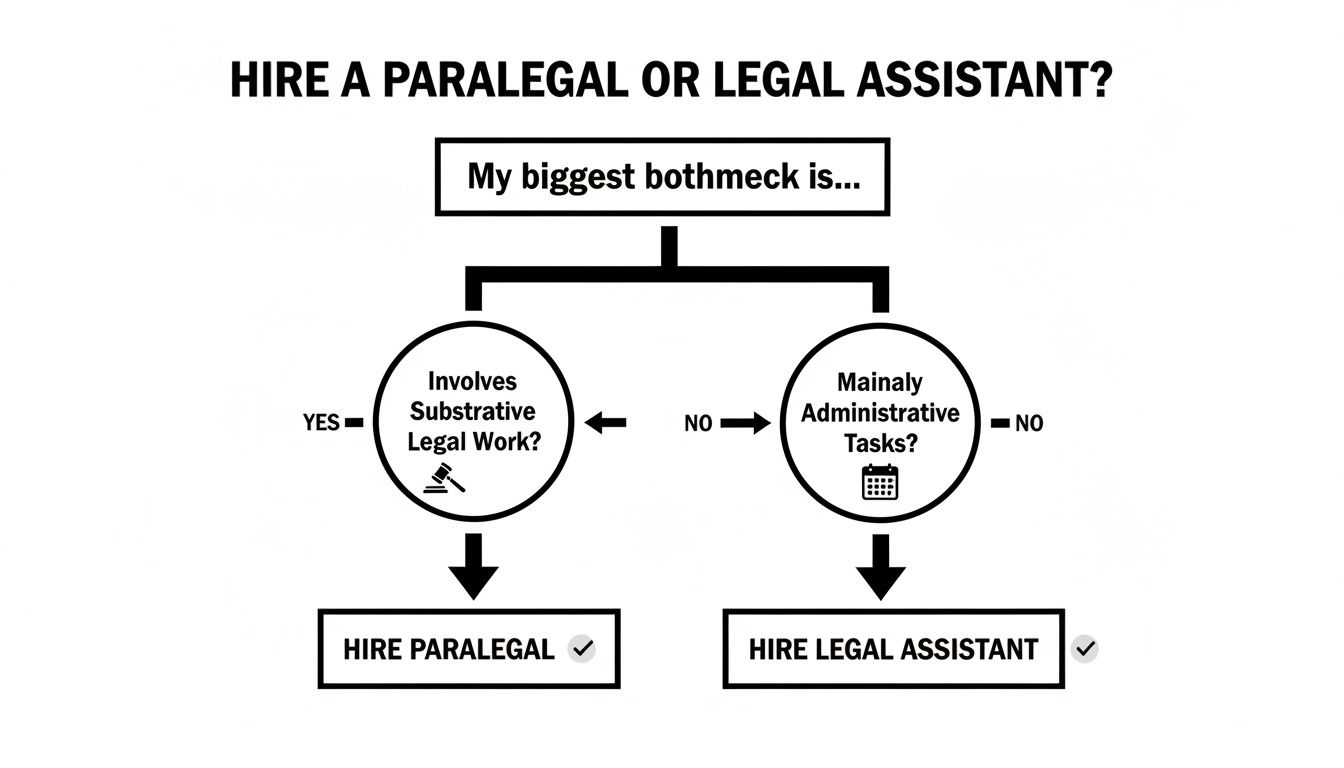
It’s a clear fork in the road. Taking the wrong path is an expensive detour you can't afford.
I’ve seen these scenarios grind dozens of practices to a halt. Find your symptom below, and you'll find your prescription. It’s usually that simple.
Symptom #1: Your Attorneys Are Drowning in Drafts
Your lawyers spend their days drafting routine discovery requests, initial pleadings, and standard contracts. They’re stuck in the document churn instead of focusing on high-level strategy. You're paying attorney rates for work a trained paralegal could crush.
Solution: Hire a Paralegal. Yesterday.
This is the textbook reason to bring on a paralegal. They are trained to own this substantive, often billable, work. A great paralegal can step in and immediately free up your attorneys to do the high-value work only they can do.
The Hard Truth: If your top litigator spends more time formatting interrogatories than prepping for a deposition, you're not just inefficient—you're lighting money on fire. A paralegal plugs that leak.
Symptom #2: Your Office Is a Hot Mess
Deadlines are being missed. Meetings are double-booked. The client intake process is a disaster. Your filing system is a black hole. The operational gears of your firm are grinding to a halt because no one is steering the ship.
Solution: Hire a Legal Assistant. Immediately.
Stop looking at paralegal resumes. Your problem isn't the legal work; it's the lack of an administrative backbone. You need an organizer, a scheduler, a gatekeeper. A legal assistant will build the systems that prevent these fires from starting in the first place.
Symptom #3: Both Problems Are Happening (The "Oh God, We're Growing" Scenario)
Welcome to the next stage of growth. Your attorneys are buried in substantive work, and your administrative systems are buckling. It feels like you need two hires at once, and honestly, you might.
Solution: Triage. Put out the biggest fire first.
Which problem is causing more immediate damage? If operational chaos is leading to missed court dates and angry clients, start with the legal assistant. If your attorneys are so bogged down in billable tasks that they're turning away new business, the paralegal is your priority. Solve the most acute problem, get stable, and then tackle the next one.
Let’s be real. The traditional hiring model is broken. You post a job, pay a small fortune, and get hit with an avalanche of resumes from candidates who are, let's just say, generous with their self-assessments.
Hope you enjoy spending your afternoons fact-checking resumes and running first-round interviews—because that’s now your full-time job. And for what? To compete with every other firm in a 50-mile radius for the same, often overpriced, local talent.
There's a much smarter way to do this.
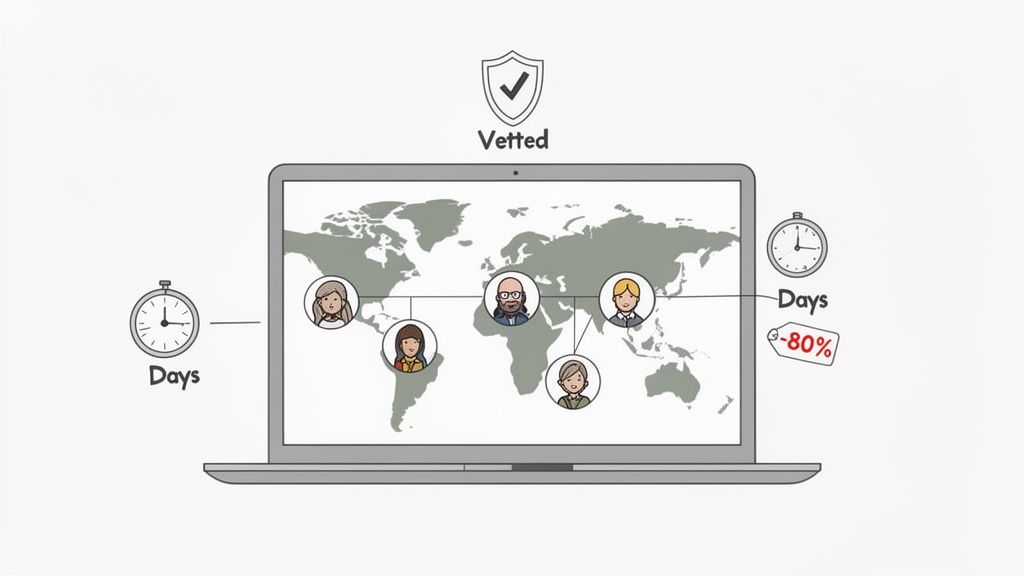
Forward-thinking firms are no longer limiting their search to a zip code. They're tapping into global talent pools to find elite, pre-vetted remote paralegals and legal assistants at a fraction of the cost. This isn’t outsourcing. It’s insourcing top-tier talent directly into your firm, no matter where they are.
Specialized platforms are making this happen, and the results speak for themselves. We’ve seen firms slash their payroll expenses by up to 80% while cutting their hiring timeline from months to days. This isn't magic; it's just a better system. Of course, to make this shift, mastering virtual hiring for remote employees is a critical first step.
The Big Shift: The question is no longer, "Who can I find in my city?" It's now, "Who is the absolute best person for this job, anywhere in the world?" Access to a global talent pool is a massive strategic advantage.
So, how do you find these pros without the usual hiring migraine? The key is a brutal, battle-tested vetting process that filters out the noise and leaves you with a shortlist of proven experts.
Here’s the no-fluff breakdown:
The result? You stop wasting time on unqualified applicants and start interviewing a handful of elite, pre-screened candidates who are ready to make an immediate impact.
Exploring the benefits of virtual paralegal employment can show you how this model can reshape your firm's operations. It's time to stop fighting over the same limited resources and start building a smarter, more scalable practice.
We get these questions all the time, and frankly, some of the answers you find online are way too polite. Here are the straight, no-nonsense answers to what law firm owners really want to know.
Absolutely not. Full stop. This is one of the brightest ethical lines in the legal profession.
A paralegal cannot give legal advice, represent a client in court, or set legal fees. Their work must be supervised by a licensed attorney who takes final responsibility. A legal assistant is even further removed. If anyone other than a licensed attorney is giving legal opinions at your firm, you have a much bigger problem than a hiring bottleneck.
Required? In most states, no. A smart move for any serious firm? Absolutely.
Let me put it this way: would you hire an accountant who decided to skip the CPA exam? Probably not. Most top-tier paralegals have completed an ABA-approved program or hold a certification like the CP from NALA. Hiring a certified paralegal is just smart risk management. It guarantees a baseline of knowledge and ethical training, which means far less hand-holding for you.
The real difference between a paralegal and a legal assistant often comes down to this formal training. One has proven, specialized education; the other excels at making the firm run. Certification is the proof in the pudding.
The single biggest mistake is writing a vague, catch-all job description for a "paralegal/legal assistant" and hoping for the best. This is a giant red flag that screams, "We haven't diagnosed our own problem!"
You have to be brutally honest. Are you trying to solve a substantive legal work problem or an administrative chaos problem? If you're buried in discovery, you need a paralegal. If your office is a disaster zone of missed calls and scheduling nightmares, for the love of all that is holy, hire a legal assistant first.
It all comes down to two things: vetting and systems. This isn't about finding a random freelancer on a gig site and hoping they're not working from a beach in Bermuda—that’s a recipe for disaster.
Truly effective remote hiring hinges on a ruthless vetting process that tests for actual legal skills, professionalism, and killer communication. You don't just want someone who says they can manage a case file; you want someone with a proven track record of doing it for firms just like yours.
The key is to work with pre-vetted professionals who are already experts in remote collaboration. When you do that, you're not just managing an employee; you're partnering with an autonomous expert who knows how to deliver. It’s a completely different ballgame.


