

 16 minutes read
Let's cut the fluff. The core difference between a legal secretary and a paralegal boils down to one thing: a legal secretary runs the office, while a paralegal helps run the case. Think of it like this: your secretary is the air traffic controller keeping the planes from crashing. Your paralegal is the co-pilot in the cockpit, helping you navigate.
One handles administrative logistics; the other performs substantive, billable legal work under your direction. Simple, right?
I see this mistake constantly. You're drowning in work, and the knee-jerk reaction is to throw money at the problem by hiring someone. But hiring a paralegal to answer phones is like using a sledgehammer to crack a nut—an expensive, soul-crushing waste of their talent. On the flip side, asking your secretary to draft a motion isn’t just a bad idea; it's an ethical minefield.
Getting this wrong isn't a simple HR oopsie. It's a costly blunder that blows up your budget and grinds your firm to a halt. Let's clear up the confusion once and for all, so you hire the right person for the right job, the first time.
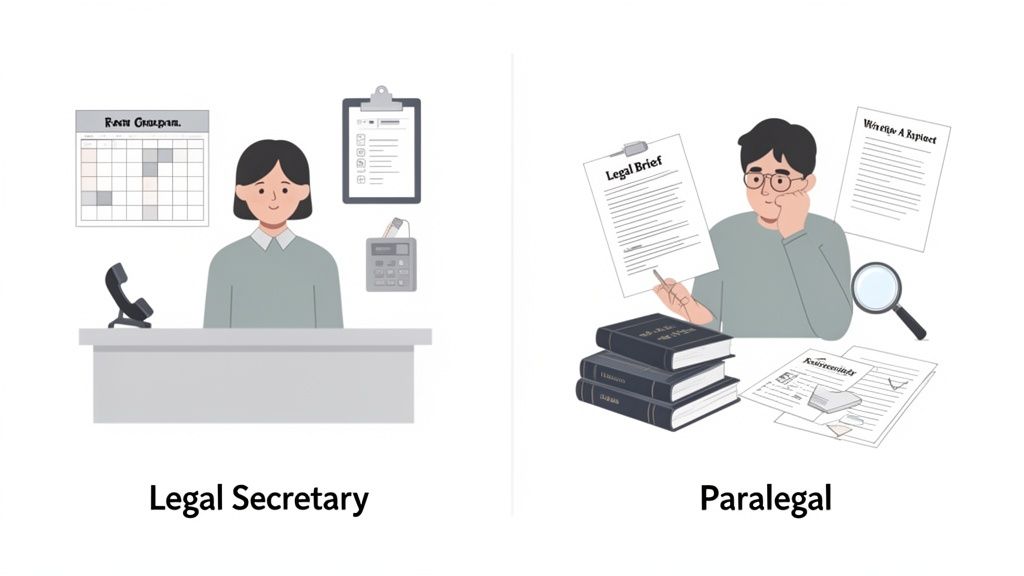
To make this decision, ask yourself one brutally honest question: is my biggest headache administrative chaos or a legal work bottleneck?
Legal Secretaries are the undisputed masters of your firm's administrative universe. They’re the ones wrestling with attorney calendars, charming opposing counsel's assistant to schedule a deposition, and ensuring documents are filed with the court before the 5 PM deadline hits. They're the operational hub that keeps your practice from imploding.
Paralegals step in to handle the tasks that would otherwise devour an attorney's precious, high-value time. We're talking deep-dive legal research, drafting initial pleadings, and assembling everything you need for trial. Their work is a direct input into your legal strategy. For a closer look, our guide on what a litigation paralegal does gets into the nitty-gritty.

The Money Shot. Here’s the real distinction: a paralegal's work is a revenue-generating asset you can bill to clients. A legal secretary’s work is essential firm overhead—absolutely critical, but not directly billable.
To make it even clearer, let's put them head-to-head.
This isn't about which role is "better." It's about which one solves your most painful problem right now. Get this right, and you look like a genius. Get it wrong, and hope you enjoy spending your afternoons fact-checking filing procedures instead of practicing law.
| Attribute | Legal Secretary | Paralegal |
|---|---|---|
| Primary Focus | Administrative and clerical support | Substantive legal work |
| Core Duties | Scheduling, client calls, filing, billing | Legal research, drafting documents, case management |
| Billable Work | No, functions as firm overhead | Yes, tasks are often billable to clients |
| Education | High school diploma, optional certificate | Associate's or bachelor's degree in paralegal studies |
Understanding this table is step one. Misjudging these roles is how you end up with a very expensive, very bored employee—or worse, a very serious mistake.
Let's ditch the formal definitions and talk about what these roles actually look like on a Monday morning when three deadlines are breathing down your neck. Because theory is useless when a crisis hits. You need to know exactly who's grabbing the fire extinguisher.
Forget generic job descriptions. I’ll walk you through a couple of real-world scenarios I’ve seen play out more times than I care to admit.
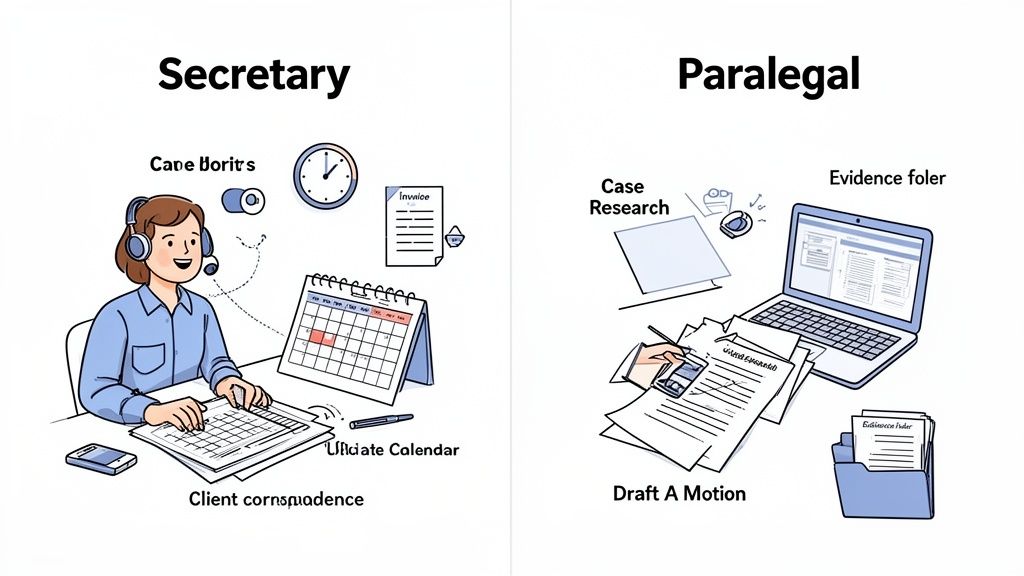
Picture it: summary judgment is next week. The pressure is on. Your office is a blur of motion, and you need flawless execution.
The Legal Secretary’s Day:
In this chaos, your legal secretary is the operational commander. Their day is a masterclass in logistics, focused on keeping the administrative machine from flying off the rails.
Without a killer legal secretary, your perfectly crafted argument might never get filed. They are the gatekeepers of process.
While the secretary manages the process, the paralegal is elbow-deep in the substance. Their work directly shapes the arguments you’ll make in court. They aren't just supporting the case; they're helping build it.
The Paralegal’s Day:
A paralegal's to-do list looks suspiciously like a junior attorney's. Their tasks are substantive, analytical, and almost always billable.
In this fire drill, the paralegal is your force multiplier, handling substantive work that frees you to focus on high-level strategy. The legal secretary is your safety net, ensuring no administrative detail derails the entire effort. One without the other is a recipe for disaster.
Now, let's swap litigation chaos for the methodical precision of transactional law. A big commercial real estate deal closes this week.
The legal secretary’s job is to make the entire process feel effortless. They schedule the closing, coordinate with the title company, and manage the flow of signed documents. They’re the ones making sure everyone is where they need to be, when they need to be there.
The paralegal, meanwhile, is buried in the deal itself. They're reviewing title commitments, drafting closing documents, and preparing the final closing statement for your review. Following the best practices for contract management is their bible.
See the pattern? The legal secretary owns the process; the paralegal owns the substance. Confusing them is like asking your co-pilot to serve drinks while the flight attendant lands the plane. Good luck with that.
Let's get straight to the bottom line: the salary gap between a legal secretary and a paralegal isn't random. It’s a direct reflection of the investment in their training and the specialized skills they bring to your firm. One role is built on administrative mastery; the other is rooted in substantive legal knowledge.
Getting this wrong means you either overpay for admin support or, far worse, leave your firm dangerously under-equipped to handle the actual legal work.
Becoming a top-tier paralegal isn’t an accident; it's a deliberate career choice demanding a serious educational foundation.
The Takeaway: You're paying a paralegal for their specialized brain. Their training allows them to perform substantive, billable work that directly impacts your bottom line.
A great legal secretary is an administrative force of nature, and their training is geared entirely toward operational excellence. While the formal education is different, the skills they master are non-negotiable for a functioning law firm.
This is why paralegal roles almost always demand 3-5 years of experience, while a huge chunk of legal secretary positions—around 44%—are open to entry-level candidates with the right administrative chops. For more on this, you can find some great insights on legal career paths.
So, what does their skill set look like?
A legal secretary is the engine of your practice. They master the process. A paralegal helps manage the case. Two different skill sets, two different price tags.
Let’s talk numbers. A full-time paralegal is a significant investment, and they damn well should be. Their ability to handle substantive, billable work frees up your attorneys to do what they do best: practice law at a high level and bring in new clients.
A legal secretary, while essential, is a critical operational cost—the glue holding the practice together. Mistaking a revenue-generating asset for necessary overhead is a classic rookie mistake that quietly bleeds firms dry.
The U.S. Bureau of Labor Statistics lays it out clearly: the median annual wage for paralegals was $66,510, while legal secretaries earned a median of $60,320.
That’s a $6,000 gap right there. For senior talent, that difference can easily double. And for the top 10% of paralegals? They’re clearing over $98,990.
So why the 10-20% premium? You're paying for specialized training, analytical skills, and the ability to perform work that directly generates revenue.
The salary is just the start. The real cost is getting the hire wrong.
Hiring a paralegal to do a secretary's job is a fantastic way to overpay for admin tasks while ensuring your new hire is bored, miserable, and gone in six months. On the other hand, asking a secretary to handle paralegal duties is a shortcut to shoddy work, missed deadlines, and ethical landmines.
The most expensive hire is the one you have to make twice. The true cost isn't the salary; it's the lost billable hours and the time you'll spend cleaning up the mess.
Before you write a single job description, use this decision tree.
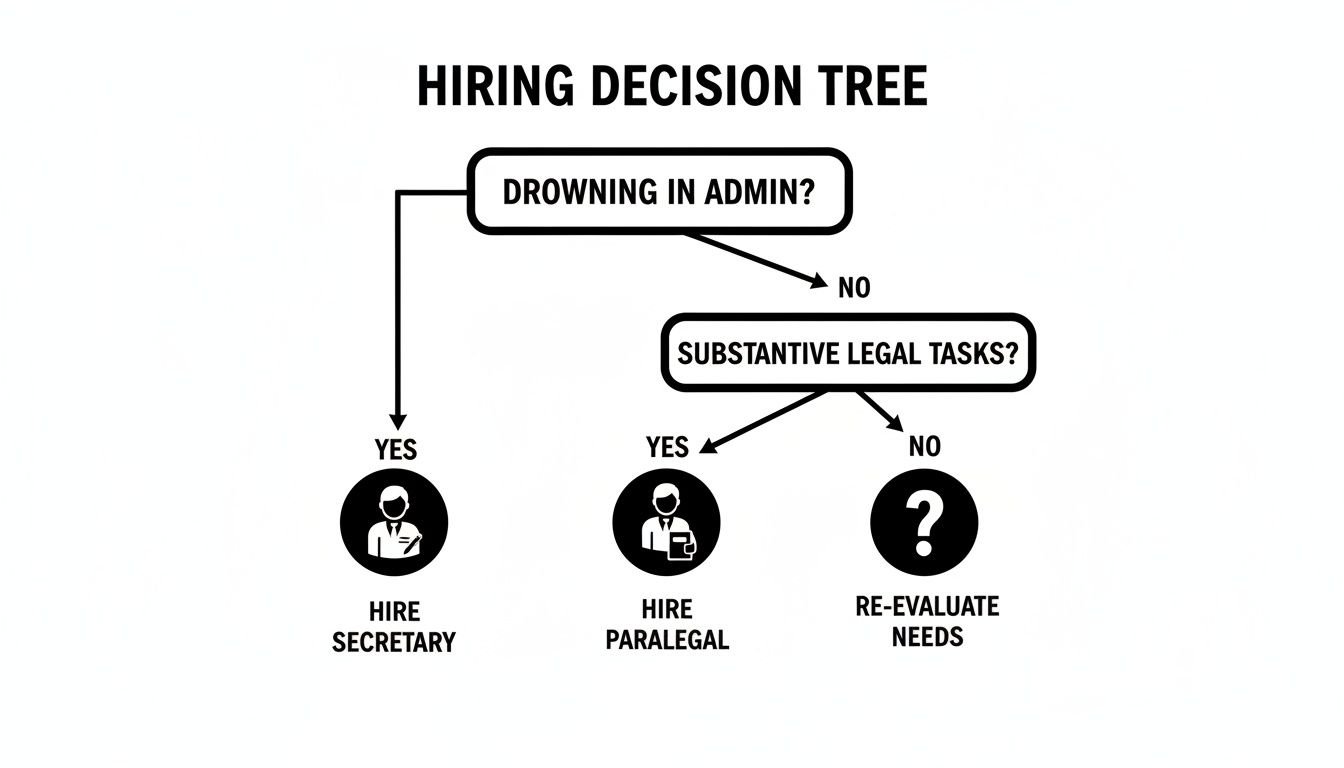
It’s painfully simple: if your pain is administrative chaos, you need a secretary. If your bottleneck is the legal work itself, you need a paralegal.
Turns out there’s more than one way to get elite legal support without mortgaging your office ping-pong table. The traditional in-house hire comes with a hefty price tag: payroll taxes, benefits, office space.
But what if you could slash those costs by up to 80%? Tapping into a curated network of pre-vetted remote paralegals changes the game. You get access to specialists without the fixed costs of a full-time employee.
This isn’t about finding cheap labor; it’s about making a smarter investment. We get into the actual numbers in our deep dive on typical paralegal hourly rates. It's a model that gives you top-tier expertise with the flexibility to scale up or down as your caseload demands.
Alright, we've dissected the roles and talked numbers. Now for the million-dollar question: who do you hire? The truth is, there’s no magic answer. The right hire depends entirely on where your firm is bleeding time and money. Think of it as a diagnosis, not a preference.
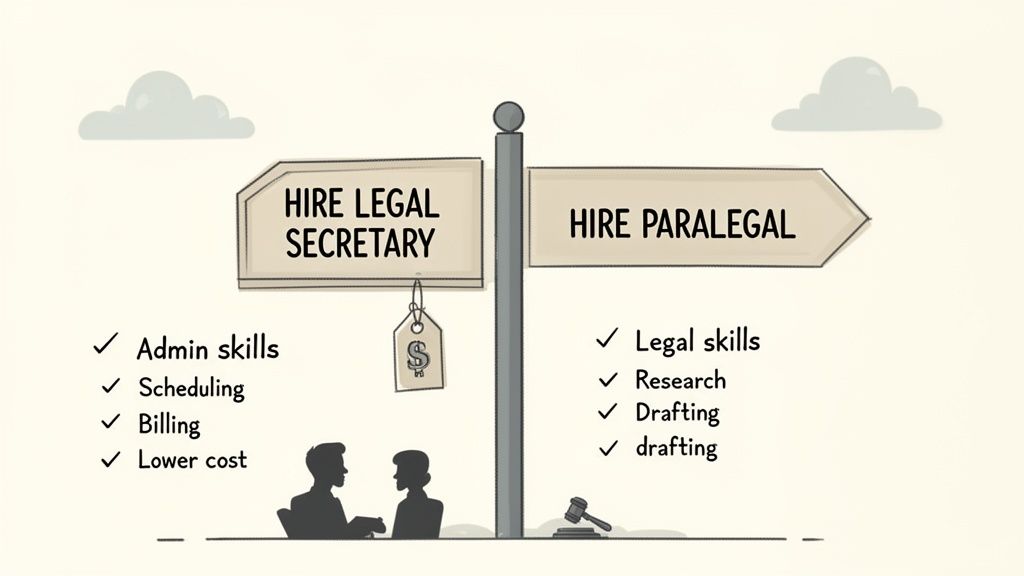
You know the scene. You're the rainmaker, the lead attorney, the IT guy, and—let's be real—the receptionist. Your biggest pain isn't complex legal research; it's the soul-crushing admin work. You’re missing calls from potential clients, your calendar is a disaster, and you haven't sent an invoice in weeks. Sound familiar?
Your Verdict: Hire a Legal Secretary or a killer Virtual Assistant, and do it yesterday. You aren't bogged down by substantive work; you're being suffocated by the logistics of running a business. A paralegal is overkill.
Your first hire should create order from chaos. This frees you up to actually practice law. Many firms also find that a specialized answering service for law offices is a great first step to cover the front lines.
Your firm has five, maybe ten attorneys. The admin side is handled. The problem? Your growth has flatlined.
Your attorneys are spending way too much time drafting standard discovery, summarizing depositions, and doing initial research. Their billable hours are tanking because they're stuck in the weeds. This is the definition of a bottleneck.
Your Verdict: You need a team of Paralegals, and using remote talent is a smart way to do it. Your problem isn't administration; it's leverage. A secretary can't draft a motion. A skilled paralegal can take on 70% of the prep work eating your attorneys' time, directly multiplying your firm's revenue capacity.
Pro Tip: Don't think you have to choose. The smartest firms build hybrid teams. They use sharp secretaries for administrative command and deploy remote paralegals as a strategic, scalable force. It’s not either/or; it’s both/and.
You're in-house. The C-suite sees you as a cost center and wants you to do more with less. Your team is stretched thin managing contracts, compliance, and internal investigations. You can't justify another full-time attorney, but the workload isn't shrinking.
Your Verdict: Bring on specialized Paralegals on a contract basis. Your problem is a lack of specialized, high-volume support. You need someone who can manage the entire contract lifecycle or organize a mountain of e-discovery data. A secretary can’t do it, and an attorney is too expensive. A remote paralegal is the perfect, budget-friendly solution.
To make it even simpler, find your pain point in the table below.
| Your Firm's Challenge | The Smartest Hire | Why This Is the Solution |
|---|---|---|
| Missed calls, chaotic scheduling, and late billing. | Legal Secretary / Virtual Assistant | Your bottleneck is purely administrative. You need an organizational expert to manage the business so you can practice law. |
| Attorneys are bogged down by research and document drafting. | Paralegal (likely remote) | You have a leverage problem. A paralegal handles billable-level work at a lower cost, freeing up attorney time for high-value strategy. |
| Overwhelming contract volume and compliance tasks. | Specialized Contract Paralegal | Your need is for scalable, substantive legal support. This role directly addresses the workload without the cost of a new attorney. |
Ultimately, this comes down to an honest assessment of what’s holding you back. Once you identify the real problem, the right hire becomes obvious.
Alright, let's tackle the questions I hear all the time. No jargon, just straight answers.
Technically, yes. And it's a terrible idea.
A paralegal can answer phones and manage calendars. But you're paying a premium for them to do work far below their skill level. It's like asking a surgeon to put on band-aids. They can do it, but you're wasting their expertise and your money.
The second you have a paralegal spending their day on admin work, you’ve lit a pile of money on fire. The core difference between a legal secretary and paralegal is this exact distinction. Respect it.
This one’s a no-brainer: the paralegal.
Their work is substantive—legal research, document drafting, discovery management. This time is almost always billable, generating direct revenue.
A legal secretary’s duties are critical administrative overhead. It's a cost of doing business, not a service you bill to a client. Confusing the two is a fundamental misunderstanding of law firm economics.
Not always. It depends on your firm’s size and biggest bottleneck.
The most efficient firms I know don't see this as an "either/or" choice. They build a hybrid system: secretaries provide the administrative backbone, and paralegals deliver the substantive firepower. One keeps the engine running; the other provides the horsepower.
Let’s be real: technology isn't making either role obsolete, but it is forcing them to evolve.
The old-school legal secretary role is changing. AI and automation can handle repetitive tasks like basic scheduling. The modern legal secretary is a tech-savvy administrative pro with project management skills. They aren't disappearing; they're upskilling.
The paralegal role, on the other hand, is becoming more critical. As firms hunt for cost-effective ways to deliver services, they lean more heavily on paralegals for substantive work. Their analytical and critical thinking skills are much harder to automate.
So, are the jobs changing? Absolutely. Are they going away? Not a chance. The key difference between a legal secretary and a paralegal will only get sharper. The smart move is to hire for the skills you need tomorrow, not the ones that worked yesterday.


