 15 minutes read
You're probably living this right now.
A partner is billing at partner rates while digging through agency records, cross-checking a consultant's sampling report, and trying to remember whether that filing belongs in PACER, CM/ECF, or the folder some associate named “final_FINAL_use_this_one.” Meanwhile, the client thinks you're “just reviewing documents.” Sure.
The old model says you throw more attorney hours at the mess and call it diligence. I've done that. It's expensive, sloppy, and a ridiculous use of legal talent. Environmental matters punish firms that confuse smart lawyers with efficient systems.
The firms that handle this work cleanly usually have one thing in common. They stop treating the environmental law paralegal like back-office support and start utilizing the role strategically.
Last week's version of this problem probably looked familiar. An expert sends over technical material on air or water quality. A regulator's deadline is closer than anyone wants to admit. A client emails asking for a “quick update,” which is never quick. One of your attorneys is stuck organizing reports instead of building strategy.
That's not a staffing inconvenience. That's margin leak.

Environmental matters create a special kind of disorder because the work isn't just legal. It's legal plus science plus agency procedure plus document volume. If your team isn't built for that mix, even routine tasks become expensive.
A generalist can help with filings. Fine. But when the case turns on interpreting technical reports, coordinating expert materials, and keeping administrative tasks from swallowing the calendar, “fine” stops being fine.

Practical rule: If a partner is spending real time wrangling records, exhibits, or scientific support materials, your staffing model is already broken.
Here's the ugly version of the day-to-day:
Environmental law punishes imprecision. A missed detail in a standard commercial matter might be annoying. In an environmental matter, the same sloppiness can scramble strategy, waste attorney review time, and make the whole file harder to manage.
And let's be honest. Most firms don't notice the problem until attorneys are already underwater. They think they need “more hustle.” What they usually need is a specialist who can carry the operational load of a complex matter without constant supervision.
That's the shift. Not more bodies. Better role design.
An environmental law paralegal isn't just a paralegal who happens to sit near the regulatory team. The good ones are the connective tissue between legal strategy, technical evidence, and the administrative machinery that keeps a case moving.
Think of the attorney as the trial captain. The environmental law paralegal is the navigator who knows where the shoals are, which forms matter, what records are missing, and why that expert's report needs to be organized before it becomes tomorrow's emergency.

The role is specialized because the work is specialized. An environmental law paralegal has to handle the legal process and understand the scientific texture of the matter well enough to support the attorneys intelligently. That includes working with expert materials and navigating the records and research flow that environmental cases generate.
The hiring market reflects that pressure. Employment of paralegals and legal assistants is projected to show little or no change from 2024 to 2034, yet about 39,300 openings are projected annually on average due to turnover and replacement needs, and environmental work is pushed by regulatory demands that make tools like Relativity, Westlaw, and LexisNexis standard parts of the job, according to the Bureau of Labor Statistics occupational outlook for paralegals and legal assistants.
That matters because you're not hiring for generic support. You're hiring for a role that can hold together messy, technical, high-volume work without needing hand-holding every ten minutes.
A strong environmental law paralegal creates value in four ways:
The firms that win with this role don't use it as overflow labor. They use it as operational control.
There's also a practical upside people skip over. Environmental matters often involve interviews, meetings, deposition prep, and technical discussions that need to be turned into reliable written records fast. If your team is still cobbling that together manually, this guide to tools for legal transcription is worth a look. It's the kind of workflow support that keeps a specialized paralegal moving instead of re-listening to audio for half the day.
A mediocre paralegal “assists.” An elite environmental law paralegal clears bottlenecks before attorneys even notice them.
That's the difference.

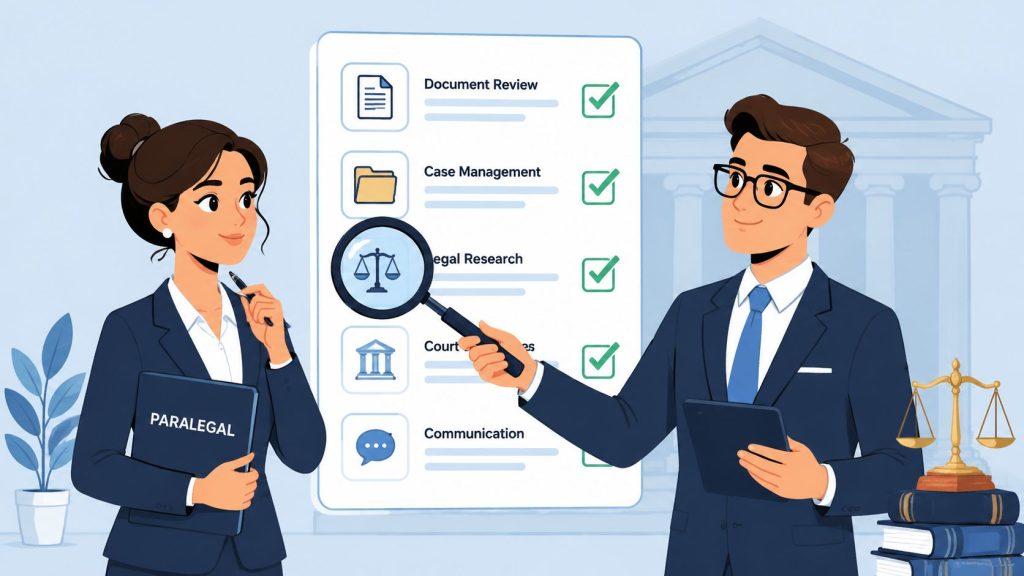
The role gets valuable when it moves from generic support into disciplined execution. Core duties include filing OPRA and FOIA requests to obtain government records, reviewing PACER and CM/ECF documents for discovery, managing electronic and paper case files, and conducting legal research using Lexis, with proficiency expected in Microsoft Office, Concordance, or similar document review software, as described in this overview of environmental paralegal job duties.
That single sentence tells you almost everything about why this role matters. Government records. Federal court systems. Discovery flow. Research. File management. That's not clerical fluff. That's the infrastructure of the case.
Here's what I look for in actual performance, not résumé poetry:
If your team handles multilingual documents, foreign supplier records, or cross-border materials, speed matters as much as accuracy. That's where a service for urgent document translation can fit cleanly into the workflow. Not glamorous, but neither is missing a deadline because a critical exhibit sat untranslated.
Environmental work doesn't reward people who are “pretty quick learners” with legal tech. You want someone already comfortable with the systems your matters depend on.
A useful benchmark is whether the candidate can discuss tools and workflow in concrete terms, including document databases, docket systems, and research platforms. If your team is still deciding what belongs in the stack, this roundup of legal research databases is a practical starting point.
If a candidate talks vaguely about being “detail-oriented” but can't explain how they track records, review dockets, or structure discovery, keep interviewing.
The best environmental law paralegals also create continuity. Associates rotate. Partners get pulled into hearings, clients, and fire drills. A sharp specialist keeps the matter coherent while everyone else is busy being important.
That coherence is where profit shows up. Not in a slogan. In cleaner execution, fewer avoidable attorney hours, and less daily nonsense.
Let's talk about the number everyone dances around.
A specialized environmental law paralegal should cost more than a generalist. Good. That's how markets work when skill matters.

The compensation gap exists for a reason. The national mean annual salary for general paralegals is $66,510, while specialized environmental paralegals average $71,376 per year as of June 2026. Top earners in the 90th percentile reach $103,500, according to ParalegalEDU's environmental paralegal salary overview.
That's not a rounding error. That's the market pricing in niche knowledge, tougher workflows, and the ability to support matters involving environmental regulations and technical material.
The cheapest hire is often the most expensive one in practice. Not because they're lazy. Because environmental work is unforgiving, and every gap in judgment gets paid for somewhere else. Usually by an attorney whose time costs much more.
Here's the business lens I use:
| Cost question | Better question |
|---|---|
| What salary can we get away with? | What level of specialization keeps attorneys out of admin quicksand? |
| Can a generalist learn this? | How much partner and associate time will that learning curve consume? |
| Do we really need one? | What is it costing us to have lawyers do this work now? |
If you need context for how firms think about pricing support work, this guide to paralegal hourly rates is useful. Just don't make the classic mistake of comparing a specialist's rate to a generic support role and pretending they produce the same outcome. They don't.
Pay for judgment in process. Pay for software fluency. Pay for someone who can touch a technical file without turning it into a scavenger hunt.
A specialist paralegal isn't on the payroll to save money in the abstract. They're there to stop your most expensive people from doing the wrong work.
That's why I call the role a profit-center. Not because the paralegal magically prints revenue. Rather, they free senior attorneys to do the work clients want to pay senior attorneys for.
Most firms wait too long.
They wait until the partner is triaging inboxes at night. They wait until expert materials are spread across email threads, shared drives, and somebody's desktop. They wait until every case update meeting begins with ten minutes of “who has the latest version?”
That's not prudence. That's avoidance dressed up as discipline.
You should hire when any of these start showing up consistently:
Here's my slightly cynical view. Traditional hiring loves overhead because overhead looks respectable. Big office. Full-time seat. Long hiring cycle. Endless interviews. Then everyone acts surprised when utilization doesn't line up with demand.
Remote and fractional support is usually the smarter first move. You get targeted capability without pretending every matter requires a permanent in-house hire from day one.
That model works especially well when you need:
One option in that category is HireParalegals, which connects firms with remote legal support for specialized practice areas, including environmental law. That kind of model fits firms that need vetted help without building a full traditional hiring process around a role they may want to scale gradually.
A lot of partners still think “serious” hiring means full-time and in-house. I used to think that too. Toot, toot.
But seriousness isn't measured by square footage or whether someone can admire your conference room art in person. It's measured by whether the work gets done cleanly, consistently, and without turning attorneys into project managers.
If the volume becomes steady and predictable, fine. Bring the role in-house. Until then, buy capability, not ceremony.
Most firms hire this role backward.
They start with a generic job description, ask generic interview questions, and then wonder why the “environmental” paralegal they hired can't do much beyond basic file support. Hope you enjoy spending your afternoons fact-checking resumes and running functional interviews, because that's now your side job.
There's a better way.
First, stop being dazzled by polished legal-adjacent résumés. You need evidence of fit, not vibes.
I'd prioritize these signals:
For the nuts and bolts of structuring the search itself, this guide on how to hire a paralegal is a practical place to start.
Ask questions that force specificity. Generalists can fake enthusiasm. They struggle to fake process.
| Question Category | Sample Question |
|---|---|
| Scientific literacy | How would you organize and summarize a technical report so an attorney can use it quickly in a strategy meeting? |
| Government records | Walk me through how you'd approach an OPRA or FOIA request when the client doesn't know exactly what records exist. |
| Discovery workflow | How do you review PACER or CM/ECF materials and keep the team from losing track of key filings? |
| Research judgment | When do you start with Lexis or Westlaw, and when do you go straight to agency materials? |
| File management | Describe your folder structure and naming conventions for a document-heavy environmental matter. |
| Remote execution | How do you keep attorneys updated without flooding them with useless status messages? |
Ask for a recent example of a messy matter they helped organize. Then listen for systems, not adjectives.
A good hire can still fail if your onboarding is sloppy. Firms often sabotage themselves in this manner. They hire a capable person, then give them no map, no matter taxonomy, and no clear communication rules.
Borrow from sensible cross-industry guidance like Steingard Financial's onboarding advice, then make it legal-specific. The principle is simple. Early clarity beats late correction.
Use a simple onboarding checklist:
The best onboarding I've seen isn't fancy. It's boring, explicit, and repeatable. Which, in legal operations, is a compliment.
If you're still thinking about an environmental law paralegal as a nice-to-have support role, you're looking at the problem from the wrong end.
This hire is about optimizing resources. It's about taking scientific evidence, agency process, record collection, file discipline, and research workflow off the plates of people who should be doing analysis, negotiation, and courtroom work. That shift changes margin, speed, and sanity all at once.
You do not need more attorney heroics. You need cleaner systems with the right specialist sitting in the middle of them.
That's why the remote or fractional route makes so much sense for many firms. You get the capability before you commit to the old parade of overhead, office logistics, and hiring theater. Toot, toot.
Here's the only question that matters. Is your current team structure built to grow environmental work profitably, or are you still treading water while expensive lawyers do jobs someone else should own?