

 23 minutes read
Let's be blunt: a bad hire is far more than just a wasted salary. It's a productivity black hole, a morale killer, and a client-relations time bomb waiting to go off. Before we dive into how to hire a legal assistant, we need to get real about why it's so critical to get this right the first time. I've learned this the hard way so you don't have to.

We've all been there. You’re drowning in administrative tasks, and you start telling yourself that any warm body who can answer a phone will do. You rush a generic job ad out the door, hire the first person with a decent-looking resume, and breathe a huge sigh of relief.
That relief lasts about a week.
Suddenly, you’re spending your billable afternoons fixing their botched e-filings and proofreading emails that make you cringe. Your star paralegal is quietly fuming because they’re now redoing the new hire’s work on top of their own. Trust me, mortgaging your firm's sanity for a cheap or hasty hire is a terrible trade.
The obvious cost is the salary you’re paying for subpar work. But the real damage goes much deeper and is far more expensive. Just think about the billable hours you, a partner, are losing while supervising, correcting, and re-training someone who just isn't cutting it.
Let’s put some real numbers on that. If a partner billing at $400/hour spends just five extra hours a week fixing mistakes, that’s $2,000 a week in lost revenue. That's over $100,000 a year straight out of the firm's pocket. And that doesn't even begin to touch on the ripple effects.

A bad hire isn't just an expense; it's a negative asset. They actively drain resources from your most valuable people, creating a downward spiral of lost productivity and sinking morale.
The financial hit is really just the beginning. A poorly chosen legal assistant can poison your firm's culture and reputation from the inside out.
Here’s the unfiltered breakdown of the collateral damage:
This isn’t about finding someone to just answer the phones; it’s about hiring the administrative backbone of your entire practice. Consider this guide the tough-love intervention you need before you post another bland job ad. We'll show you how to get it right.
Let’s be honest. Your current job description is probably boring. It reads like a laundry list of duties you copied from a template, full of stale phrases like "detail-oriented" and "team player."
That kind of language doesn't attract the superstar who can manage a chaotic discovery calendar while spotting a typo in a contract from across the room. It attracts everyone. And when you write for everyone, you end up hiring no one special.
A great job description isn't just a net; it's a filter. It should actively repel the wrong candidates and magnetically pull in the right ones. Think of it as your first and best tool to stop wasting time on interviews that were doomed from the start.
You need to stop listing what they’ll do and start selling them on what they’ll be. Are they just "answering phones," or are they the "Director of First Impressions," the person who sets the tone for every single client interaction? Are they "managing calendars," or are they the "Strategic Operations Coordinator" who ensures the partners are always in the right place at the right time?
Titles matter. They reframe a role from a collection of chores into a mission. This isn't about being fluffy; it’s about showing a candidate that their work is valued and has a genuine impact on the firm’s success.
Your job description is your opening argument. If it’s weak, generic, and uninspired, you’ve already lost the case for attracting top talent before the first resume even lands in your inbox.
Think about the actual, real-world problems you need this person to solve. Then, frame their responsibilities around those challenges.
Instead of: "Filing documents with the court."
Try: "Own the e-filing process for all civil litigation matters, ensuring 100% of deadlines are met and documents are flawlessly submitted via our state and federal portals."
Instead of: "Client communication."
Try: "Serve as the primary point of contact for client inquiries, providing empathetic, professional, and prompt updates that build trust and reduce client anxiety."
See the difference? One is a task. The other is a responsibility with a clear purpose and a measurable outcome. High performers are always drawn to purpose, not just a to-do list.
It's time to get brutally honest about what you actually need. You have your non-negotiable hard skills—the technical abilities someone either has or they don’t. Then you have the soft skills, which are harder to quantify but are often the true predictor of long-term success in a role.
Your job description has to clearly separate the two.
Non-Negotiable Hard Skills (The "Don't Bother Applying If" List):
Crucial Soft Skills (The "This Is Who Thrives Here" List):
When you're this specific, you're doing more than just listing qualifications. You’re painting a vivid picture of the exact person who will succeed in your unique environment. You’re giving the wrong candidates an easy off-ramp and the right one a compelling reason to get genuinely excited about the opportunity.
If your entire hiring strategy is just posting an ad on a massive job board and praying for the best, you’re doing it wrong. Hope you enjoy spending your afternoons fact-checking resumes and running endless interviews—because that’s now your full-time job. You're fishing in a crowded, murky pond and wondering why you only catch old boots.
The truth is, the best legal assistants are almost always passive candidates. They’re happily employed, absolutely crushing it for another firm, and aren't doom-scrolling job sites on their lunch break. To find them, you have to stop broadcasting and start hunting.
Let’s be honest: the big job boards are a volume game, not a quality one. You’ll get a hundred applicants, and maybe two are worth a phone screen. It’s a soul-crushing time sink designed to make you feel productive while you’re actually just drowning in mediocrity.
You need to go where the pros hang out. Think niche, think exclusive, think smarter.
The goal isn’t to get the most applicants; it’s to get the right ones. A single referral from a trusted source is more valuable than a hundred random resumes from the internet.
Now for the big question: does this person need to be sitting ten feet from your office? The legal world has been notoriously slow to adapt, but the talent pool for remote work is simply undeniable. The legal job market is fiercely competitive, with job openings surging by nearly 50% year-over-year. Despite this, a staggering 62% of new legal job postings are still for on-site roles, showing a cautious but definite shift toward flexible work is underway. If you want to dig into the numbers, you can explore a detailed legal roles in demand analysis.
Deciding between an in-house hire, a remote employee, or a virtual assistant isn't just about preference; it's a fundamental business decision that impacts your budget, workflow, and firm culture.
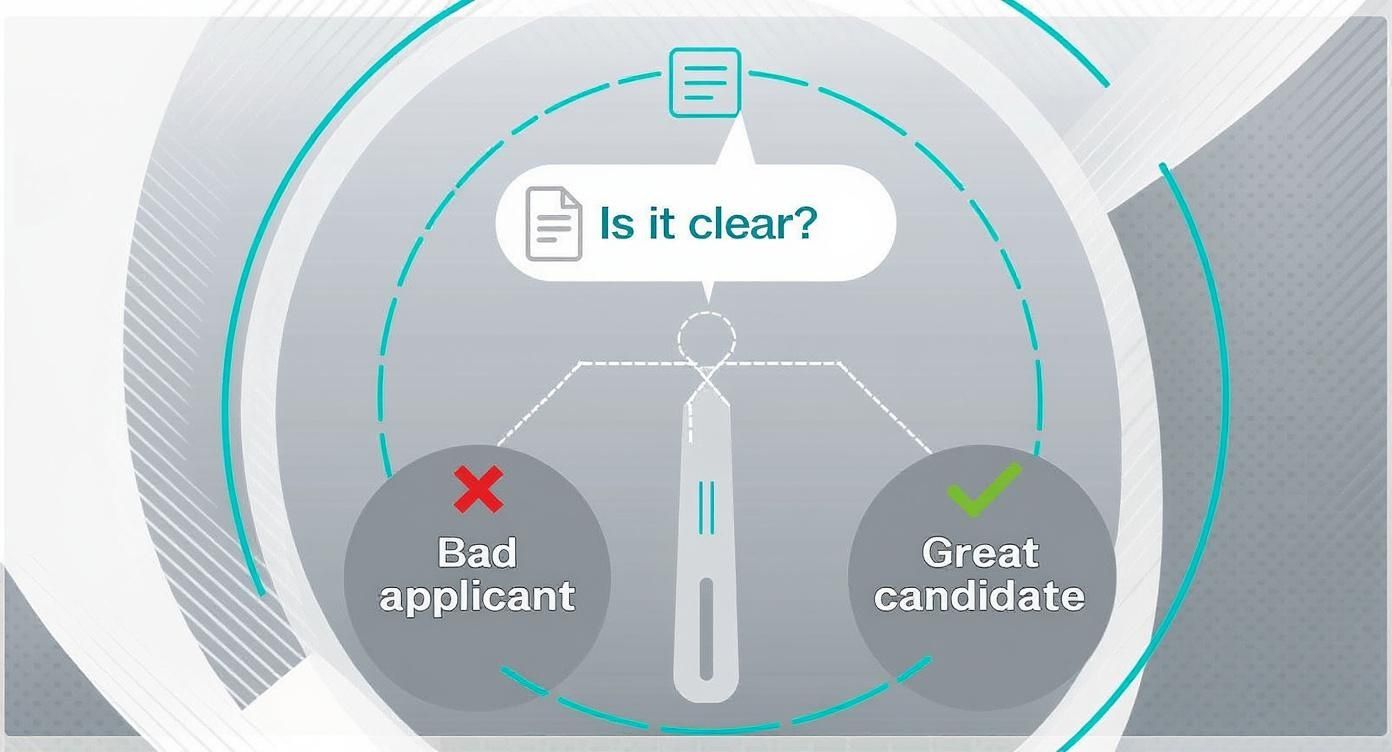
This image hammers home a key point: clarity at the start of the process is the single best predictor of finding a quality candidate, regardless of where they'll be working.
So, which path is right for your firm? It really comes down to weighing the trade-offs between control, cost, and scalability. This table breaks down the key differences to help you make an informed decision.
| Factor | Full-Time In-House | Full-Time Remote (Direct Hire) | Virtual Assistant Service (Fractional) |
|---|---|---|---|
| Cost & Overhead | Highest (Salary + benefits, payroll tax, office space, equipment) | Medium (Salary + benefits, payroll tax, potential tech stipend) | Lowest (Flat hourly or monthly fee, no benefits/payroll tax) |
| Talent Pool | Limited to your local commuting area | National or even global, access to top talent anywhere | Access to a pre-vetted pool of specialized professionals |
| Control & Oversight | Maximum direct supervision and hands-on management | High, but requires structured communication and PM tools | Lower direct control; managed through a service provider |
| Cultural Integration | Easiest; they absorb culture by being physically present | Requires deliberate effort (virtual events, clear communication) | Minimal; they are a service provider, not an employee |
| Flexibility/Scalability | Low; fixed hours and salary, difficult to scale up or down | Low; still a full-time commitment for the firm | Highest; easily scale hours up or down based on workload |
| Best For… | Firms needing deep cultural integration and on-site tasks (e.g., mail, court runs) | Firms looking for top talent regardless of location and with strong remote systems | Firms with fluctuating workloads or needing specialized help without a full-time hire |
Ultimately, choosing the right channel to hire a legal assistant depends entirely on your firm's immediate needs and long-term goals. Stop fishing where everyone else is. It's time to start hunting where the real talent hides.
A resume tells you what a candidate claims they’ve done. A great interview tells you what they can actually do.
If you’re still asking tired questions like, “What’s your biggest weakness?” you might as well just flip a coin. You’re going to get a canned answer about being “too much of a perfectionist.” It’s time to turn your interview from a friendly, useless chat into a strategic assessment.
Forget what they say; let's see what they do.
Before you waste a single billable hour on an in-person meeting, you need a ruthless phone screen. This isn’t an interview; it’s a disqualification round. Your goal is to weed out the 80% of applicants who look good on paper but can't handle the basics.
Keep it to 15 minutes, tops. You’re testing for three things and three things only:
This quick call will save you countless hours. If they can’t impress you in 15 minutes, they won’t impress you in 60.
Talk is cheap. Anyone can say they’re detail-oriented. The only way to know for sure is to test them. A practical skills assessment is non-negotiable if you want to hire a legal assistant who won’t drive you insane.
This isn’t about hazing them; it’s about simulating the actual job. Set up a short, 30-minute test with tasks they would genuinely be doing from day one. This small investment of time upfront will save you from months of agonizing frustration later.
A good skills test is your crystal ball, showing you exactly how a candidate will perform under pressure. Below is a blueprint for a test that assesses the skills that truly matter.
| Skill Category | Task Example | What to Look For |
|---|---|---|
| Attention to Detail | Give them a one-page document riddled with formatting errors, typos, and grammatical mistakes. Ask them to proofread and correct it. | Did they catch everything? Did they use Track Changes correctly? Is the final version clean and professional? |
| Organizational Skills | Provide a jumbled list of appointments, deadlines, and meetings. Ask them to organize it into a coherent weekly calendar for a partner. | Did they prioritize correctly? Did they spot scheduling conflicts? Was the final calendar easy to read and logical? |
| Client Communication | Present a slightly vague and mildly annoyed client email. Ask them to draft a professional, empathetic, and helpful response. | Is the tone right? Did they address the client's (unspoken) concerns? Did they offer a clear next step without overpromising? |
Remember, this isn’t about finding perfection. It's about seeing their thought process and baseline competency. How they handle this small, controlled fire will tell you exactly how they’ll perform when the real fires start.
Once a candidate has passed the phone screen and the skills test, it’s time for the real conversation. This is where you probe for problem-solving ability, tech-savviness, and client-facing poise. And yes, a little self-awareness from us (toot, toot!)—we’ve refined these questions after a few hiring misadventures of our own.
Instead of generic prompts, get specific with scenario-based questions. These reveal how someone thinks on their feet.
The answers to these questions are far more telling than any prepared speech about their five-year plan. For a more exhaustive list to pull from, check out our guide on critical legal assistant interview questions that help separate the contenders from the pretenders.
The best candidates won't just tell you what they would do; they'll explain why. They'll walk you through their reasoning, showing a grasp of risk, priorities, and professional judgment.
Keep in mind, the role of a legal assistant is evolving. The World Economic Forum's Future of Jobs Report highlights that while some administrative tasks may decline due to automation, the demand for tech-savvy legal professionals is on the rise, especially for supporting challenges like data protection and cybersecurity. An assistant who is merely a task-doer is becoming obsolete; you need a proactive problem-solver. You can find more on this trend by reading about what the future of jobs means for the legal profession. Your interview process must identify the candidates ready for that future.

You did it. You’ve waded through the resumes, sat through the awkward interviews, and finally found the one. Now comes the critical part: don't blow it with a clumsy offer or a chaotic first week.
Getting them to sign the offer letter is one thing. The real work is making their first 90 days so effective and welcoming that they can't imagine working anywhere else. Remember, a great hire with a terrible onboarding experience is just a short-term employee you haven't lost yet.
Before you even think about throwing a number out there, do your homework. Lowballing a top-tier candidate is a classic rookie mistake. It signals that you either don't know the market or you simply don't value their skills. You don’t have to break the bank, but you absolutely have to be competitive.
The latest government data shows the median annual wage for paralegals and legal assistants was $61,010 as of May 2024, which works out to about $29.33 per hour. This isn’t just an entry-level admin role; it’s a career demanding a specific skill set and significant responsibility. The pay needs to reflect that.
Don’t just match the median. Factor in their specific experience, the cost of living in your area, and the unique demands of the role. A slightly higher offer is cheap insurance against having to restart this entire draining process in six months.
Once you’ve settled on a fair number, get the offer letter out—fast. A-players have options, and making them wait two weeks for paperwork feels like indecision on your part. Keep the letter clean, professional, and enthusiastic.
Let's talk about a fun topic that trips up more firm owners than I can count: employee classification. I know it’s tempting to classify your new hire as a 1099 independent contractor to sidestep payroll taxes and benefits.
Don't do it. Just don't.
Unless they are a true freelancer running their own business, setting their own hours, and using their own equipment, the IRS will almost certainly see them as a W-2 employee. Misclassifying someone can lead to a world of pain, including back taxes, penalties, and audits that will make your worst deposition feel like a spa day. If you control how, when, and where the work gets done, they are an employee. End of story.
The job isn’t done when they sign on the dotted line. A structured onboarding plan is the single best predictor of long-term success. The goal isn't just to show them where the coffee machine is; it's to integrate them into your firm’s DNA.
Here’s a no-fluff roadmap to get you started:
First 30 Days: The Foundation
This is all about immersion and basic training. You want them to feel competent and connected, not completely overwhelmed.
First 60 Days: Gaining Autonomy
Now they can start taking real ownership. The training wheels are coming off, but you’re still there to spot them.
First 90 Days: Driving Value
By the end of three months, your new legal assistant should be a proactive contributor, not just a task-doer. They should be anticipating needs and solving problems before you even realize you have them.
A deliberate, structured onboarding process is critical, especially for remote hires. For a deeper dive, check out our guide on https://hireparalegals.com/how-to-onboard-remote-employees/. It’s the difference between a new hire who thrives and one who just survives.
Alright, let's get straight to it. You’ve gone through the playbook and seen the warnings, but a few nagging questions are probably still rattling around in your head. That's a good sign. It means you’re taking this hire seriously.
Here are the direct, no-fluff answers to the most common questions we hear from partners and firm owners who are deep in the trenches.
If you're doing it right, from the moment you post the job to your new hire’s first day, you should budget at least four to six weeks.
Anything faster, and you’re likely cutting critical corners. Let it drag on longer than eight weeks, and you’re almost certainly losing your best candidates to firms that move with more purpose.
Here’s a realistic (and yes, slightly painful) breakdown of the timeline:
Rushing this is the fastest way to find yourself right back here in six months, doing it all over again. Be patient and be methodical.
Easy. They hire for skills but completely forget about attitude.
You can teach a sharp, motivated person how to use your practice management software. You absolutely cannot teach someone to be proactive, to have a thick skin, or to genuinely care about the quality of their work. That's either there or it isn't.
We’ve learned this the hard way: a candidate with 80% of the technical skills and 100% of the right mindset is infinitely more valuable than one with perfect skills and a terrible attitude. The latter will poison your culture, guaranteed.
Spend less time in the interview grilling them on software versions and more time asking behavioral questions that reveal their character and how they actually solve problems.
This is the million-dollar question now, isn't it? The answer is a classic lawyerly "it depends."
If your biggest pain points are fluctuating administrative tasks—things like document formatting, scheduling depositions, or sending basic client follow-up emails—a virtual or fractional legal assistant can be a game-changer. They offer incredible flexibility and can be very cost-efficient.
However, if you need someone deeply integrated into your firm's daily chaos, someone who can handle physical mail, run documents to the courthouse, and absorb your firm’s culture by just being there, then a full-time, in-house hire is probably the smarter play. There’s no single right answer, only the right answer for your firm's current stage. To stay current on this and other critical aspects of running a modern practice, you can explore additional legal resources.
Stop guessing and start researching. Offering a competitive salary isn't about being generous; it's about being strategic. The national median wage for legal assistants might hover around $60,000 per year, but that number is almost useless without local context.
Your offer must be based on three key factors:
Don’t try to get a deal on talent. Pay slightly above the market rate for a true A-player. It's the best investment you’ll make all year.


