

 22 minutes read
Let's be honest: you didn't wake up this morning hoping to add 'recruiter' to your job title. The decision to hire a paralegal is a big step, and it's almost always born from necessity—not a sudden passion for sifting through résumés. It’s a move you make when you realize the way you're working just isn't working anymore.
You’re likely here because something feels broken. Maybe you’re drowning in discovery documents, your own billable hours are being eaten up by calendar management, or you're starting to notice client communication slipping through the cracks. This isn’t just about being “busy.” This is that critical moment where doing everything yourself starts to actively damage your firm’s growth.
This is a gut-check moment. We're going to walk through the real signs that it’s time to stop trying to be a hero and start delegating. Putting off this hire isn't saving you money; it's quietly costing you a fortune in lost revenue and your own sanity.

Every firm owner I've ever talked to has been in this exact spot. You tell yourself you’ll hire someone “when things calm down” or “after this big case wraps up.” But that day never comes, does it? In the meantime, the cost of inaction just keeps piling up.
Delaying a paralegal hire doesn't just mean longer hours for you. It means your firm’s most valuable asset—your time as an attorney—is being wasted on tasks that could be handed off for a fraction of your hourly rate.
Think about it this way:

The breaking point isn't a single event. It's the slow, creeping realization that you're spending more time managing the work than actually doing the high-value legal work you're trained for.
So, what are the real red flags? Let's skip the generic advice. These are the specific pain points that should have you opening a new browser tab to search for paralegal candidates today.
Your Non-Billable Hours Are Out of Control
Take a hard look at your time entries. Are you consistently spending more than a third of your day on admin? If tasks like client intake, scheduling, and document management are dominating your calendar, you have an efficiency problem that a person, not a new productivity app, needs to solve. You should be the strategist, not the administrative engine.
The Client Experience is Suffering
Are phone calls going to voicemail more often? Are clients asking for updates you haven't had time to prepare? A great paralegal becomes the frontline for client communication, making sure nothing falls through the cracks and every client feels attended to. Remember, poor service is the fastest way to kill your referral pipeline.
You've Become the Bottleneck
If every single document, email, and decision has to run through you, your firm simply cannot scale. A paralegal can prepare initial drafts, manage discovery timelines, and handle routine correspondence, freeing you up to review and approve. This is a vital step in building a resilient practice, a concept we explore further in our guide to effective workforce planning strategies. This isn't just about offloading tasks; it's about reclaiming your role as a lawyer.
So, you've decided you need a paralegal. Congratulations. Hope you enjoy spending your afternoons fact-checking resumes and running interviews—because that’s now your full-time job. Kidding… mostly.
Trying to hire a paralegal today can feel like a soul-crushing grind, but that’s only if you don't know where to look. It’s a loud, crowded market, and most of the sourcing channels are filled with noise. Let’s be brutally honest about your options. Is LinkedIn just a numbers game? Is ZipRecruiter a firehose of mediocrity? Yes and yes, if you don't have a solid plan.
This is your tactical playbook for building a pipeline of great candidates without losing your mind.
Before you even think about posting a job description, you have to decide what kind of help you actually need. This isn't a small detail—it's a foundational decision that impacts your budget, your workflow, and your firm’s ability to adapt. Don't just default to a W-2 hire because it feels like the "proper" thing to do.
I've been down all three roads. Each has its place.
My take? Start with the most flexible option that solves your immediate pain. For most small to mid-sized firms, that means bringing on a freelancer or using an agency/platform. You can always convert a rockstar contract paralegal to a full-time employee down the road.
Alright, let's get into the weeds of where you actually find these people. Every channel has its benefits and its drawbacks, and anyone who tells you otherwise is probably selling something. After years of trial and (plenty of) error, here's my no-BS breakdown.
| Sourcing Channel | Best For… | Typical Cost | The Brutal Truth |
|---|---|---|---|
| General Job Boards (Indeed, ZipRecruiter) |
High-volume, entry-level roles where you can afford to sift through hundreds of applications. | Low (posting fees) | You’ll get a flood of applicants, which feels great for five minutes. Then you realize 95% are unqualified. It’s a numbers game you will probably lose. |
| Poaching experienced talent from competitors or finding candidates with specific Big Law or in-house experience. | Moderate (premium account, job slots) | Better, but still noisy. Its real power is in proactive outreach, not passive posting. The "Easy Apply" feature has made it almost as bad as Indeed. | |
| Legal Staffing Agencies | Firms with more money than time who need a senior-level, full-time domestic hire yesterday. | Extremely High (20-30% of first-year salary) | They do the initial screening, which is a huge time-saver. But those fees are a budget-killer for most growing firms. You're paying a massive premium for convenience. |
| Niche Platforms (Like HireParalegals) |
Firms that want pre-vetted remote talent without the agency price tag or direct-hire overhead. | Low to Moderate (platform/subscription fees) | This is about working smarter. The talent pool is curated, which means you’re fishing in a stocked pond, not the entire ocean. The best way to find the right fit, fast. |
The right channel is the one that gets you the best person with the least amount of friction and cost. For a modern law firm, that usually means skipping the old-school methods that chew up your time and budget.
You’ve got a stack of résumés piling up in your inbox. This is where the initial optimism of finding help often dies a slow death. Suddenly, you're not a lawyer anymore; you're an unpaid, overworked résumé critic.
Let's cut through that noise. Vetting isn't some mystical art. It's about building a system—a practical, repeatable filter that quickly weeds out the mismatches so you can focus your valuable time on the handful of candidates who are actually worth talking to.
This decision tree can help you figure out which hiring route makes the most sense for where your firm is at right now, balancing your budget against your immediate needs.
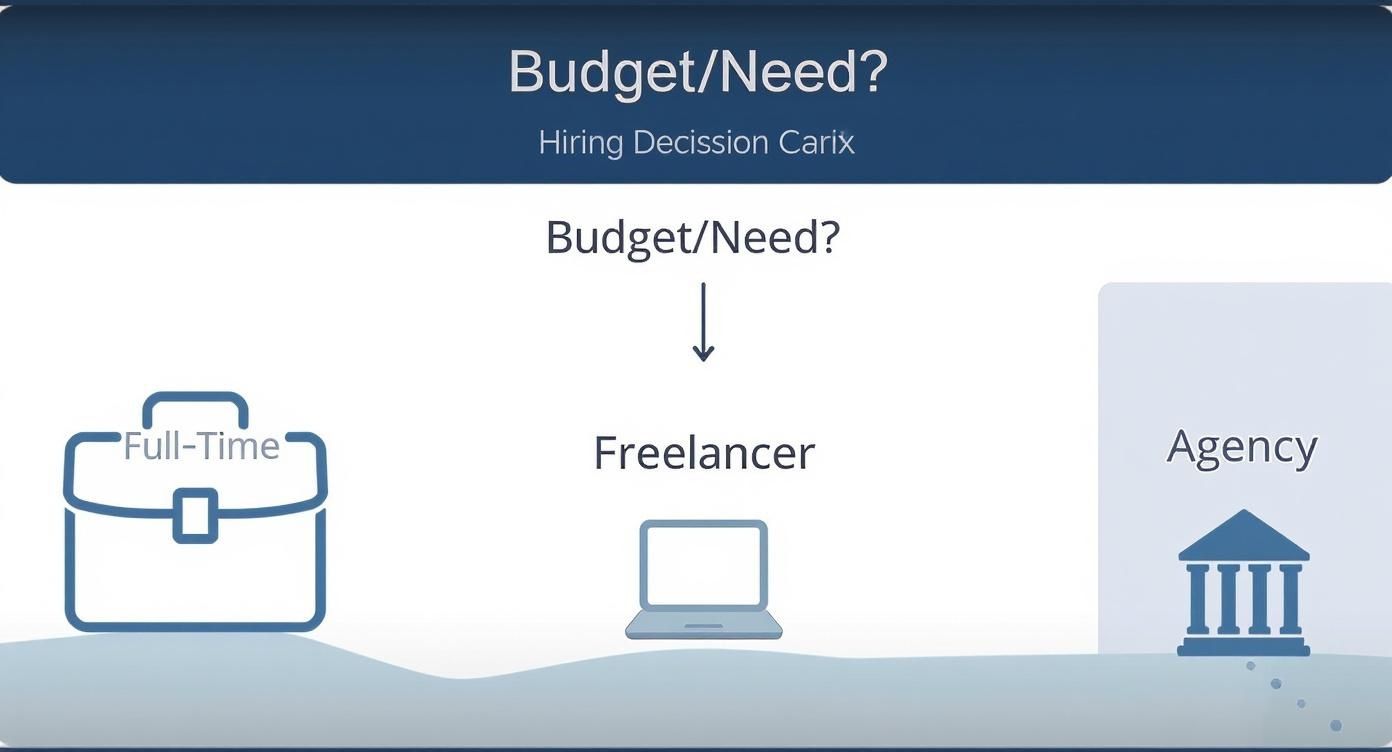
The real takeaway here is that there's no single "best" way to hire. The smartest firms align their hiring strategy with their current operational and financial realities.
Before you even open a single PDF, draw a line in the sand. You have to separate the skills you absolutely cannot live without from the ones you can teach a promising new hire. So many attorneys fall into the trap of writing a job description for a mythical legal unicorn, then get frustrated when no one fits the bill.
Here’s a more realistic way to break it down:
Non-Negotiables (Hard to Train): These are the foundational traits. If a candidate is missing one of these, they're out. Simple as that.
Nice-to-Haves (Easy to Train): These are bonus points. A candidate with these skills gets a closer look, but a lack of them is far from a dealbreaker.
Get this list finalized before you review applications. It's your filter.
Your only goal during the initial résumé screen is speed. You aren't looking for reasons to hire someone; you're looking for obvious red flags that let you disqualify them and move on.
The blunt reality is that 80% of applicants can probably be disqualified in this first pass. Be ruthless. Your time is too valuable to waste on candidates who don’t clear this basic bar.
Keep in mind, the current legal hiring market is incredibly competitive. Data from early 2025 showed the unemployment rate for paralegals was just 1.9%—a fraction of the national average. This talent crunch means the best people get offers fast. With high demand for skills like eDiscovery and litigation support, a swift, decisive vetting process gives you a huge advantage. You can learn more about which legal roles are in highest demand right now.
Please, do not ask, "What's your greatest weakness?" You're just inviting a canned, pre-rehearsed answer that tells you nothing. The point of an interview is to see how a person thinks on their feet, not to test their memorization skills.
Instead, use practical, scenario-based questions that reveal how they actually operate. For an even deeper well of ideas, our guide on the top legal assistant interview questions is designed to help you spot top-tier talent.
Here are a few of my go-tos:
The answers to these questions will tell you infinitely more than a dozen generic ones ever could. You're listening for logic, a sense of ownership, and a problem-solving mindset—the true hallmarks of a fantastic paralegal.
You’ve found ‘the one.’ After sifting through a mountain of résumés and conducting interviews that felt more like interrogations, you have your candidate. Don’t fumble the ball now. This is the unglamorous but critical step that turns a great candidate into your new, productive team member.
Getting this part wrong is surprisingly easy. A weak offer or a confusing contract can undo all your hard work, sending your top choice running for the hills—or worse, into the arms of a competitor. Let's navigate this administrative swamp without getting bogged down.
The first rule of making an offer is simple: don’t be cheap. I get it, you’re running a business, and every dollar counts. But trying to save a few thousand on salary for an A-player is the definition of stepping over a dollar to pick up a dime. A great paralegal isn't an expense; they're a revenue-generating asset.
So, how do you land on the right number?
Benchmarking is key. According to recent U.S. labor statistics, the median annual wage for paralegals was around $61,010 in May 2024. This number can be much higher in major markets like D.C. or for paralegals with specialized compliance or tech skills. Knowing this data is crucial; it’s your defense against both overpaying and under-offering. You can see more about paralegal career compensation and trends on the BLS website.
Your offer letter isn't just a formality; it's a legal document that sets expectations from day one. Keep it clean, clear, and comprehensive. No one wants to start a new job feeling confused.
Your letter must include, at a minimum:
Send the offer letter as a clean PDF and give the candidate a clear deadline to respond—usually 48 to 72 hours. A long, drawn-out acceptance process is a sign of hesitation you need to address immediately.
Now for the fun part: compliance. How you classify your new hire has huge legal and tax implications. Misclassifying an employee as a 1099 contractor when they function as a W-2 employee is a classic, costly mistake that can attract the wrong kind of attention from the IRS.
Here’s the gut check:
Don't try to get clever here. The risk of misclassification penalties far outweighs the perceived savings. When you hire a paralegal for a permanent role, bite the bullet and set them up as a W-2 employee.
Hiring a new paralegal is a major investment. All the time you just sank into vetting and interviewing? That was just the down payment. The real work starts now, and a sloppy, disorganized onboarding process is the fastest way to kill your return on that investment.
You can't just hand them a login and expect magic to happen. A great onboarding plan isn't a welcome lunch; it's a deliberate 90-day strategy designed to get your new hire productive and fully integrated. You didn't go through this whole process just to get a glorified scheduler. You want a genuine asset.

The first month is all about assimilation. The goal isn’t to have them drafting complex motions by week two. It's about getting them comfortable, confident, and equipped with the tools they need to actually do their job without asking you where the digital stapler is every five minutes.
Don't just dump a 200-page procedures manual on their desk. Instead, focus on the immediate essentials.
Your primary objective for the first 30 days is simple: remove all roadblocks. Make it easy for them to find information, ask questions, and learn the basic rhythm of the firm. Productivity will follow.
Okay, they’ve got their logins and know who to ask for help. Now it’s time to hand over real responsibility. The 30-to-60-day mark is about transitioning them from a passive learner into an active contributor. This is where you’ll start to see the first glimmers of real ROI.
The training wheels come off, but you're still jogging alongside. Delegate tasks that require them to think, not just follow a checklist.
Examples of "Next Level" Tasks:
This is also the perfect time for your first formal check-in. Sit down and have a real conversation. What's working? What's confusing? This isn't a performance review; it's a course correction. If you've hired someone remotely, this structured communication is even more vital. We break down more of these nuances in our complete guide on how to onboard remote employees.
By day 90, your new paralegal should be operating with a significant degree of autonomy. They shouldn't just be taking tasks off your plate; they should be anticipating needs and proactively managing their responsibilities. This is the payoff.
This is where you graduate from simple delegation to true empowerment.
If you’ve followed this framework, you won't have just a new employee by the end of the first quarter. You'll have a fully integrated team member who is already generating a tangible return on your investment.
Alright, we’ve covered a lot of ground. But let's be real, you probably still have a few nagging questions. When you’re about to make a decision this big, the details matter. So let’s cut the fluff and get straight to the point.
Here are the frank answers to the questions I hear most often from firm owners on the fence.
This is the big one, isn't it? The answer is: it depends, but probably less than you think for the value you get. A full-time, experienced domestic paralegal in a major US city can easily command a salary of $60,000-$85,000+ plus benefits. Turns out there’s more than one way to hire elite support without mortgaging your office ping-pong table.
The game has changed. With remote and offshore talent, you can access highly skilled, experienced paralegals for a fraction of that cost. It's not uncommon to find top-tier remote paralegals in the $15-$30 per hour range. This isn't about finding "cheap" labor; it's about taking advantage of global talent pools. For the cost of one junior domestic paralegal, you could potentially build a small team of specialized remote paralegals.
People use these terms interchangeably all the time, and it drives me crazy. It’s a classic mistake that leads to hiring the wrong person for the job and wondering why it's not working out.
Here’s the simple breakdown:
You hire a legal assistant to manage your practice. You hire a paralegal to help you practice law. Knowing which problem you’re actually trying to solve is half the battle.
I used to be a skeptic on this one. I thought you needed someone in the office, breathing the same recycled air, to truly be part of the team. I was completely wrong.
A great remote paralegal isn’t just effective; they can be more effective. Why? Fewer office distractions. The key isn't proximity; it's process.
With the right tools and communication rhythm, a remote paralegal integrates seamlessly. You just need a few things in place:
The talent pool is global now. Limiting yourself to a 20-mile radius around your office is just hamstringing your firm’s potential.
If you’re a solo or small firm making your very first paralegal hire, my advice is to lean toward a highly competent generalist. You need someone who can handle a bit of everything—from litigation support to client communication—without getting flustered. Your first hire is about plugging the biggest leaks in the dam.
Once your firm grows, that’s when you start bringing in specialists. Need someone who lives and breathes e-discovery for complex litigation? Hire for that specific skill. But don’t make the mistake of hiring a niche specialist when what you really need is a versatile utility player.


