

 15 minutes read
Let's cut the fluff. You want to know how much contract attorneys really make. The generic answer you'll find everywhere is around $119,188 per year, or about $57 an hour.
That number is technically correct. And almost completely useless.
The real answer depends on whether you’re hiring a legal eagle to save your multi-million dollar M&A deal or a rookie to review a pile of documents. One costs a fortune, the other is a bargain. Knowing the difference is what separates a smart hire from a budget bonfire.
So, you're trying to figure out if bringing on a contract attorney is a brilliant financial move or a budget-killer. Spoiler: It’s almost always the former, but I get it—the numbers can feel all over the map if you don't know what you're looking at.
My goal here isn't to parrot some fuzzy industry average. It's to give you the hard salary data you need to benchmark your next move. Think of this as your cheat sheet for making smarter, faster decisions without mortgaging your office ping-pong table.
Let's break down the salary distribution. This shows just how much the pay can swing based on who you're hiring and what you need them to do.
| Percentile | Hourly Rate (USD) | Annual Salary (USD) |
|---|---|---|
| Top 10% | $82/hour | $172,000 |
| 75th | $67/hour | $139,000 |
| Average | $57/hour | $119,188 |
| 25th | $43/hour | $89,500 |
This range tells a simple story: expertise costs money. Demand drives the price.

The key takeaway? You get what you pay for. A generalist handling basic doc review won't command the same rate as a specialist navigating a complex IP dispute—and that’s a good thing.
Knowing these brackets helps you match your project's complexity with the right talent at the right price point. It’s not just about finding temporary help; it's about finding the right help without getting ripped off.
For attorneys looking to jump into this world, understanding these numbers is just as important. Take a look at our guide on finding the best freelance attorney jobs to see how your skills stack up against what the market is paying for right now.
Ever stared at a rate sheet and wondered why a contract attorney in San Francisco costs a small fortune, while an equally qualified one in Des Moines seems like a steal? It's not random. The two factors that will absolutely make or break your budget are geography and specialization.
Seriously, forget national averages. They’re a nice starting point for a blog post, but they’re pretty much useless for real-world budgeting. The cost of living and the intensity of local market demand create massive pay gaps across the country. An attorney charging $175/hour in New York City is standard. That same rate in a smaller midwestern city would be considered top-of-the-market. It's the same reason a sad desk salad costs more in Manhattan than it does in Omaha.
This graphic gives you a quick visual on the general compensation tiers you'll run into.
As you can see, the jump from "average" to "top-tier" pay is significant. That gap is almost always a product of being in a high-cost city or having a ridiculously in-demand skill set.
It boils down to simple economics. Legal hubs like New York, Los Angeles, and Washington D.C. have a higher concentration of big firms, corporate HQs, and high-stakes litigation. This fierce competition for top talent drives up demand and, you guessed it, the rates.
Even state governments are feeling the squeeze. Idaho recently had to raise its hourly rate for contract attorneys from $100 to $125 just to find enough lawyers to cover its rural areas. They were simply acknowledging the reality of competing with more lucrative private markets.
You’re not just paying for the attorney; you’re paying for the entire ecosystem they operate in. The higher rates in major metros reflect higher overhead, stiffer competition, and access to a different caliber of legal work.
This doesn't mean you can't find incredible talent elsewhere. It just means you need to be strategic. If the work can be done remotely, looking outside of those Tier 1 cities is one of the fastest ways to slash costs without sacrificing quality.
If location sets the baseline, specialization is what creates the premium. A generalist handling routine document review is a completely different budget item than a patent attorney with a Ph.D. in biochemistry. The more niche and in-demand the practice area, the higher the price tag.
Think about it this way:
This is where you'll see rates that easily clear $200-$300+ per hour. And you know what? Firms and companies will gladly pay it, because the cost of getting it wrong is astronomical. You’re not just hiring an extra pair of hands; you’re buying specialized knowledge that can save a multi-million-dollar deal or fend off a crippling lawsuit.
This principle holds true across all legal support roles. You can learn more about how specialization impacts paralegal hourly rates in our detailed guide.
Let’s get one thing straight. Lumping all contract attorneys into one bucket is like saying a line cook and a Michelin-starred chef are both just "cooks." Sure, they’re in the same business, but you’re not paying them the same, and you’re definitely not hiring them for the same gig.
It’s no different in the legal world. Specialization isn't just a nice-to-have; it's often the single biggest factor that separates a $75/hour rate from a $250/hour one.
Think of it as supply and demand, but on steroids. How many attorneys can competently handle a standard discovery request? Thousands. But how many can navigate the maze of FDA compliance for a new biotech product? That number is much, much smaller. Scarcity creates a premium.
When a firm hires a specialist, they aren't just paying for hours on a timesheet. They’re paying for a very specific, often painfully acquired, set of skills that solves a critical—and usually expensive—problem. They will happily write a big check for a contract attorney who can parachute in and prevent a multi-million dollar mistake.
Specialization is the ultimate leverage. It transforms a lawyer from a commodity—someone who bills hours—into a strategic asset who delivers a specific, high-value outcome. This is where the real money is made.
This dynamic plays out all the time in several high-demand fields:
So, which specializations consistently bring in the highest rates? When you dive into specific, high-stakes niches, the pay scales jump dramatically.
In practice areas like real estate and complex contracts, for instance, the average annual salary can climb to around $158,000 (roughly $76/hour), a significant leap from more generalist roles. Top earners in these fields push past $184,000 a year. This isn't a random bump; it’s a direct reflection of intense market demand for attorneys who can guide the high-value transactions that drive major U.S. markets. You can explore more data on how specialization impacts attorney salaries to see the full picture.
At the end of the day, when you’re trying to figure out how much contract attorneys make, the most important question isn't "what's the average rate?" It's "what specific problem do I need to solve?" The more specialized and painful the problem, the more you should expect to invest.
Alright, let's wade into one of the oldest debates in law: the billable hour versus the flat fee. The billable hour is the traditional, comfortable route. The flat fee offers predictability. So, which one actually makes sense?
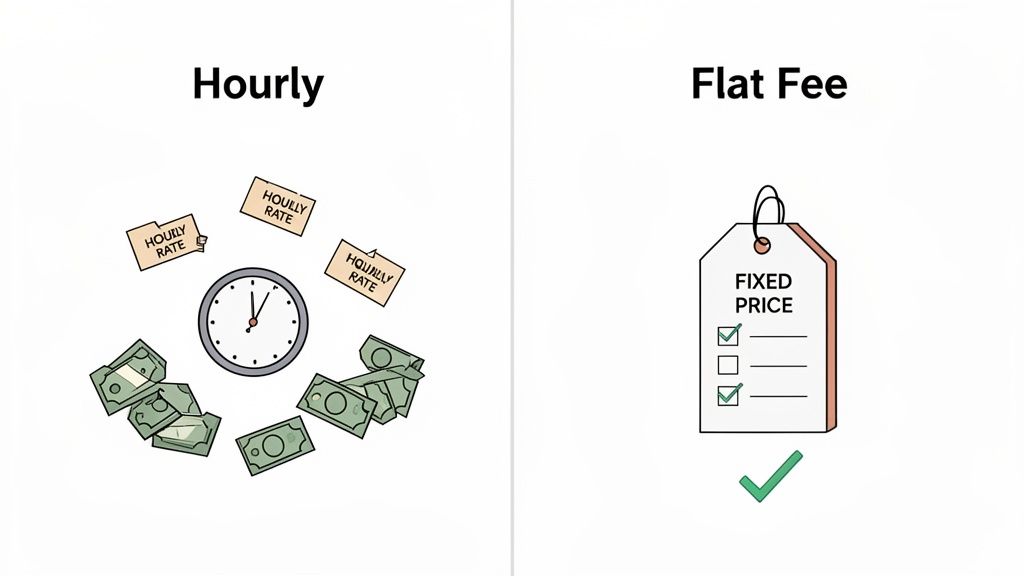
The truth is, there’s no single "better" option. It’s all about context. Getting this wrong is a fast track to overpaying for simple tasks or getting hit with an unexpected invoice that has you questioning your life choices.
Hourly billing is the standard for a simple reason: it excels when the scope of work is a moving target. Think of it as a pay-as-you-go plan for legal expertise.
This model is your best friend for work like:
The obvious downside is the lack of budget certainty. It can also create an incentive for inefficiency. That's why it’s best reserved for projects where the scope is genuinely unknowable.
Flat-fee arrangements are all about one thing: predictability. You agree on a single, fixed price for a specific scope of work. End of story. No clock-watching, no surprise overages.
Flat fees shift the focus from hours logged to results delivered. The incentive is on the attorney to be efficient and effective, which is exactly what you want for clearly defined projects.
This pricing structure is the clear winner for tasks such as:
Using flat fees for these projects lets you lock in your costs. Your legal spend becomes a fixed, predictable line item. The catch? You need an ironclad scope of work. Any ambiguity, and you'll end up debating what was actually included in that price. Choose wisely.
That $125 an hour rate you see advertised? It’s just the tip of the iceberg. The real story—and the real value—is everything that rate covers beneath the surface.
You're not just buying 60 minutes of legal work. You're buying a comprehensive service package. Think of it as an all-inclusive price for high-level talent without any of the usual strings attached.
A contract attorney is a small business owner. Their rate isn't pure profit; it’s a calculated number designed to cover all the operational costs you’d normally have to pay for an employee on top of their salary.
This "all-in" rate typically includes:
Firms rack up huge operational expenses for full-time staff. Just consider the investment in technology; thinking through the key questions for lawyers investing in video conferencing reveals just one slice of the overhead that contract attorneys absorb themselves.
It’s easy to get sticker shock from an hourly rate, but let’s do some quick math. The median salary for a full-time lawyer hovers around $151,160, while the average contract attorney earns closer to $119,188. And remember, that $151,160 figure doesn't even touch the mountain of overhead we just discussed.
A contract attorney’s rate isn't an expense; it's a strategic investment in efficiency. You're paying for the precise legal output you need, exactly when you need it, without the long-term financial drag of a full-time hire.
With the demand for legal talent pushing salaries up by 5% or more, firms are feeling the pressure. The contract model is a brilliant workaround. It lets you bring in specialized expertise for a specific project without locking your firm into a permanent payroll increase.
Once you understand these "hidden" costs, the perspective shifts. You aren't just hiring a person; you're outsourcing the entire administrative and financial burden that comes with them. That’s the real value.
Okay, so maybe even flexible contract attorney rates are making your budget sweat. What’s the next move? Go back to the drawing board and start interviewing for another full-time hire you can't quite afford?
Not so fast. It might be time to think differently.
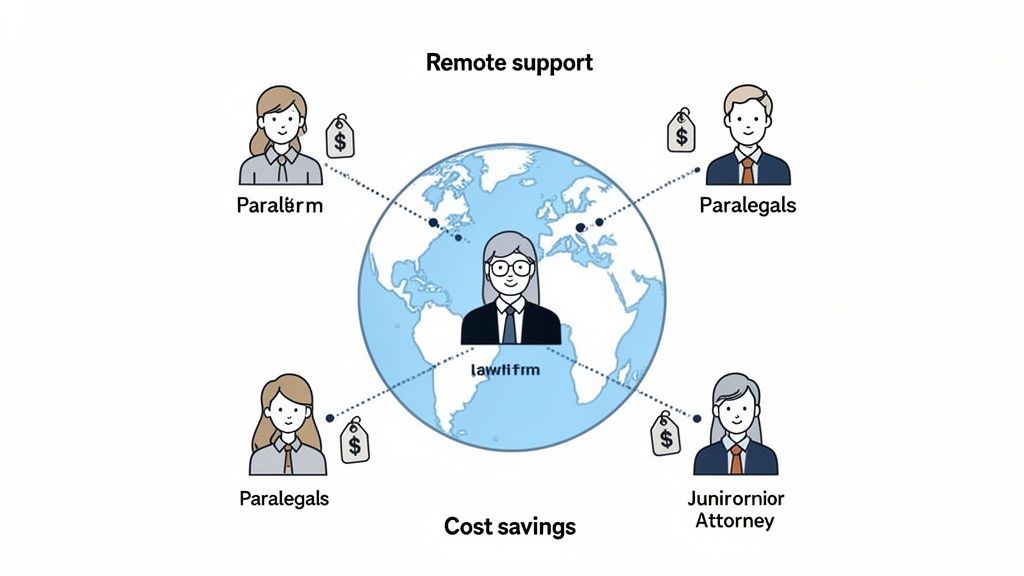
Instead of paying a premium, US-based attorney rate for every single task, the most efficient firms are embracing fractional and remote legal support. This isn't about replacing your high-level strategic counsel. It's about augmenting your team in a much smarter way.
Think about all the legal work that piles up but doesn't require a $200/hour specialist. A huge chunk of the day-to-day grind—document prep, legal research, case management, and client intake—can be handled exceptionally well by experienced paralegals and junior attorneys from global talent pools.
Adopting this blended model lets you:
When you're comparing support models, looking through a comprehensive 'make vs. buy' cost analysis can really put the true costs of in-house versus outsourced solutions into perspective.
The goal isn't just to find the cheapest help. It's to build the smartest, most cost-effective legal team possible by allocating your budget where it has the maximum impact.
This is how modern firms stay lean and mean. By exploring a global talent pool, you get the perfect balance of expertise and affordability. To see how this actually works, check out our guide on legal outsourcing services and see how you can build a more efficient firm.
Alright, let's get into the questions we hear all the time. Here are the straight-up answers.
Almost always. Think of the initial rate as a starting point, not a price tag set in stone.
Sure, a seasoned specialist in a red-hot practice area has less reason to budge. But for most gigs, there's wiggle room. Your strongest negotiating chip? The promise of steady work. An attorney is far more likely to offer a better rate for a guaranteed six-month project than for a frantic, one-off assignment. Come prepared with good market data and a well-defined scope, and you'll find most are open to talking numbers.
Experience is everything. It's what separates a competent pair of hands from a strategic problem-solver who can run a file with minimal oversight.
You're not just paying for their time; you're paying for the judgment and efficiency that come from years in the trenches.
Ultimately, the rate reflects how much hand-holding they'll need. The higher the price, the less you should have to do.
No—and this is one of the biggest financial wins of the contract model. Contract attorneys are independent contractors (1099 workers), not employees (W-2). This means they are responsible for their own health insurance, retirement savings, and self-employment taxes.
This is the secret sauce that makes hiring contract attorneys so compelling. A high hourly rate can still be a steal when you remember that a full-time employee includes an additional 25-40% "loaded cost" for benefits, payroll taxes, and other overhead.
You get access to top-tier talent without the long-term financial chains that come with a full-time hire. It’s a clean, straightforward arrangement.


