

 22 minutes read
Getting a job as a paralegal isn’t about just having the right degree. It’s a strategic game of having the right education, a laser-focused specialty, and the core skills that law firms are secretly desperate for. Forget what you think you know; this is about becoming an indispensable asset from day one.
Forget the generic career advice that tells you to "follow your passion." Passion is great, but it won’t get your resume past the robotic gatekeepers of an applicant tracking system. Landing a great paralegal job isn’t a lottery win; it’s about making a series of smart, deliberate moves long before you even think about hitting 'apply'.
Let's be blunt: the legal field is a meat grinder. It's demanding, competitive, and hiring managers are drowning in resumes. They aren't looking for "potential"—that's a word for people who need hand-holding. They're looking for proof that you can parachute in and start contributing immediately.
This means your first steps are everything. We're talking about the foundational choices that separate the candidates who get interviews from the ones who get archived into digital oblivion.
Before you draft a single cover letter, you need to lock down three things: your education, your niche, and your tech stack. Get these right, and the whole process gets a hell of a lot easier. Get them wrong, and you're just another piece of paper in a very, very large pile.
This simple flowchart shows how these pieces fit together. It's not a buffet; it's a recipe.
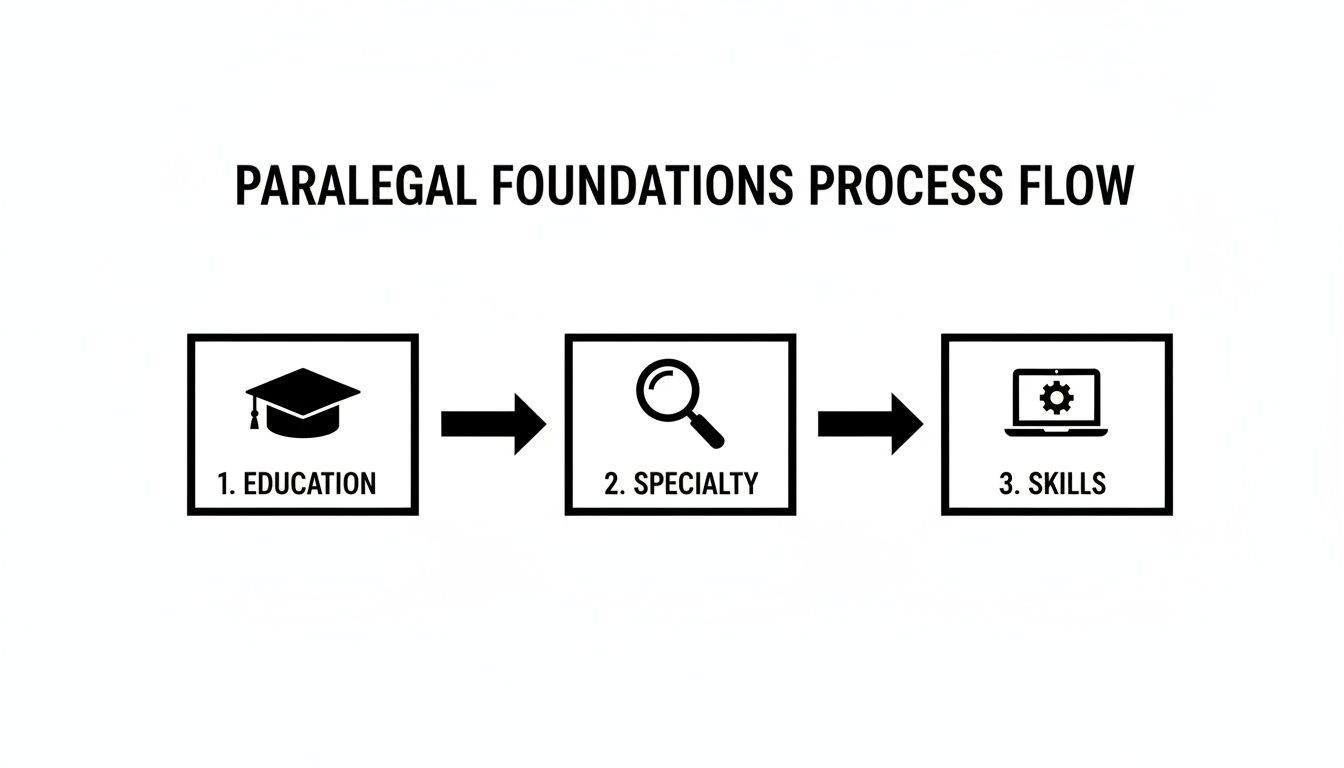
As you can see, these aren't isolated decisions. Each one stacks on top of the last, building a profile that’s hard to ignore.
But is the market even worth the effort? Fair question. The Bureau of Labor Statistics projects around 39,300 paralegal openings each year through 2034. Here’s the insider take: most of that is churn—people retiring or fleeing the industry. This creates a constant stream of opportunity, but only for the candidates who come prepared for battle. You can dig into the paralegal job market outlook if you love spreadsheets.
Here’s your cheat sheet for the first moves you should be making yesterday.
| Action Item | Why It Matters | Pro Tip |
|---|---|---|
| Choose an ABA-Approved Program | ABA approval is the industry's Good Housekeeping Seal. It tells employers your training isn’t from some diploma mill, saving them the headache of wondering if you know what you’re doing. | Find programs with killer internship placements. Real-world experience is the tiebreaker that wins championships. |
| Select a High-Demand Specialty | Specializing in an area like litigation or IP makes you a targeted weapon, not a Swiss Army knife with a bunch of dull blades. | Stalk the job boards in your city. See what’s in demand. A corporate paralegal in a tech hub is golden; in a small town, maybe not so much. |
| Master Key Legal Tech | Knowing your way around e-discovery, case management (like Clio), and legal research platforms isn't optional. It’s table stakes. | Most of these companies have free trials. Use them. Get certified. Slap those logos on your LinkedIn profile. It works. |
| Network with Intention | Your first job will probably come from a human, not a job board. Join local paralegal associations and stop lurking on LinkedIn. | Don't slide into DMs asking for a job. Ask for a 15-minute "virtual coffee" to hear their war stories. People love talking about themselves. |
Making these calls early isn't about ticking boxes. It’s about building a candidate profile so strong it feels like you're cheating.

The bottom line: The legal world doesn’t hand out participation trophies. It rewards brutal preparation. Your goal isn't to get a job; it's to build a foundation that makes you the only logical choice for the right job.
Here's a dose of reality that might sting: you get six seconds. That’s the average time a recruiter gives your resume before it lives or dies.
Brutal? Yep. But that’s the game when you’re chasing a top-tier paralegal job. All that time you spent agonizing over fonts and action verbs can be wiped out in the blink of an eye. The goal isn't a pretty resume; it's a weaponized one that’s scannable, powerful, and survives the first cut.
Your resume is a sales brochure, and the product is you. So let's skip the boring templates and build something that screams competence so loudly they have no choice but to call you.
Long before a human sees your application, it’s being judged by a robot—an Applicant Tracking System (ATS). These are the cold, heartless gatekeepers of the legal world, programmed to find keywords and shred everything else. Your first mission is to get past them.
This means your beautifully designed, two-column resume with fancy graphics is probably toast. When it comes to the ATS, simple is lethal. You need to learn how to properly format an ATS-friendly resume with clean, single-column layouts and standard fonts. No funny business.
The blunt truth: your resume has two audiences—a robot and a human. You have to satisfy the machine's cold logic and then immediately grab the attention of the overworked human who reads what's left. It's a two-stage boss battle.
Stop listing what you were supposed to do. Nobody cares. Hiring managers want to know what you actually accomplished. Make this one change, and you’ll leapfrog 90% of your competition.
Every bullet point needs to be a mini-story of the value you delivered. Don’t just copy the job description. Quantify your wins.
A little before-and-after magic:
See the difference? The second one isn't a task; it's a victory. It screams initiative, efficiency, and a direct benefit to the firm’s bottom line. That’s what gets you the interview.
This focus on what you can do is exactly where the industry is heading. Smart firms are all about skills-based hiring, where provable wins matter way more than a fancy job title from your last gig.
Sending the same generic resume everywhere is the fastest way to get ghosted. It’s lazy, and in a field obsessed with detail, that's a death sentence.
The pro move is to have a "master resume" loaded with everything you’ve ever done. Then, for each application, you carve out a custom version.
Yes, this takes an extra 15 minutes. But would you rather spend 15 minutes tailoring your resume or 15 weeks wondering why nobody is calling you back?
If your entire job search strategy is mashing the refresh button on Indeed, we need to talk. Flinging your resume into the black hole of a mega job board is like buying a lottery ticket and calling it a retirement plan. It’s a low-yield, soul-crushing game.
The best paralegal gigs are rarely the ones with 1,000 applicants. They’re hiding in the "hidden job market"—the places most people are too lazy to look. This is where you outsmart the competition, not just outwork them.
The big job boards are a numbers game designed to make you feel exhausted and inadequate. Your time is better spent on platforms where quality beats quantity. The goal isn't to find every job; it's to find the right one before the horde descends.
What does this mean? It means focusing on specialized legal job boards and the websites of your local bar associations. Firms posting there are looking for serious local candidates, not a tidal wave of resumes from people who can't even spell the firm's name right.
Let's be real: finding a good paralegal job is like fishing. You can cast a giant net and catch a bunch of old tires and seaweed, or you can find the quiet, well-stocked pond no one else knows about. I’ll take the pond every time.
Most people treat LinkedIn like a digital tombstone they update once a year. Huge mistake. LinkedIn is a search engine and a networking weapon. Start using it like one. Don't just follow firms; engage with their content. Better yet, connect with their paralegal managers, attorneys, and recruiters.
Here's the power move: never send a blank connection request. Ever. Add a short, personalized note. Something like, "Hi [Name], I'm a litigation paralegal and I've been following [Firm Name]'s work in [Practice Area]. Would be great to connect and learn from your experience."
It’s simple, it’s not creepy, and it gets you on their radar. When a job opens up, you’re not a stranger—you’re that sharp person who reached out months ago.
The old world chained you to your zip code. You could only work for firms you could drive to. That world is dead. For top talent, your physical address is becoming increasingly irrelevant.
This is a game-changer, especially when you see where paralegal jobs are clustered. California has 30,790 of them, Florida has 27,460, and New York has 24,240. That used to be a wall for people living elsewhere. Now, it's a massive opportunity for platforms that connect those firms with vetted remote talent from anywhere. You can geek out on more data on where paralegals work on CareerExplorer.com.
Platforms like HireParalegals are flipping the script. Instead of you chasing firms, the firms come to the platform hunting for specific, verified skills. It’s a curated marketplace. You’re not fighting the entire internet—just other qualified pros. (Toot, toot! Yeah, that's one of ours, but the point stands). If you want to dive deeper, check out our guide on the top paralegal job websites that aren't the usual suspects.
Let’s be honest, the word "networking" makes most people want to fake an illness. We picture stuffy rooms and forced small talk over bad cheese cubes. Reframe it. Networking is just making professional friends.
A simple, effective plan:
This isn't about being a slick operator. It's about building real relationships. Your next job offer is far more likely to come from a warm referral than a cold application. Every. Single. Time.

So, your resume worked. It dodged the robots, survived the six-second scan, and landed you an interview. Great. Don't celebrate yet. Now you have to prove you’re the person in that document and not just someone who’s good with resume templates.
The interview is where the rubber meets the road. It’s your chance to prove you’re more than a list of keywords—you’re a problem-solver who understands the crushing pressure of the legal world. Screw this up, and that beautiful resume is headed straight for the shredder.
Let’s be brutally honest: most candidates are terrible at interviewing. They give canned answers, ask zero intelligent questions, and are utterly forgettable. This is your playbook for being the one they can’t stop talking about.
Walking into an interview without deeply researching the firm is like a lawyer showing up to court without reading the case file. It's malpractice. Don't just skim their homepage. That's the bare minimum, and it shows.
Go deeper. Who are their rainmakers? What big cases have they handled? What’s their reputation? This isn't just to impress them; it's to figure out if you even want to work for these people.
An interview isn’t an interrogation; it's a two-way street. You are interviewing them just as much as they are interviewing you. A bad culture fit is a fast track to misery, so do your damn due diligence.
Once you’ve done your research, you can start predicting their questions. Every firm wants to know why you want to work for them. "You're a prestigious firm" is the kiss of death. You need a specific, compelling reason that connects their work to your career goals.
The questions are coming. From "Tell me about yourself" to those sneaky behavioral curveballs, your job is to tell a story, not just recite your resume.
They’ll want to know how you've used your skills. Prepare a few short, powerful success stories. Think about a time you had to tame a chaotic discovery request or manage a deadline that was clearly set by a sadist.
Here’s a breakdown of what you'll face:
The interview is a high-stakes conversation. For a deeper tactical breakdown, our guide on common legal assistant interview questions gives you the questions and the winning frameworks to answer them.
When they ask, “Do you have any questions for us?” the only wrong answer is “No.” This is your final, and best, chance to show you’re a serious player.
This is where your research pays off. Don't ask about stuff you could have Googled. Ask questions that show you're thinking like an employee, not an applicant.
Killer questions sound like this:
These questions prove you’re thinking about hitting the ground running and solving their problems. That’s how you walk out of an interview and wait for the offer.
Let’s get one thing straight: generalists get overlooked. Specialists get headhunted. If you want a paralegal job that pays well and has an actual future, the best thing you can do is stop trying to be everything to everyone.
Think about it from the firm's side. They have a massive intellectual property case about to go nuclear. Are they looking for a paralegal who "has some experience with everything"? Hell no. They are desperately searching for an IP specialist who lives and breathes patent law.
Trying to be a jack-of-all-trades is a career-killing strategy. It makes you a commodity, easily replaced and stuck in the entry-level salary ghetto. Specializing is your ticket out of the slush pile and into a role where you’re a critical, indispensable weapon.
Sure, you could be a paralegal in a dozen fields, but not all specialties are created equal. Some are stagnant backwaters, while others are rocket ships. If you want high demand, a real challenge, and a fatter paycheck, these are the arenas you should be looking at.
Litigation Paralegal: This is the frontline. You’re in the trenches managing document dumps, prepping for depositions, and drafting motions. It's high-pressure, deadline-driven insanity, perfect for anyone who secretly loves a good fight.
Corporate Paralegal: Welcome to the world of big-money deals. You'll handle entity formations, maintain corporate records, and assist with due diligence. If you're obsessively organized and love bringing order to chaos, this is your zone.
Immigration Paralegal: This is less about corporate warfare and more about high-stakes human stories. You’ll prepare visa petitions and residency applications, navigating the bureaucratic nightmare of U.S. immigration law. One tiny mistake can change someone's life forever. No pressure.
Real Estate Paralegal: From home closings to massive commercial developments, you'll manage titles, deeds, and closing documents. This requires a terrifyingly meticulous eye for detail and the ability to juggle multiple deals at once without dropping the ball.
Intellectual Property (IP) Paralegal: One of the hottest fields, period. You’ll help protect patents, trademarks, and copyrights for cutting-edge companies. It’s a fast-paced, intellectually stimulating game for the tech-savvy.
Choosing a specialty can feel like betting on a horse. This table breaks down the day-to-day reality of the top contenders. Be honest about which one actually fits your personality and skills.
| Specialty | Key Responsibilities | Essential Skills | Demand Outlook |
|---|---|---|---|
| Litigation | E-discovery, drafting pleadings, deposition and trial prep, case management. | Insane organizational skills, e-discovery software (Relativity, Clio), thrives under pressure. | Very High |
| Corporate | M&A support, managing corporate records, entity formation, due diligence. | Meticulous attention to detail, contract management, fluent in corporate governance. | High |
| Immigration | Preparing visa petitions (H-1B, L-1), green card applications, asylum cases. | Extreme accuracy, cultural sensitivity, knows USCIS forms backwards and forwards. | Growing |
| Real Estate | Title searches, preparing closing docs (deeds, HUD-1s), coordinating with lenders. | Transaction management, real estate law knowledge, ability to juggle closings. | Stable to High |
| Intellectual Property | Filing patent/trademark applications, managing deadlines, IP research. | Tech-savviness, research skills, understands the black box of USPTO procedures. | Very High |
The best specialty is the one you’re willing to go deep on. The demand is there for true experts who know their niche cold.
Choosing is the easy part. Now you have to get dangerously good at it. This means grabbing the specific, tangible skills that make you valuable in that niche.
A corporate paralegal needs to be a wizard with cap tables. A litigation paralegal who doesn't understand e-discovery is already a fossil. You can even specialize within your specialty, like becoming the go-to person for deposition prep by mastering a complete guide to legal transcription services.
It’s about stacking skills unique to your field. The more specialized your knowledge, the more expensive you are to replace.
Let’s be blunt: a firm will pay a premium for a paralegal who can manage a multi-state corporate compliance calendar without having a meltdown. They won't pay a premium for someone who can "kind of" do a little bit of everything. Expertise is where the money is.
"But I'm already a generalist!" Don't panic. You're not doomed to a career of fetching coffee. You can pivot strategically.
Look for overlap in your current experience. Even in a general practice, you’ve probably touched on litigation, real estate, and maybe some family law. Pick the one that didn't make you want to quit and start branding yourself as a specialist-in-training.
Here’s your game plan:
You have to build a bridge from where you are to where you want to go. It takes work, but it beats being stuck in a dead-end generalist role forever. This is the difference between having a job and building a career.
Alright, let's cut the crap. You've made it this far, which means you're serious. But the job hunt is a minefield of bad advice and nagging questions. Time for some straight answers.
This isn't your typical, fluffy FAQ. This is the blunt, pragmatic advice you wish someone gave you from the start.
Let's get real. While there’s no Paralegal Police demanding a degree, trying to get a job at a decent firm without one is like trying to win a marathon in flip-flops. Can you do it? Maybe. But you're making your life impossibly hard.
Most firms want one of two things: an Associate's degree in paralegal studies or a Bachelor's degree plus a paralegal certificate. The gold standard that gets you past the gatekeepers is a program approved by the American Bar Association (ABA).
Could you get a job without it? Sure, if you've been a rockstar legal assistant for ten years and have a killer reference. For everyone else, that piece of paper is your ticket to the game.
The million-dollar question with a fifty-cent answer: it depends. Your starting salary comes down to geography, firm size, and specialty. A corporate paralegal in Manhattan will make a hell of a lot more than a family law paralegal in rural Idaho. That's just how it works.
A realistic starting salary is somewhere in the $45,000 to $65,000 range. If your first offer is on the low end, don't freak out. Your first job is about getting experience, not getting rich.
Your entry-level salary isn't your forever salary. It's the price of admission. Survive the first year, prove you're not a liability, and your earning potential will jump—especially if you picked a lucrative specialty.
Once you have real experience, you have leverage. That’s when you can command a higher salary, either by asking for a raise or by finding a new firm that will pay for your proven skills. The first paycheck is just the opening bid.
Easy. The single biggest, most fatal mistake is the "spray and pray" application strategy. That’s when you fire off the same generic resume to 50 jobs and cross your fingers.
It’s lazy, and hiring managers can smell it a mile away.
The legal profession is built on an almost psychotic attention to detail. If your application isn’t tailored to the specific firm and role, you're screaming, "I don't have the attention to detail this job requires." You've failed the first test before you even took it.
Customize every single application. Mirror the language in their job description. Your cover letter must explain why you want to work for that firm. I promise, five highly targeted applications will beat 100 generic ones. Every. Single. Time.
Yes, with a huge caveat: it's only worth it if it comes from a legit, nationally recognized organization. We're talking about the big dogs:
These certifications aren't a joke. They tell an employer you've met a high national standard. It separates the pros from the amateurs and absolutely leads to better jobs and more money.
Be very, very wary of sketchy online "certificate" programs that aren’t ABA-approved or tied to a national credential. A real certification from NALA or NFPA is an investment that pays dividends for your entire career. It's a signal that you’re not just looking for a job—you’re a professional.


