

 21 minutes read
Let's be real. Your law firm is drowning in work that isn't quite lawyer-level but is far too critical to hand off to an assistant. That gap? That's where a great paralegal lives. And if you think of them as just an 'assistant,' you're already losing money. Think of them as an operational force multiplier for your entire practice.
So, you’re buried under a mountain of discovery requests, and your star associate is spending half their billable day chasing down client signatures. Sound familiar? This isn't just inefficient; it's a colossal waste of high-value attorney time. Hope you enjoy spending your afternoons playing project manager—because that’s now your full-time job.
This is the exact pain point where a paralegal becomes your firm's secret weapon. They aren’t just handling administrative overflow. A skilled paralegal steps in to manage the procedural and documentary backbone of your cases, transforming chaos into a well-oiled machine that lets your attorneys focus on what they do best: strategy, arguments, and winning.
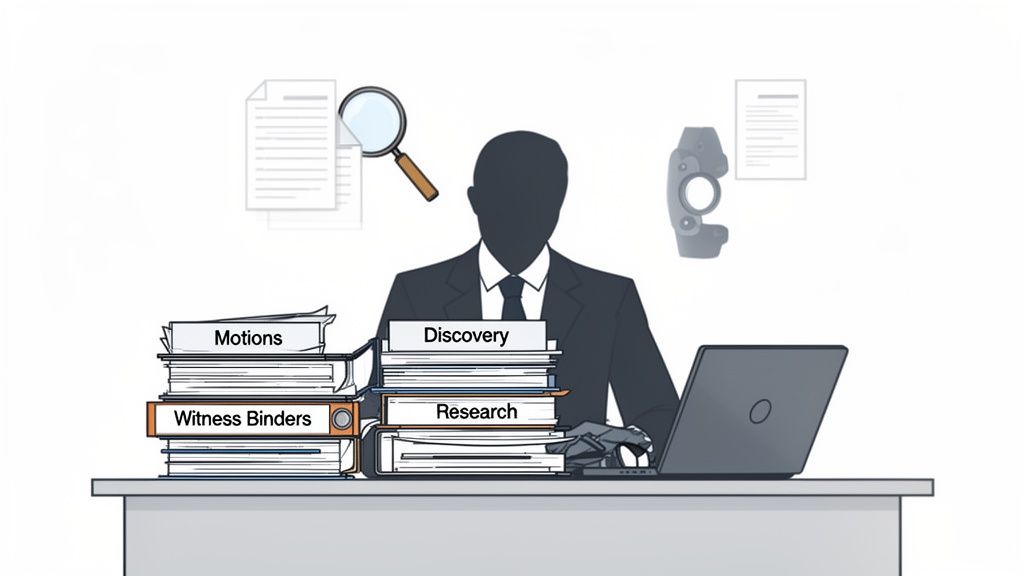
Forget the outdated image of someone just making copies. Today's high-performing paralegal is a genuine strategic asset. They are often the ones who know the case file inside and out—sometimes, let's be honest, even better than the attorneys themselves.
While you’re outlining your opening statement, they’re the ones making sure every exhibit is perfectly organized, every deadline is calendared, and every potential hiccup has been anticipated.

They're the difference between an attorney walking into a deposition feeling prepared versus feeling panicked. It’s not about delegation; it’s about strategic leverage.
Their role is a blend of substantive legal work and meticulous project management, and it’s billable time that directly contributes to your bottom line. They are an investment that pays for itself by freeing up your most expensive resources—your lawyers.
The daily grind for a paralegal is anything but monotonous. It's a dynamic mix of tasks that keep the gears of justice moving. One morning they might be deep in Westlaw hunting down obscure case law; by the afternoon, they could be coordinating with expert witnesses who charge more per hour than your therapist.
Here’s a snapshot of what that actually looks like:
The paralegal profession is a true cornerstone of the legal industry. And while the Bureau of Labor Statistics projects slower job growth through 2032, it also forecasts approximately 38,500 openings each year as seasoned professionals retire or change careers. Translation: demand for top talent isn't going anywhere.
Let’s get one thing straight: not all paralegals are created equal. Posting a job for a “paralegal” and hoping for the best is like walking into a hospital and asking for a “doctor” when you actually need a brain surgeon. In today’s legal world, specialization isn't just a nice-to-have; it's the entire game.
Sure, anyone can list "organized" and "detail-oriented" on a resume. That's table stakes. We're talking about the hard skills that actually move the needle on your cases—the kind of expertise that makes a paralegal less of a cost center and more of a profit driver.
You wouldn’t hire a carpenter who doesn't know how to use a power saw. So why would you hire a paralegal who can't navigate the essential tech stack of a modern law firm? This is about more than just knowing Microsoft Word.
I'm talking about genuine fluency in the tools that underpin your practice. This includes:
A great paralegal doesn't just use your software; they own it. They become the in-house expert, the person your associates turn to when they can't figure out how to properly tag a production set.
This technical skill isn't just about efficiency. It's about risk management. A paralegal who understands the nuances of e-discovery can prevent the inadvertent production of privileged documents—a mistake that can cost you a case, or worse.
Now we get to the heart of the matter. A generalist paralegal is a jack-of-all-trades and, frankly, a master of none. The true value comes from hiring someone with deep, domain-specific experience in your practice area. The day-to-day work of a corporate paralegal looks wildly different from one in family law.
Let’s break down what that actually means.
Litigation Paralegals: The Trial MVPs
These are your battlefield commanders. They live and breathe the lifecycle of a lawsuit, from initial filing to final appeal. A top-tier litigation paralegal doesn’t just organize exhibits; they anticipate what the opposing counsel will challenge and prepare accordingly. They’ve sat in the "hot seat" at trial, managing documents in real-time while an attorney is cross-examining a witness.
Corporate Paralegals: The Deal Makers
These paralegals are masters of corporate governance. They’re not just filing paperwork; they’re managing capitalization tables, drafting board resolutions, and handling the meticulous due diligence required for mergers and acquisitions. Hiring a corporate paralegal without this experience is like asking a podiatrist to perform open-heart surgery.
Immigration Paralegals: The Navigators
The world of immigration law is a labyrinth of acronyms and ever-changing forms. A specialist here knows the difference between an H-1B and an L-1 visa petition in their sleep. They can prepare a flawless adjustment of status package for USCIS, saving you from the dreaded Request for Evidence (RFE) that stalls cases for months.
Family Law Paralegals: The Empaths
Working in family law requires a unique blend of technical skill and emotional intelligence. These paralegals are not only drafting divorce decrees and child custody agreements, but they’re also often the first point of contact for clients in crisis. Their ability to handle sensitive information with compassion is just as critical as their knowledge of discovery rules.
The bottom line is simple: you need a specialist. Hiring a paralegal with proven experience in your niche is the fastest way to add immediate value and reduce attorney time spent on training and oversight. Their specialized knowledge means fewer errors, faster turnaround, and a better work product. It's a critical investment, not just a line-item expense. And a huge part of that is clear communication, which is why we suggest that you read our guide about using plain English in legal writing.
Let's talk money. What does a paralegal actually cost? It's the most common question I hear from managing partners, and it's a critical one. You're convinced of the value, but you need to know if the numbers work for your firm's budget.
The cost of paralegal talent can seem all over the map. You see a job posting in San Francisco with an eye-watering salary, then another in a smaller market for half that amount. It feels unpredictable, but there's a clear logic behind the numbers. Understanding these factors is key to making a smart financial move, not just a desperate one.
Thinking all paralegals should cost the same is like assuming every attorney bills the same hourly rate. It just doesn't work that way. A paralegal's compensation is a direct reflection of their expertise, the demand for their skills, and the impact they can have on your caseload.
Some skills are simply worth more because they are harder to find and can dramatically influence a case's outcome.
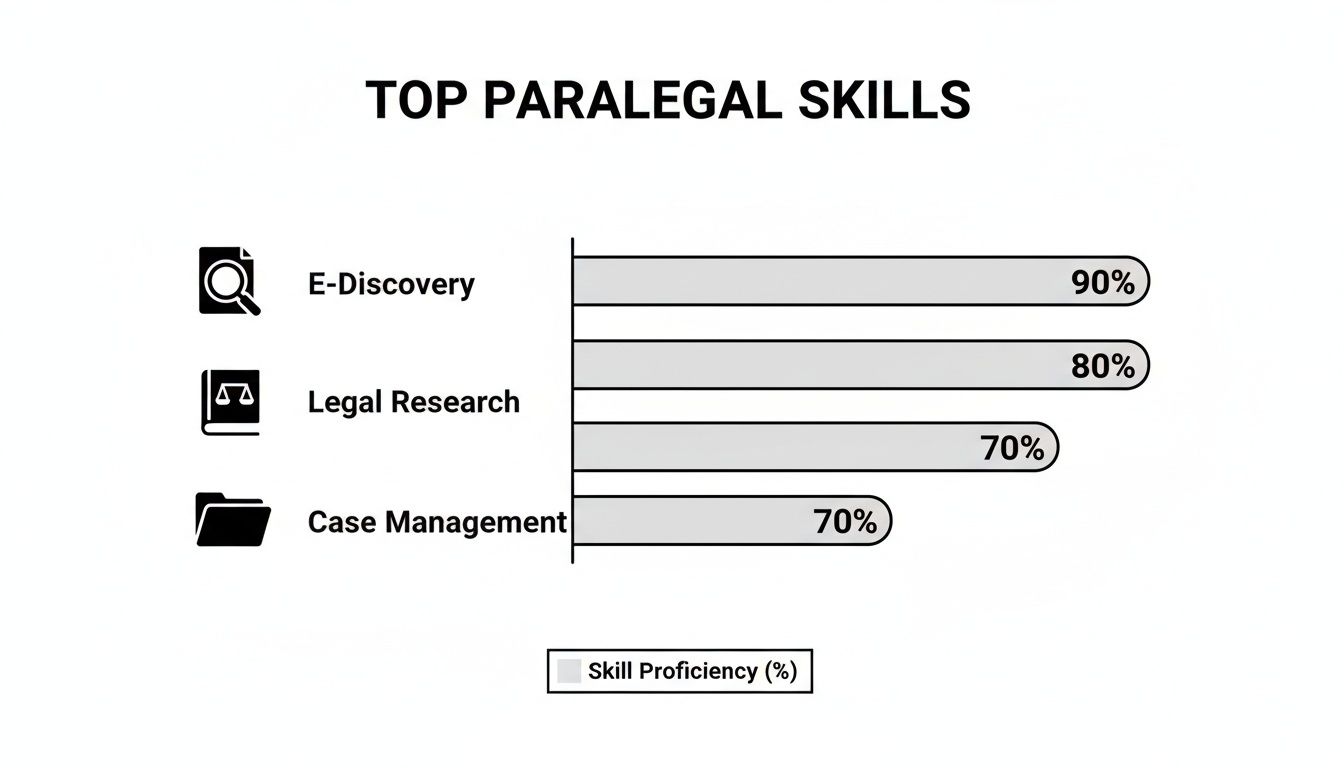
As you can see, high-demand skills like e-discovery (90%) and legal research (80%) directly correlate to higher earning potential.
So, what are the primary factors that move the needle on salary and rates?
Now for the real-world financial breakdown. When you hire a full-time, in-house paralegal, the salary is just the starting point. I call this the "fully-loaded cost" trap, and it’s something firm owners often overlook until it's too late.
You aren't just paying a salary. You're also covering payroll taxes, health insurance, paid time off, retirement contributions, office space, and equipment. That median U.S. salary of $61,010 quickly balloons to an $80,000 or higher line item on your budget. For the top 25% of paralegals earning $75,560 or more, the total cost can easily surpass six figures, especially in major markets like San Jose or Boston. You can explore these government salary insights on the BLS website.
This is where most firms get stuck. They desperately need the help, but the fully-loaded cost of a traditional hire feels like a massive, fixed financial commitment.
What if you could access that same top-tier talent without all the overhead? This is the strategic shift that on-demand paralegal platforms make possible. It's not about finding someone cheaper; it's about engaging expertise in a more efficient, flexible way.
The table below breaks down the stark difference in cost between a traditional hire and a remote, on-demand professional.
| Cost Factor | In-House US Paralegal (Annual Est.) | HireParalegals Remote Paralegal (Annual Est.) | Savings |
|---|---|---|---|
| Median Base Salary | $61,010 | $43,200 (based on 30 hrs/wk at $30/hr) | $17,810 |
| Payroll Taxes (FICA, FUTA, SUTA) | $6,101 | $0 (Handled by HireParalegals) | $6,101 |
| Health Insurance | $7,911 | $0 | $7,911 |
| Retirement Contribution (401k Match) | $2,440 | $0 | $2,440 |
| Office Space & Equipment | $5,000 | $0 | $5,000 |
| Recruiting & Onboarding | $3,000 | $0 | $3,000 |
| Paid Time Off (Vacation, Sick) | $4,693 | $0 | $4,693 |
| Total Estimated Annual Cost | $90,155 | $43,200 | $46,955 |
By moving from a fixed-cost employee to a variable-cost professional, you eliminate overhead and gain incredible financial flexibility. This isn't about cutting corners; it's about making a smarter investment in your firm's growth. To dive deeper into the numbers, our guide on understanding paralegal hourly rates is an excellent resource.
Let's get straight to the point. Bringing a paralegal on board can supercharge your firm's efficiency, but it comes with a massive responsibility. Ignoring the ethical guardrails isn't a minor fumble; it's a direct path to a bar complaint or even a malpractice suit. It can turn your greatest asset into your biggest liability overnight.
This isn't just some abstract concept you skimmed in an ethics course. This is about the real-world protection of your license, your clients, and your firm's reputation. You absolutely must understand the bright lines that define what a paralegal can and cannot do.
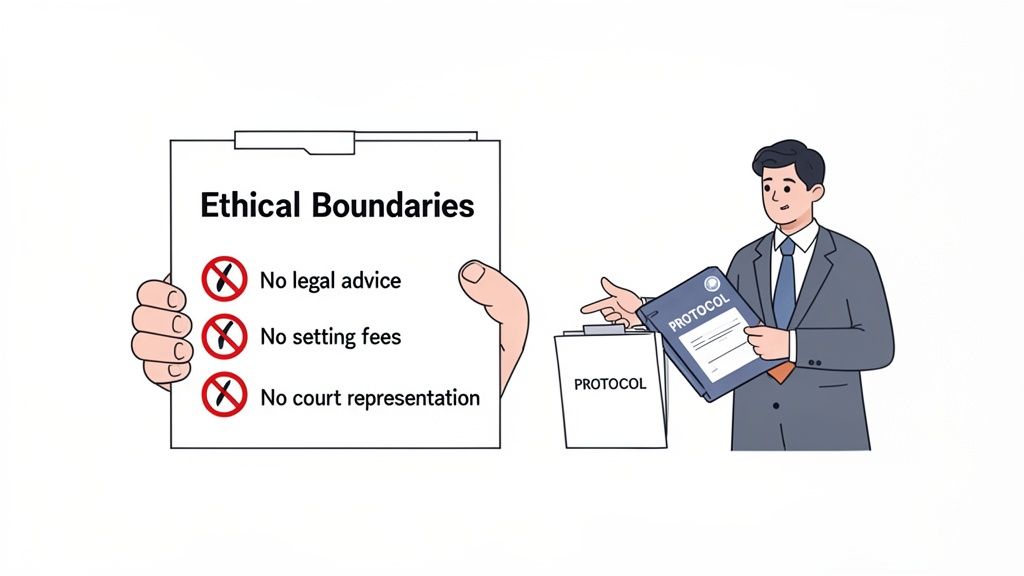
Everything comes down to one fundamental rule: a paralegal cannot engage in the unlicensed practice of law (UPL). It sounds simple, but when you're swamped and a client is demanding an immediate answer, that line can get blurry, fast. As the supervising attorney, it's your job to ensure it remains crystal clear for everyone.
This means you need airtight protocols. It's not enough to mention the rules once during onboarding. You need to build a culture of compliance that’s reinforced through consistent supervision and clear communication channels.
The rule is simple: if an action requires a law license, a paralegal cannot perform it. Full stop. This isn't a gray area to navigate with creative workarounds; it's a brick wall.
So, what does avoiding UPL actually look like day-to-day? It boils down to three non-negotiable prohibitions. These need to be the gospel in your firm.
No Giving Legal Advice: This is the most common and dangerous trap. A client asks, "Should I accept this settlement offer?" or "What do you think my chances are on this motion?" A paralegal's only correct response is to defer to an attorney. Even a seemingly innocent comment like, "That looks like a pretty fair deal," can cross the line. They can relay information from you, but they can never offer their own interpretation or guidance.
No Setting Legal Fees: The conversation about money belongs exclusively to the attorneys. A paralegal cannot negotiate a retainer, quote an hourly rate, or set the terms of a fee agreement. This is a core part of establishing the attorney-client relationship, and it cannot be delegated.
No Representing Clients in Court: This one should be obvious, but it’s critical. A paralegal cannot appear in court for a client, argue motions, or conduct depositions. While they are invaluable for trial prep—organizing exhibits, prepping witnesses, and managing logistics—their role is strictly behind the scenes once formal proceedings begin.
Ultimately, you are the captain of the ship. The supervising attorney is always accountable for the paralegal's work and their adherence to these ethical standards. Good supervision isn't micromanagement; it's smart risk management. Get this right, and your paralegal will be the force multiplier you need. Get it wrong, and you're gambling with your entire practice.
So, you’re ready to hire a paralegal. That’s a great step. Now for the bad news.
Hope you enjoy spending your afternoons fact-checking resumes and running screening interviews—because that’s now your full-time job. You'll post an ad on a generic job board and get swamped with a hundred applications. If you're lucky, maybe ten will look promising on paper, three will actually have the skills you need, and one might be a decent fit.
This is the traditional hiring meat grinder. It’s slow, it’s expensive, and it burns through your most valuable resource: your time.
Or, you could just skip that entire nightmare.
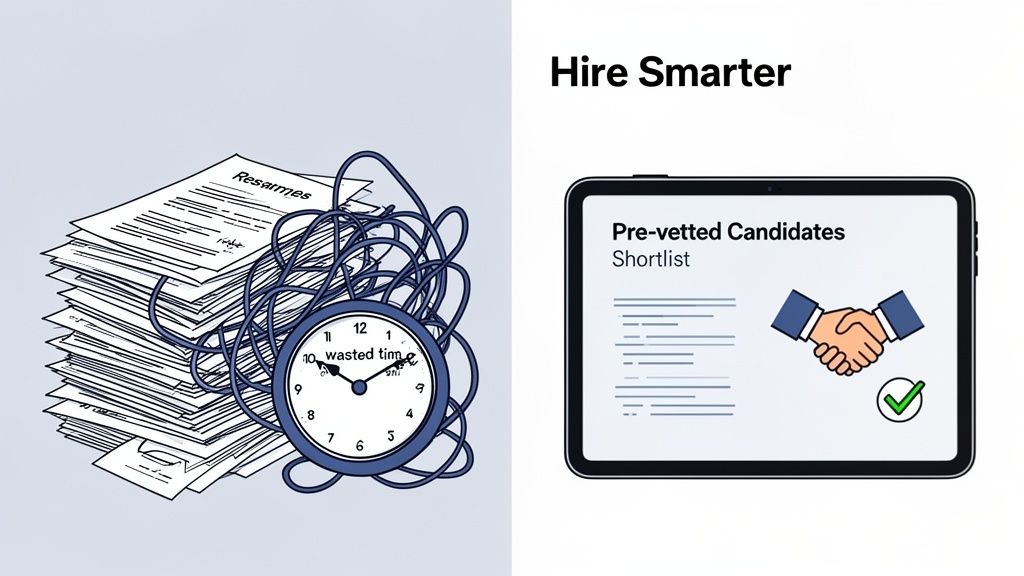
Let's be brutally honest for a minute. The old ways of hiring are completely broken for modern law firms. They were designed for a different era, and they put all the risk and tedious work squarely on your shoulders. It’s a numbers game you’re almost guaranteed to lose.
The traditional hiring funnel is a disaster.
Either way, you’re still the one stuck conducting endless interviews, checking references, and making a gut-wrenching decision based on a few hours of conversation. It's exhausting. And when you are in the thick of it, using a smarter interview notes template can at least bring some much-needed structure to the chaos.
But what if you could bypass the circus entirely? What if, instead of digging through a mountain of resumes, you were simply handed a custom shortlist of three to five pre-vetted, highly qualified candidates who perfectly match your firm's specific needs?
That’s the game-changing shift offered by curated talent platforms. It's not about getting more candidates; it's about getting the right candidates, faster than you ever thought possible.
Think of it like this: a job board is a public library. All the books are there, but you have to go in, find them, vet them, and read every single one to find what you need. A curated platform is like having a research librarian who takes your request and comes back with the three exact books you were looking for.
This isn't just a better hiring process; it’s a completely different philosophy. You’re moving from a model of mass-market recruiting to one of precision-matched talent acquisition.
This approach flips the script. The platform does all the heavy lifting—the sourcing, the initial interviews, the skills validation, and the background checks. You get to skip straight to the only part that really matters: choosing from the best of the best.
So what makes this model so effective for law firms? It boils down to a few key benefits that directly solve the biggest headaches of traditional hiring. You’re essentially de-risking the entire process from the start.
Here’s what you get:
The old way forces you to become a part-time HR manager. The new way lets you stay focused on being a lawyer. Turns out there’s more than one way to hire elite talent without mortgaging your office ping-pong table.
Even after breaking down the role, there are always a few lingering questions. I get them all the time from firm owners who are hesitant to ask, thinking they're the only ones wondering.
Let's clear the air. These are the practical, no-fluff questions that come up when you're seriously considering adding a paralegal to your team.
The short answer is a resounding yes. In fact, a better question might be, why wouldn't they?
Unless a key part of the job involves schlepping boxes of physical files from the '90s, almost every core paralegal task is perfectly suited for remote work. Legal research, drafting documents, managing e-discovery, and even communicating with clients can all be handled efficiently from anywhere with a good internet connection. I’ve seen countless firms shift from being skeptical about remote paralegals to becoming true believers.
The advantages are hard to argue with. You suddenly gain access to a nationwide talent pool, breaking free from the limitations of your local market. Plus, you cut down on overhead costs like office space and equipment. It’s a classic win-win.
This is a critical distinction, and blurring the lines can get expensive. Think of it this way: a legal assistant is like an air traffic controller for the firm, while a paralegal is like a co-pilot for the attorney.
Getting this wrong means you’re either paying paralegal rates for administrative support or, more commonly, wasting an attorney's valuable time on work a paralegal could and should be doing.
That really depends on the employment model you choose. If you hire a full-time, in-house paralegal, you’re committing to a 40-hour workweek. You pay for their entire day, whether they're swamped with urgent filings or it's a slow Tuesday afternoon.
The on-demand or fractional model completely changes the equation. You pay only for the hours you need. Got a massive trial prep project that needs 50 hours of work this week? No problem. Next week, if you only need 10 hours, that's all you pay for. It’s a much smarter, more agile way to manage your firm's resources.
The traditional model forces your caseload to fit into a rigid 40-hour box. A modern, on-demand approach allows your support to flex with the natural ebb and flow of your work. You're paying for actual productivity, not just for someone's presence.
Nope. Next question.
Okay, I'll elaborate a bit. AI is an incredible tool, but it's just that—a tool. It isn't a substitute for human intellect, experience, and judgment. We've all seen the cautionary tales, like the attorney who got sanctioned after his AI-powered research cited eight of nine cases that were completely fabricated.
A great paralegal’s value isn't just in gathering information; it’s in understanding its context, identifying what's missing, and applying critical thinking to solve problems. AI can spit out a first draft, but it can’t negotiate a complex discovery dispute with opposing counsel or reassure a nervous client.
The role of a paralegal isn’t vanishing; it’s evolving. The best paralegals are now learning to master AI tools to handle routine tasks faster, which frees them up to focus on the higher-level strategic work that an algorithm simply can't touch. They're becoming the tech-savvy experts in their firms, not getting replaced by technology.


