

 27 minutes read
Let's be honest. The idea of law school, and the mountain of debt that comes with it, is enough to make anyone break out in a cold sweat. For years, the gatekeepers have told us the only way into the legal world is with a Juris Doctor degree clutched in your hand. But what if I told you that's just not true? After years in the trenches, watching firms scramble for talent, I've seen firsthand that some of the most critical roles in a legal practice don't require you to spend three years buried in casebooks.
You can build a lucrative, respected career in the legal field without ever stepping foot in a law school lecture hall. The secret isn't a secret at all: it's about targeting the right roles, building specific skills, and knowing how to market yourself. Since your path involves working in law without a traditional degree, understanding how to list your education effectively on a resume, or how to highlight other qualifications, is particularly important. You need to show employers that your experience and certifications are more valuable than a piece of paper from a university.
Forget the traditional path. Hope you enjoy having options, because we're about to break down 10 killer jobs in law without a degree that offer real salaries, real career growth, and zero law school debt. We'll give you the inside scoop on what these roles actually entail, what they pay, and the exact steps you can take to land one. This isn't theoretical advice; it's a practical roadmap for breaking into a field that's far more accessible than you've been led to believe.
Think of a paralegal as the mission control for a legal team. While the lawyer is the astronaut making the final spacewalk, the paralegal is the expert on the ground managing every system, running diagnostics, and ensuring the entire operation doesn't explode. They are indispensable, handling the substantive legal work that keeps cases moving forward, making this one of the most respected jobs in law without a degree.
Paralegals are the backbone of any legal practice. You aren't just filing papers; you're drafting legal documents, conducting in-depth legal research, managing massive case files, and prepping attorneys for hearings and trials. It’s a role that demands precision, a knack for investigation, and an almost obsessive level of organization.
While a four-year degree isn't always mandatory, just showing up with a can-do attitude won't cut it. Most successful paralegals have completed a certificate program or an associate's degree in paralegal studies. These programs give you the foundational knowledge you need to be effective from day one.

Pro Tip: Don't skip the certification. Earning credentials from organizations like NALA (National Association of Legal Assistants) or the NFPA (National Federation of Paralegal Associations) is a non-negotiable for serious candidates. It’s the fastest way to signal to employers that you have the required skills and professional commitment. You can learn more about the specific paralegal certification requirements here.
The Bureau of Labor Statistics projects faster-than-average growth for this field, and for good reason. Firms rely on paralegals to handle tasks that are too complex for administrative staff but don't require a licensed attorney, saving clients a ton of money. You can advance by specializing in a lucrative niche (like e-discovery or healthcare law) or by moving into a paralegal manager role, overseeing an entire team.
If a paralegal is mission control, the legal secretary is the air traffic controller of the entire airport. They're the command center, managing the flow of information, scheduling, and client communication that prevents the entire law firm from grinding to a halt. Far from a simple admin role, this position is the organizational engine of a legal practice, making it one of the most essential jobs in law without a degree.
A legal secretary is the ultimate multitasker, a master of administrative and procedural detail. You're not just answering phones; you're preparing and filing legal correspondence, managing attorney calendars with surgical precision, and handling client billing. Executive legal secretaries take it a step further, often supervising other administrative staff and handling more complex tasks for senior partners.
A high school diploma is often the only formal educational requirement, but that won't get you hired alone. Success in this role hinges on demonstrable skills. Completing a legal secretary certificate program or an associate's degree can give you a massive advantage by teaching you legal terminology, court procedures, and the specific software used in the industry.
Pro Tip: Don't underestimate the power of tech skills. Proficiency in case management systems, billing software, and legal research tools like Westlaw and LexisNexis is a game-changer. Prove you can handle the tools, and you'll prove you can handle the job. If you’re preparing for an interview, make sure you know how to answer common questions for legal support staff to stand out.
While the general "secretary" field is projected to decline, the outlook for specialized legal secretaries remains stable. Law firms will always need staff with specific knowledge of legal procedures. A common and lucrative career path is transitioning into a paralegal role after gaining on-the-job experience and additional certification. You can also advance to an office manager or executive legal secretary position, taking on greater responsibility and leadership.
If a paralegal is mission control, a legal researcher is the deep-space explorer charting unknown territory. They are the detectives of the legal world, diving headfirst into dense case law, statutes, and obscure legal precedents to find the one piece of evidence or the single ruling that can make or break a case. It's less about managing logistics and more about pure, focused investigation, making it one of the most intellectually stimulating jobs in law without a degree.

A legal researcher's primary job is to find the legal authority that supports an attorney's argument. You're not just Googling things; you're navigating complex legal databases, verifying sources, and synthesizing your findings into clear, concise memos. This role requires an analytical mind, an incredible attention to detail, and the tenacity to keep digging when the answer isn't obvious.
You don't need a J.D., but you do need to prove you can think like a lawyer. Many legal researchers start with a paralegal certificate that has a strong research component. The key is demonstrating proficiency with the tools of the trade, primarily major legal research platforms like Westlaw and LexisNexis. An internship or a role as a library clerk at a law school or law firm can be an excellent entry point.
Pro Tip: Your ability to use research databases is your golden ticket. Get certified directly by Westlaw and LexisNexis, as many offer free training and certification programs. This is a concrete skill you can put on your resume that screams "I can do this job" to any hiring manager. It shows you're not just curious; you're already equipped.
As legal issues become more complex, the need for skilled researchers grows. You can advance by becoming the go-to expert in a high-demand area like cybersecurity law, environmental regulations, or intellectual property. From there, you could move into a senior researcher position, manage a research department, or even transition into a related field like competitive intelligence. To get started, you'll need to know which tools are non-negotiable, and you can explore the best legal research databases here.
If a company is a high-speed train, the legal compliance officer is the one meticulously checking every inch of the track ahead. They aren't just rule-followers; they are the strategic defenders who prevent the entire operation from derailing due to a missed regulation or a sloppy internal policy. This role is a critical nexus of law, ethics, and business operations, making it one of the most impactful jobs in law without a degree.
A compliance officer's job is to ensure a company plays by the rules—all of them. You'll be developing and implementing internal policies, conducting audits to find potential risks, and training staff on everything from data privacy to anti-bribery laws. It’s a job that requires a detective's mindset, a diplomat's tact, and the foresight to spot trouble before it happens.
You don't need a J.D., but you do need to prove you understand risk and regulation. Many enter this field with experience in a specific industry (like finance or healthcare) and then pivot into compliance. An associate's degree in a related field or a specialized certificate can give you a significant advantage and the foundational knowledge needed to be credible.
Pro Tip: Certifications are your golden ticket here. Earning credentials like the Certified Compliance & Ethics Professional (CCEP) from the SCCE is a non-negotiable for serious career growth. It tells employers you're not just learning on the job; you are a dedicated professional who understands the framework of corporate integrity. You can learn more about the CCEP certification and its requirements here.
With regulations constantly changing and expanding, the demand for skilled compliance officers is exploding. The career path is robust: you can specialize in a high-demand area like environmental compliance or data privacy, or you can climb the ladder to a Chief Compliance Officer (CCO) role, a C-suite position responsible for an entire organization’s ethical and legal standing.
If a paralegal is mission control, a Forensic Document Examiner is the elite detective called in when the evidence itself is a lie. These specialists are the real-life CSI of the paper world, analyzing documents to uncover forgery, alterations, and fraud. They determine if a signature is genuine, if a page was inserted into a will, or if the ink on a contract is older than claimed, making this a critical job in law without a degree for those with a scientific mind.
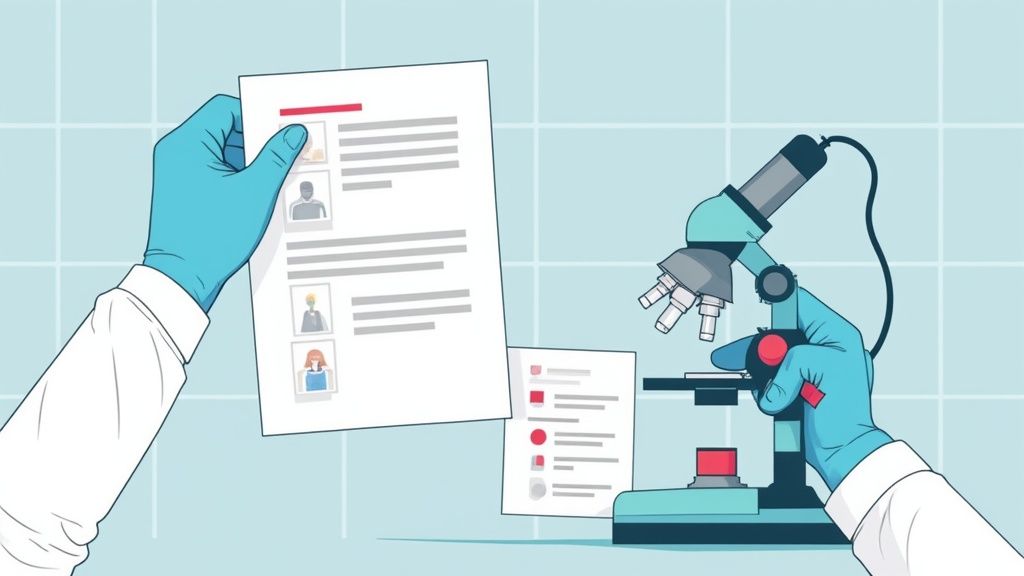
Forget what you’ve seen on TV; this is meticulous, scientific work. You'll use microscopes, infrared and ultraviolet light, and chemical analysis to dissect handwriting, signatures, ink, paper, and printing processes. Your findings become expert testimony in court, where you must clearly explain complex scientific principles to a jury. A deep commitment to understanding document analysis is the foundation of this entire profession.
A formal degree isn't the entry ticket, but an intense, structured apprenticeship is. You’ll need to find an established, certified examiner to train under for at least two years. This hands-on training is non-negotiable and covers the scientific principles, lab techniques, and ethical standards required to be a credible expert witness. Some university-level coursework in forensic science or chemistry can give you a significant leg up.
Pro Tip: Certification from the American Board of Forensic Document Examiners (ABFDE) is the gold standard. It's a grueling process involving rigorous testing and peer review, but without it, your credibility on the witness stand can be easily challenged. Don't even think about skipping this if you want to build a serious career.
The path here is one of building reputation. Initially, you'll work under a mentor or within a government agency. As you gain experience and credibility, you can branch out as an independent consultant, commanding high fees for your specialized expertise. The demand for qualified examiners remains steady, as document fraud is a timeless problem in both criminal and civil law. Progression means becoming the go-to expert in a specific niche, like historical document authentication or digital document forensics.
If lawyers are the actors on the legal stage, court reporters are the official historians, capturing every word for posterity. They are the silent, lightning-fast typists in the corner of the room, creating an exact, verbatim record of legal proceedings. This is one of the most highly specialized jobs in law without a degree, demanding a unique blend of speed, accuracy, and intense focus.

Court reporters use stenotype machines to transcribe spoken testimony, legal arguments, and judicial rulings in real-time. This isn’t just about fast typing; it's a form of shorthand that requires translating spoken language into a symbolic code at speeds exceeding 225 words per minute. The final transcript becomes the official record of the proceeding.
You can’t just wing this one. Becoming a court reporter requires completing a dedicated certificate or associate's degree program from a school accredited by the National Court Reporters Association (NCRA). These programs, which typically take two to three years, are intense and focus on building the necessary speed and accuracy on a steno machine.
Pro Tip: Certification is everything in this field. Earning the Registered Professional Reporter (RPR) credential from the NCRA is the industry standard. It's not just a nice-to-have; it's often a mandatory requirement for employment, proving you can perform under pressure with near-perfect accuracy. You can find an NCRA-approved school here to get started.
The demand for court reporters remains strong, especially for those providing realtime translation and CART services. Experienced reporters can earn a significant income, particularly those who freelance and take on high-profile deposition work. Advancement often means building a robust client list of attorneys, specializing in complex litigation like medical malpractice, or moving into a management role within a court reporting agency.
If a law firm were a high-performance engine, the legal billing specialist would be the person meticulously managing the fuel intake and exhaust. They are the guardians of the firm's financial lifeblood, ensuring that every minute of billable work is accurately tracked, invoiced, and collected. This isn't just about sending bills; it's about translating complex legal work into clear financial terms, making it one of the most critical jobs in law without a degree.
As a legal billing specialist, you are the crucial link between the attorneys' hard work and the firm's revenue. You’re responsible for managing the entire billing lifecycle, from processing attorney time entries and preparing invoices to handling client inquiries and chasing down payments. This role demands an eagle eye for detail, a strong head for numbers, and the diplomacy to navigate sensitive financial conversations with both clients and lawyers.
You don't need a law degree, but a solid foundation in accounting or bookkeeping is non-negotiable. An associate's degree in accounting or a related field is a common entry point. Experience with industry-standard billing software like Clio, MyCase, or PracticePanther will give you a significant edge. Many start in a general accounts payable or receivable role and specialize into the legal field.
Pro Tip: Master the art of the billable hour. Understanding the nuances of different billing models, from flat fees to complex retainers and contingency agreements, is what separates a good billing specialist from a great one. This knowledge is your currency and makes you an indispensable asset to any practice.
The need for meticulous financial management in law firms is constant, making this a stable career path. With experience, you can move into a billing manager or law firm controller role, overseeing the entire financial operations of a practice. Earning certifications like Certified Bookkeeper (CB) can accelerate your career and earning potential. As firms increasingly adopt technology to optimize operations, specialists who are proficient in the latest legal tech and financial analytics will be in high demand.
If paralegals are mission control, legal assistants are the skilled ground crew prepping the rocket for launch. They are the organizational engine of a law firm, managing the critical administrative tasks that ensure lawyers can focus on the law, not the logistics. Far from a simple secretarial role, this position is a foundational stone for a legal career, making it one of the most accessible jobs in law without a degree.
A legal assistant is the master of a law firm's daily operations. You're not just answering phones; you're the central hub for communication, scheduling, and document management. This role requires an impeccable sense of order, sharp communication skills, and the ability to juggle multiple priorities without breaking a sweat. You are the glue that holds the practice together.
While some firms will hire legal assistants with general administrative experience and a high school diploma, your best bet is a certificate in legal administrative assisting or a similar vocational program. These courses provide essential knowledge of legal terminology, court procedures, and the specific software used in law offices, giving you a serious advantage over other applicants. Think of it as your express pass to getting hired.
Pro Tip: Don't underestimate the power of specialization. Even at the assistant level, showing an interest and developing basic knowledge in a specific practice area like family law or real estate can make you a much more attractive candidate. It signals you're not just looking for a job, but building a career.
The legal assistant role is a fantastic launchpad. Many use it to gain experience before pursuing paralegal certification, which opens up more responsibility and higher pay. With proven competence, you can advance to roles like office manager or senior administrative positions within a firm. The demand for skilled assistants remains steady, as every effective legal team needs a strong administrative core to function.
Think of an IP Technician as the meticulous librarian for a company's most valuable secrets. While the patent attorney is arguing the novelty of an invention, the IP technician is the one managing the entire library of patents, trademarks, and copyrights, ensuring every due date is met and every document is flawlessly filed. They are the guardians of innovation, making this one of the most intellectually stimulating jobs in law without a degree.
IP Technicians are the organizational engine behind protecting a company's creative and inventive assets. You're not just a paper-pusher; you're managing complex IP portfolios, preparing and filing documents with the U.S. Patent and Trademark Office (USPTO), and tracking critical deadlines that could mean the difference between a protected idea and a public-domain free-for-all. It’s a role that demands a technical mindset, obsessive attention to detail, and a deep understanding of procedural rules.
While a law degree is off the table, a background in a technical field or administration is a huge plus. Many IP technicians start with an administrative certificate or an associate's degree and then receive on-the-job training in the highly specific world of intellectual property law. A strong aptitude for software and databases is non-negotiable, as you'll live in specialized IP management systems.
Pro Tip: Don't just learn the rules; master the technology. Expertise in IP portfolio management software and deep familiarity with the USPTO and international IP databases will make you far more valuable than a candidate who only knows the theory. This practical skill is your golden ticket to landing a top-tier position.
The world of innovation isn't slowing down, and neither is the demand for skilled technicians to protect it. You can advance by specializing in a high-demand area like international patent prosecution or by becoming a team lead or IP portfolio manager. For the truly ambitious, passing the USPTO patent bar exam to become a registered Patent Agent is a major step up, allowing you to legally represent inventors before the patent office without ever stepping foot in law school.
If lawyers are the surgeons in the courtroom, legal investigators are the detectives hitting the streets to crack the case. Forget the trench coat and fedora; this role is about meticulously piecing together the truth that wins lawsuits. They are the fact-finders, the witness-wranglers, and the evidence-hunters who arm attorneys with the irrefutable proof they need, making this one of the most dynamic jobs in law without a degree.
A legal investigator is far more than a private eye from a noir film. You're the boots on the ground, conducting the critical fact-finding that underpins legal strategy. This involves locating and interviewing witnesses, performing exhaustive background checks, gathering and documenting physical evidence, and serving legal documents. It's a role for the curious and the persistent, demanding a sharp eye for detail and the ability to connect disparate dots.
You don't need a law degree, but you do need a specific skill set. Many investigators transition from careers in law enforcement or the military, bringing invaluable field experience with them. For others, the key is obtaining a state-issued private investigator (PI) license, which is a common requirement and instantly boosts your credibility with law firms.
Pro Tip: Don't just be a generalist. Specialize. Becoming an expert in areas like digital forensics, financial fraud, or workers' compensation investigations makes you a high-value asset. Building a strong network of contacts in law enforcement and the legal community is just as critical as any formal training.
The need for solid, verifiable information in legal proceedings is never going away. Experienced investigators can advance by opening their own agency, specializing in high-stakes corporate cases, or moving into a supervisory role within a large firm or government agency. The more complex the world gets, the more lawyers need skilled investigators to uncover the facts that lie beneath the surface, ensuring a steady demand for those who know how to find them.
| Role | Implementation complexity | Resource requirements | Expected outcomes | Ideal use cases | Key advantages |
|---|---|---|---|---|---|
| Paralegal | Moderate — formal training or certificate recommended | Legal databases (Westlaw/Lexis), case management software, attorney supervision | Drafted pleadings, research, discovery prep, organized case files | Litigation support, corporate legal teams, transactional work | Cost-effective substantive legal work; versatile across specialties |
| Legal Secretary / Executive Legal Secretary | Low–Moderate — clerical and administrative skills | Office software, filing systems, calendar/billing tools | Efficient scheduling, correspondence, filings, billing support | Small firms, administrative backbone, executive attorney support | Improves office workflow; lower hiring barrier |
| Legal Researcher | Moderate — strong analytical and writing skills | Subscription databases, remote workstation, citation tools | Research memoranda, case law analysis, legal updates | Complex legal questions, policy research, appellate work | Deep analytical support; remote and specialized research capability |
| Legal Compliance Officer | High — cross-functional policy and regulatory expertise | Compliance platforms, audit tools, training programs, certifications | Compliance programs, audits, training, regulatory reporting | Regulated industries (finance, healthcare, tech) | Reduces regulatory risk; strategic organizational oversight |
| Forensic Document Examiner | High — specialized technical training and certification | Microscopy and forensic equipment, lab access, accreditation | Forensic reports, authenticity analysis, expert testimony | Suspected forgeries, contested signatures, criminal/civil disputes | Highly credible expert evidence; specialized niche skillset |
| Court Reporter / Stenographer | High — intensive stenography training and certification | Stenotype/realtime software, digital recorders, certifications | Verbatim transcripts and official court records | Trials, depositions, hearings, official record keeping | Produces admissible, precise transcripts; essential to litigation |
| Legal Billing Specialist / Legal Accountant | Moderate — accounting knowledge and firm procedures | Billing/accounting software (Clio, Timeslips), Excel, financial controls | Accurate invoices, AR management, profitability reports | Law firm finance departments, billing-heavy practices | Ensures revenue accuracy and financial compliance |
| Legal Assistant (General) | Low — entry-level with on-the-job training | Basic office tools, case management basics | Administrative support, document prep, client intake | Small practices, general support roles, entry-level positions | Flexible, low-cost support; pathway to paralegal roles |
| Intellectual Property (IP) Technician | Moderate–High — technical or scientific background beneficial | USPTO/IP databases, docketing systems, technical knowledge | Managed filings, docketing, maintenance of IP portfolios | Tech, pharma, and IP-focused law firms or in-house teams | Specialized IP expertise; gateway to patent agent roles |
| Legal Investigator | Moderate — investigative skills, possible licensing | Surveillance tools, travel budget, public-records access, PI license | Witness locations, evidence collection, investigation reports | Fraud, background investigations, trial preparation, internal probes | Field evidence gathering and fact development; transferable skills from law enforcement |
So, there you have it. Ten legitimate, well-paying career paths in the legal field that don’t require you to spend four years and a small fortune on a traditional degree. The dusty, mahogany-paneled image of the law is fading. It’s being replaced by a dynamic, tech-driven industry that needs specialized talent now more than ever.
The biggest takeaway isn't just the list of jobs in law without a degree; it's the paradigm shift. The legal world is a massive ecosystem, and lawyers are just one part of it. It takes a village of paralegals, investigators, compliance officers, and tech specialists to win a case, close a deal, or protect intellectual property.
Don't fall into the trap of thinking you need to start from zero. The skills you already possess are more valuable than you think.
The old gatekeepers are losing their power. Smart law firms and corporate legal departments are waking up to the fact that talent, drive, and specific certifications are often more valuable than a generic diploma. They're hemorrhaging money on inefficient processes and struggling to find people who can actually do the job. They need problem-solvers, not just paper-chasers.
The Insight: A certificate in paralegal studies or a court reporting license is a direct signal to an employer that you have a specific, applicable skill they can put to use on day one. It’s a specialized tool, not a general key.
Information is useless without action. If you're serious about breaking into the legal field, your next steps aren't complicated, but they do require focus. Forget about the overwhelming "what ifs" and concentrate on a simple, three-step launch sequence.
For the hiring managers, solo practitioners, and corporate teams reading this: your talent pool is bigger than you think. Turns out there’s more than one way to find elite support staff without mortgaging your office ping-pong table. The person who can streamline your billing or perfect your e-discovery process might be an industry-switcher with a killer certification, not a fresh-faced college grad.
The door to a rewarding legal career is wide open. The path is clearer and more accessible than it has ever been. The only thing standing in your way is the outdated belief that you need permission to walk through it. You don't. Go get what's yours.


