

 13 minutes read
Curious what a law office assistant really does and why your firm can’t survive without one? Think of this role as the engine that powers your case workflow—administrative muscle meets legal savvy. Without it, you might as well be mortgaging your office ping-pong table to keep the lights on.

In the trenches, law office assistants are the unsung heroes who handle the day-to-day grunt work so attorneys can chase billable hours instead of filing paper cuts. They wrestle documents into submission, tame unruly calendars, and gatekeep exactly who gets to bother the lawyers. Saving you from drowning in paperwork? Check.

“Hiring a solid assistant bought our team an extra billable hour every day.”
Numbers don’t lie. Here’s your cheat sheet before you jot down that job req.
| Metric | Value |
|---|---|
| Workforce Size | 376,200 |
| Median Annual Wage | $61,010 |
| Annual Openings | 39,300 |
These figures map out the talent pool and the battle for top talent. For a deeper dive, check the BLS website.
Attorneys already juggle case strategy, client drama, and court dates. Offload the scheduling and paperwork, and you instantly unlock 15–20% more attorney time. More billables, fewer botched filings—sounds like a no-brainer.
Not everyone starts with a paralegal degree—sometimes life (and budget) dictates otherwise.
Armed with this overview, you’re ready to craft that killer job posting and grill candidates. Spoiler: we’ll nail that next.
A Law Office Assistant is your daily ops hub, blending hands-on admin with legal flair. They keep the practice chugging—whether they’re corralling evidence or customizing AI prompts for client letters.
This isn’t your grandma’s secretary or a mini-paralegal. It’s a full-tilt hybrid position that touches every workflow bottleneck. Picture oil in your firm’s machine, smoothing out snags you didn’t even see coming.
One minute they’re assembling exhibits; the next they’re tweaking AI drafts. That flexibility slashes turnaround times and dials mistakes down to zero.
Technology isn’t optional—it’s table stakes. 54% of legal pros now use AI for letters (39% at big firms, 20% in smaller shops). Peek the full scoop on FedBar’s 2025 Report.
“Our assistant’s AI skills cut drafting time in half, freeing up lawyers for strategy.”
| Role | Primary Focus | Key Skill |
|---|---|---|
| Law Office Assistant | Admin workflows & tools | Versatility & tech |
| Paralegal | Substantive case work | Legal research |
| Secretary | Clerical duties | Scheduling & typing |
Some firms live on paper; others thrive on digital triage. Choose your side, and watch who thrives.
Dive into the paralegal vs. legal assistant debate in our detailed guide (link).
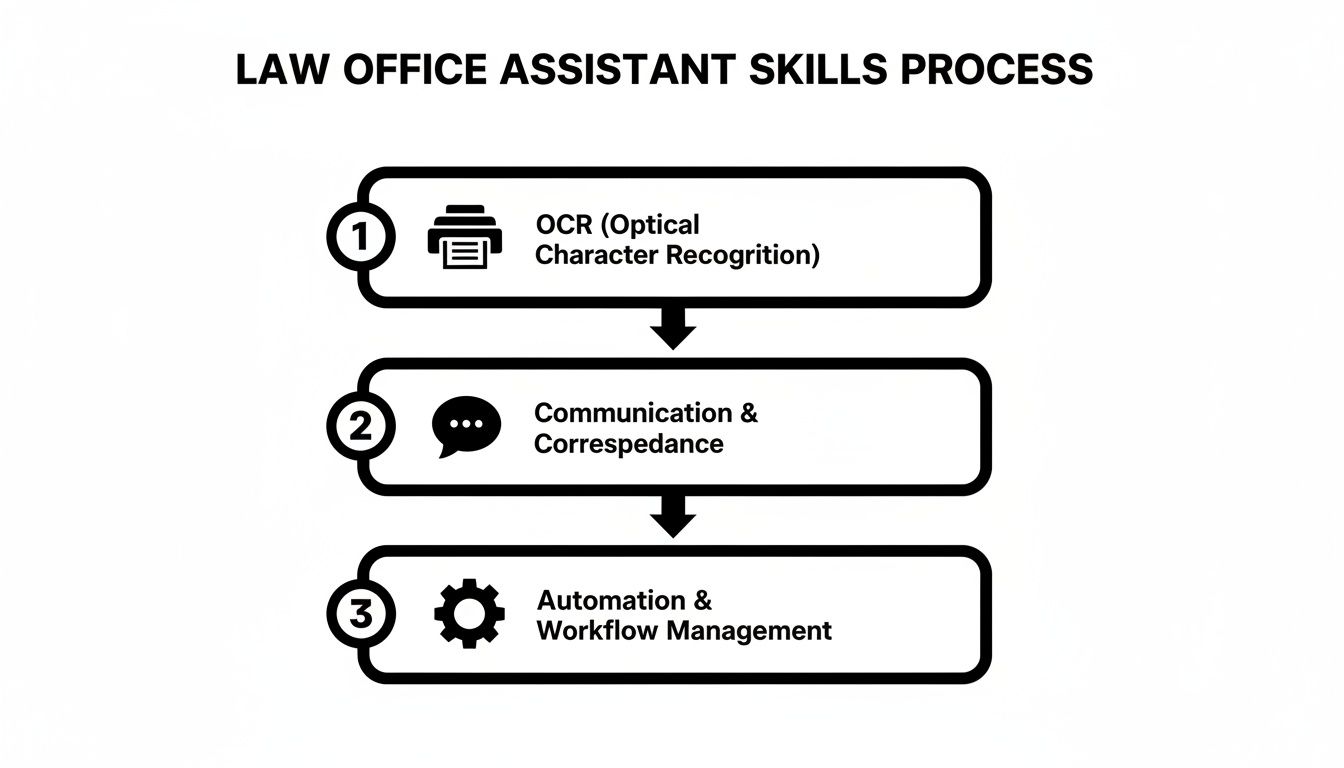
Delegation is all about balancing risk and speed. Routine docs? Hand ‘em off. Complex e-filings? Invest in your assistant’s OCR and document automation chops.
Analog know-how + digital prowess = bottleneck eradication before it snowballs into week-long fire drills.
Start with the high-impact tools. Two quick wins: mastering OCR scanners and your case-management dashboard.
With these skills locked in, you’ll know exactly which tasks to delegate—and where to spend your next training dollar.

Here’s where the rubber meets the road. A law office assistant handles the daily grind so attorneys can chase clients and cash.
Imagine corralling wild paperwork into neat, searchable files. That’s document management. Digitize, tag, and archive hundreds of pages without losing your mind—or the versions.
“A solid filing rule cut our document retrieval by 60%,” says Olivia Chen, managing partner.
Scheduling is like running a bustling train station—every piece needs to arrive and depart on time. Your assistant monitors court deadlines, books hearings, and blasts reminders. No-shows drop by 25%. Magic? Nope—just good practice.
First impressions set the tone. A smooth intake process tells clients you mean business. Assistants gather client details, draft engagement letters, and log billing codes—freeing up 60+ minutes of attorney time each day.
Inbox triage is air-traffic control. Every message needs the right runway. Your assistant flags urgent notes, drafts replies, and routes case questions to the right team member.
Trial prep is like staging a play—everything’s got to hit its mark. Assistants print, tab, and cross-reference exhibit packets, shaving 15 minutes off each witness prep.
Research lays the foundation for rock-solid motions. Assistants dive into statutes and case law, highlight key passages, and summarize findings—often in 10 minutes flat. Attorneys then polish it all, saving hours.
“Our assistant’s research note saved me two billable hours last week,” reports attorney David Lee.
Without clear guardrails, duties bleed into forbidden territory—think unauthorized motions or billing errors.
| Duty | Pitfall |
|---|---|
| Document Management | Version confusion |
| Calendar Coordination | Overlapping bookings |
| Client Intake | Unvetted commitments |
| Billing Support | Missed charge entries |
| Trial Prep | Misfiled exhibits |
| Research And Drafting | Unauthorized drafting |
Tip: Map each duty to your SOP and review quarterly. Shields up, drama down.
Nailing these responsibilities unlocks your assistant’s full potential—and buys you an extra billable hour every single day.
One firm I know watched their assistant master OCR tools and cut document prep by 70%, freeing lawyers to focus on strategy instead of chasing lost files. Hard skills open doors; soft skills keep them swinging.
Courts have weird quirks—deadline rabbit holes and formatting landmines. An assistant who breezes through e-filing portals can slash rejection notices by 40%.
Family law isn’t corporate compliance. Niche knowledge matters. I’ve seen an assistant knock out a beneficiary inventory for an estate closing—error-free and ahead of schedule.
“Our assistant’s niche expertise shaved an hour off our estate closing,” says a managing partner.
Clear emails and thoughtful calls build trust. A savvy assistant knows when to handle issues solo or ring the alarm.
Top assistants link platforms so data moves itself. When OCR feeds straight into your case management, you cut double entry by 80%.
| Tool | Benefit |
|---|---|
| OCR Scanner | Text searchability in seconds |
| Zapier | Automated document routing |
| Clio Connect | Centralized case access |
Use this checklist to screen for real expertise, not just buzzword bingo.
Ready to level up? Next, we’ll dive into hiring strategies and onboarding hacks.
Stop winging your support desk hires. Apply these battle-tested steps to land a rockstar assistant without the usual headache.
Whether they sit next door or half a world away, a clear pipeline turns a mountain of resumes into a shortlist of unicorns.
A laser-focused job description weeds out the riff-raff. Nail the title, day-in-the-life, must-have skills, and perks—hello remote days and training budgets.
In-House Law Office Assistant
Remote Law Office Assistant
Pro tip: Listing a salary range boosts quality applicants by 32%. And be upfront about your software stack—no one likes surprise tech pop quizzes.
For a full roadmap, see HireParalegals.
Generic fluff questions? Snooze. Instead, ask for real war stories.
“Real stories uncover real skills better than hypotheticals.”
You can even role-play mini-exercises. One firm shaved 10 hours off trial prep by spotting weak points pre-hire.
Drag out orientation, and watch productivity crater. Here’s a seven-day blitz to get them billable fast.
Day One: Orientation
Day Two: Process Deep Dive
Day Three: Skill Check
Days Four–Five: Hands-On Tasks
Days Six–Seven: Autonomous Trial
Pair them with a mentor and keep the tempo brisk—no one wants to drown in onboarding.
Skip sourcing headaches with a specialized platform. Services like HireParalegals can field vetted candidates in 24 hours and slice hiring costs by up to 80%.
Negotiate trial runs or volume discounts—test the waters without cannonballing your budget.
Track metrics—time-to-fill, retention, performance—and refine your playbook each hire. With clear benchmarks, you’ll dodge mis-hires and keep the firm humming.
Pinpointing the true cost of a law office assistant is like peeling an onion—layer upon layer. Smart budgeting needs clear salary ranges across support roles.
Senior paralegals earn $80,000–102,750, small-firm admins start near $70,000, and big-firm chiefs top $150,000. Most practices allocate 35–45% of an attorney’s salary to support. For the full chart, check LeanLaw.
| Cost Element | In-House Hire | Remote Hire |
|---|---|---|
| Base Salary | $70,000–150,000 | $40,000–80,000 |
| Benefits (35%) | $24,500–52,500 | $0 (usually) |
| Equipment & Office | $8,000 | Minimal or none |
| Recruitment Fees | 20% of salary | 5% flat platform fee |
| Overhead Total | $102,500–230,500 | $42,000–84,000 |
Remote roles can slash support costs by up to 60%. Reinvest your savings into client outreach, training, or that office ping-pong table upgrade.
Negotiate platform fees for even bigger wins:
“We repurposed savings into pro bono clinics and client events.”
Remote staffing opens hidden cost-containment gates:
“We cut training time by 40% thanks to pre-vetted talent,” says our COO.
Crunch the numbers before you sign. If an in-house assistant costs $120,000 with benefits, a remote hire at $60,000 frees up $60,000 annually.
For more tactics on trimming overhead, see How To Reduce Operational Costs.
Accurate budgeting turns guesswork into strategy—letting your firm scale with confidence.
A Law Office Assistant is your admin backbone—organizing files, prepping routine docs, and syncing calendars. A Paralegal dives deep into research, drafts pleadings, and manages the meat of case work. Keeping roles distinct prevents overlap and lets everyone shine in their lane.
| Role | Focus | Main Strength |
|---|---|---|
| Law Office Assistant | Admin Support & Tools | Organization & Efficiency |
| Paralegal | Substantive Legal Work | Research & Drafting |
Treat virtual assistants like they’re in the war room—minus the parking drama. Regular video standups, shared task boards, and clear SLAs keep the wheels turning.
“Consistent check-ins cut miscommunication by 50%,” says our COO.
Ditch hypotheticals. Ask for real war stories—e-discovery wins, billing automation tricks, that time they saved a trial. Concrete examples always trump "what would you do…" fluff.
When they’re spending 20%+ of their week on research or drafting motions, it’s time. Level up their title, training, and compensation to match the role.


