

 25 minutes read
If you've ever tried hiring a legal assistant, this probably sounds familiar: you post a job, get buried in a mountain of nearly identical résumés, and waste weeks interviewing candidates who look great on paper but can't find their way out of a paper bag. You finally hire someone, only to have them leave six months later.
It's a costly, soul-crushing cycle that burns through your firm's most valuable resources—time and money. But this isn't just bad luck; it's a broken system.
Let’s be honest. The way most law firms hire is a slow-motion disaster. You’ve been there. You dust off an old job description, toss it up on a few job boards, and cross your fingers. What you get is a pile of mediocrity.
Hope you enjoy spending your afternoons fact-checking résumés and running screening calls—because that’s now your full-time job. You're not practicing law anymore; you've become an amateur recruiter, and the meter is definitely running.

This outdated playbook fails for a few brutally simple reasons:
We tend to focus on salary, but the true cost of a bad hire is so much higher. Think about the billable hours you and your team lose to endless interviews and retraining.
A single hiring misstep can cost a firm up to 30% of that employee's first-year salary. For a legal assistant earning $50,000, that’s a $15,000 mistake. Ouch.
The idea that you can build a high-performing team by staring at a pile of résumés is fundamentally broken. It’s why so many people are questioning traditional pre-employment assessment methods. It’s a game of chance when you need a game of precision.

This isn't just about finding a legal assistant; it's about finding the right one without mortgaging your office ping-pong table to do it. The goal is to stop playing the numbers game and start making strategic, skill-backed decisions.
It’s time to ditch the post-and-pray method for good. Your firm deserves a system that filters for excellence from the start, saving you from the expensive, time-wasting cycle of hiring and firing. Let's build that system.
Before you even think about writing a job description, stop. This is the step most law firms get spectacularly wrong. They throw together a generic wish list—"detail-oriented," "team player," "proficient in MS Office"—and then wonder why they end up with someone who’s just… fine.
You’re not just hiring someone to check off tasks. You're bringing in a force multiplier for your entire firm. The goal here is to craft a role profile so precise that it acts as a magnet for the right talent and a powerful filter for the wrong kind.
This isn't about finding someone who can answer the phone. It's about finding the person who knows which calls you need to take and which ones can wait. There's a huge difference.
First, let's have a reality check. Are you looking for someone to simply follow a checklist, or are you looking for someone who can help you write a better one? One role is about managing administrative debt; the other is about creating leverage for your attorneys.
A task-doer handles the basics, and that's perfectly fine if it's what you need:
A strategic partner, on the other hand, operates on a different level:
Deciding which you need is probably the single most important decision in this entire hiring process. If you hire for a task-doer role but secretly expect a strategic partner, you're just setting everyone up for disappointment. Be brutally honest about what your firm truly needs right now.
Over the years, I've learned that résumés can be deceiving. They don’t exactly lie, but they certainly don't tell the whole story. That's why I developed a "Non-Negotiables" checklist to separate the good-on-paper candidates from the ones who will be great in practice.
It all boils down to three core areas:
Notice this isn't about their alma mater or the number of years on their resume. It's about character and capability. This mindset is the core of what’s known as skills-based hiring. You can learn more about what skills-based hiring is and why it's so effective in our detailed guide. It's a game-changer for finding top talent.
"Hit the ground running" is one of the laziest management phrases out there. What does it actually mean? To avoid this trap, you need to define what success looks like with crystal-clear benchmarks.
Instead of a vague wish list, I build a 30-60-90 day plan. It looks something like this:
By Day 30: Fully proficient in our case management software (e.g., Clio, MyCase), independently handling all incoming client calls, and successfully scheduling all attorney calendars without errors.
By Day 60: Proactively managing document discovery for at least two cases, drafting standard client correspondence with minimal supervision, and has already identified one inefficiency in our current administrative workflow.
By Day 90: Taking full ownership of the client intake process, has trained a new associate on our filing system, and we’ve received positive feedback from at least three different clients about them.
This gives your new hire a clear roadmap and gives you an objective way to measure their performance. It transforms the fuzzy idea of a "good fit" into something tangible and measurable. This is especially important in a booming market; with the legal employment sector projected to grow 5% through 2033, you need top performers to stay competitive. In fact, there are an impressive 39,300 annual openings for paralegals and legal assistants, meaning the best candidates have plenty of options. Learn more about the legal job market's expansion.
Get this definition stage right, and you've already won half the battle. Your job description will practically write itself, and you'll attract candidates who are genuinely excited about the specific role you’ve designed, not just someone looking for any old job.
So, you’ve put in the work and crafted the perfect role description. You know exactly who you need to bring on board. Now for the really hard part: getting them from "applicant" to "new hire" without them disappearing into thin air.
Because let’s be honest, your current hiring process is almost certainly leaking your best candidates, and you might not even see it happening.
Think of it like a slow plumbing leak. A small drip here, a tiny crack there—it doesn't seem like a big deal until the water bill arrives. In hiring, that bill shows up as wasted hours, missed opportunities, and the ever-present danger of making a panic hire who just isn't the right fit.
Let’s get brutally honest about the traditional methods for a minute. You post an ad on a job board, maybe engage a recruiter, and then you wait. But what’s really going on behind the scenes?
You’re paying for access to a massive, unfiltered pool of applicants. Every hour you spend on low-value work like sifting through résumés is an hour you’re not billing clients or growing your practice.
And recruiters? They can be a fantastic resource, but they come with a hefty price tag. A typical fee runs 20-30% of the first year's salary. That means a legal assistant with a $50,000 salary just cost you an extra $10,000-$15,000 before they even start. That's one expensive introduction.
Getting your role definition right from the very beginning is the best way to plug these leaks before they even start. Focusing on the right things ensures your pipeline is filled with quality candidates from day one.
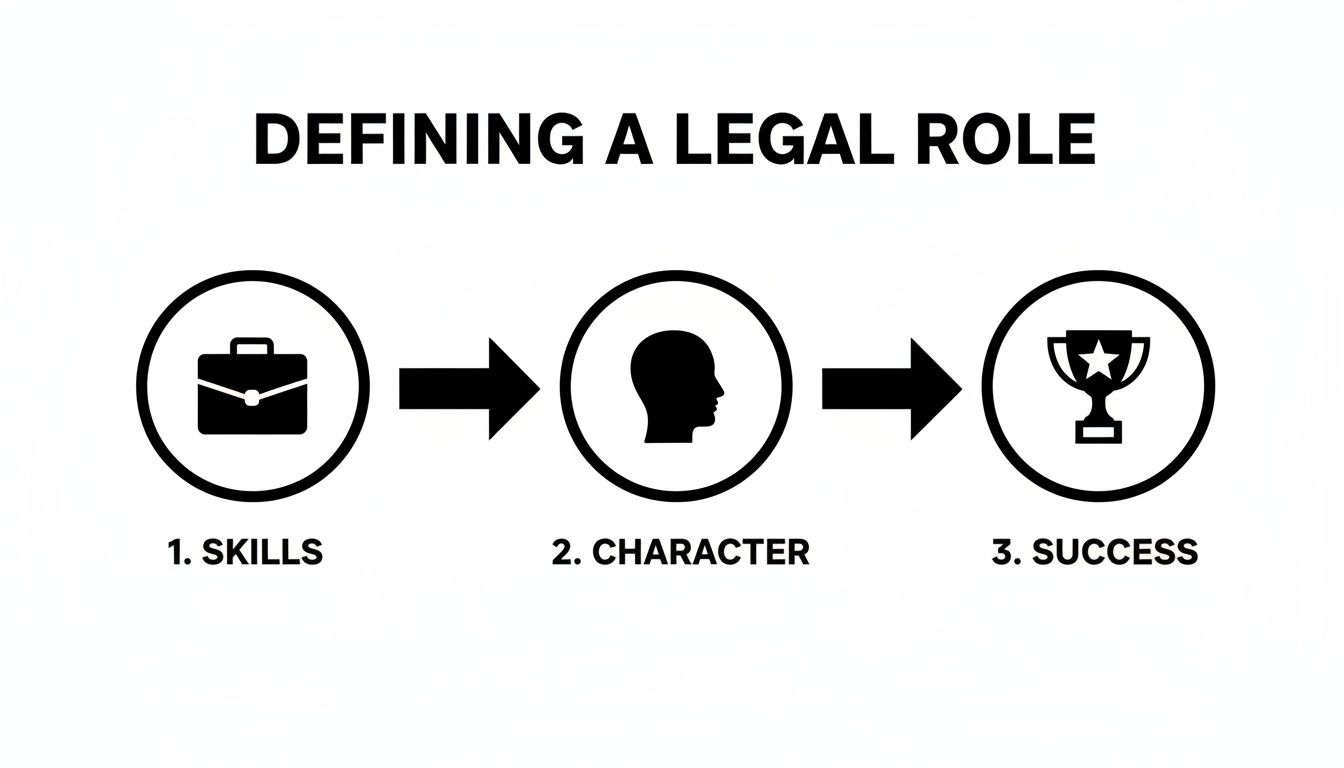
This kind of focused approach forces you to prioritize what actually matters—core competencies and character—instead of getting distracted by résumé fluff.
The traditional hiring funnel for a legal assistant is a slow, multi-week slog that actively works against you in today's market. Here's a reality check: the best candidates are off the market in about 10 days. If your process takes a month, you're not even in the game.
The current talent market is absolutely unforgiving. Unemployment for legal assistants is hovering around 1.9% (less than half the national average), while job openings have skyrocketed by nearly 50%. This intense supply-and-demand crunch means your old timeline is officially obsolete. Platforms built for this new reality can shrink the hiring time to as little as 24 hours, giving firms a massive edge. If you want to see the numbers, research from Robert Half confirms the data revealing the high demand for legal roles and proves why speed is everything.
Let’s map out where the leaks usually happen:
Each of these leaks is a self-inflicted wound. They're symptoms of a process that puts the firm's convenience ahead of the candidate's experience.
The brutal truth: In a tight talent market, the hiring process is no longer just about you evaluating them. It’s also about them evaluating you. A slow, clunky funnel screams, "We're inefficient and we don't value your time."
Now, imagine a different way. Instead of casting a wide net and hoping you catch something good, you tap into a pre-vetted, curated pool of talent. This isn't just about moving faster; it's a completely different strategy.
Let's look at how the numbers really stack up when you compare the old way with a modern, on-demand approach.
| Hiring Stage | Traditional Method (Job Boards/Recruiters) | On-Demand Platform (HireParalegals) |
|---|---|---|
| Sourcing | 1-2 weeks. Post jobs, sift through 100+ résumés. High volume, low quality. | 24 hours. Access a pre-vetted pool. Get a curated shortlist of 3-5 candidates. |
| Screening | 1 week. Multiple phone screens to filter out unqualified applicants. | 0 days. Vetting, skills tests, and background checks are already completed. |
| Interviews | 1-2 weeks. Coordinate schedules for multiple rounds of interviews. | 2-3 days. Go straight to final-round interviews with the best-fit candidates. |
| Offer & Onboarding | 1 week. Internal approvals, offer negotiation, background checks. | 1-2 days. Make an offer to a pre-checked candidate. |
| Total Time-to-Hire | 4-6 weeks | 3-5 days |
| Cost | $5,000 – $15,000+ (Recruiter fees, job board costs, staff time) | Flat subscription or placement fee. Typically a fraction of recruiter costs. |
| Risk | High. Risk of a bad hire, wasted time, and losing top talent to faster competitors. | Low. Candidates are skill-validated. Many platforms offer a replacement guarantee. |
The table makes it pretty clear. The traditional method is a gamble—it's slow, expensive, and you risk losing the very people you want to hire.
An on-demand platform completely changes the game. The most time-consuming part—the initial screening—is already handled. You aren't starting with a mountain of 200 résumés; you're starting with a shortlist of three to five highly qualified people who have already been background-checked and skills-validated.
The funnel becomes shorter, tighter, and built for decisive action. You define your need, and within hours, you get back a curated list of candidates, often complete with video introductions and verified credentials. You can skip the endless screening calls and go straight to meaningful conversations.
This isn’t about cutting corners. It's about eliminating the pointless, time-wasting steps that cause great candidates to give up and go elsewhere. You plug the leaks by replacing a slow, manual process with a fast, precise system. It's how you win the war for talent today.
Let’s talk about the legal assistant interview. For most firms, it's a piece of performative theater. You ask the same tired questions, get the same rehearsed answers, and learn absolutely nothing about how the candidate will actually perform when a deadline is screaming and three clients are on hold.
It's useless. And it’s a colossal waste of your most valuable asset: your time.
The goal of an interview isn't just to be "impressed" by a polished résumé or a charming personality. The goal is to predict future performance. So, let’s stop the charade and start having conversations that actually tell you something.
"What's your biggest weakness?" Oh, please. You know the answer is going to be some version of "I'm a perfectionist" or "I just care too much." These questions are an open invitation for candidates to feed you a pre-packaged, focus-group-tested response.
You need questions that break the script. Questions that force them to think on their feet and reveal their true problem-solving style, not just their ability to memorize interview prep guides.
They aren't trick questions; they're scenario-based prompts designed to get past the surface level. For a deeper dive, our guide on the best legal assistant interview questions breaks down even more of these powerful, script-breaking prompts.
Another massive time-waster? The glorified typing test you call a "skills assessment." Knowing someone can type 80 words per minute tells you nothing about their ability to draft a client email with the right tone or spot a critical error in a filing document.
Instead of a quiz, give them a micro-project. A real-world simulation that mirrors the actual work they’ll be doing.
Here are a few examples I’ve used that work wonders:
These small tests take maybe 15-20 minutes but provide a mountain of insight into their actual capabilities. You'll learn more from this than from an hour of asking about their five-year plan.
In the age of remote work, most of your interviews will happen over a screen. This is a golden opportunity to spot subtle red flags that might not be apparent in a stuffy conference room.
It’s not about judging their home office decor. It’s about observing their professionalism and preparedness in a digital environment.
Pay attention to the small things. Did they test their tech beforehand, or are they fumbling with their microphone for the first five minutes? Are they making eye contact with the camera, or are their eyes darting around the screen, clearly reading from a script?
These aren't deal-breakers on their own, but they help paint a bigger picture. A candidate who can't manage a simple video call might struggle with the demands of remote case management.
Watch for these signals:
Toot, toot! Here's where I become incredibly biased, based on years of banging my head against the wall with traditional hiring. The single biggest leap forward you can make in your hiring process is to stop interviewing unqualified people in the first place.
Imagine if you could skip the entire first round of interviews—all those 30-minute screening calls that go nowhere.
That’s the power of tapping into a curated platform like HireParalegals. We do the heavy lifting for you. Every candidate you see has already been through a rigorous vetting process: their skills are tested, their background is checked, and their experience is verified.
Many even come with short video introductions. In 90 seconds, you can get a sense of their personality and communication style—something that would normally take a full screening call to uncover.
This isn't about skipping the interview entirely. It's about making sure every single interview you conduct is a high-value conversation with a genuinely qualified, top-tier candidate. You move straight to the final round with people who are already a great fit on paper, saving you dozens of hours and letting you focus on what really matters: finding the absolute best person for your firm.
You did it. You navigated the interview gauntlet, ran a real-world skills test, and found the one. The impulse is to breathe a sigh of relief, but hold on. The most critical phase—the one that determines if this brilliant hire stays for years or is gone in six months—is just beginning.
Finding the perfect candidate is only half the battle. Screwing up the offer and onboarding process is like fumbling the football on the one-yard line. All that work, wasted.

A great hire can be utterly ruined by a clumsy, impersonal onboarding experience. The goal here isn't just hiring; it's retention. And retention starts the moment you decide to make an offer.
In a competitive market, speed is your ally. Don't let your top choice twist in the wind for a week while you get internal approvals. While you’re deliberating, another, more decisive firm is already sending them a contract.
But a compelling offer isn't just about throwing money at them. Sure, the salary needs to be competitive—data from Indeed puts the national average around $51,468, but this varies wildly by location and experience. The real magic happens in the details that show you value them as a human.
Think about what truly moves the needle for top talent today:
Your offer letter should be more than a dry legal document. It should be a final sales pitch that reaffirms why they should be excited to join your team.
Once they've accepted, it's time for the background check. This isn't about digging for dirt; it's about basic risk management and verifying the credentials they've presented. Keep it professional and transparent.
Most firms will run a standard check covering:
Just let the candidate know this is a standard part of the process for all new hires. If you’re using a platform like HireParalegals, this step is often already completed, which is another massive time-saver. You get peace of mind without adding another week of delay to the hiring timeline.
The first week sets the tone for everything. A new hire logging into an empty inbox with no clear instructions is a recipe for anxiety and buyer's remorse. You need a structured plan that makes them feel welcome, prepared, and part of the team from day one.
A thoughtful, structured onboarding process is your best insurance policy against the dreaded revolving door of legal assistant hiring. It's the difference between an employee who feels like a contractor and one who feels like a cornerstone of the firm.
Your "Week One Success Kit" should be a mix of practical setup and personal connection. Here's a checklist to get you started:
Effective onboarding is paramount for retaining your new legal assistant. For more ideas, you can discover templates to streamline employee onboarding processes and ensure a smooth transition. For remote hires specifically, we've also put together a detailed playbook on how to successfully onboard remote employees that you'll find incredibly useful. It's about creating a system that makes every new hire feel like they've made the best decision of their career.
We've walked through the whole playbook, but let's be honest—hiring is never as clean as it looks on paper. You probably still have some lingering questions.
So, let's get right to it. Here are the straight answers to the questions we hear all the time from firms just like yours. No theory, just practical advice from years of experience.
Absolutely. In fact, you probably should be thinking about it.
The old-school idea that your assistant needs to be just outside your office door is a holdover from a time before secure, cloud-based software. A fantastic remote assistant who knows their way around your tech stack is far more valuable than a so-so local one.
What truly matters isn't their physical address; it's their ability to seamlessly integrate into your workflow and communicate effectively. With today's case management systems and secure messaging tools, a remote assistant can be just as connected—if not more so—than someone down the hall.
Plus, when you hire remotely, your talent pool explodes. You're no longer limited to a 30-mile radius. You get to search for the best person for the job, period.
This is always the big question, isn't it? The national average salary for a legal assistant floats around $51,468, but that number is pretty misleading on its own. A legal assistant in a major city like New York is going to have a very different salary expectation than one in a smaller midwestern town.
Instead of getting hung up on national averages, take a more targeted approach:
Whatever you do, don't try to lowball. In this market, a truly great legal assistant will likely have other options. Paying a few thousand dollars above the market rate to lock down a genuine A-player is one of the smartest investments you can make for your firm's future.
This is a critical distinction that often gets blurred. Here's a simple way to think about it: a legal assistant manages the practice, while a paralegal helps practice the law.
Your legal assistant is your firm's operational core. They’re the ones handling the scheduling, fielding client calls, managing billing, and keeping all the administrative trains running on time. They create the organized environment lawyers need to focus on high-value work.
A paralegal, on the other hand, performs substantive legal tasks under an attorney's supervision. This includes things like legal research, drafting pleadings, and helping with trial prep. The American Bar Association (ABA) officially clarified the distinction in 2020, but there's still a lot of confusion out there.
Here's the key takeaway: If your biggest problem is administrative overload, missed calls, and a chaotic calendar, you need a legal assistant. If you’re buried under billable work that a non-lawyer could legally handle, you need a paralegal. Knowing what you actually need is the first step to making the right hire.


