

 19 minutes read
Let's get one thing straight: landing one of the good legal assistant jobs in Austin isn't about spamming Indeed with a resume your mom said "looks nice." It's a game of strategy. I've been in the trenches, hired for these roles, and seen the same mistakes kill hundreds of otherwise qualified candidates. This guide is your playbook—the unfiltered, insider scoop on what Austin law firms are actually looking for.
If your picture of Austin is just a laid-back city with killer breakfast tacos, you're living about a decade in the past. The legal market here is on fire. It's being supercharged by a constant flood of tech money, insane real estate deals, and the kind of high-stakes litigation that follows big egos with big bank accounts.
But here’s the cold dose of reality. For every single decent opening, there are dozens—sometimes hundreds—of applicants. They all have "strong organizational skills" and are "proficient in Microsoft Office." You know what that is? Boring. That’s the bare minimum, the price of entry. To actually get noticed, you need to burn the generic playbook.
Forget the tired advice you've read on those giant, soulless career blogs. The legal community in Austin has its own unique DNA. It’s a bizarre mix of old-school Texas swagger and a hyper-caffeinated, tech-forward startup culture. What plays well in Dallas will get you laughed out of the room here.
Think about it. A hiring partner at a boutique IP firm up in the Domain is looking for something wildly different than a managing partner at a massive litigation firm downtown. One needs a tech-savvy assistant who can jump into complex software without hand-holding. The other might just desperately need someone who knows the weird, arcane quirks of e-filing in Travis County. Your job is to figure that out before you even dream of hitting "apply."

I’m not just talking about skills; I’m talking about mindset. The legal assistants who get the best jobs in Austin are proactive problem-solvers, not glorified task-doers. They anticipate needs, they don’t over-communicate, and they understand they’re a critical part of making the firm money—not just administrative overhead.
To get hired, you have to prove you understand this. Your entire approach—from the first line of your resume to your final interview question—has to be sharp, tailored, and prove you've done your homework.
That’s what this guide is for. We're skipping the fluff and getting right to the actionable strategies that work in this market. Think of this as the conversation you wish you could have with a hiring manager over a beer on South Congress.
We'll cover:
Let's cut to the chase and talk about money. If you’re basing your salary expectations on some national average you Googled, you’re setting yourself up for disappointment. Austin is its own unique, expensive ecosystem, and the pay scales reflect that.
Your actual paycheck will be a cocktail of several key factors: the firm's size, its practice area, your actual skills (not the ones you list, the ones you can prove), and even where the office is. A small family law practice in Westlake doesn't have the same budget as a massive IP firm raking it in near The Domain. Shocker, I know.
So, what are we really talking about? The baseline figures are a decent starting point, but they’re just that—a start. Recent data from October 2025 shows the average legal assistant in Austin, Texas, earns around $22.98 per hour, which works out to about $47,792 a year. For newbies, the entry-level average dips to $21.60 per hour, or roughly $44,920 annually. You can explore more about these salary benchmarks, but treat these numbers as the appetizer, not the main course.
The average salary won't pay your rent on South Lamar. What really moves the needle?
Specialization. A generalist legal assistant doing basic admin work will earn a respectable wage. But one who has deep experience in high-stakes commercial litigation, knows the Travis County e-filing system inside and out, or is a certified wizard with a tool like Clio will command a much higher premium.
Think of it this way: are you a "doer" or a "driver"? A doer waits for tasks. A driver anticipates an attorney's needs, manages complex files before they become a dumpster fire, and makes the whole legal process smoother. Firms pay top dollar for drivers because they aren't an expense; they're a force multiplier.
This chart gives you a quick snapshot of the Austin legal scene. It’s a booming market, but the fierce competition means you have to bring your A-game to land the top-tier pay.

The takeaway? The opportunities are plentiful, but so is the talent pool. This forces firms to pay more for specialized, high-impact people who can navigate the city's unique legal culture without a map.
I’ve spent years in these trenches, hiring people and seeing what the market actually demands. Here's a more realistic breakdown based on what I’ve witnessed firsthand.
The Founder's Takeaway: Don't just fixate on the salary number. A firm offering slightly lower base pay but with a killer bonus structure, great health insurance, and a real commitment to your professional development is a much better deal than a place that will burn you out in six months for an extra two grand.
Your experience level is the obvious lever. A recent grad with a paralegal certificate is in a different universe than a ten-year veteran who's seen multiple trials through from start to finish. But it's not just about the number of years—it's about the quality of that experience.
Here’s a table outlining what you can generally expect in the Austin market.
This table breaks down the typical compensation ranges you'll find in Austin, based on where you are in your career.
| Experience Level | Typical Hourly Rate (Austin) | Typical Annual Salary (Austin) |
|---|---|---|
| Entry-Level (0-2 Years) | $21 – $24 | $43,000 – $50,000 |
| Mid-Level (3-5 Years) | $25 – $32 | $52,000 – $67,000 |
| Senior (5+ Years) | $33 – $40+ | $68,000 – $83,000+ |
| Specialist (e.g., IP, Litigation) | Varies Greatly | Add a 10-20% premium |
These are still just benchmarks. If you bring a rare skill to the table—like fluency in a second language or a certification in niche legal software—you have leverage. Use it.
Don't be afraid to negotiate, especially in a market this hot. The worst they can say is no, and the best-case scenario is a salary that actually reflects the value you bring to the firm.
If you think finding a great legal assistant job in Austin is about setting up alerts on LinkedIn and Indeed, you’re missing the point. And the best opportunities. Relying on those massive job boards is like screaming into a void filled with "quick apply" resumes from a thousand other people.
The truth is, the most compelling roles often never get posted there. They're filled through word-of-mouth, niche professional circles, and specialist recruiters who are on a first-name basis with hiring partners. It's a hidden job market, and if you’re not tapped in, you’re only seeing the scraps.

Sure, the demand is there. Austin’s legal field is humming, with over 300 job vacancies for legal assistants listed as of late 2025. You can see the latest numbers on Austin's legal job market, but that sheer volume creates an insane amount of noise.
The challenge isn't finding a job posting; it's cutting through the static to get your resume in front of the right eyeballs.
For a city this big, Austin’s legal scene is surprisingly tight-knit. People know each other, they talk, and they refer candidates they trust. This isn't about schmoozing at every event, but making a real effort to engage with local professional organizations is non-negotiable.
Here’s where you put your energy:
Joining is more than paying dues. It’s showing up, having real conversations, and not being weird about it. Your next job offer is far more likely to come from a casual chat with a CAPA member than from a cold application you fired off at 2 AM.
Let’s talk recruiters. I know, they can be a mixed bag. Some are just resume-pushers who don’t know a tort from a torte. But a good legal recruiter—one who specializes in the Austin market—is a powerful ally.
The best ones have deep relationships with the city’s top firms. They know about openings before they’re posted and can walk your resume directly to the hiring manager. They’ve spent years building trust, and that trust extends to you.
The Insider Tip: Don't work with just any recruiter. Find someone who focuses exclusively on legal support staff in Central Texas. Ask them which firms they partner with and how many legal assistants they’ve placed in the last year. A great one will have impressive answers; a mediocre one will give you fluff.
When a firm pays a recruiter a fat fee to find the right person, they're already invested in the candidates that recruiter brings them. You get to bypass the slush pile and land at the top of the list. It’s like having a VIP pass.
While the mega-boards are a mess, a few niche sites offer a more curated experience. These are where serious firms go when they want serious candidates.
You have to be selective; many sites just scrape from the same sources. But a few are worth checking daily. We’ve put together a guide on the most effective paralegal job websites that you should have on your radar.
The goal isn't to apply for everything. It's to find the handful of high-quality openings on platforms that hiring managers actually respect. It’s quality over quantity. Combine direct networking, a savvy recruiter, and a focus on these niche boards, and you’ll find the legal assistant jobs in Austin everyone else is missing.
Let’s be brutally honest. A busy partner will give your resume about six seconds. Not ten, not thirty. Six. In that tiny window, they'll decide if you’re worth a closer look or if you’re headed for the digital trash can.
If your resume starts with "Seeking a challenging legal assistant position…" you’ve already lost. That’s not a strategy; it’s a surrender. Every line needs to be a tactical decision, designed to scream, "I get it, I can do this job, and I can start yesterday."
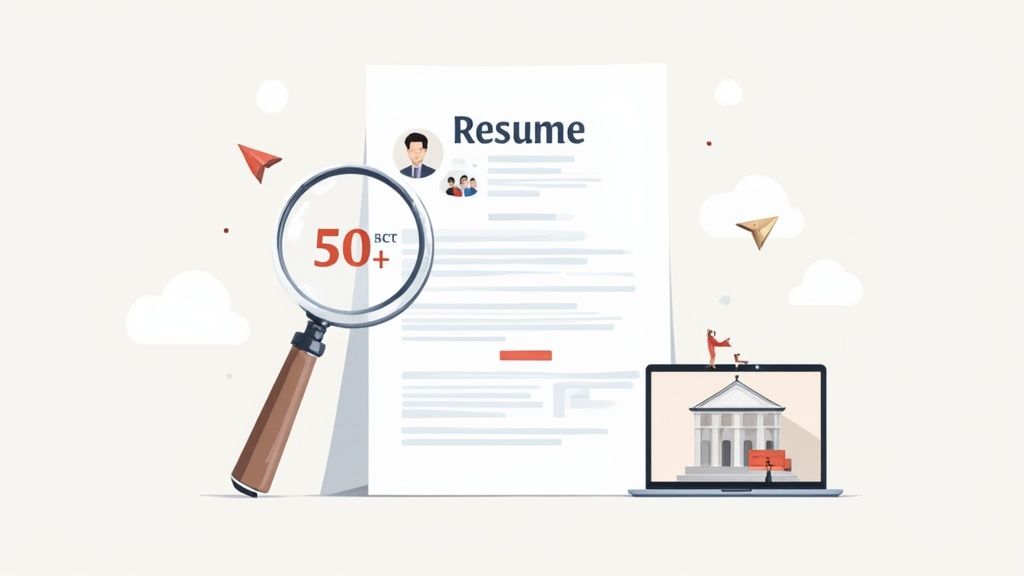
Here’s the biggest mistake I see. People list their duties. "Responsible for filing," "Managed calendars," "Answered phones." Nobody cares. What a hiring partner wants to know is the impact you had.
You have to speak their language: metrics, efficiency, and results. Stop listing what you did and start showing how well you did it. Quantify everything.
Here’s the shift:
Boring: "Managed case files."
Better: "Managed 50+ complex litigation case files simultaneously, ensuring 100% of deadlines were tracked and met."
Boring: "Responsible for billing."
Better: "Processed over $200,000 in monthly client invoices with a 99% accuracy rate, cutting payment delays by 15%."
See the difference? One is a passive description. The other is a powerful statement of accomplishment. It shows you’re an asset, not an expense. Understanding what makes a resume stand out to recruiters is the first step to getting noticed.
Local firms want to know you can hit the ground running. Highlighting "Microsoft Office" is like bragging you know how to use a fork. Get specific.
Mention the exact legal software they’re using. Are you a wizard with Clio, MyCase, or PracticePanther? Say so. Do you know the ins and outs of the Travis County e-filing system? Put that front and center. These are the details that signal you won’t need six weeks of hand-holding.
The Hard Truth: A candidate with two years of experience who knows the local court rules and the firm's case management software is infinitely more valuable than a candidate with five years of generic experience from another state. Local knowledge is a massive competitive advantage.
It's also worth knowing how your experience lines up with the specific legal assistant job requirements in Texas. For a broader overview, you can check the general requirements for paralegal jobs to see how you stack up.
Forget the fancy fonts and weird layouts. Legal is a conservative industry, even in Austin. Your resume needs to be clean, professional, and brutally efficient.
This isn’t the time for creativity; it’s the time for clarity. Here’s a structure that works every time:
That’s it. No fluff. Just a powerful, one-page document that makes it impossible for them to say no. This is your marketing brochure, and in the hunt for legal assistant jobs in Austin, it needs to be a bestseller.
Alright, you did it. Your killer resume got you in the door. Now what? This is the moment that matters. Austin firms aren't just hiring a skill set. They're hiring a personality, a problem-solver, and someone who won't drive the rest of the team crazy.
If you walk in expecting a simple Q&A, you're setting yourself up for that polite, "we'll keep your resume on file" email. This is a conversation. You’re interviewing them just as much as they’re interviewing you.
Hiring partners in Austin love situational questions. They don't want to hear that you can handle pressure; they want a real story about how you did it.
Be ready for questions like these:
They’re testing your judgment and communication. Don't give a textbook answer. Tell a real story with a clear beginning, middle, and end that shows how you turned a potential disaster into a managed success. For more practice, we've got a whole list of common legal assistant interview questions to get you prepped.
The worst thing you can do is say, "Nope, I think you've covered everything!" That’s a huge red flag. It screams lack of interest. You absolutely must come prepared with your own insightful questions.
This isn’t just about looking smart—it’s about figuring out if you actually want to spend 40+ hours a week there. You can find some great inspiration by reviewing the best questions to ask at the end of an interview. Good starting points are asking about the firm's biggest challenges or what success in this role looks like six months from now.
An interview is not a test. It's a discovery process. A candidate who asks thoughtful questions about team dynamics, firm culture, and future growth is demonstrating they're a strategic thinker, not just another warm body looking for a paycheck.
The follow-up is a delicate dance. You want to show you're interested, not desperate. A simple, well-written thank-you email sent within 24 hours is non-negotiable. Make it personal by referencing something specific from your conversation.
If you don't hear back in the timeframe they gave you, a polite check-in email is fine. Keep it brief. The goal is to stay top-of-mind without being annoying.
The legal assistant field in Austin is growing. The Bureau of Labor Statistics projects a 4% employment growth for paralegals and legal assistants between 2022 and 2032. That's about 38,000 new jobs opening up each year nationwide. Austin firms are definitely hiring, but they can afford to be picky. Nailing the interview is how you prove you’re the one they can’t afford to lose.
Alright, let's cut through the noise. You've heard the hype about the Austin market, you know it's competitive, and you're trying to figure out the unwritten rules. I get it. I’ve been there.
Here are the straight-up, no-fluff answers to the most common questions I hear. Think of this as the advice I’d give a friend over a ridiculously expensive coffee on South Congress.
The million-dollar question. Short answer: no, it isn't legally required. Pragmatic answer: it really helps.
Think about it from the hiring partner's perspective. They’re sifting through a mountain of resumes. A paralegal certificate from an ABA-approved program is a quick signal that you’ve invested in your career. It tells them you know the difference between a deposition and a subpoena.
Can you get a great job without one? Sure, if you have years of solid, in-the-trenches experience. But if you're newer to the field, that certificate can be the tiebreaker that gets you in the door. It’s about de-risking your candidacy for a busy law firm.
Austin has this laid-back reputation, but let's be clear: law firms are still law firms. Deadlines are brutal, attorneys are demanding, and trial prep will swallow your evenings. Anyone who tells you otherwise is selling something.
However, the culture around that work is often different here. Many Austin firms, especially smaller boutiques and tech-focused practices, have ditched the stuffy, old-school mentality. They understand burnout is real.
The Unfiltered Take: You will work hard. Period. But you're more likely to find a firm that respects your time and won't side-eye you for leaving at 5:30 p.m. on a Tuesday than in other major legal markets. The key is to ask smart questions during your interview to sniff out the firm’s true culture, not just the one on their website.
So, you don't want to be fetching coffee forever. Good. Ambition is an asset. The traditional ladder looks something like this:
But the path isn't always linear. In Austin, I’ve seen stellar legal assistants move into roles like:
The trick is to identify what you're good at and what the firm needs, then make a case for creating that role. The best Austin firms will invest in talent they want to keep. Don't wait for a promotion; build the argument for it yourself.
To wrap things up, here’s a quick-reference table answering some more of the most common questions we see.
| Question | Answer |
|---|---|
| What's the best practice area for a new legal assistant in Austin? | Litigation is a great starting point because it teaches you core skills. However, high-growth areas like tech law, intellectual property (IP), and real estate are booming in Austin and offer excellent long-term prospects. |
| How important is tech proficiency for this role? | Critical. At a minimum, be an expert in the Microsoft Office Suite. Familiarity with case management software like Clio or MyCase, and e-discovery platforms like Relativity, will put you far ahead of the competition. |
| Can I negotiate my salary as an entry-level candidate? | It's tough, but not impossible. If you have relevant prior experience, a specialized skill, or a paralegal certificate, you have leverage. Always research the market rate using the resources mentioned earlier so you're negotiating from a position of knowledge. |
| Are remote legal assistant jobs common in Austin? | They are becoming more common, especially for experienced professionals. Many Austin firms now offer hybrid schedules. Fully remote positions are still less frequent for roles that require significant in-office support, but they do exist. |
Hopefully, this gives you a clearer picture of the landscape and the confidence to take the next step.


