

 18 minutes read
Here's the simple truth: The legal assistant paralegal difference boils down to one thing—one organizes the game, while the other helps you win it. A legal assistant tames your firm's administrative chaos. A paralegal is a force multiplier for your legal work, handling the substantive, billable tasks you shouldn't be doing.
Confusing the two is a rookie mistake. I’ve seen it cost firms a fortune in wasted salaries and lost billable hours. Let's fix that.
Let’s be blunt. If you're a managing partner, you've probably felt the sting of a bad hire. You bring on someone you think is a paralegal, only to discover you've hired a very expensive administrative assistant who can't draft a motion to save their life.
Or worse, you hire a legal assistant and pile on substantive legal work, creating an ethical landmine and a fast track to burnout. Hope you enjoy spending your afternoons fact-checking resumes and running interviews—because that’s now your full-time job.
This isn't just about job titles; it's about smart resource allocation. You wouldn't ask your top litigator to manage the office calendar, so why are you paying paralegal rates for administrative support? Precision is profit.
A legal assistant is your firm’s operational backbone. They are the masters of scheduling, filing, client intake, and keeping the administrative gears turning so you can focus on practicing law.
A paralegal, on the other hand, is a direct extension of your legal capacity. They conduct legal research, draft pleadings, manage discovery, and handle the kind of substantive work that requires formal training and falls under an attorney’s direct supervision.
Think of it like building a house. The legal assistant is the project manager, keeping all the permits, schedules, and materials perfectly organized. The paralegal is the skilled craftsperson—the one framing the walls and installing the electrical—doing the specialized work that gets the job done.

The biggest mistake firms make is hiring for a title instead of a function. Before you write a job description, identify your bottleneck. Are you drowning in paperwork, or are you turning away billable work? Your answer tells you exactly who to hire.
To cut through the noise, I’ve broken down the fundamental differences into a no-nonsense comparison. No jargon, no fluff—just the critical distinctions you need to make the right hiring decision. The first time.
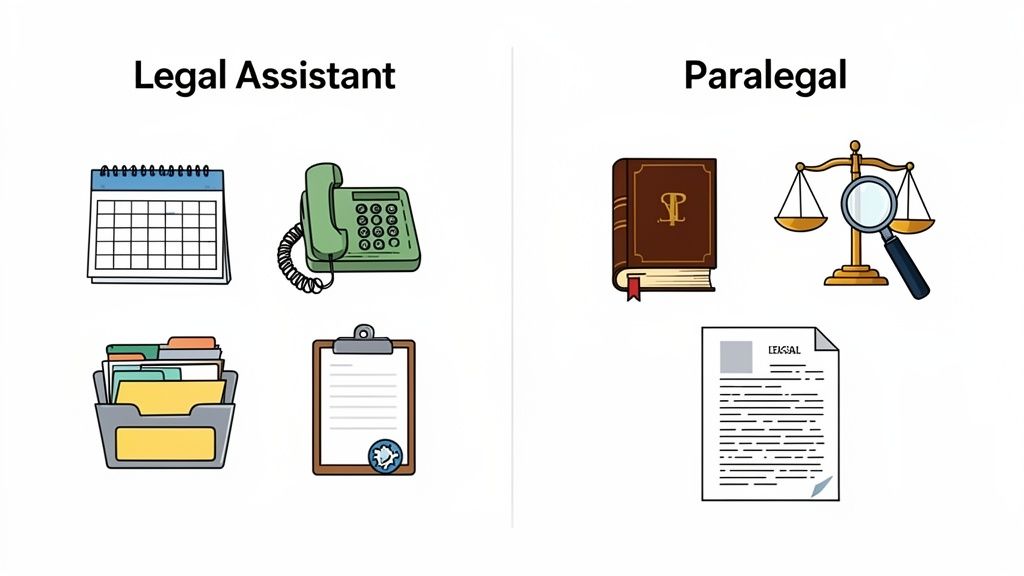
This table strips away the complexities to give you a clear, side-by-side view of how these roles function and where their value truly lies.
| Key Area | Legal Assistant (Operational Backbone) | Paralegal (Legal Force Multiplier) |
|---|---|---|
| Primary Function | Administrative and organizational support. Manages the business of the law firm. | Substantive legal support. Directly assists with the practice of law. |
| Typical Tasks | Answering phones, scheduling appointments, client intake, filing documents, managing office supplies. | Legal research, drafting motions and pleadings, discovery management, preparing for trial, summarizing depositions. |
| Billable Work | Almost exclusively non-billable. Their work enables others to be billable. | Primarily billable. Their hours directly generate revenue for the firm. |
| Impact on Firm | Increases operational efficiency, improves client service, and frees up attorney time. | Increases case capacity, enhances legal strategy, and drives firm profitability. |
Ultimately, one keeps the lights on; the other helps you win cases. You need both, but you need them in the right seats.
Job descriptions are abstract nonsense. The best way to really understand the difference between a legal assistant and a paralegal is to see what they actually do all day. Think of it this way: one is the firm's air traffic controller, and the other is your co-pilot on a specific case.
Let's drop the hypotheticals and look at what their typical Tuesday looks like.
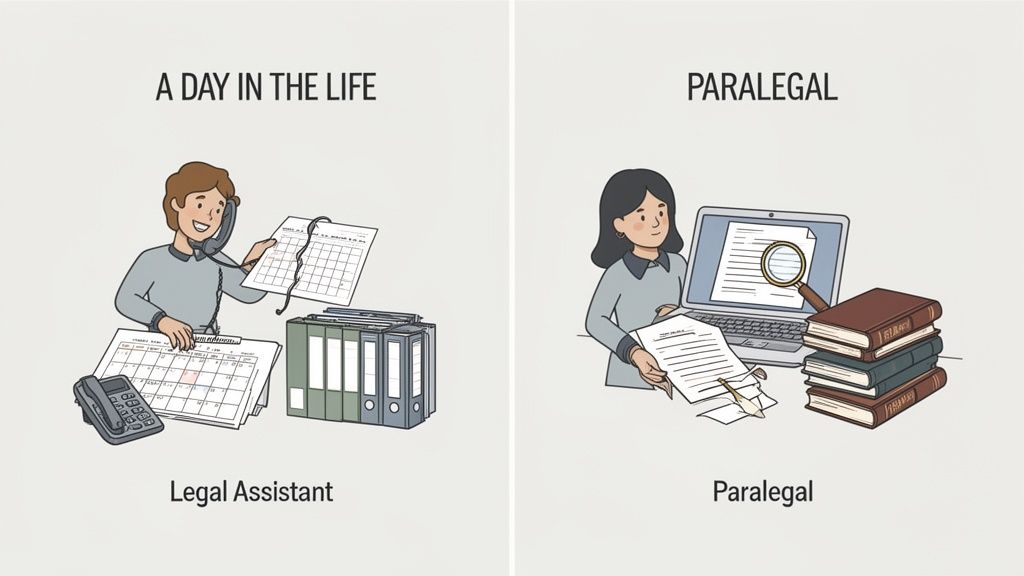
It’s 9 AM in a busy litigation firm. The legal assistant’s phone has been ringing since they walked in the door.
Their morning is a whirlwind of operational triage. They are the firm's gatekeeper, ensuring the administrative side of the practice runs like a Swiss watch.
Simply put, a legal assistant is the operational glue. Without them, your firm grinds to a halt.
Meanwhile, the paralegal is already neck-deep in substantive legal work. Their focus isn't on firm logistics; it’s on case strategy and execution.
The paralegal isn't answering the main firm line; they're on a direct call with a witness to schedule a pre-deposition interview. Their work is a direct, billable contribution to moving a case forward.
Their morning looks completely different:
This clear division of labor isn't just for litigators. In corporate law, the legal assistant handles the admin side of entity formation and coordinates board meetings. The paralegal is busy drafting shareholder agreements and managing due diligence checklists for a merger.
In family law, the legal assistant is the empathetic first point of contact, scheduling consultations with distressed clients. At the same time, the paralegal is drafting petitions for dissolution and organizing mountains of financial disclosures.
It’s also worth noting the demographic context. Data shows a significant gender disparity, with women holding nearly 90% of paralegal and legal assistant positions but just over 36% of lawyer roles. This imbalance highlights how support roles remain predominantly female. You can learn more about the demographics of legal occupations from Law Week Colorado.
Bottom line: a legal assistant’s work allows the firm to run. The paralegal’s work is the revenue-generating work. One protects your time; the other multiplies it.
Hiring someone with the wrong qualifications isn't just a mistake; it's an ethical landmine. I’ve seen firms get this wrong, and the cleanup is always uglier and more expensive than just hiring the right person from the start.
The barrier to entry for a legal assistant is, frankly, pretty low. A high school diploma and exceptional organizational skills are often enough. You're hiring for an operational genius, not a legal scholar.
For a paralegal, the stakes are much, much higher.
This is where the legal assistant paralegal difference becomes non-negotiable. Most credible paralegals hold at least an associate's degree in paralegal studies or, more importantly, a certificate from an American Bar Association (ABA)-approved program. That piece of paper isn’t just for show; it's your assurance they understand legal procedure, research methods, and professional ethics.
They need this formal education because they perform substantive legal work. They need to know the difference between a motion to dismiss and a motion for summary judgment because they’ll be the ones drafting them.
Don’t get mesmerized by a long list of credentials. The key is ABA approval and relevant certifications. It separates the professionals from the pretenders.
While not always mandatory, professional certifications signal a higher level of commitment. The one that carries the most weight is from the National Association of Legal Assistants (NALA), which offers the Certified Paralegal (CP) designation. Seeing "CP" after a candidate's name is a good sign you’re dealing with a serious professional. If you want to dig deeper, learn more about paralegal certification requirements and their importance.
Now for the part that can get you into real trouble. Understanding ethical boundaries isn't just good practice—it’s mandatory for avoiding Unauthorized Practice of Law (UPL) claims. I can't stress this enough.
Here are the hard-and-fast rules:
These aren't suggestions. They are bright red lines. As the supervising attorney, you are 100% responsible for your paralegal's actions. If they cross a line, it’s your license on the hook.
Both roles require professional standards. Delve deeper into the best practices for ensuring compliance and ethics in a law boutique to navigate these complexities.
A legal assistant’s qualifications are about efficiency. A paralegal’s qualifications are about competence and ethics. Confusing them exposes your entire practice to risk.
Let's talk money. You can’t afford to overspend, but a cheap hire will cost you far more in the long run. The entire financial model of a law firm is built on leverage. This is where the legal assistant vs. paralegal difference becomes a critical calculation.
Paralegals command higher salaries for a reason—their skills are specialized and, most importantly, billable. A legal assistant is a cost center, a necessary expense. A paralegal is a profit center, directly generating revenue.
The rookie mistake is looking only at the paycheck. The true cost of an employee goes much deeper. A full-time, in-office employee comes with a whole caravan of hidden expenses that drain your resources.
Think about it. When you hire someone full-time, you're not just paying a salary. You're also on the hook for:
This is where the old-school hiring model starts to creak under its own weight. It’s expensive, slow, and frankly, outdated.
Stop thinking about cost-per-hire and start thinking about value-per-hour. A traditional hire is a long-term liability on your balance sheet before they ever become an asset. An on-demand professional delivers immediate ROI without the financial drag.
So why absorb the six-figure, all-in cost for a full-time paralegal when what you really need is specific expertise on demand?
The Bureau of Labor Statistics reported a median paralegal salary of $61,010 as of May 2024. But that's just the start. Let's put the traditional model head-to-head with a more agile approach.
Here's a pragmatic comparison of the true costs.
| Cost Factor | Traditional In-House Hire | On-Demand Remote Hire |
|---|---|---|
| Annual Salary | $57,000 (Average) | Pay-per-hour or project basis |
| Benefits & Payroll Taxes | ~$17,100 (at 30%) | $0 |
| Overhead & Equipment | ~$5,000+ | $0 |
| Recruiting & Onboarding | Weeks of your time + potential fees | A few hours, tops |
| Total Year 1 Cost | $79,100+ | Varies, but with up to 80% savings |
The numbers don't lie. Turns out there’s more than one way to hire elite support without mortgaging your office ping-pong table.
Platforms like HireParalegals flip the script. You tap into a pre-vetted network of professionals, cutting payroll costs dramatically and slashing hiring time from months to mere days. It’s about surgical precision—getting the exact expertise you need, right when you need it. Understanding precise invoicing is critical, making an exploration of how to track billable hours highly relevant.
Shifting to a flexible model isn't just about saving money; it’s a strategic move. It allows you to scale your team based on caseload, turning a fixed cost into a variable one. That’s not just smart; it’s survival.
Let's get right to it. Making the right hire is about solving the biggest problem holding your practice back. Get this wrong, and you're just patching a symptom instead of curing the disease.
The entire legal assistant vs. paralegal debate boils down to one simple question: What is the real bottleneck in your firm? Is it administrative chaos, or is it a crushing legal workload?
Your answer tells you exactly who you need.
Are you drowning in paperwork? Is your inbox out of control? Are you missing calls from potential clients because you're stuck in a meeting? If this hits close to home, your bottleneck is purely administrative.
You're burning valuable, high-rate hours on non-billable tasks. You've become the firm's most expensive (and least efficient) administrator, and it's stalling your growth.
Here’s a quick gut-check. You need a legal assistant immediately if:
A great legal assistant doesn't just get you organized; they give you back your time. They build the operational foundation you need to focus on what you actually do best: practicing law. Stop playing office manager.
This decision tree helps visualize that core question.
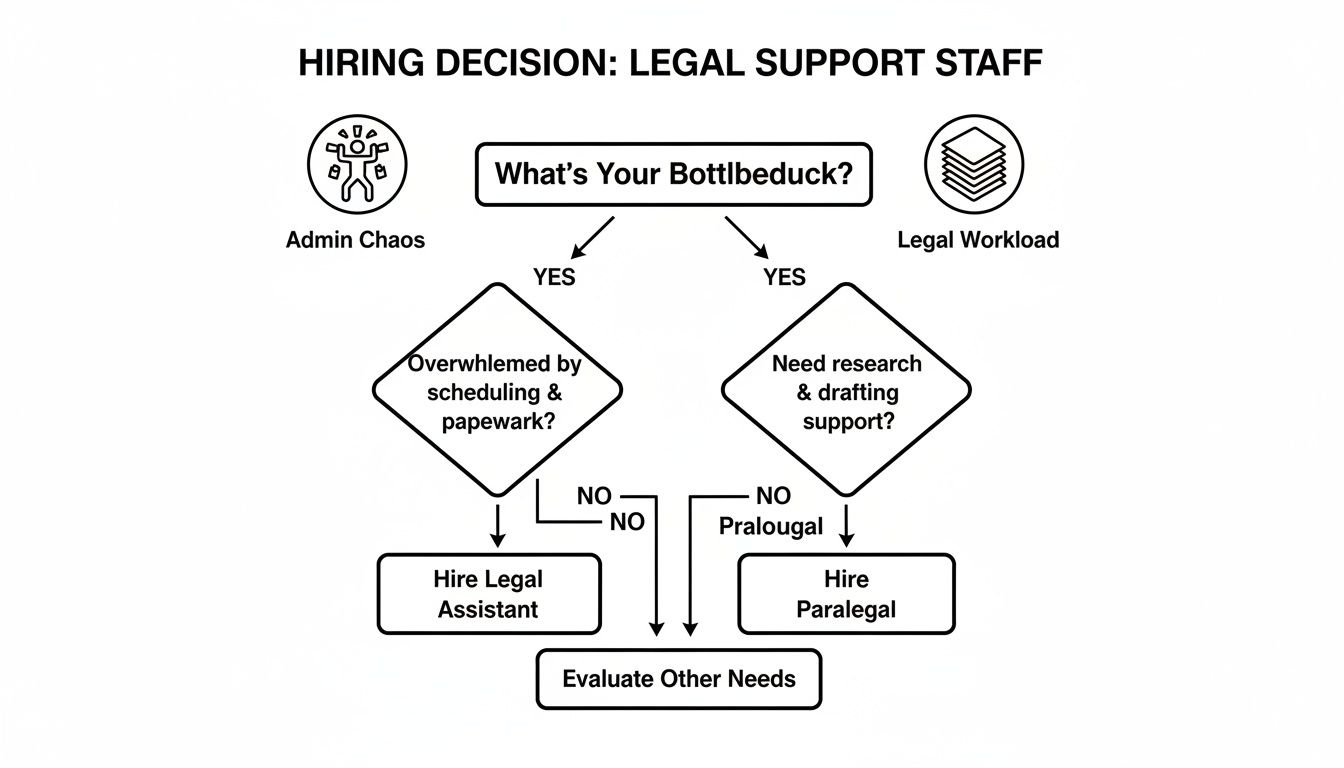
As the flowchart shows, if your firm is suffering from operational friction, a legal assistant is the clear choice. But if the legal work itself has become unsustainable, you need a paralegal.
Now, let's look at the other side of the coin. Maybe your office runs like a well-oiled machine. But you’re still working until midnight, and your to-do list just keeps getting longer.
You're bogged down in drafting documents, managing discovery, and conducting legal research. These are billable tasks, but they're pulling you away from high-value work like client strategy and court appearances. You're turning away good cases simply because you don't have the capacity.
Your problem isn’t a lack of organization; it's a lack of leverage. You're a one-person army trying to fight a war on multiple fronts, and you're losing ground.
You desperately need a paralegal if:
Hiring a paralegal is a direct investment in your firm's ability to generate revenue. They act as a force multiplier, enabling you to take on more cases and grow your bottom line.
Unless you enjoy sifting through resumes and conducting endless interviews, you need a better plan. I’ve seen bad hires cripple firms—it's a nightmare of wasted time, money, and morale.
The difference between a great hire and a total disaster often boils down to asking the right questions. The goal isn't to verify a resume; it's to understand how a candidate thinks. Ask vague questions, get vague answers.
Forget the classic, "What are your greatest weaknesses?" It's a tired script. You need questions that force candidates to demonstrate actual competence.
For a paralegal, try these:
For a legal assistant, focus on their organizational genius:
You're not listening for a "right" answer. You're listening for structure, logic, and real-world experience.
Founder-to-founder advice: Stop trying to do all this yourself. Your time is worth far more than the hours you'll sink into a hiring process you're probably not an expert in.
Here’s the thing—even with the best questions, you’re still one person trying to vet a mountain of candidates. This is where I got smart and stopped trying to be the hero. A service like HireParalegals can handle the entire soul-crushing vetting process for you.
They take care of the sourcing, skills validation, and background checks. You won't see a single resume until a candidate has been thoroughly vetted. What lands on your desk is a curated shortlist of top-tier professionals. To learn more, check out this guide on the benefits and process of bringing on administrative support.
This is your cheat sheet. You can either run a much smarter hiring process on your own, or you can delegate it to the pros and get back to growing your firm.
Alright, let's tackle some of the common questions I hear. No fluff, just straight talk.
In theory, yes. In practice, it's a terrible idea. Asking one person to manage the constant interruptions of administrative work while also doing the deep, focused thinking required for substantive legal tasks is a recipe for burnout and mediocrity.
You wouldn't ask your star trial strategist to also answer the phones. Define your most urgent need. If you're drowning in paperwork, you need a legal assistant. If you're bogged down with billable work, you need a paralegal. Merging the two roles means both jobs get done poorly.
Honestly, they can often be more effective. A great remote paralegal is hired for one thing: their expertise. They are free from the daily distractions of office life—the hallway chatter, the "quick question" that turns into a 30-minute conversation.
With today's secure, cloud-based case management software, a skilled remote paralegal integrates into your workflow just as easily as someone in the next office. The focus shifts from physical presence to actual performance.
Without a doubt, it's hiring for a generic job title instead of solving a specific business problem. I've seen it a hundred times: a firm posts an opening for a "paralegal" when what they're truly desperate for is a legal assistant to get their chaotic front office under control.
This mismatch is expensive. You end up with an overqualified professional who grows bored with administrative tasks. They'll leave within a year, and you're right back where you started. Before you write a job ad, list the exact tasks that are bottlenecking your firm. That list will tell you exactly who to hire.
If you're going the traditional route, be prepared for it to take weeks, if not months. It's a huge time sink.
A managed platform like HireParalegals, on the other hand, can dramatically speed things up. Because we have a pre-vetted network of experienced professionals, we can often present you with a shortlist of ideal candidates within 24 hours. From there, you could be hiring in a matter of days. We’re not saying we’re perfect. (Toot, toot!) Just more accurate more often.


