

 20 minutes read
Let’s be honest. That last invoice from your law firm made you wince, didn't it? You’re trying to build a business, not personally fund a partner's next vacation home. Legal process outsourcing (LPO) services are your on-demand legal ops team, ready to crush the high-volume, soul-crushing tasks without the sticker shock of traditional law firm rates.
You've heard the term "legal process outsourcing services" thrown around. To most people, it just sounds like corporate speak for "send sensitive work to a stranger on the internet." I get it. The first time I explored it, I had the exact same thought. But the reality is far less scary and a whole lot smarter.
Think of it as the ultimate form of leverage. Instead of having your best (and most expensive) legal minds burn hours on repetitive work, you offload it. This frees up your A-team to focus on the high-stakes stuff—negotiating the big deal, crafting brilliant litigation strategy, and giving you the nuanced counsel you’re actually paying for.
Let’s cut the fluff. We are not talking about replacing your General Counsel with an algorithm. LPO is all about smartly delegating the specific, often mind-numbingly time-consuming, legal support functions.
This could be work like:
For example, specialized legal transcription services can be a dead-simple but powerful way to manage documentation and cut costs. It's these small, smart shifts that add up to a leaner, meaner legal operation.
One of the biggest myths about legal outsourcing is that it’s a tool reserved for massive corporations with sprawling, hundred-person legal departments. That’s ancient history. Today, it’s a complete game-changer for small to mid-sized firms and startups that need to operate like a much bigger company without the massive budget.

The goal isn’t to be cheap; it’s to be smart. LPO lets you stop your legal budget from being a black hole and start treating it like a strategic investment.
The market gets it. The global LPO market is already a multi-billion dollar industry, with some analysts projecting it will explode to nearly USD 158 billion by 2035. This isn't some fringe trend; it's the new standard for efficient legal ops. You can find more details in this market analysis from Future Market Insights.
To really feel the shift, look at this before-and-after.
| Your Team's Focus Without LPO | Your Team's Focus With LPO |
|---|---|
| Drafting standard NDAs from scratch | Reviewing high-stakes, non-standard contracts |
| Manually reviewing thousands of discovery docs | Developing case strategy based on key findings |
| Basic legal research and citation checking | Crafting persuasive legal arguments |
| Chasing down contract signatures and renewals | Negotiating better terms on critical deals |
| Answering routine client intake questions | Building high-value client relationships |
The difference is stark. It's reallocating your team's brainpower from "busy work" to high-value strategic work. Understanding the costs is a crucial first step, and our breakdown of virtual paralegal rates gives you a clear baseline for what to expect.
So, you’re on board. You're ready to stop watching your legal budget go up in smoke. Now for the hard part. Not all legal process outsourcing services are created equal. Picking the wrong model is like hiring a brilliant specialist who only works while you’re asleep—the work might get done, but the process will be a nightmare.
Let's walk through the options. Your first big decision is geography. It sounds simple, but it changes everything from cost to communication.
I’ve worked with teams all over the world, and trust me, the answer isn’t "just pick the cheapest." You’re not just buying a service; you're choosing a partner.
Onshore LPO: This is your domestic choice. The team is in your country, speaks your language natively, and works in your time zone. The huge advantage is seamless communication. The trade-off? It’s the most expensive option. No surprise there.
Offshore LPO: This is the model that put LPO on the map, often using talent in places like India, South Africa, or the Philippines. The cost savings can be staggering—we’re talking potential reductions of 70-80%. The catch is navigating time zone chasms and potential communication hurdles.
Hybrid (or Nearshore) LPO: This is often the "just right" solution. You might have a project manager in your city coordinating with a team in a nearby time zone, like Latin America. It strikes a great balance between big cost savings and decent working-hour overlap, which is a massive win for projects that require back-and-forth.
This simple flowchart can help visualize the decision. Are high legal bills getting in the way of your actual business strategy?
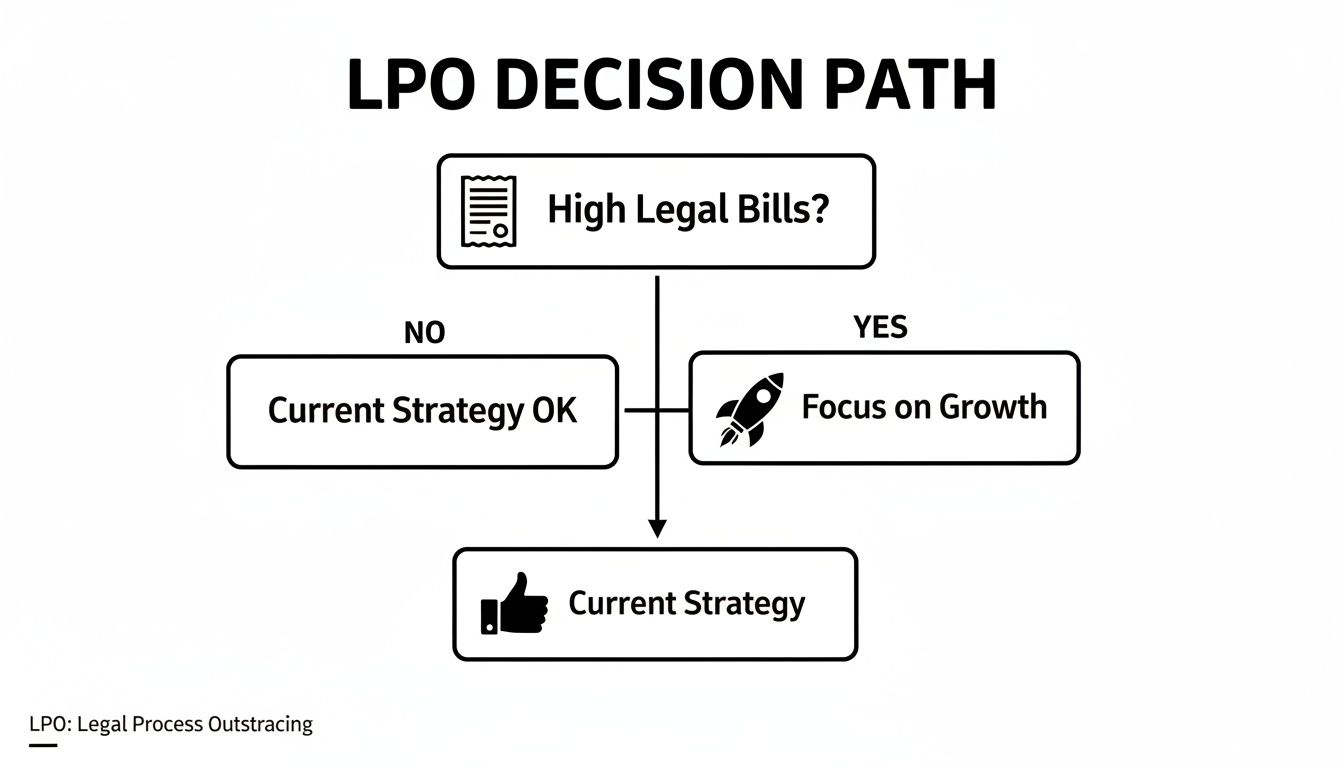
The takeaway is clear: if ballooning legal costs are holding you back, it's time to find a smarter way to operate so you can get back to focusing on growth.
Once you've picked a location, you have to decide how you want to work with them. Are you handing over an entire function, or do you just need an extra pair of hands for a specific project?
Managed Services is the "done for you" approach. You’re outsourcing a whole process, like contract lifecycle management. You define the outcomes—the SLAs and KPIs—and the provider takes full ownership. This is perfect when you want to completely offload a function that isn't a core competency.
With a managed service, you're buying a result. You don't need to know how the sausage is made, as long as it's high-quality and delivered on time.
Staff Augmentation, on the other hand, is like calling in the cavalry. You need three extra paralegals for a massive e-discovery project for six months. They plug directly into your team, report to your managers, and act as a seamless extension of your staff. You keep full control; you're just bringing in talent when you need it.
So, how do you choose? If you have a solid process and just need more horsepower, staff augmentation is your bet. But if your process is broken, inefficient, or a distraction, handing it off to a managed service makes a lot more sense.
If you're curious, you can explore a list of top-tier legal process outsourcing companies to get a feel for how they structure their offerings.
Everyone kicks off the LPO conversation talking about cost savings. And look, I get it. The sticker shock is real. But focusing only on the price tag is a rookie mistake I’ve made myself. It’s like buying a race car just for its gas mileage—you’re completely missing the point.
The real magic of smart legal process outsourcing services isn’t just about shaving points off your legal spend. It's about what that freed-up capital and—more importantly—freed-up time unlocks for your business. It's a force multiplier.
Let’s get real. Your company just landed a massive opportunity that requires doubling your due diligence capacity… by next Tuesday. What’s your move? Hope you enjoy spending your afternoons fact-checking resumes and running interviews—because that’s now your full-time job.
Or, you tap an LPO partner and have a vetted team ready to go in days, not months. This is scalability on demand.
LPO isn’t about replacing your team; it’s about giving them superpowers. It’s the ability to say “yes” to big projects without having to mortgage your office ping-pong table to hire for them.
You can spin up resources for a massive project and then scale back down just as quickly. No painful hiring cycles, no awkward layoffs. Just pure, agile operational muscle.
How many deals are sitting in your sales pipeline right now, waiting on a final contract redline? I’m willing to bet it’s more than a few. When your in-house counsel is buried under a mountain of low-complexity tasks, they become a bottleneck. It's not their fault; it's a resource problem.
This is where outsourcing becomes a strategic weapon. By offloading tasks like:
Suddenly, your legal department isn't the place where deals go to die. It's the engine helping the business close deals faster. To delve deeper into the admin support side, consider the benefits of embracing AI virtual receptionists, which can handle initial client interactions with brutal efficiency.
The most expensive person in your legal department should not be spending their day redlining NDAs. Full stop. Every minute your General Counsel spends on a repetitive task that could be handled by a qualified outsourced professional is money set on fire.
The ultimate benefit of LPO is focus. It empowers your most expensive talent to concentrate exclusively on the complex, high-stakes work that creates genuine value—the kind of work that wins cases, closes transformative deals, and protects the company from existential threats. This isn't just about saving money; it’s about building a leaner, smarter legal function that actively helps the business win.
Let's address the elephant in the room. The cost savings are great, but there's a small voice in your head asking, "But what about security and confidentiality?" Good. You should be listening to that voice.
Are you just shipping your firm's most sensitive information—client data, trade secrets, litigation strategy—off to the lowest bidder? This is precisely the kind of question that should be keeping you up at night. If you ask a potential LPO provider about data security and they get vague, run. Don't walk.

This isn’t about fear-mongering; it’s about smart, diligent prep. Think of it as building a fortress around your data before you hand over the keys.
First and foremost: attorney-client privilege. This is the bedrock of the profession. One misstep can have catastrophic consequences. Simply handing over privileged documents to a third party without the right safeguards can waive that privilege for good.
So, how do you avoid this nightmare? Your relationship with an LPO provider must be structured as an extension of your firm. They must function as an agent under your direct supervision, just like an in-house paralegal.
Your contract with an LPO provider isn’t just another vendor agreement. It's a critical legal instrument designed to extend your firm's confidential environment. If it doesn't explicitly define supervision, confidentiality, and how privilege will be maintained, it's not worth the paper it's printed on.
This is a crucial piece of the puzzle. Our guide on the fundamentals of outsourcing your legal process takes a much deeper dive into structuring these relationships the right way.
How do you know a provider practices what they preach? You need to become their toughest critic. Get into the weeds and demand proof.
Here are the non-negotiable security and compliance questions you must ask:
This isn't about being difficult; it's about fulfilling your professional duty. You are the ultimate custodian of your client's information. Treating that responsibility lightly isn't just bad business—it's a serious ethical lapse.
Choosing an LPO provider feels like navigating a minefield. The landscape is crowded with firms making the same lofty promises. They all claim to be the best, fastest, and most cost-effective. Yawn.
So, how do you cut through the noise and find a genuine partner who becomes an extension of your team, not just another vendor who overpromises and under-delivers? It comes down to a rigorous, no-nonsense vetting process.

Your evaluation has to start with proof, not promises. Case studies are a good start, but they need to be relevant. Don't let them show you how they helped a Fortune 500 company if you're a 20-person law firm. Insist on seeing references from organizations just like yours—same size, same industry, same challenges.
The $500 Hello: The single best way to vet a partner is with a paid pilot project. Never commit to a long-term contract based on a PowerPoint. Give them a small, low-risk, but real piece of work. This is your trial run. Observe everything: Did they meet the deadline? Was the quality up to your standards? How did they communicate when they hit a snag? This small test will tell you more than a dozen sales calls ever could.
Here’s a critical distinction: some LPO providers are just staffing agencies built on labor arbitrage. What you really want is a partner that operates like a technology company, using modern tools to enhance their legal expertise.
Ask them direct questions:
A great LPO provider isn't just cheaper; they're smarter. They use technology to deliver a better, faster work product. If they can’t talk fluently about their tech, they’re already behind the curve.
This isn’t a nice-to-have. The industry is shifting. The real growth is in AI-enabled services. Data on the legal process outsourcing landscape clearly shows this trend toward tech-driven solutions.
Finally, the Service Level Agreement (SLA). This document is everything. It’s the blueprint for the relationship—it defines success, sets boundaries, and establishes accountability. A vague SLA is a huge red flag.
A solid SLA needs teeth. It must be built around clear, measurable Key Performance Indicators (KPIs). Don't accept vague promises like "high-quality work." Get specific.
Here’s what should be non-negotiable in your agreement.
| KPI Category | Example Metric | Why It Matters |
|---|---|---|
| Turnaround Time | 95% of standard NDAs reviewed within 24 hours | Sets clear expectations for speed and stops your legal team from being a bottleneck. |
| Accuracy Rate | Less than a 1% error rate on document coding projects | Defines the quality standard so you aren't spending your own time fixing their mistakes. |
| Response Time | All email inquiries acknowledged within 2 business hours | Guarantees clear communication so you’re never left wondering about project status. |
| Error Resolution | Critical errors corrected within 4 hours of notification | Establishes a formal process for fixing mistakes quickly, showing they take ownership. |
This upfront diligence is the most critical part of the process. Choosing the right partner can unlock tremendous advantages. Getting it wrong just creates a new set of problems. Be thorough, be demanding, and be clear about your expectations. It's your business, after all.
We’ve covered the strategies, the models, and the compliance traps. Now for the part everyone really wants to know: what’s the actual, bottom-line ROI when you use legal process outsourcing services?
If your first thought is to compare an LPO provider’s hourly rate to what you pay your own team, you’re missing the bigger picture. That’s like judging a five-star restaurant by the price of its flour. The real value isn't just in the ingredients.
The true calculation is about opportunity cost. It’s about what your most valuable people could achieve if they weren't drowning in repetitive tasks.
Think about your sharpest paralegal, the one who knows your cases inside and out. What happens when they’re stuck spending 30 hours a week just reviewing and tagging documents? You aren’t just paying their salary for low-level work; you're actively stopping them from doing what they do best—preparing a key witness, drafting a motion that could turn a case, or managing critical client relationships.
The simple math of (Your Rate - LPO Rate) x Hours is misleading. The real formula looks more like this: (Direct Cost Savings) + (Value of Your Team’s Redeployed Time). That second part of the equation is where the real money is.
Don't just ask what you're saving per hour. Ask what your team could earn per hour if they were free to focus on high-value work. That’s the ROI that truly moves the needle.
Let's walk through a couple of examples. I’ve seen scenarios like these play out in the real world more times than I can count.
Scenario 1: The SaaS Company Buried in NDAs
A fast-growing tech company has to get through 50 standard NDAs every month. Their in-house counsel, whose fully-loaded cost is around $150/hour, spends about an hour on each one.
So, they outsource the entire NDA process to an LPO provider for a flat fee of $2,500/month.
Scenario 2: The Law Firm Facing an E-Discovery Nightmare
A mid-sized litigation firm gets hit with a massive e-discovery project involving 500,000 documents. Handled internally, their paralegals would be tied up for months, running up a huge billable clock and neglecting other cases.
Instead, they bring in a managed LPO service that uses AI-powered review platforms. The provider gets through the first-pass review in three weeks for a fixed cost of $50,000. The firm’s team then steps in to handle the much smaller, prioritized set of relevant documents.
This isn’t about cutting costs. It’s about redesigning how your legal work gets done, transforming your legal function from a cost center into a strategic engine for growth.
If you still have questions, good. It means you’re thinking critically. Let's tackle some of the most common—and important—questions that come up when people first explore legal process outsourcing services.
It can be, but the burden of proof is entirely on the provider. You have to be relentless in your security vetting. A reputable LPO provider won't just say they're secure; they'll prove it with certifications like SOC 2 Type II or ISO 27001. If a potential partner gets defensive or vague when you ask about data encryption and access controls, it’s a massive red flag. Walk away. Your clients' data is too important to leave to chance.
The sweet spot is anything that's repeatable, process-driven, and high-volume. You're not outsourcing your core legal judgment. You're getting the time-consuming, but necessary, work off your team's plate so they can focus.
Common starting points include:
When done thoughtfully, it does the opposite. When your team isn't drowning in paperwork, they have more time and mental energy for meaningful client conversations.
The goal isn’t to put a third party between you and your clients. The goal is to remove the internal drag that keeps you from giving clients the strategic attention they deserve.
An LPO partner can manage the follow-ups and scheduling, freeing your lawyers to focus on the high-value advice and relationship-building that clients actually pay for.
An old misconception. In my experience, it's the small to mid-sized firms and lean corporate legal teams that get the most immediate bang for their buck. They don't have the deep bench of support staff that a global firm does. LPO gives them the operational firepower of a much larger organization without the staggering overhead. It's a way to level the playing field. (Toot, toot!)


