

 20 minutes read
So, what is legal research outsourcing? At its core, it's just handing off mind-numbing research tasks to outside experts. Digging up case law, analyzing statutes, drafting full legal memoranda—the works.
Instead of your in-house team drowning in database tabs, you get on-demand specialists. This frees up your best people to focus on what actually makes you money: strategy, client relations, and winning cases. It's a strategic trade—swapping the library grind for a sharp, actionable brief delivered right to your inbox.

You know the moment. It’s late, the office is dead quiet, and the takeout on your desk went cold an hour ago. You’re lost in a sea of Westlaw tabs, hunting for one obscure precedent for a motion due at sunrise. You glance at the clock and it hits you: you haven't spent a single minute today on actual client strategy.
This isn’t why you started a firm. The real work—the brilliant strategy, the compelling advocacy, the thrill of a client win—is being suffocated by an avalanche of research and grunt work. This is the exact moment most founders hit a wall and realize they can't keep doing it all themselves.
This is where you start seriously considering legal research outsourcing.
Let's get real about the cost of keeping research in-house. It’s not just the six-figure salary for a junior associate or the painful subscription fees for legal databases. The truly crippling cost is the hidden one: opportunity.

Every hour a partner spends digging through precedents for a routine motion is an hour they aren't bringing in a new high-value client, negotiating a settlement, or mentoring junior staff. That's not just a lost billable hour; it's a lost opportunity for growth.
That's the kind of math that should keep you up at night.
The smart play is to reframe the entire conversation. Outsourcing isn't about admitting your team can't handle the workload. It’s a cold, calculated move to reclaim your most valuable, non-renewable asset: time. It’s about putting your best people on their highest-value work.
Think about it:
This isn't about cutting corners. It's about building a leaner, more resilient firm. The moment you realize your most expensive people are doing your most commoditizable tasks is the moment you see a much smarter way forward.

Let’s be honest. The old way of hiring legal support is a slow, expensive gamble. You know the drill: post a job, get flooded with a hundred nearly identical resumes, and spend weeks sifting through them.
Hope you enjoy spending your afternoons fact-checking resumes and running interviews—because that’s now your full-time job.
After all that, you finally make a hire. But then you realize they need six months of hand-holding just to get up to speed, all while you're paying a full salary, benefits, and overhead. It’s a massive resource drain for what amounts to a coin-flip outcome.
We've all been there. You hire a promising junior paralegal, and the first few months feel more like an investment than a return. You’re paying for their learning curve, their mistakes, and the time your senior staff spends training them instead of billing clients.
That "investment" adds up. Fast. It's not just their salary; it's the lost productivity rippling across your team. While your new hire is still figuring out the case management software, deadlines are getting tighter and partners are still pulling late nights.
This isn't an inconvenience; it's a structural flaw. You're paying a premium for potential, not for immediate, proven productivity.
Sticking to the old playbook is like insisting on using a flip phone in an iPhone world. Sure, it technically works, but you're getting absolutely smoked by the competition.
This isn’t just a hunch; the numbers are staggering. The entire legal process outsourcing (LPO) industry is exploding because firms are waking up. The global market, valued at $19.0 billion in 2024, is projected to surge to an astonishing $132.6 billion by 2033, with offshore solutions making up the lion's share.
This growth is being supercharged by a 24.1% rise fueled by AI and new tech, allowing firms to slash payroll costs by up to 80%. You can read the full research about LPO market trends and see for yourself.
This isn’t some niche trend. It's a fundamental rewiring of how successful law firms are built.
The alternative is a model built for modern agility. Instead of gambling on a full-time hire, you tap into a network of pre-vetted, on-demand legal professionals ready to contribute from day one.
Imagine needing an expert in a specific niche of family law for a three-month project. With legal research outsourcing, you can:
This isn't just about saving a few bucks. It's about building a firm that can pivot instantly, scale on demand, and focus its most expensive resources—your attorneys—on high-value, strategic work. It's time to retire the old playbook.
Alright, you’re convinced. Now for the tricky part: finding a partner who won’t set your money on fire.
This is where so many firms stumble. They get distracted by the lowest bidder and end up with research so flimsy it’s unusable. Suddenly, you’re spending your afternoons re-doing their work. That’s not saving time; it's creating a new, frustrating full-time job.
You need a genuine extension of your team. Let’s walk through the battle-tested playbook for vetting providers so you can skip the headaches.
The first warning sign is always the provider who promises the world for a rock-bottom price. A suspiciously cheap quote is code for inexperienced researchers, zero quality control, or a complete misunderstanding of the work. Your legal work is the last place you should be bargain hunting.
Instead of starting with "How cheap can you go?" lead with these questions:
A quality provider will have confident, detailed answers. A weak one will start to squirm.
There's a massive difference between a curated talent platform and a generic freelance marketplace. One is a strategic partner; the other is a digital free-for-all.
A freelance site dumps the entire vetting burden on you. You're left to sift through dozens of profiles and just hope for the best.
A specialized platform, on the other hand, does that heavy lifting for you. They invest in a rigorous screening process because their entire reputation is on the line. At HireParalegals, our process is relentless for a reason—we know you don’t have time to gamble. It’s the difference between hiring an expert and managing a project. If you're looking for a deep dive, check out our guide on finding the right https://hireparalegals.com/legal-outsourcing-company/.
The whole point of outsourcing is to reduce your management burden, not create a new one. A platform that doesn't vet its people is just giving you a second, more stressful job.
The cost savings are a huge draw. Third-party providers are projected to generate $15.96 billion in revenue in 2024 precisely because they offer specialized expertise.
With North America accounting for 36% of market growth, US firms are slashing payroll by up to 80% by outsourcing routine research to experts in legal hubs like India, the Philippines, and South Africa. This isn't just about cost; it's about getting focused expertise on demand.
| Vetting Factor | Legal Outsourcing Provider | Traditional In-House Hire |
|---|---|---|
| Experience & Skills | Review case studies, sample work, and platform vetting process. | Verify resume, conduct skills tests, check references. |
| Cost & Budget | Evaluate pricing models (hourly, project-based) and potential for scalability. | Calculate salary, benefits, taxes, overhead, and training costs. |
| Security & Confidentiality | Scrutinize NDAs, data encryption, and access control protocols. | Rely on internal IT policies, employment agreements, and physical security. |
| Quality Control | Ask about their QA process, revision policies, and dedicated project managers. | Depends entirely on your internal review process and direct supervision. |
| Scalability & Flexibility | Assess their ability to scale up or down based on your caseload. | Limited by the employee's capacity; scaling requires a new hiring process. |
| Trial Period | Use a small, paid pilot project to test their entire workflow. | Relies on a formal probationary period (e.g., 90 days) post-hiring. |
Vetting a provider is about confirming their processes. Vetting an in-house hire is about evaluating an individual.
Before you sign any long-term contract, insist on a small, paid trial project. This is the single most effective way to vet a potential partner.
Give them a narrowly defined, non-critical research task with a clear deadline. It’s about evaluating their entire process.
This small upfront investment can save you thousands. If they can’t knock a simple task out of the park, they will absolutely fumble your complex, high-stakes work.
The core principles of due diligence apply across all legal services. To ensure you select the best partners for any task, consider these 7 tips to choose a translation company to translate legal documents, as the fundamental ideas of vetting for quality are universal.
So, you’ve found a provider that checks all the boxes. Great. Now comes the part where most firms drop the ball.
Bringing on an outsourced partner isn't a "hire and forget" task. It’s about building a system—a workflow so smooth you’ll wonder how you ever managed without it.
If you enjoy micromanaging, by all means, skip this part. But if you want to delegate with complete confidence, you need a solid workflow from day one. Here’s how we built ours, brick by painful brick, so you don’t have to.
It all starts with the brief. A vague request like "find cases about contract disputes" is an invitation for disaster. You’ll get back a 20-page memo that’s totally irrelevant, wasting everyone's time.
You have to be ruthlessly specific.
Your research brief is the single most important document in this process. Get it right, and the work practically does itself. Get it wrong, and you’re signing up for a week of frustrating back-and-forth emails.
Here’s what every single one of our briefs includes, no exceptions:
This isn’t spoon-feeding; it’s providing clear guardrails. A good researcher thrives on this.
Next up: security. Sharing sensitive client info over standard email is just asking for trouble. Before any work begins, you must have a secure, locked-down system. This is non-negotiable.
Your provider should have an encrypted client portal ready to go. If they don’t, that's a massive red flag. We also insist on a signed, comprehensive NDA before a single document changes hands.
A provider who is casual about your data security will be casual about your work product. Don’t walk away from these providers—run.
The workflow itself should be simple: all communication, file transfers, and drafts live inside this secure environment. This creates a single source of truth and a clean audit trail.
The final piece is the feedback loop. Don't wait until the final deadline to see the work for the first time.
For any project longer than a few hours, we schedule a quick check-in. The goal is simple: course-correct early. Catching a misunderstanding two hours in is a minor fix. Catching it two days in means you’ve just wasted time and money.
Our feedback process is structured and direct:
Building this system takes some effort upfront, but it pays off a hundredfold. It turns legal research outsourcing from a gamble into a reliable, efficient engine for your firm. Suddenly, your outsourced team feels less like a vendor and more like they’re in the office next door—without the overhead. For additional insights, explore our guide on the best legal research databases to see which tools your outsourced team might be using.
So, you’ve hired a remote paralegal and built a slick workflow. How do you know if this whole legal research outsourcing thing is really working? Spoiler: it’s not about the invoice.
If your only metric is the hourly rate, you’re missing the point. Chasing the cheapest option is a rookie mistake that almost always ends in shoddy work. You need to measure the things that truly impact your firm's bottom line and your sanity.
The real win isn't just saving a few bucks; it's buying back your most valuable asset—the time of your senior attorneys.
Let’s be brutally honest. A cheap hourly rate means nothing if the research is inaccurate, late, or needs a complete rewrite. You’ll just pay twice—once for the shoddy work, and again with your own time to fix it.
Instead of obsessing over cost-per-hour, start tracking the KPIs that define a successful outsourcing relationship.
Here’s a simple framework:
Tracking these data points gives you an objective look at performance. It moves the conversation from "it feels slow" to "our average turnaround time has increased by 15%."
This is the metric that truly matters. "Return on Time"—we just coined that, toot toot!—measures how outsourcing frees up your most expensive people to do their most valuable work.
Are your partners spending more time on billable strategy sessions? Are you finally getting to that backlog of business development calls? That’s the real gold. It’s the opportunity cost you were hemorrhaging before.
Think about it: if outsourcing a 10-hour research project frees up a senior partner to land one new client, the ROI is astronomical. You're not just saving the cost difference; you're generating entirely new revenue.
This simple workflow visualizes how a well-structured process is the engine that powers this return on time.
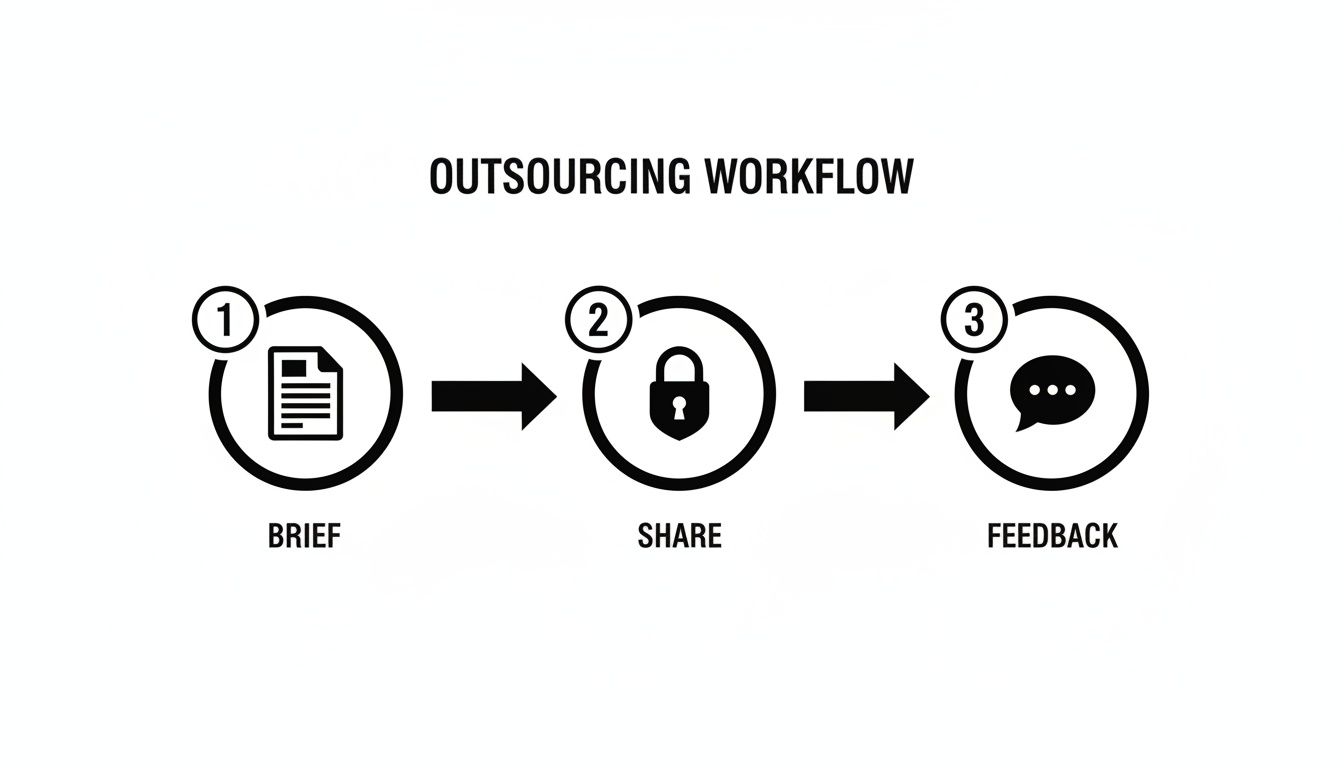
Each step is designed to maximize clarity and minimize friction, ensuring your outsourced team can hit the ground running.
Let's put this into a real-world scenario. Say you have a complex motion that requires about 20 hours of deep-dive research.
The math isn't even close. You spent $750 to unlock eight hours of a partner's time, which they converted into new business. This is how you scale a firm. This efficiency is a core principle of effective legal project management. You can learn more in our article on what is legal project management.
Stop looking at outsourcing as an expense to be minimized. Start seeing it as a strategic investment in your firm's most critical resource.
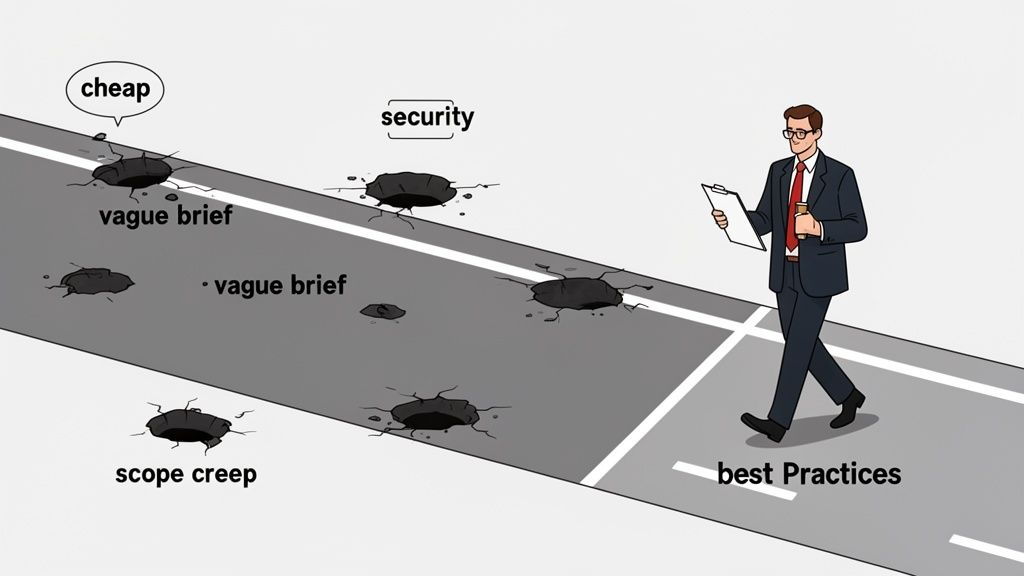
We’ve seen it all. The firm that chased the cheapest provider and got back garbage research. The partner who failed to set clear expectations and ended up in a communication black hole. The solo attorney who got sloppy with security and put client data at risk.
This isn't a lecture. It's a frank look at the landmines we’ve watched other firms step on so you don’t have to. Think of this as getting a decade of hard-won experience without the expensive lessons.
Let's get this out of the way first. Hiring the cheapest provider for your legal research outsourcing is like buying the cheapest parachute. It feels like a smart move right up until the moment it really, really isn't.
A price that seems too good to be true almost always is. It’s a red flag for inexperienced researchers or non-existent quality control. You’re not saving money; you’re just creating a new full-time job for yourself: re-doing their shoddy work.
The most expensive research is the research you can't use. Don’t let a low hourly rate trick you into a high-cost mistake.
Instead of asking "who's the cheapest," ask "what's your process for ensuring quality?" Their answer will tell you everything you need to know.
Another classic mistake is the "just figure it out" approach. You fire off a one-line email asking for "research on breach of contract cases" and then act surprised when you get back a 50-page memo that’s completely irrelevant.
This isn’t on the researcher; it’s on you. A brilliant researcher can’t read your mind. Garbage in, garbage out. Vague instructions are a direct invitation for scope creep and wasted hours.
To sidestep this, treat your research brief like a surgical instrument—be precise and specific. A great brief includes:
A little discipline upfront saves you an avalanche of frustration on the back end.
When you’re outsourcing, especially offshore, you're not just dealing with a different time zone. You're often dealing with different communication styles. Assuming your provider works and thinks exactly like your in-house team is a recipe for misunderstanding.
For example, in some cultures, asking clarifying questions can be seen as challenging authority. A researcher might spin their wheels for days on an unclear instruction rather than "bothering" you. This isn't a flaw in their work ethic; it's a cultural difference.
The fix is simple: over-communicate. Explicitly state that you welcome questions and that you’d rather have five "dumb" questions at the start than a major course correction at the end. Establish a clear, open line for communication and encourage its use.
Finally, the most common pitfall is treating outsourcing as a one-time transaction instead of an ongoing relationship. You can’t just hand over a project and disappear until the deadline.
Success in legal research outsourcing hinges on building a feedback loop. A quick 15-minute check-in call a day or two into a big project can be the difference between a minor tweak and a complete restart.
Don't wait until the final delivery to see the work. Ask for a preliminary outline or a rough draft. This allows you to catch any misinterpretations early. By creating a system of regular, structured feedback, you turn your outsourcing provider from a simple vendor into a true, integrated part of your team. This proactive management is what separates the firms that thrive with outsourcing from those that just get frustrated.


