

 17 minutes read
Let’s be honest. Most legal writing is a train wreck. It’s dense, confusing, and makes clients feel like they need a secret decoder ring just to understand their own case. We’ve all been there—burning billable hours translating jargon for a frustrated client or, worse, watching a prospect walk because our first email read like an appliance warranty.
Writing in plain English isn't "dumbing down" your work. It's getting smart. It's about clear, direct communication that clients, judges, and even opposing counsel can understand without a Tylenol. Making this one shift will build insane levels of trust, save you a shocking amount of time, and actually grow your firm’s bottom line.
Think of it this way: clear communication is a persuasion tool. The strategic edge you get from plain English is the same reason you learn how to write business proposals that actually win clients—it gets you to "yes" faster.
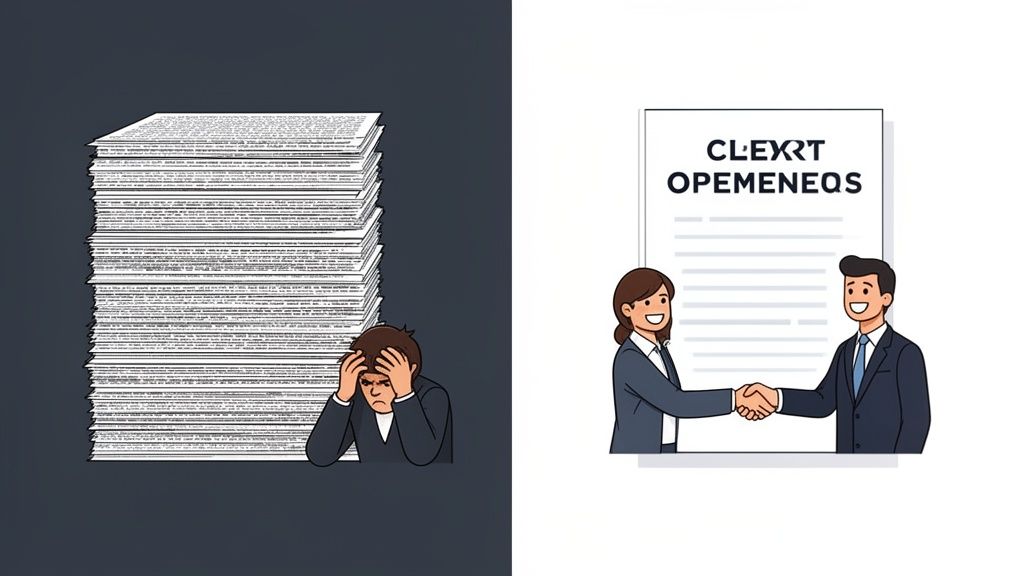
It’s time to torch what law school taught you about "sounding like a lawyer." Clinging to that dusty old jargon comes with real costs that hit your firm right where it hurts. Every minute you waste clarifying a convoluted email is a minute you can't bill. Every client who churns because they feel intimidated is revenue walking out the door. It’s a death spiral of inefficiency disguised as "professionalism."
This isn’t just a gut feeling; the data is screaming at us. After the Cleveland Clinic simplified its billing statements, patient payments shot up by a jaw-dropping 80%. That little tweak helped them rake in an extra $1,000,000 a month. Other studies show massive drops in customer service calls just by rewriting forms in plain language.
The hidden costs of legalese are a silent killer. The ROI of clarity is immediate and loud.
| Business Area | The Old Way (Legalese) | The Smart Way (Plain English) |
|---|---|---|
| Client Onboarding | Confusing retainers cause delays and friction. | Clear agreements get signed faster with fewer questions. |
| Billing & Invoices | Clients call to question every cryptic line item. | Invoices are understood and paid. On time. |
| Risk Management | Misunderstood advice is a malpractice suit waiting to happen. | Clear communication ensures clients actually get it. |
| Team Efficiency | Associates and paralegals waste hours "translating" for each other. | Internal comms become fast, accurate, and painless. |
| Marketing & Intake | Your website scares off prospects before they even call. | Simple language attracts and converts the clients you want. |
The takeaway is brutally simple: complexity costs you money. Clarity makes you money.
Switching to plain English isn’t an academic exercise; it's a cold, hard business decision. It's a competitive advantage that makes other firms look like they're stuck in the 19th century.
Here's what happens when you commit:

Ultimately, you stop hiding behind complexity and start communicating with confidence. Plain English forces you to sharpen your own thinking, making your arguments more focused and deadly persuasive. It’s the highest-leverage skill your team can possibly master.
Making the leap to plain English in your legal writing can feel like deciding to climb Everest. I get it. But you don't need to memorize a thousand grammar rules. It boils down to a mindset shift built on three pillars.
Nail these, and everything else falls into place. This isn't theory; it's the framework that stops you from sounding like a legal droid and starts connecting you with actual humans. It's what separates a document that gets ignored from one that gets results.
Let's be real: nobody reads legal documents for fun. Your clients are stressed, judges are buried in paperwork, and they’re all scanning for the bottom line. So stop burying your main point three pages deep behind a wall of definitions.
The mission is simple: put the important stuff first.
Use headings and subheadings like a GPS for your reader. Break up those terrifying blocks of text. Aim for short, two-to-three-sentence paragraphs. This isn't about making it look pretty; it's about forcing the reader's eye to the exact point you need them to see.
A well-structured document respects the reader's time. It screams confidence and clear thinking before they’ve even read a single word of your argument.
Now for my favorite part: the jargon safari. We've all done it. We reach for those dusty, ten-dollar words that scream "LAWYER!" but say nothing to a normal person. It’s a bad habit we all picked up in law school. Time to unlearn it.
This means actively swapping out tired Latin phrases and stuffy words for simple, direct ones. Instead of "heretofore," just say "before now." "Pursuant to" can almost always be "under" or "according to." A huge part of this is mastering concise writing, which is all about making every single word pull its own weight.
Here are a few common offenders to put on your hit list:
It seems small, but this one change makes your writing instantly more accessible and, frankly, way more persuasive.
This is the pillar holding it all up. It's the most important rule and, ironically, the one we forget most often. You have to stop writing to impress some imaginary law professor who died 50 years ago.
Write for the human on the other end.
Who are you talking to? A panicked client who needs simple instructions? A judge who's already read 50 motions today? Opposing counsel you're trying to corner? Each audience needs a different flavor, but the principle is the same: get out of your own head and into theirs.
Before you type a single word, ask: "What does this person need to know, and what's the clearest possible way I can say it?" Start there, and you're already halfway to a win.
Alright, theory time is over. What does this actually look like day-to-day? This is your tactical playbook for turning dense, headache-inducing legalese into clear communication that clients will actually thank you for.
This isn't about just swapping a few words. It's about re-engineering your documents for impact. Think of this as a system you can hand to your entire team, freeing up senior attorneys for the high-value work only they can do.
Let's start with the easiest win imaginable: the classic "Find and Replace." We all have those crutch words we use to sound more "lawyerly." It's time to fire them.
Pull up your last document and hit CTRL+F. Hunt down these usual suspects and swap them for their simpler, better-looking cousins.
This one tiny habit will instantly make your writing less stuffy and more human. It’s a small change with a massive impact.
The whole process boils down to three steps: structure it logically, choose your words wisely, and never, ever forget who you're writing for.
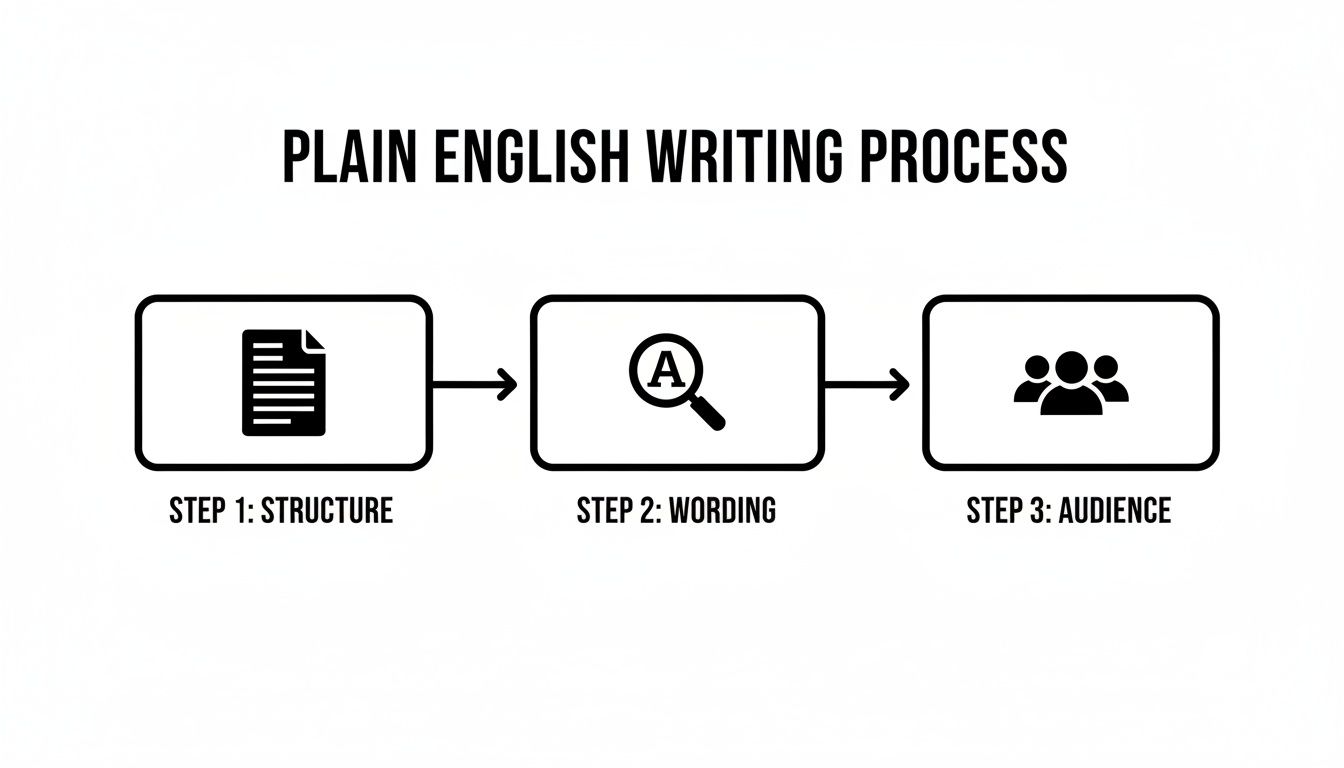
As you can see, clear writing isn’t a single action. It’s a process: organize your thoughts, pick the right weapons (words), and always keep your target (the reader) in mind.
Next up, my personal favorite: the "Sentence Chop." For some reason, lawyers love cramming every possible contingency into one sentence that spools on for half a page. The result? A confusing mess nobody can follow.
The fix is ruthless but simple. Find any sentence that runs longer than three lines and chop it in half. Or thirds. Your goal is one main idea per sentence.
Before: "Notwithstanding any other provision contained herein, the party of the first part shall, upon the successful completion of the aforementioned obligations, be entitled to receive remuneration from the party of the second part, provided that all deliverables are submitted in a timely manner pursuant to the schedule outlined in Exhibit A."
I bet your eyes glazed over. Let's try that again.
After: "You will be paid after you complete your obligations. To be paid on time, you must submit all work according to the schedule in Exhibit A."
Same information. One is written for a lawyer. The other is written for a human who signs checks. Choose wisely.
To make this even easier, here's a cheat sheet. Pin it to your wall. Tattoo it on your arm. Just use it.
| Instead of This (Legalese) | Use This (Plain English) | Example Sentence |
|---|---|---|
| In the event that | If | If the payment is late, a fee will be applied. |
| Hereinafter referred to as | (Just use the name) | Acme Corp. (“Acme”) agrees to… |
| For the duration of | During | The agreement is valid during the project term. |
| Prior to | Before | All invoices must be approved before payment. |
| Execute | Sign | Please sign the document on the final page. |
| Cease and desist | Stop | You must stop using our trademarked logo. |
| In accordance with | Under, per, by | The audit was conducted under GAAP standards. |
This isn't exhaustive, but it’s a damn good start. Making these swaps a habit will improve your writing clarity almost overnight.
Manually editing every document is a soul-crushing grind, and you have better things to do. This is where you let the robots help. The legal tech world is finally catching up.
Reports show that specialized drafting tools can slash editing time by 20–40%. A popular one, Spellbook, claims its users save 25–30% of their time on certain drafting tasks. To see what's out there, you can explore more about AI's impact on legal writing.
These aren't just fancy spell-checkers; they're built to understand legal context while simplifying language. They're invaluable for training your team to adopt a legal writing plain English mindset by default.
Okay, so you're on board. Great. But getting an entire firm to change its habits can feel like trying to turn a battleship with a canoe paddle.
This isn’t about sending one hopeful memo that everyone ignores. To make this stick, you have to build systems that make clarity the path of least resistance. It has to become part of your firm's DNA. If you don't, old habits will creep back in the second someone gets busy.
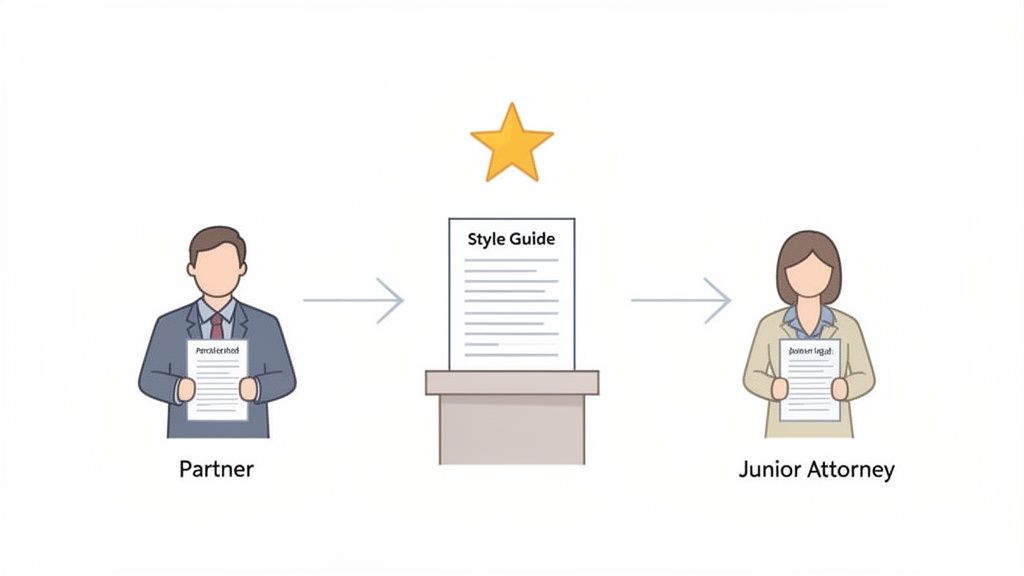
First move: create a simple, firm-wide style guide. No, not a 300-page grammar bible that collects dust. Think of it as a one-page cheat sheet. The firm's single source of truth for communication.
Here's what it needs:
The goal isn't more rules; it's consistency. A good style guide removes the guesswork and makes sure every document that leaves your firm speaks with the same clear, confident voice.
Next, build a library of plain English templates for your most common documents. Engagement letters, client updates, standard motions—anything you do on repeat. Turn your best work into a reusable asset.
When a junior associate needs to draft something, they shouldn't start with a blank page and a prayer. They should start with a battle-tested template that has clarity baked in. This is how you scale good habits. A great place to start is to document these templates in your firm’s operational playbook; you can get ideas by learning how to create standard operating procedures.
This isn't just about speed. It's risk management. Clear, consistent templates slash the odds of a rogue clause or costly misunderstanding sneaking into your work.
Think this is overkill? The U.S. government passed the Plain Writing Act of 2010 to force federal agencies to communicate clearly. They set goals to track progress, like cutting reading grade levels and reducing confused customer calls. As you can learn more about their approach, it’s proof that system-wide change is possible.
Finally—my favorite part—unleash your paralegals. They are your secret weapon for making this change stick. Train them on the new standards first and empower them to be the first line of defense against jargon.
Make it part of their job description to scrub every draft for clarity before it hits a partner’s desk. This saves senior attorneys a staggering amount of editing time and reinforces the new standard with every single document. When your paralegals become plain English evangelists, the culture shifts from the ground up.
Let's talk about the pushback. Because the minute you start this crusade, you'll get skeptical looks from colleagues who've been doing things the "old way" for 20 years.
I’ve heard every excuse in the book. This is your playbook for winning them over—not with ideals, but with cold, hard business sense.
Ah, the classic. The fear that simple language makes you sound, well, simple. That's a myth.
Clarity isn’t a lack of intelligence; it’s a sign of confidence. Truly brilliant minds don't need to hide behind jargon. They can distill complex ideas into simple, powerful terms.
Think about it from the client's perspective. Who do you trust more? The lawyer who mumbles incomprehensible clauses, or the one who looks you in the eye and explains your options clearly? Clients pay for competence, not for long words.
Here's another golden oldie. The argument that legalese, for all its sins, is precise. A necessary shield against ambiguity.
Wrong. The opposite is true.
Convoluted sentences and vague, ten-dollar words are a breeding ground for ambiguity. They create loopholes. They invite misinterpretation. Writing in plain English forces you to be surgically specific with every word.
By stripping away the fluff, you aren't losing precision—you're sharpening it. A clear, direct argument is much harder to attack than a rambling paragraph of "heretofores" and "pursuant tos."
This one is my personal favorite because it’s so completely out of touch with reality. No client in history has ever said, "I really wish my lawyer's emails were more confusing."
They might expect it because that's the stereotype, but they don't want it. What they want is to feel understood, informed, and confident. Delivering that clarity is a huge part of learning how to manage client expectations effectively.
Happy clients pay their bills. It’s that simple.
And now, the big one. The time excuse. We’re all buried, and the idea of adding one more thing to the to-do list feels insane.
But this isn't an extra task. It's an investment that pays you back tenfold.
Think about all the time you currently waste on cleanup:
Investing 15% more time upfront to write clearly saves you countless hours of rework and client hand-holding later. It’s not about adding work; it’s about shifting it to where it has the most impact. Plain English isn't just a writing style; it's a profit-driving business strategy.
You've made it this far, so you're either nodding along or you've still got a few nagging questions. Let’s tackle them head-on. This is the quick-fire round for anyone who's intrigued but still skeptical.
Absolutely. In fact, that's where it shines brightest. Plain English isn't about deleting necessary terms of art; it's about clearing out the jungle of fluff surrounding them.
A clear contract is less likely to be disputed because both sides actually understand their obligations. A clear brief is more persuasive because the judge gets your point on the first read. The goal is precision through clarity, not stripping out substance.
Remember, complexity doesn't equal precision. It's often just a smokescreen for fuzzy thinking. Plain language forces you to sharpen your argument, making it stronger.
Don't try to boil the ocean. Start small and create undeniable proof that it works. This is about small, strategic wins.
Pick one or two high-impact documents. Your engagement letter is perfect. So are your invoices.
Use that success as an internal case study to win over the rest of the team. Momentum builds on proof, not memos.
Yes, and you'd be crazy not to use them. While no tool can replace a sharp legal mind, technology is a fantastic editing assistant. It catches the low-hanging fruit so you can focus on strategy.
Tools like Grammarly and the Hemingway Editor are great for flagging passive voice, run-on sentences, and complex words. They give you a readability score to benchmark your progress.
For more specialized help, legal tech like Spellbook or Clearbrief is designed to understand legal context while simplifying language. They're brilliant for a "first pass" edit and can dramatically speed up training your team to spot issues in their own legal writing plain English. They help turn good habits into muscle memory.


