

 17 minutes read
Let's get straight to the point. When we talk about paralegal employment in Minnesota, we're really talking about two different worlds. There's the Twin Cities, and then there's everywhere else. The market is solid, but it’s not a uniform gold rush across the state. Think of it more like a few highly productive mines, with the biggest one sitting right in the metro.
So, what's the real story? Is the Minnesota paralegal scene a booming market or a frozen pond? The truth is, it’s both, and your mileage will vary wildly based on your zip code. Don't make the mistake of thinking a paralegal job in Duluth is the same game as one in downtown Minneapolis. It’s not even close.
The entire universe of paralegal employment in Minnesota revolves around the Minneapolis-St. Paul metropolitan hub. That's not a gut feeling; the hard numbers back it up.
Recent data paints a brutally clear picture. Out of the roughly 5,650 paralegals and legal assistants punching the clock in this state, a staggering 4,660 of them are crammed into the Twin Cities. This creates a completely different reality for both job seekers and hiring managers inside the I-494/694 loop. If you want to see the full data dive, you can dive into more Minnesota legal career data.
This concentration means more job openings, more specializations, and—let's be honest—better pay.

You can absolutely build a fantastic career as a paralegal outside the metro. But if you're chasing the biggest firms, the highest salaries, and the most diverse casework, all roads lead back to Minneapolis and St. Paul. Pretending otherwise just sets you up for a frustrating search.
When it comes to your paycheck, geography is destiny. You’re not just negotiating with a firm; you're negotiating against the local market rate. The salary a downtown Minneapolis skyscraper firm can offer is worlds apart from the budget of a small practice up on the Iron Range.
This table breaks down the salary chasm for paralegals across Minnesota's key cities. The Twin Cities premium is right there in black and white.
| Metropolitan Area | Average Annual Salary | Employment Concentration |
|---|---|---|
| Minneapolis-St. Paul | $70,170 | Highest |
| Rochester | $65,470 | Moderate |
| Duluth | $54,340 | Lower |
As the data shows, the gap isn't just a few thousand bucks—it’s a career-defining chasm.
This chart really drives the point home, visually comparing the average salaries across these key Minnesota hubs.
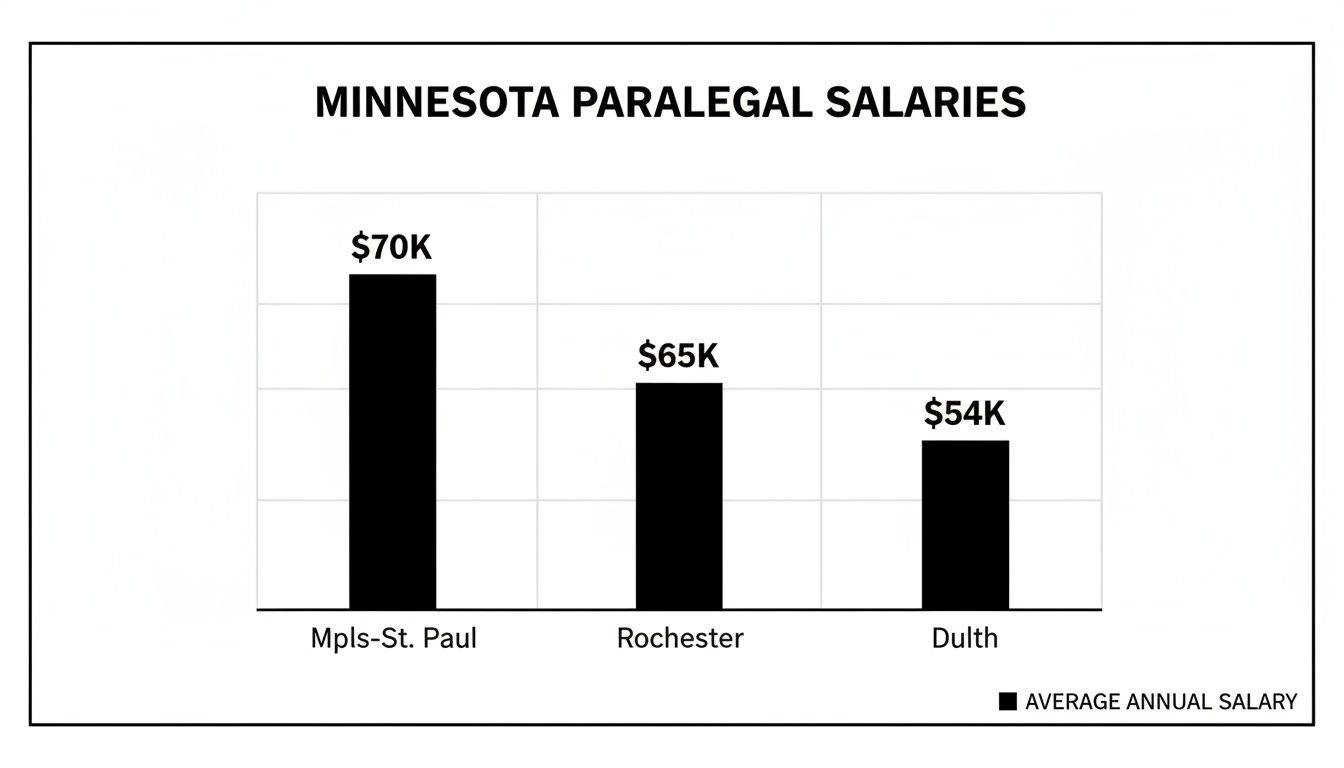
The numbers are pretty stark. Paralegals in the Twin Cities can expect to earn an average salary hovering around $70,000. Head south to Rochester, and that number dips to about $65,000. Go north to Duluth, and the average plummets to $54,000. This is the financial reality that shapes hiring strategies and career moves across the state.
This is where things get interesting in the North Star State. Minnesota doesn't have a rigid, state-run licensing board telling you how to become a paralegal. So, you can just hang out a shingle and get to work, right?
Not so fast. While the state government is refreshingly hands-off, the legal market itself is the real gatekeeper. The best law firms and corporate legal departments have their own standards, and these unwritten rules are tougher than any state exam. If your resume doesn't show a degree from an ABA-approved program or a few solid years in the trenches, good luck getting past the front door.
Think of it this way: the state gives you an open road, but the top employers have built their own toll booths. They're the ones who decide who gets through, and they almost always want to see specific qualifications. This reality has a huge impact on paralegal employment in Minnesota, creating a clear pecking order among candidates.
Your paper and your past are major factors in hiring and salary talks. Even without a state mandate, employers heavily favor graduates from ABA-approved programs or paralegals with 2–4 years of experience. This preference is why salaries can swing from $47,000 for a rookie to over $78,000 for a seasoned pro. You can explore more about these paralegal credentialing trends and their impact.
Because the market calls the shots, a few common paths have emerged for anyone serious about a paralegal career in Minnesota.
No matter which path you take, there’s one regulation you absolutely cannot ignore: Minnesota Rule of Professional Conduct 5.3. This is the big one. It mandates that a lawyer must provide direct supervision over any non-lawyer staff, and that absolutely includes paralegals.
This rule is the bedrock of the entire profession. It means you can't be a freelance agent taking on your own clients. You are, by law, an extension of your supervising attorney, who is ultimately on the hook for all of your work. It's the invisible tether that connects every Minnesota paralegal to a licensed lawyer, ensuring ethical conduct and professional responsibility.
Getting your head around this is crucial. It doesn't limit your potential—it defines your role. It's the foundation you'll build your career on.
Thinking about bringing a new paralegal on board? Smart move. But if you’ve only budgeted for their salary, you’re in for a nasty surprise. That paycheck is just the tip of the iceberg, and ignoring the rest is a classic recipe for a Q4 budget meltdown.
To get a real sense of the investment, you have to look at the whole picture. Let's break down the pragmatic, no-nonsense numbers every hiring manager needs to see before posting a job ad.
First up are the mandatory costs—the extras you legally can't dodge. For every dollar you commit to in salary, a hefty chunk gets tacked on immediately. This isn't optional; it's the cost of having an employee on the books.
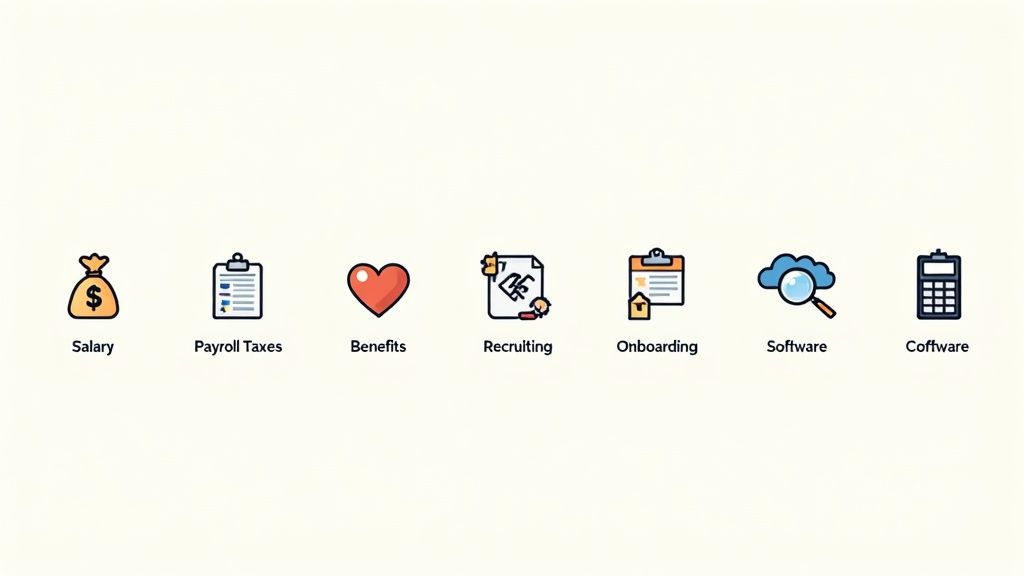
We’re talking about the essentials:
These "hidden" expenses can easily add another 20-30% on top of the base salary. Suddenly, that $70,000 Minneapolis paralegal is actually costing you closer to $90,000—and they haven't even logged their first billable hour.
Now, let's talk about what it takes to land and keep top talent. In the competitive world of paralegal employment in Minnesota, skimping on benefits is a losing game. The best paralegals know their worth and have options.
A solid health insurance plan is non-negotiable. Then you have to consider other table stakes like a 401(k) match, dental and vision coverage, and a fair PTO policy. Each one adds another layer to your total cost.
But the spending doesn't stop there. Your new paralegal needs the right gear to actually do their job.
Think about it: a paralegal without access to Westlaw or LexisNexis is like a surgeon without a scalpel. You have to factor in annual subscriptions for legal research, case management systems, and e-discovery platforms. On top of that, budget for continuing legal education (CLE) to keep their skills sharp.
These are real, recurring costs that are essential for productivity. Don't cheap out.
Long before your new hire walks in the door, you’ve already started spending money just to find them. Recruiting isn't free. You’re paying for job board postings, recruiter fees, or the internal staff hours spent sifting through résumés and conducting interviews. It all adds up.
Once you make a hire, the spending continues with onboarding. Getting them up to speed on your firm’s processes, culture, and software takes time—and time is money. This initial phase is a significant cash outlay you need to account for long before you see a return.
When weighing your options, exploring different compensation models can be a lifesaver. This guide on paralegal hourly rates offers a great perspective on alternative structures. At the end of the day, it's the total financial picture, not just the salary, that matters.
Stop tossing job postings into the black hole of massive, generic job boards. That’s like fishing for walleye in the middle of a desert. If you want to land top-tier paralegal talent in Minnesota, you need to fish where the fish actually are.
Let’s be honest: your firm’s reputation is your best recruiting tool. Top paralegals talk, and they know which firms are great places to work and which are burnout factories. Before you even think about posting a job, make sure your own house is in order. A major part of that is improving candidate experience from the first click to the final offer.
Forget the national platforms that bring you a flood of unqualified applicants from a thousand miles away. The real gems are found in local, targeted channels where serious Minnesota professionals gather. This is about precision, not volume.
Think smaller and smarter by focusing on these high-impact channels:
The Minnesota Paralegal Association (MPA): This isn't just a professional group; it's the nerve center of the state's paralegal community. Posting on their job board puts your opening directly in front of the most engaged, career-focused paralegals in Minnesota. It’s a no-brainer.
Paralegal Program Alumni Networks: Go straight to the source. Connect with the career services offices at top Minnesota paralegal programs like Inver Hills Community College or North Hennepin Community College. Their alumni networks are pipelines of well-trained candidates invested in the local market.
Your job description is a sales pitch, not a legal summons. It needs to attract the right people and, just as importantly, repel the wrong ones. Ditch the corporate jargon and write like a human.
What does a day really look like? What specific software will they use every single day? What are the three most critical tasks they'll own from day one? The more specific and honest you are, the better your applicant pool will be. A vague description just screams, "We don't really know what we need."
Be crystal clear about the must-haves versus the nice-to-haves. If deep experience with e-discovery software is a deal-breaker, say so. If you're willing to train the right person on your case management system, mention that. This simple act of clarity saves everyone a ton of time.
To help you get started, here’s a quick comparison of the channels that consistently deliver for paralegal employment in Minnesota.
| Channel | Best For | Effectiveness Rating | Insider Tip |
|---|---|---|---|
| Minnesota Paralegal Association | Experienced, certified professionals | Excellent | Attend an MPA event. Networking in person is still the most powerful tool. |
| College Alumni Networks | Entry-level & recently certified talent | Very Good | Build a relationship with career services—don't just post and ghost. |
| Niche Legal Recruiters | Highly specialized or senior roles | Good | Vet them carefully; the good ones are worth their fee, the bad ones are a waste of time. |
| Generic National Job Boards | High-volume, entry-level searches | Fair | Be prepared to filter through a mountain of irrelevant applications. |
As you can see, a targeted, local-first strategy is almost always the most effective path. Focus your energy on the MPA and local colleges, and you’ll connect with a pre-qualified, motivated talent pool right in your backyard.
Let’s be honest: a slick resume can hide a multitude of sins. We’ve all seen them—beautifully formatted, full of action verbs, but about as substantive as a puff of smoke. You can't afford a hiring mistake, especially in a small firm where every team member either sinks the ship or helps it sail faster.
So, how do you see past the polished PDF and find a paralegal who can actually do the job? You stop asking tired, generic questions and start running interviews that feel more like a work simulation than a friendly chat. This is about testing for competence, not just pleasantries.
Forget asking, "What's your biggest weakness?" unless you genuinely enjoy hearing rehearsed answers about being "too organized." Instead, put candidates into situations that mimic the real, chaotic world of legal work. The goal is to see how they think, not how well they prepared for the world's most predictable questions.
Practical assessments are your best friend here. They cut through the fluff and get right to their actual skills.
The Proofreading Test: Hand them a one-page document riddled with errors—typos, incorrect citations, grammatical nightmares. Set a timer for five minutes and see what they catch. This tells you more about their attention to detail than any line on a resume ever could.
The Process Outline: Describe a common task, like responding to a discovery request. Ask them to walk you through the steps they would take, from receipt to filing. Listen for their understanding of deadlines, procedural rules, and attorney review points.
These aren't trick questions; they're direct reflections of the daily grind.
The best candidates won't just answer your questions; they'll ask their own. They'll want to know about deadlines, specific court rules, or your firm's preferred formatting. This isn't weakness—it's the mark of a pro who knows that details matter.
In today's legal world, a paralegal who isn't comfortable with technology is a massive liability. You need to know if they can handle more than just Microsoft Word. Again, don't just ask—test.
Give them a simple, scenario-based tech challenge. For example, "We have ten large PDF exhibits that need to be Bates-stamped, redacted, and combined into a single file for an upcoming filing. How would you approach that?"
Their answer reveals everything. Do they mention specific software like Adobe Acrobat Pro? Do they talk about quality control checks? Or do they just give you a blank stare? This is how you find the right fit for a modern Minnesota law firm.
This practical approach is how you hire a paralegal who will be an asset from day one, not just a warm body filling a chair.

The remote work wave hit the legal field, but let’s be honest—it looks different here. For law firms across Minnesota, the conversation isn't just "can this job be remote?" but "should it be?"
On one hand, opening a position to remote candidates can dramatically widen your talent pool beyond the Twin Cities metro. Suddenly, you've got access to fantastic paralegals from Rochester to Roseau. It sounds like a clear win.
But then, the practicalities set in. Remember Rule 5.3? That crucial requirement for direct attorney supervision doesn't vanish because your paralegal is logging in from their cabin up north. The supervising attorney is still completely on the hook, and proving you're meeting that standard from a distance is a whole other challenge.
This isn't just about managing tasks; it's a game of liability. A remote paralegal handles incredibly sensitive client info, often over a home Wi-Fi network. If that data is breached, the consequences fall directly on your firm.
So, how do you make the call? Before you dive into the remote hiring pool, you need to take a hard, clear-eyed look at your operations. A remote or hybrid setup can be a massive strategic advantage, but only if you get the execution right.
It means being brutally honest about a few critical areas:
Hiring a remote paralegal isn’t a small logistical tweak; it’s a fundamental shift in how your firm operates. For those seriously considering this path, our deep dive into virtual paralegal employment lays out a more detailed, practical framework.
Get the policies right, and you unlock talent across the state. Get them wrong, and you're just opening the door to unnecessary risk.
Let's cut through the noise and answer the questions we hear most from both aspiring paralegals and the law firms looking to hire them in Minnesota.
Technically, no. Minnesota doesn't have a state-mandated certification board for paralegals. But don't let that fool you.
While there's no official government requirement, the market has its own rules. Top-tier firms, and even many smaller practices, have high standards. They almost always look for candidates who have either graduated from an ABA-approved paralegal program or can show a solid track record of on-the-job experience.
Don't expect to be buying a lakefront cabin on your first year's salary. While experienced paralegals in specialized fields in the Twin Cities can certainly command salaries over $70,000, the entry-level picture is more modest.
For someone just starting out, a realistic salary is typically between $45,000 and $55,000. Where you land in that range will depend heavily on your education, any internships, and the location of the firm (metro versus greater Minnesota).
The first job isn't about getting rich; it's about getting the experience that makes you valuable enough to command a higher salary for your second job.
It’s a challenge, but not impossible. The classic "need experience to get a job, need a job to get experience" paradox is very real in the legal field.
Here's how to break through:


