

 18 minutes read
Thinking about a paralegal career in North Carolina? Let's cut the fluff. The short answer is yes, it's a solid career move, but only if you know where to look and how to position yourself. This isn't a gold rush, but for the right candidate, the opportunities are real, rewarding, and frankly, pretty damn good.
So, you're trying to figure out if becoming a paralegal in North Carolina is worth the student loans and the endless studying. Forget the generic national stats you’ve seen elsewhere. The ground truth is that the market here is surprisingly robust, driven by a legal sector that’s been quietly expanding for years.
This isn’t just wishful thinking; the numbers tell a clear story. North Carolina is home to roughly 12,270 paralegals, placing it among the top 10 states for paralegal employment nationwide. That’s not a rounding error.
That demand isn't happening in a vacuum. It’s directly tied to the growth of the legal profession itself—between 2011 and 2021, the number of active lawyers in the state jumped by a massive 17%. More lawyers means more work, and more work creates a very real need for sharp, competent paralegals who can do more than just fetch coffee. You can explore more insights on the state's legal workforce trends to see the data for yourself.
To put these numbers into context, let's look at the market at a glance.
| Metric | Statistic | What This Means For You |
|---|---|---|
| Total Paralegal Jobs | Approx. 12,270 | High volume of opportunities across various sectors. You're not trying to find a needle in a haystack. |
| Lawyer Growth (2011-2021) | +17% | The legal field is expanding, signaling long-term stability and growing demand for support staff. Translation: job security. |
| National Rank | Top 10 State for Employment | North Carolina isn't a small-time player; it's a major hub for legal professionals. You're in the big leagues. |
This table confirms what experienced paralegals already know: North Carolina is a serious contender for building a lasting career.
This consistent growth creates a stable and dynamic job market. It means you aren't just looking for a job; you're building a career in a state with a thriving legal community. But it also means you’ll face real competition from other qualified candidates who also read the memo.
Here’s what you need to keep in mind:
This guide isn’t about just finding any job. It’s about arming you with the insider knowledge to land a great one. Let’s get you positioned to win.
Alright, let's get down to brass tacks—the part everyone really cares about: money. National salary averages are a dime a dozen, but they don't mean much when you're calculating your monthly budget in Raleigh or Charlotte. So, what’s the real story for paralegals in North Carolina?
The short answer? It's all over the map. But that doesn't mean you're flying blind when it comes to figuring out your potential earnings.
Some recent data puts the average annual salary for North Carolina paralegals around $54,283, while other reports suggest that even entry-level professionals can start closer to $66,993. The reality is, your paycheck is a direct result of three key factors: where you live, what you know, and how long you've been doing it. A corporate paralegal in a massive Charlotte firm is playing in a completely different financial league than a family law paralegal in a smaller town.
This is a good time to look at the big picture. In North Carolina's legal field, paralegals are the essential support system for attorneys.
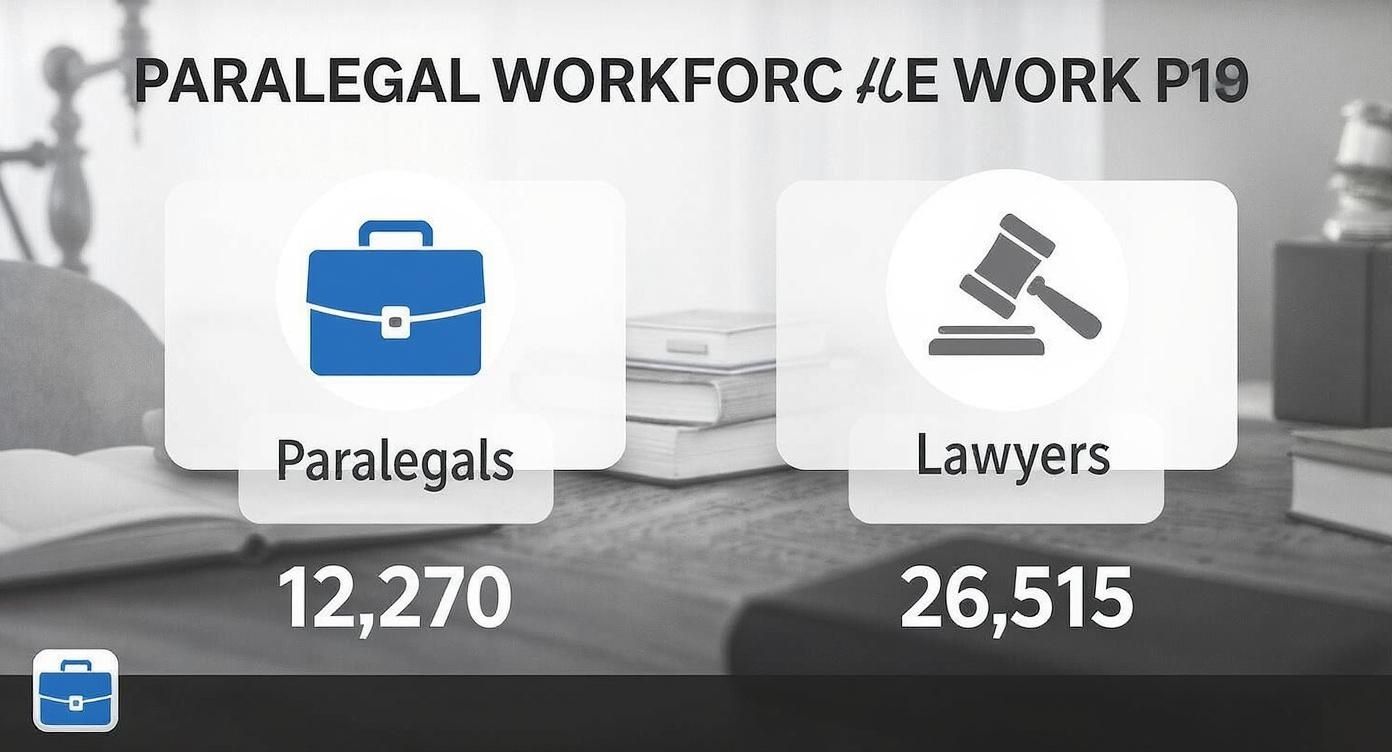
The numbers show there are roughly two lawyers for every one paralegal, which really underscores just how critical skilled paralegals are to keeping the legal machine from grinding to a halt. This ratio is a big part of what drives demand and, ultimately, your salary.
Think of your salary potential like real estate: it's all about location, location, location. The paychecks are simply bigger in major metro areas because the cost of living—and what clients are willing to pay—is much higher.
A critical skill that directly impacts your value, no matter where you work, is mastering your timekeeping. Knowing how to track billable hours like a pro is non-negotiable. Your ability to accurately log every minute is tied directly to the firm's profitability—and, in many cases, your own bonus potential. Get good at it.
Want the fastest route to a bigger paycheck? Stop being a generalist and become a specialist in a high-demand field.

The real money isn't just in being a good paralegal; it’s in being the only paralegal your attorney trusts to handle complex e-discovery protocols or manage a multi-million dollar real estate closing. That’s when your value skyrockets.
Honing your skills in areas like corporate law, commercial litigation, or intellectual property can add a serious premium to your salary, especially with the tech boom in the Research Triangle. These fields demand niche expertise that firms are more than willing to pay top dollar for. Forget being a jack-of-all-trades; become a master of one.
Think your four-year degree is a golden ticket for a paralegal job in North Carolina? Think again. In a competitive market like this, a diploma just gets your resume into the pile. The right qualifications are what pull it out and put it on the hiring manager's desk.
This isn't about collecting a bunch of acronyms to tack onto your email signature. It's about building a toolkit that solves real, everyday problems for a busy attorney or law firm. Get ready to be indispensable—because that’s exactly what the right skills will make you.
Let's be direct: North Carolina doesn't legally require paralegals to be certified. But showing up to a job interview without a respected credential is like showing up to a NASCAR race on a bicycle. You're just not playing in the same league.
The North Carolina State Bar offers a voluntary certification that smart paralegals go after: the North Carolina Certified Paralegal (NCCP) credential. It’s not just a piece of paper; it’s a clear signal to employers that you understand state-specific laws and that you take this profession seriously. It’s a major differentiator.
Earning your NCCP signals a high level of professional competence and instantly builds trust with a potential employer. It tells them you’ve gone beyond the basics and are truly committed to the craft. For a deeper dive into the specifics, you can review our comprehensive guide on paralegal certification requirements.
Beyond formal certifications, law firms are crying out for practical skills that make their lives easier from day one. They simply don't have the time or resources to teach you the fundamentals. They need you to hit the ground running.
Here’s what they’re really looking for on your resume:
At the end of the day, your qualifications are all about proving your value. A degree is the foundation, but targeted certifications and rock-solid practical skills are the structure that will support a long and successful career in North Carolina’s legal field.
Let's be honest: you can be the most skilled paralegal in the state, but if you're looking for a job in the wrong city, you’re just spinning your wheels. When it comes to building a paralegal career in North Carolina, location is everything. Not all cities are created equal.
Sending out applications blindly is like throwing darts in the dark. You need to know where the action is. North Carolina’s legal market is concentrated in a few key hubs, and understanding where they are—and what makes them tick—is the first step to landing a great role.
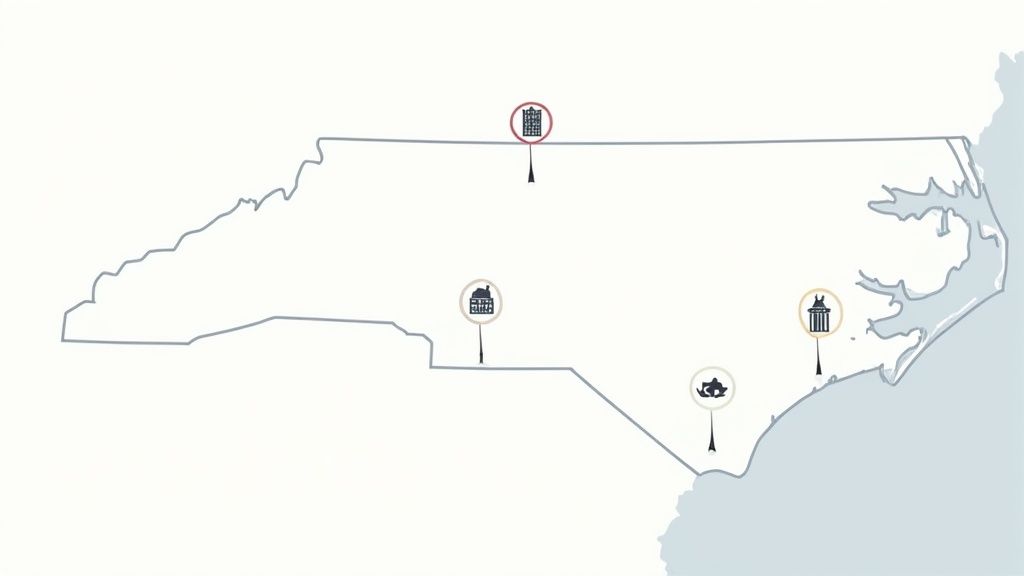
It’s no surprise that Charlotte and the Research Triangle (Raleigh-Durham) are the heavy hitters. These metro areas are the epicenters of opportunity, packed with big law firms, corporate legal departments, and government agencies. But they aren't the only places with great jobs.
First, let's break down the titans of North Carolina's legal scene. These are the markets where you'll find the highest number of openings and the most competitive salaries.
Charlotte: The Financial Kingpin
As the second-largest banking center in the U.S., Charlotte’s legal world is all about corporate law, finance, and real estate. If you have a background in mergers and acquisitions, securities, or commercial litigation, this is your playground. The demand for sharp corporate paralegals is consistently high, and the paychecks reflect that. To see what's out there right now, you can explore paralegal jobs in Charlotte, North Carolina, which gives you a real-time pulse on what local firms are looking for.
The Research Triangle: The Innovation Hub
Raleigh, Durham, and Chapel Hill form a tech and biotech juggernaut. For paralegals, this translates into a huge need for expertise in intellectual property, patent law, and complex contracts. If you’re tech-savvy and thrive in a fast-paced environment, the Triangle offers incredible career growth alongside innovative companies.
While Charlotte and Raleigh grab most of the headlines, ignoring the state's other cities is a rookie mistake. You can find fantastic opportunities in these growing legal markets if you know where to look.
Let's be real—not everyone wants the big-city grind. The secret is finding a city where career opportunity meets the quality of life you're actually looking for. Sometimes the best job is in a place you didn't expect.
Think about cities like Wilmington, with its expanding port and booming real estate development, or Asheville, which has a vibrant small business and healthcare sector. These areas might not have the sheer volume of a Charlotte, but they offer specialized roles and, frankly, a much better work-life balance for many people.
Your job search should match your career goals and your lifestyle goals. Don't just follow the crowd; find the market that’s the right fit for you.
If your job search feels like you're just refreshing Indeed all day, you're doing it wrong. It's a frustrating approach that puts you in a digital line with hundreds of other applicants for the same handful of publicly listed jobs. The real trick is to find the openings before they hit the mainstream job boards.
Think of it like this: by the time a job is on a massive site, the party's already started. You need to get on the insider list. This means tapping into the niche channels where law firms and corporate legal departments look for top talent first. It's about being one of the first few to apply, not just another resume lost in the shuffle.
The most promising paralegal jobs in North Carolina rarely show up on giant, national websites first. They almost always appear in local, industry-specific places where serious legal professionals gather.
Make these your first stop:
These aren't just places to find listings; they're networking gold. Showing up to an event—even a virtual one—gets your name and face in front of the very people who make hiring decisions.
A general recruiter often doesn't understand the nuances of the legal field. They might see "paralegal" and think it's just an administrative role. You need someone who speaks the language and works exclusively within the North Carolina legal scene. These specialists have long-standing relationships with firms that often hire without ever posting a public job ad.
A great legal recruiter acts as your personal agent. They're privy to the unlisted jobs, the confidential replacement searches, and the firms that are quietly looking to bring on new talent. They open doors to opportunities you would never have found on your own.
Finding them is easier than you think. A quick LinkedIn search for "legal recruiter Raleigh" or "legal recruiter Charlotte" will give you a list of specialists. Look for those who specifically mention placing paralegals and reach out. A fifteen-minute chat with the right recruiter can be more productive than fifteen hours of scrolling. It’s the key to working smarter to advance your paralegal employment in NC.
Let's be honest: finding a truly great paralegal is a nightmare. You’re not just filling a seat; you’re bringing on a critical team member who can either bog you down or become your firm's secret weapon for efficiency.
If you’re just posting a job and hoping for the best, get ready to sift through a mountain of lackluster resumes. Top-tier candidates are smart. They can spot a generic, copy-and-paste job description from a mile away and will scroll right past it. They're looking for an employer who understands their value and has a clear vision for the role.
The employment outlook for paralegals in North Carolina is solid, with job growth keeping pace with the national average. With around 10,950 paralegals in the state, there's a decent talent pool to draw from, but remember—the best candidates always have options.

So, how do you make your opportunity stand out? It all starts with a job description that reads less like a legal filing and more like a compelling career move.
The goal isn’t to get a hundred applications. It's to get five great ones. A well-crafted job description is your first and most important filter.
Once you have a shortlist, the real work begins. A resume tells you what a candidate has done in the past; a great interview tells you what they can do for you in the future. You have to go beyond the standard "tell me about yourself."
A crucial part of this process involves taking effective interview notes for hiring to track and compare candidates accurately. Try presenting applicants with a real-world (but anonymized) problem your firm has actually faced. Ask them how they would approach it. Their thought process is often far more revealing than their resume.
This kind of thoughtful approach helps you build a team that gives your firm a genuine competitive edge.
To connect with pre-vetted candidates and shorten your hiring timeline, learn how to https://hireparalegals.com/hire-paralegals-in-north-carolina/. It’s your shortcut to finding the talent you need without the usual headaches.
Let's dive into a few of the questions that pop up all the time when people are exploring paralegal jobs in North Carolina. Here are the straightforward answers you're looking for.
The short answer is no, it's not legally required. North Carolina doesn't mandate certification for you to work as a paralegal.
However, choosing to work without one is a serious handicap in a competitive market. The North Carolina State Bar offers the North Carolina Certified Paralegal (NCCP) credential, and it’s a huge differentiator. Earning it signals to law firms and corporate legal teams that you've met a high standard of competence and are well-versed in North Carolina's specific legal procedures. It’s one of the best ways to get your resume to the top of the pile.
The biggest needs are often tied directly to the state's economic engines. In major business centers like Charlotte and Raleigh, the classic, high-demand fields are still king: corporate law, real estate, and litigation. These areas are constantly active and always in need of skilled paralegal support.
But there's a newer story unfolding, especially around the Research Triangle Park. The boom in tech and biotech has created a surging demand for paralegals with expertise in intellectual property and complex contract law. If you have a knack for technology and innovation, this is where you can really shine.
The takeaway is simple: align your skills with a booming sector of the state’s economy. Generalists get by, but specialists who can navigate complex, high-stakes work become invaluable.
It’s far more common today than it was just a few years ago, but it’s not yet the standard for every role. Progressive firms and large corporate legal departments are increasingly offering hybrid and even fully remote positions, particularly for seasoned paralegals with a track record of autonomy and reliability.
That said, many traditional practices, especially in litigation, still value the on-the-ground collaboration that comes with trial prep and case management. You'll find the most remote and hybrid opportunities in the larger metro areas where firms have the technology and infrastructure to support it.


