

 21 minutes read
So you're thinking about ditching the 9-to-5. Paralegal freelance work means you’re offering your legal ninja skills to attorneys on a contract basis. No more mandatory meetings, no more office politics—just you, your laptop, and total control. You’re the boss. This path gives you incredible flexibility and lets you choose your clients, which is exactly why so many seasoned pros are jumping ship.

The freelance dream is a potent one. More freedom, more control, maybe even more money without having to mortgage the office ping-pong table. But let's get one thing straight: this isn't about swapping a stuffy cubicle for a sunny spot on your couch. This is a complete career demolition and rebuild.
Congratulations. You're not just a paralegal anymore. You're now the CEO, head of marketing, the entire billing department, and, yes, the one-person IT helpdesk when the printer inevitably jams at 11 PM.
Before you draft that fiery resignation letter, you need a come-to-Jesus meeting with yourself. As an employee, you have a safety net—a steady paycheck, benefits, and a partner who worries about where the next client is coming from. When you're a freelancer, you are the safety net.
This leap demands a radical shift in how you think. The most successful freelance paralegals I’ve ever met operate like founders, not employees waiting for their next to-do list. They’re pathologically proactive, relentlessly self-motivated, and always hunting for a better way to get things done.

The real challenge isn’t the legal work; it’s everything else. The biggest predictor of success is your ability to embrace the hustle of running a one-person business with the same rigor you apply to drafting a motion.
So, the first question isn't "Can I do the paralegal work?" It's "Am I ready to own this entire mess?" That means getting cozy with a few new realities:
If that sounds terrifying, good. It should. But if it also sounds like the kind of challenge that lights a fire in your belly, then you’re on the right track. Remote legal support is exploding, and there's a massive opportunity for paralegals with the right skills and the right guts. This guide is here to give you the real-world advice to build a profitable career in paralegal freelance work—not just a temporary side gig.
Alright, let's talk about the boring-but-critical stuff. I know, you're itching to land clients and see the money roll in, but skipping these foundational steps is like building a house on quicksand. It’s a recipe for a very expensive, very public disaster.
Too many aspiring freelancers screw this up. They either get stuck in "analysis paralysis," researching LLCs for six months straight, or they blow past it, thinking "I'll figure it out later." Both are terrible ideas. This is your pre-flight checklist. You don't take off until every box is ticked.
First things first: what do you actually sell? Saying "I'm a freelance paralegal" is about as helpful as a chef saying "I cook food." It's lazy and uninspired. You have to get specific. Are you an e-discovery wizard? A master of corporate filings? Do you live and breathe family law QDROs?
Don't just list skills—package them into services that solve a lawyer's biggest problems.
See the difference? One is a passive skill; the other is a direct solution to a lawyer's chronic lack of time. Define your niche, package your offerings, and you'll immediately stand out from the sea of generalists.
Let’s be brutally clear about one thing: as a freelance paralegal, you work for an attorney. That attorney works for the client. You are never, under any circumstances, giving legal advice. This is the third rail of our profession, the Unauthorized Practice of Law (UPL), and touching it will vaporize your career.
Your supervising attorney is your shield. They review your work, take ultimate responsibility, and are the only one communicating legal advice. Your job is to make them look brilliant, not to play lawyer yourself.
Every email you send, every document you draft, every call you make should pass through one filter: "Is this a task a paralegal performs under the direct supervision of a licensed attorney?" If the answer is even a little fuzzy, stop.
Now for the paperwork. How you structure your business has real-world consequences for your bank account and your ability to sleep at night. For most of us, it boils down to two options.
Sole Proprietorship: This is the default. It's just you, doing business. It’s easy, cheap, and requires almost no setup. The massive, glaring, terrifying downside? There is zero legal separation between you and your business. A pissed-off client sues you, and your personal assets—your car, your house, your savings—are fair game. For me, that's a hard pass.
Limited Liability Company (LLC): This creates a separate legal entity for your business. Yes, it costs more and requires some upkeep, but it provides a critical liability shield. If your business gets sued, your personal assets are generally protected. For the full download, it's worth understanding business structures like an LLC. It’s the professional standard for a reason.
You don't need a dozen flashy subscriptions to run your business. You need a few bulletproof, secure tools. This isn't about convenience; it's a client-mandated necessity. Today, 42% of freelance paralegals work remotely full-time, a shift made possible because 83% of law firms now use legal tech solutions.
Here's the bare-bones starter kit:
With these pieces in place, you’re ready to actually find clients. When you're ready to make that leap, you can find quality gigs here: https://hireparalegals.com/freelancing-legal-jobs/.
This is it. The conversation everyone dreads, but the one that determines if you have a real business or a very demanding, low-paying hobby. Let's pull back the curtain on pricing. It's less of a dark art and more of a science you must master.
Forget pulling a number out of thin air. Your rate is a statement about your value, your expertise, and your professionalism. Price yourself too low, and you don't just lose money—you lose respect.
Everyone starts with hourly billing. It feels safe. It's also often a trap that punishes you for being good at your job. Think about it: the faster you get, the less you earn. That's a fundamentally broken model.
Here’s my unfiltered take on the pricing models for paralegal freelance work:
The moment you shift your mindset from "How many hours will this take?" to "What is the value of this outcome to the attorney?" is the moment you start building a real business. Project fees reward expertise, not just showing up.
Your rate needs to cover more than your salary. It has to cover taxes, software, insurance, and the soul-crushing reality of non-billable time. Hope you enjoy marketing, invoicing, and chasing down late payments—because that's now your unpaid side gig.
The business foundation you've already built directly supports your ability to command higher rates.
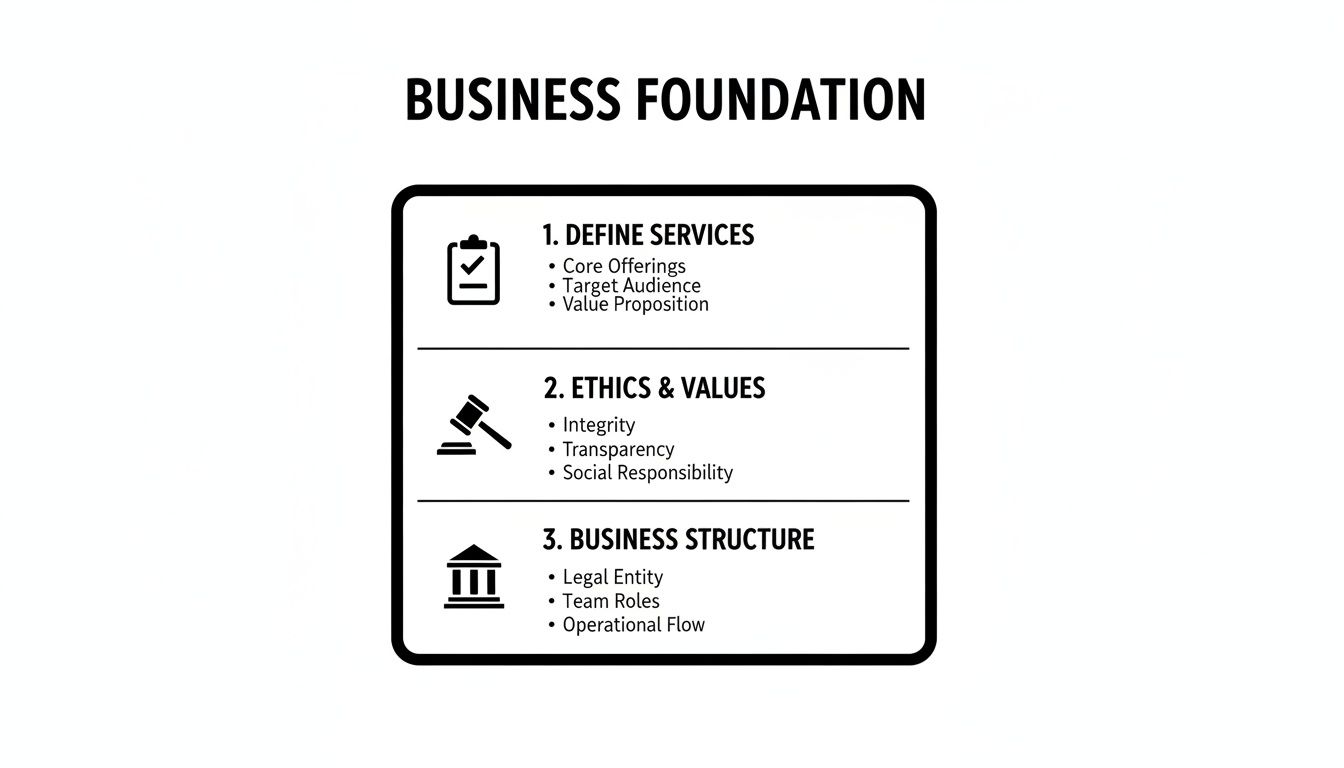
Having defined services, an ironclad ethical framework, and a proper LLC tells clients you're a serious professional, not a hobbyist. This lets you charge accordingly.
So, how do you find your baseline number? Simple reverse engineering. Start with your target income, pile on all your business expenses and taxes, then divide by the hours you can actually bill in a year. A work year has 2,080 hours, but after you subtract marketing, admin, and vacation, you’re lucky to hit 1,200-1,500 billable hours.
This table gives you a dose of reality.
| Hourly Rate Calculation: A Reality Check |
| :— | :— | :— |
| Item | Calculation Example | Description |
| Desired Annual Salary | $70,000 | Your target take-home pay before your own taxes. |
| Annual Business Expenses | $10,000 | Software, insurance, marketing, coffee, etc. |
| Self-Employment Tax (15.3%) | $10,710 | The "fun" tax for being the boss (approximate). |
| Total Revenue Needed | $90,710 | The absolute minimum your business must generate. |
| Total Billable Hours | 1,300 | A realistic estimate (25 hours/week for 52 weeks). |
| Minimum Hourly Rate | $69.78 (Round up to $70/hr) | This is your break-even point. Your floor, not your ceiling. |
This quick math shows why a rate that sounds high is actually just what's needed to survive. To thrive, you charge more.
Math is one thing; reality is another. You can't just pick a number that feels good. You have to know what attorneys in your target market will actually pay for top-tier paralegal freelance work.
The U.S. has over 345,000 paralegals, with a national average salary around $64,270. But averages are for amateurs. In major legal hubs, pay skyrockets; the mean wage in New York is $78,850, and in California, it's a stunning $79,210. Senior specialists in L.A. can pull $100,000 to $120,000 plus bonuses.
What does this mean for you? Your zip code matters less, but your client's zip code matters a lot. A solo attorney in rural Iowa has a different budget than a partner in Manhattan. Your pricing has to reflect that. When you're trying to figure this all out, it's helpful to explore different pricing strategies from other industries.
Ultimately, pricing is a weapon. Start with a rate grounded in math and market data, but don't be afraid to test it. The right clients won't flinch. The wrong ones will—and that's a brilliant filtering mechanism.

Let's be blunt. Finding clients isn't hard. Finding good clients—the ones who respect you, pay on time, and don’t trigger your anxiety—is the real game.
Anyone can polish their LinkedIn profile and pray. We’re going to talk about a real strategy. This is about building a client roster you're actually excited to work with, not one you dread hearing from. It’s about being picky, knowing your worth, and learning to say "no."
Sure, tap your existing network first. It’s a potential goldmine. Just don't come across as desperate. A simple, confident announcement that you’ve gone freelance is all you need.
But your personal network will dry up. And relying on generic job boards is a soul-crushing waste of time. The real key to scaling is to let someone else do the grunt work of finding and pre-screening clients for you.
This is where specialized platforms are a game-changer. They do the heavy lifting.
Platforms like HireParalegals essentially become your outsourced marketing team. (Toot, toot!) They connect you directly with law firms that are actively looking for—and have the budget for—elite talent. This saves you hundreds of non-billable hours and drastically improves the quality of your leads. Work smarter, not harder.
Remember, that first call is a two-way street. You are interviewing them just as much as they are interviewing you. The goal isn't just to land the gig; it's to figure out if you even want this partnership. After a few of these, you'll develop a finely tuned BS detector.
Here are the red flags I’ve learned to spot, usually the hard way:
Trust your gut. If a potential client feels disorganized, disrespectful, or ethically sketchy on that first call, no amount of money is worth the inevitable migraine. It’s always cheaper to say no upfront.
Once you find a client who seems like a decent human being, it's time to make it official. Your engagement agreement isn't a formality; it's your shield. Don’t you dare start a single minute of work without a signed one.
Your agreement needs to be painfully clear on these points:
This feels like overkill until the first time a client tries to ghost you on an invoice. It filters out the flakes and builds trust with the pros. If you're looking for opportunities where this is the standard, check out curated platforms for freelance legal assistant jobs.
Let's be real. Most of us didn't get into the legal field because we secretly love crafting the perfect LinkedIn post. You'd rather spend your day buried in discovery documents than agonizing over your "personal brand." I get it. But here’s the cold, hard truth: to run a freelance business, you have to market it.
The good news? You don't need to become a slick, self-promoting guru. This is a practical, no-fluff plan for people who just want to do great work.
Your goal isn't to go viral. It's to build a simple system that quietly brings the right clients to you. That means less time chasing leads and more time billing hours.
Forget the fancy website with stock photos of people in suits shaking hands. Your single most powerful marketing tool is a portfolio that shows what you can do. It's not a resume; it's a collection of evidence that proves your value before you even say hello.
This portfolio needs to be a curated set of work samples that speak directly to your ideal client. And it goes without saying, but I'll say it anyway: every sample must be so heavily redacted and anonymized that your own mother couldn't identify the case. This is non-negotiable.
What goes in it?
A killer portfolio does the selling for you. It turns the vague claim "I'm experienced" into cold, hard proof.
You can talk all day about how great you are. It will never be as powerful as a happy client saying it for you. Actively collecting and using testimonials is one of the highest-impact, lowest-effort marketing moves you can make.
Don't be passive. The moment you wrap a great project and the client is thrilled, that's your window. Make it easy for them. A simple, "Would you be willing to write a sentence or two about working with me? It would be a huge help," is all it takes.
A single, specific testimonial that says, "Her e-discovery analysis saved us at least 20 billable hours on a tight deadline," is worth more than a hundred of your own posts. It's credible, third-party proof that you deliver results.
Sprinkle these golden nuggets everywhere—your LinkedIn profile, your portfolio, your email signature. They build instant trust and answer a potential client's biggest unspoken question: "Is this person actually any good?"
You don't need to be a TikTok star, but you absolutely need a clean, professional online footprint. The first thing a potential client will do is Google you. What they find better inspire confidence.
At a bare minimum, you need a polished and complete LinkedIn profile. This is your digital handshake. Get a pro headshot, write a headline that screams your specialty (e.g., "Freelance Corporate Paralegal for M&A Deals"), and fill out your experience with results, not just duties.
This isn't just about looking the part. It's about positioning yourself to catch the tidal wave of freelance hiring. The global freelancing market was projected to hit a mind-boggling $455.2 billion by 2023. This isn't a trend; it's a fundamental rewiring of how law firms get work done. As you can discover more insights about the freelance economy, it's clear that paralegal freelance work is a massive piece of this new world.
We’ve covered a ton of ground, from the terrifying leap into self-employment to the nitty-gritty of pricing and marketing. But I know you still have questions. These are the ones that pop up in every freelancer forum. Let’s tackle them head-on, no fluff.
Yes. Full stop. Don't let anyone tell you otherwise. This isn't a "nice-to-have." It's a non-negotiable cost of doing business. Yes, you work under an attorney's supervision, but that doesn't make you bulletproof.
You need an Errors & Omissions (E&O) policy. This is what protects you if an attorney claims your mistake—a missed deadline, a botched filing—cost them a case.
Think of it this way: E&O insurance isn't just to cover a judgment. It's to cover the ruinous cost of simply defending yourself. It’s also a giant neon sign to potential clients that you are a serious professional who takes risk seriously.
It gives both you and your clients peace of mind. It’s a mandatory business expense. Period.
This is one of your most sacred ethical duties. Screwing this up will demolish your reputation and could even get an attorney disbarred. You need a rock-solid system for checking conflicts from day one. No winging it.
Before you even agree to a call, you must get the names of all parties from the prospective attorney. That means plaintiffs, defendants, co-defendants, key witnesses, associated companies—everyone.
Your process needs to be meticulous:
It is always better to be paranoid and turn down a good project than to risk a conflict. Your integrity is your most valuable asset. A single ethical lapse can wipe it out.
Welcome to the freelance feast-or-famine cycle. One month you’re drowning in billable hours, the next you’re stress-refreshing your inbox. The key to survival is brutal financial discipline from day one.
First, stop thinking of your business account as your personal ATM. It’s not. Religiously move 25-30% of every single payment into a separate savings account for taxes. Do not touch it. This one habit will save you from a world of pain.
Next, build a serious emergency fund. The standard advice is 3-6 months of personal expenses. For freelancers, I say you need 3-6 months of both business and personal expenses. This is your buffer against slow quarters, deadbeat clients, and life in general.
Finally, the real goal is to get off the rollercoaster. The best way to do that is to land one or two clients on a monthly retainer. Even a small, consistent retainer provides a predictable income baseline, which transforms chaotic project work from a source of stress into a welcome bonus.
Specializing is the fastest way to jack up your rates, attract better clients, and stop competing with every other paralegal on the planet. Generalists are a dime a dozen. Experts are rare and in high demand. If you try to be everything to everyone, you’ll be the first choice for no one.
So how do you pick your niche? Look at your past work.
Once you pick a lane, go all-in. Your marketing should scream your specialty. Change your LinkedIn headline from "Freelance Paralegal" to "Freelance E-Discovery Paralegal for Complex Litigation." Write a blog post about a pain point in that niche. Hang out in online groups where those attorneys congregate.
By focusing your marketing and building a portfolio that proves your deep expertise in one area, you change the entire conversation. You stop being a commodity and become an indispensable strategic partner.


