

 20 minutes read
Let's be real. Hiring for paralegal positions in CT isn't like ordering staples. The market is tight, top talent gets poached overnight, and a bad hire costs you more than just a salary—it costs billable hours, client trust, and your sanity. You're not looking for a warm body; you're hunting for a force multiplier.

Forget the generic advice you've read on a thousand other blogs. Hiring in the Nutmeg State is its own unique beast. You're competing with financial giants in Fairfield County, insurance HQs in Hartford, and a hundred boutique firms in between. Each demands a different flavor of paralegal, and the good ones know exactly what they're worth.
This guide is your battle plan, built from the trenches of legal hiring. We'll cut through the fluff and give you a pragmatic, step-by-step approach to navigating the Connecticut paralegal landscape without pulling your hair out.
Don't let Connecticut's size fool you. You're fishing in a surprisingly crowded pond. There are 4,850 paralegals working in Connecticut, making it a serious hub for legal support in the Northeast.
Despite what you hear about national job markets, Connecticut still sees around 510 annual openings from retirements and turnover, which keeps the market churning. For a deeper dive into the raw numbers, you can explore the insights on Connecticut's paralegal careers.
So, what does this mean for your firm?

"A bad paralegal hire doesn't just fail to add value—they actively subtract it. They create more work for attorneys, miss critical deadlines, and can even damage client relationships. The cost is far greater than their salary."
To compete, you need to know the local dynamics. Compensation and talent pools vary wildly from Hartford to Stamford. Pretending they're the same is a rookie mistake.
| Metro Area | Number of Paralegals | Average Annual Salary |
|---|---|---|
| Bridgeport-Stamford-Norwalk | 2,050 | $77,690 |
| Hartford-East Hartford-Middletown | 1,600 | $67,580 |
| New Haven | 710 | $66,740 |
These figures tell a story: the closer you get to NYC, the higher the salary expectations climb. A killer offer in New Haven might not even get a second look in Stamford.
Hope you enjoy spending your afternoons fact-checking resumes and running interviews—because if you stick to the old "post and pray" method, that's now your full-time job.
The real challenge isn't finding a paralegal; it's finding the right paralegal. You need someone with a precise blend of experience in your practice area, fluency in your firm’s tech stack, and the temperament to handle the pressure without cracking.
They need to be a Swiss Army knife: part legal researcher, part project manager, part client whisperer. They are the engine room of a successful practice, and finding one requires a smarter approach. Let's start with the first place you're probably getting it wrong: the money.
Before you write a single word of that job description, let's talk cash. Get this wrong, and nothing else matters.
Underpaying is the fastest way to get a flood of unqualified applicants while the real talent ghosts you. Overpaying? That’s just lighting money on fire, and whose budget has room for that?
Let’s dissect what paralegals actually make in Connecticut, moving beyond vague statewide averages that lump a recent grad in Torrington with a senior litigation paralegal in Stamford. They aren't the same, and your offer shouldn't pretend they are.
Location, location, location. It’s not just for real estate. In Connecticut, geography dictates salary more than almost any other factor. A paralegal in Greenwich isn’t just paying more for coffee; they’re operating in a high-stakes legal market fueled by finance and corporate HQs.
The data paints a clear picture. The average paralegal salary in Connecticut is around $56,821 annually, or about $27.32 per hour. But that number is a smokescreen. The real action is in the details, with the top 10% of earners pulling in over $76,000. You can explore these Connecticut paralegal salary benchmarks on ZipRecruiter for a closer look.
That's a massive spread. The key is knowing where your firm lands on that spectrum.
The Bridgeport-Stamford metro area is the undisputed heavyweight champion of paralegal pay in the state, with an average salary of $76,150. That’s a staggering 24% higher than the state average.
Why? It's simple economics. Your firm is competing with hedge funds and Fortune 500 legal departments that can afford to pay top dollar for the best people.
Contrast that with other parts of the state. While still competitive, salaries in Hartford or New Haven reflect a different cost of living and a different corporate landscape. Your offer needs to be calibrated to your specific locale, not some generic number you found on a national job site.
Think of it this way: Offering a Hartford salary for a Stamford-based role is like showing up to a Formula 1 race with a go-kart. You’re not even in the running.
So, what drives these numbers beyond the zip code?
A winning offer is more than just a salary. It's a package. Top candidates are evaluating the whole picture, and you should be, too.
Here’s how to build a package that gets a 'yes' without having to mortgage the firm’s ping-pong table.
1. Benchmark Your Base Salary Aggressively: Research your specific metro area, not just the state. Be honest with yourself about where you need to be to attract the caliber of talent you want.
2. Don't Skimp on the Benefits: Health insurance, 401(k) matching, and PTO are table stakes. If your benefits are weak, you'll have to overcompensate on salary, which is usually a more expensive route.
3. Use Bonuses Strategically: A performance-based bonus can be a powerful motivator and a great way to compete with larger firms if your base salary has a lower ceiling. It ties compensation directly to value.
4. The Certification Premium: Don't forget the credentials. A certified paralegal from a program like NALA or NFPA has proven their commitment. This isn't just a piece of paper; it’s a mark of quality that typically justifies a 10-15% salary premium. Paying for it signals you value expertise.
Your job description is your opening argument. And frankly, most firms are losing the case before they even get to speak. A bland, copy-pasted list of duties is a one-way ticket to a pile of mediocre resumes.
Let's be brutally honest. Your job description is a sales pitch, not a legal filing. Its primary purpose is to act as a magnet for high-performers and a filter for everyone else. If it reads like the terms and conditions for a software update, you’ve already failed.
It’s time to stop listing tasks and start selling the opportunity.
If your job description includes phrases like “fast-paced environment,” “team player,” or the dreaded “work hard, play hard,” you might as well just write, “we are exactly like every other firm.” These phrases are meaningless corporate jargon.
Instead of clichés, get specific.
This kind of directness attracts people excited by that challenge and repels those who would crumble by week two. That’s a win-win.
A great job description makes the right person think, 'This job was written specifically for me.' A bad one makes them think, 'I've seen this exact post ten times today.'
One of the biggest mistakes is creating an impossible wish list. Requiring ten years of experience, a specific certification, fluency in three e-discovery platforms, and the ability to juggle flaming torches immediately shrinks your talent pool to zero.
Be ruthless about separating your true deal-breakers from your "would be nice" list.
For paralegal positions in CT focusing on corporate law, proficiency with Clio might be a must-have. But is experience with a niche contract management software you can teach in an afternoon really a deal-breaker? Probably not. This widens your pool without lowering your standards. It lets you find a brilliant litigation paralegal who can easily learn your software, instead of passing them over for a less-skilled candidate who happens to check an arbitrary box. To really stand out, a detailed guide on how to write a good job description that attracts top talent is an indispensable resource.
Nobody wakes up excited to "file documents" or "organize case files." What top-tier paralegals want to know is the impact of their work.
Frame their responsibilities around the value they create.
See the difference? One is a chore; the other is a mission. For more guidance, check out our deep dive into crafting the perfect paralegal job description that gets results.
Finally, be honest. If the role requires late nights before a major trial, say so. The right candidate will see it as part of the challenge; the wrong one will self-select out. Honesty builds trust from the first interaction.
Alright, let's get down to brass tacks. Posting a job opening and waiting for the perfect candidate to appear isn't a strategy—it's a lottery ticket. The best paralegals aren't scrolling through job sites. They're too busy being indispensable somewhere else.
It’s time to stop waiting for great candidates to find you and start going out to find them. This is how you hunt for talent, not just post a help-wanted ad.
The standard approach is to blast your job description across a few major job boards. It’s a necessary first step, but it’s the bare minimum. You'll get a high volume of applicants and spend countless hours sifting through resumes that just don't fit.
To find premier talent for paralegal positions in CT, you need to fish in better ponds.
The $500 Hello: Spending a few hundred dollars to sponsor a local paralegal association's newsletter or virtual event can give you more direct access to qualified, engaged candidates than thousands spent on a national job board.
To streamline your search, you might also consider exploring the latest and best recruitment tools available.
Here’s a thought that makes some partners nervous: what if your next best hire doesn't live within driving distance? The pandemic proved high-level legal support can be done remotely. This simple shift in thinking opens up a global talent pool.
Regions like Latin America have become a hotbed for highly skilled, English-fluent legal professionals well-versed in the U.S. legal system. The timezone alignment is nearly perfect, and the cost savings can be substantial—often up to 70% on payroll.
But I know what you’re thinking. Hiring internationally sounds like a compliance headache. It absolutely can be, if you go it alone. That’s where specialized platforms come in, handling the heavy lifting for you:
This isn't about finding "cheap" labor; it's about finding exceptional, vetted talent in a less competitive market. Exploring a list of the top paralegal job websites can provide a serious strategic advantage. It's about hiring smarter, not just harder.
The resumes have landed. Now the real work starts. This is where you find out who truly has the skills and grit to excel at your firm.
The goal isn't to fill a seat; it's to find a partner for your practice. That requires a thoughtful interview plan designed to systematically identify the superstars and weed out those who only look good on paper. This isn't about trick questions—it's about creating scenarios that show you how a candidate actually thinks.
A great interview process acts like a funnel, not a revolving door. You want to get progressively more serious with a smaller, more qualified group at each stage. This respects everyone's time.
Here’s a structure that works:
This flow chart gives a bird's-eye view of how different sourcing channels feed into this kind of structured system.
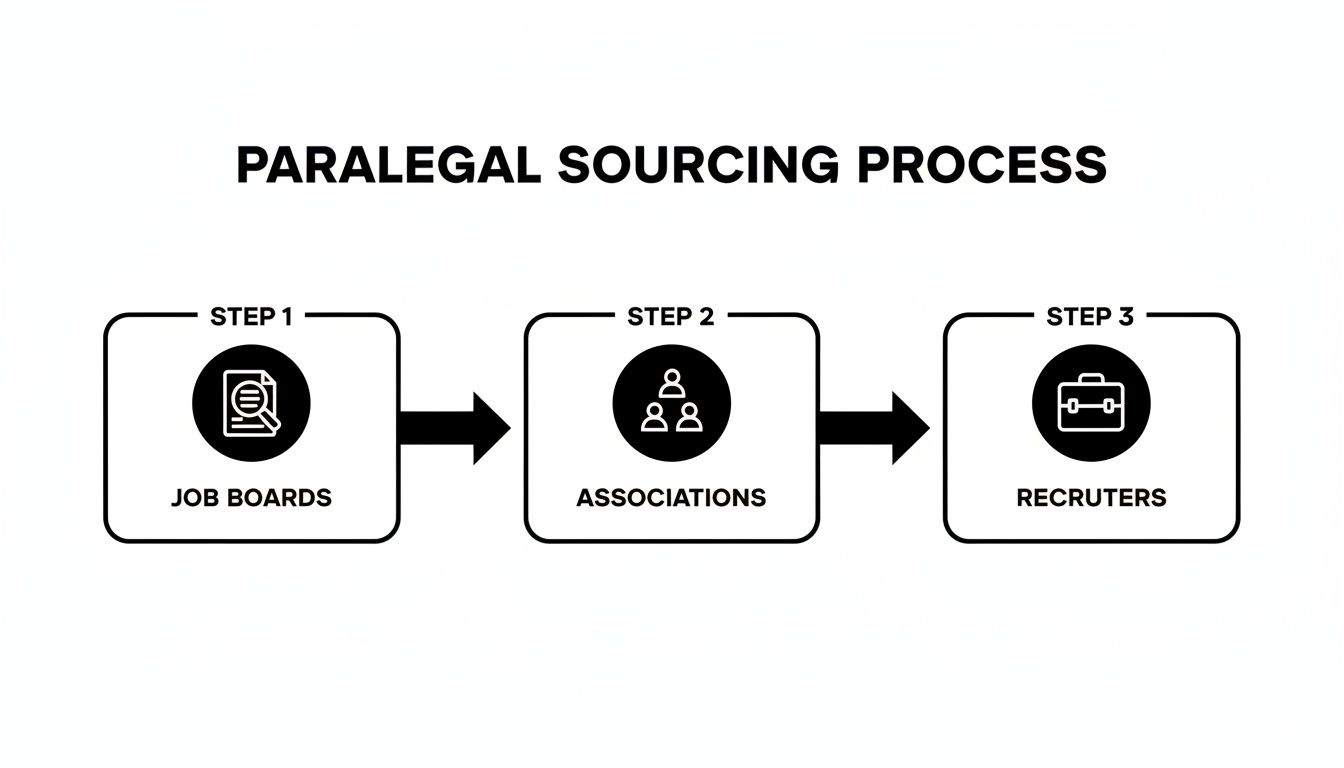
Whether you find candidates through job boards, associations, or recruiters, the objective is the same: funnel the best ones into a process that rigorously tests their capabilities.
Every interviewer brings a different perspective. A managing partner cares about the bottom line, while an office manager is focused on workflow. Tailoring your questions ensures you get a 360-degree view.
Here’s a simple matrix to guide who should ask what.
| Interviewer | Sample Question | What You're Really Looking For |
|---|---|---|
| Managing Partner | "Describe a time you identified a potential issue in a case that your supervising attorney had missed." | Initiative & commercial awareness. Do they just complete tasks, or do they think strategically? |
| Senior Attorney | "Walk me through your process for preparing for a major trial or closing." | Technical competence & organization. Can they articulate a clear, logical workflow? Do they mention quality control? |
| Office Manager | "Tell me about the most challenging team project you've worked on. What was your role, and what made it difficult?" | Collaboration & problem-solving. How do they handle interpersonal dynamics? Do they blame others or focus on solutions? |
By assigning specific areas of inquiry, you avoid asking the same questions three times and get a much richer picture of your potential new hire.
A resume tells you what a candidate claims they can do. A skills test shows you what they can do. This is your insurance policy against a bad hire.
Forget generic, multiple-choice quizzes. A powerful skills test is a miniature version of a real task they’d handle in their first week.
A great skills test isn't about finding a perfect answer. It's about seeing their thought process, how they handle ambiguity, and whether their attention to detail is as sharp as they claim. It’s the closest you’ll get to a test drive.
Here’s a simple but effective example for a litigation paralegal:
This single assignment will reveal more than an hour of conversation ever could. For more ideas, you can explore our guide on essential legal assistant interview questions to build out your interview plan.
Don't treat reference checks as a formality. Prepare specific questions for former supervisors.
Instead of asking, "Was she a good paralegal?" try this: "Can you give me an example of a time she had to manage a high-pressure deadline and how she handled it?" The difference in the answer you'll get is night and day.
Once you’ve found your all-star, put together a clear, competitive offer letter and deliver it quickly. This is the final move that helps you land top talent for the best paralegal positions in CT.
Let's be realistic. Everything we've covered is a massive drain on your time. It's a full-time job in itself, one you can't afford when you're busy running a firm.
So, what’s the alternative to getting stuck on this hiring hamster wheel?
This is where a service like HireParalegals comes in. We aren't just another job board. Think of us as your dedicated, outsourced hiring partner. We’ve already done all the painful, time-consuming heavy lifting for you. (Toot, toot!)
The traditional process forces you to become an expert resume detective overnight. You have to spot red flags, verify credentials, and read between the lines. It’s a skill that takes years to hone.
We’ve already vetted thousands of top-tier paralegals, focusing on the skills that actually drive results:
We don't just hand you a stack of resumes and wish you luck. Our job is to deliver a curated shortlist of perfectly matched candidates who have already passed a rigorous screening process. You get to skip straight to the final round with pre-qualified all-stars.
Your time is your most valuable non-billable asset. Wasting it sifting through hundreds of applications for paralegal positions in CT is an expensive distraction. We take the entire top-of-funnel process off your plate, handling everything from sourcing and screening to the initial vetting interviews.
This frees you up to do what only you can do: make the final, critical decision based on a handful of elite candidates. You can focus on finding the right personality fit for your team, knowing their technical skills are already a given. It's the strategic advantage busy firms need to hire smarter, not harder.
You've got questions, we’ve got answers. After helping countless firms navigate this maze, we’ve heard just about everything. Here are the straight-up answers to the most common questions we get about finding talent for paralegal positions in CT.
Legally? No. The state doesn't require certification. But should you? Absolutely.
Think of a certification from a program like NALA or the NFPA as a powerful signal. It tells you a candidate is serious about their career and has a verified, foundational knowledge of the law. In a tight market, it's one of the best filters you can use.
Easy. They get tunnel vision, fixating on finding someone within a ten-mile radius of the office while completely ignoring the global talent pool. Your perfect candidate for a role in Stamford might be sitting in Miami, or even Bogotá, ready to work East Coast hours for a far more competitive rate.
Limiting your search to your immediate zip code is an old-school strategy that no longer works. It dramatically shrinks your options and forces you to fight over the same small, expensive pool of local candidates.
The best person for the job rarely lives just down the street. Expanding your search isn't just an option anymore; it's a competitive necessity for finding top-tier, affordable legal support.
It can definitely feel that way if you try to figure out compliance and international payroll yourself. But you're asking the wrong question.
Instead of asking if it's complicated, ask: "How can I hire a remote paralegal without the complications?"
This is exactly where a dedicated service comes in. A partner handles all the messy stuff—vetting, background checks, international payroll, and compliance—so you can focus on what matters: interviewing a shortlist of highly qualified candidates ready to hit the ground running. It’s the ultimate strategic shortcut.


