

 19 minutes read
Alright, let's cut to the chase. The whole paralegal and legal assistant debate boils down to one simple thing: what’s actually on fire in your law firm? A paralegal tackles the substantive, billable work—the legal research and drafting that actually wins cases. A legal assistant, on the other hand, is your firm’s air traffic controller, managing the administrative chaos of scheduling, client intake, and billing so you don't fly the whole operation into a mountain.
One helps you practice law. The other stops your practice from falling apart. You need to know which problem you're solving.
Ever feel like you’re just throwing money at a problem when it comes to hiring support? You know you need help, but the titles "paralegal" and "legal assistant" get tossed around like confetti, and it’s impossible to tell which one you actually need. Hiring the wrong one is like buying a fire extinguisher for a flood. Great tool, completely useless for your current disaster.
The confusion is understandable. For years, the lines were blurry. Today, they're not. Nailing the difference is the first step to scaling your firm intelligently instead of just bloating your payroll. It’s about finding the exact bottleneck that’s choking your growth and hiring the right specialist to smash it.
Let's ditch the textbook definitions. In the daily grind of a law firm, the difference comes down to one question: Is the work making the firm run, or is it making the case move forward?

The $50,000 question: Does this task keep the lights on, or does it help win the case? One manages the machine; the other helps build the engine.
To make it even clearer, here's a no-fluff breakdown.
| Attribute | Paralegal (The Specialist) | Legal Assistant (The Organizer) |
|---|---|---|
| Core Function | Handles substantive, billable legal work. | Manages administrative and operational tasks. |
| Typical Duties | Legal research, drafting documents, discovery prep. | Scheduling, client intake, billing, filing. |
| Required Skills | Deep legal knowledge, analytical skills, writing. | Freakish organization, communication, tech savvy. |
| Strategic Impact | Multiplies a lawyer's billable capacity. | Stops the firm from grinding to a halt. |
This table makes it painfully obvious: each role solves a completely different business problem.
This isn't just semantics; paralegals and legal assistants are the backbone of a modern law firm. There are around 376,200 of them in the US, with a projected 4% growth rate. That’s about 38,000 new openings every year, especially in remote-friendly fields like personal injury and insurance litigation.
So, what's your biggest pain point? Are you drowning in admin tasks that keep you from your real job? Get a legal assistant. Are you buried under a mountain of substantive legal work you can't get to? You need a paralegal.
Knowing the difference prevents you from making a hiring mistake that costs you six months and a pile of cash. For the nitty-gritty on qualifications, check out our guide on paralegal certification requirements.
Okay, you get the difference. Great. But knowing when to pull the trigger is what separates a firm that’s just busy from one that’s actually growing. Time for some brutal honesty about your firm's bottlenecks.
Let's try a little thought experiment. Look at your to-do list from last week. How much time did you spend on actual, billable legal work versus… everything else? If you're spending more hours scheduling depositions than preparing for them, you’re not a lawyer. You’re a very, very expensive administrator. And that's a terrible business model.
The most obvious sign you need help is that feeling of being buried in tasks that feel urgent but don't actually move a single case forward. This is administrative quicksand. It looks like work, it feels like work, but it’s slowly suffocating your profitability.
Sound familiar?
If you just nodded your head, your firm is screaming for a legal assistant. These tasks are vital, but they are an absolutely criminal waste of an attorney's time. Every hour you spend on them is an hour you’re not billing, not strategizing, not bringing in new business. It's death by a thousand papercuts.
But what if your admin is running like a Swiss watch? Your calendar is pristine, your files are organized. The problem isn’t the chaos. The problem is you. You are the bottleneck for the actual legal work.
This is a different, and frankly, more dangerous problem. It’s when you have plenty of work but physically can’t get to it all. You’re pushing deadlines, working weekends just to keep up, and still feeling like you’re losing ground. This is your cue to hire a paralegal.
You need a paralegal when your primary constraint is no longer time, but your own capacity to perform high-level legal tasks. It's the moment when cloning yourself starts to sound like a genuinely good business plan.
You need someone who can draft motions, prep discovery, summarize depositions, and manage case files without you holding their hand. This isn't just about delegating tasks; it's about leverage. A great paralegal doesn’t just take work off your plate—they multiply your ability to produce high-quality legal work.
This decision tree should make it crystal clear.
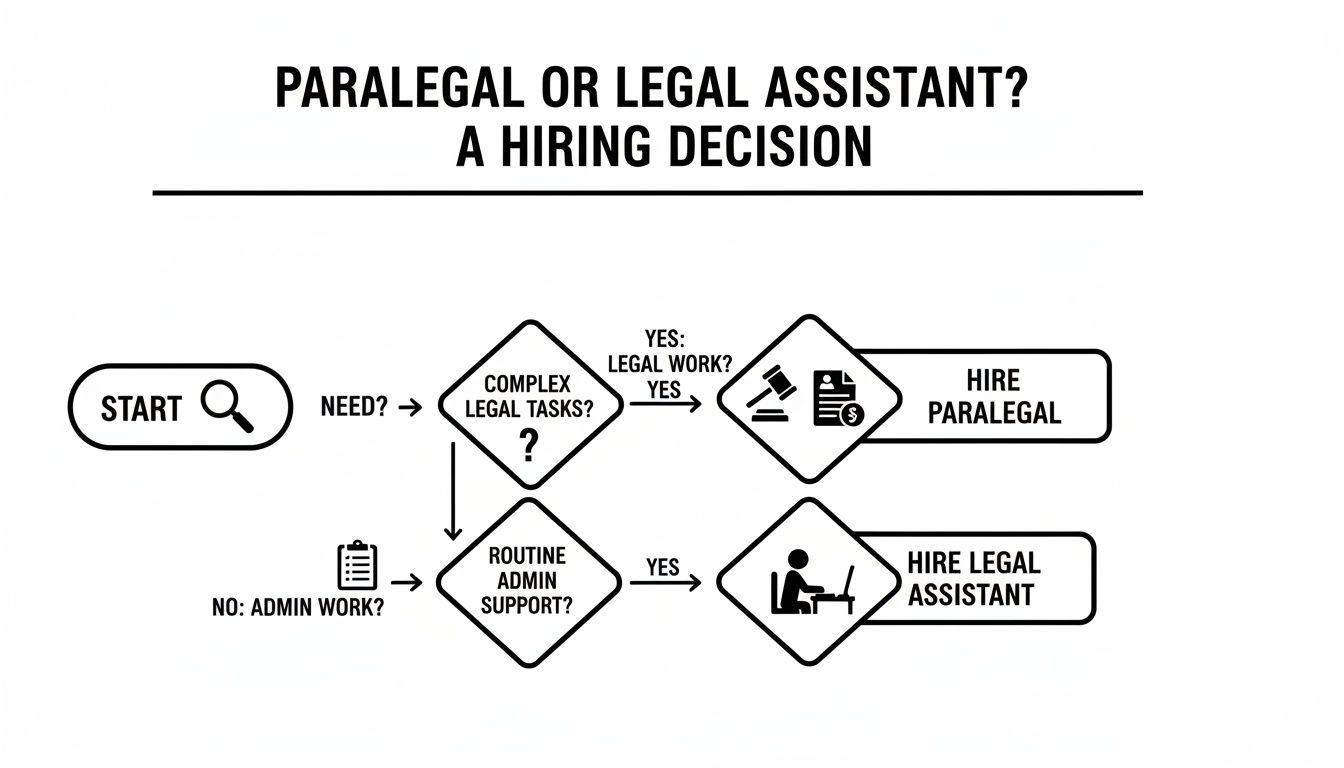
The right hire is a direct solution to a specific operational drag. It’s either administrative chaos or a crisis of legal capacity. Pick your poison.
And while you're adding people, take a hard look at your law firm IT support. Because adding new team members, especially remote ones, without upgrading your tech is like buying a race car and trying to run it on regular gasoline. Don't do that.
Still think your support team needs to be breathing the same recycled office air as you? You’re not just old-school; you’re actively holding your firm back. The traditional butts-in-seats model isn't just expensive; it’s a tiny, shallow talent pool. The idea that legal work can't be done remotely is a myth that died in 2020.
The legal industry has already moved on. The real question isn't if you should hire remotely, but how much you're losing by clinging to the past.
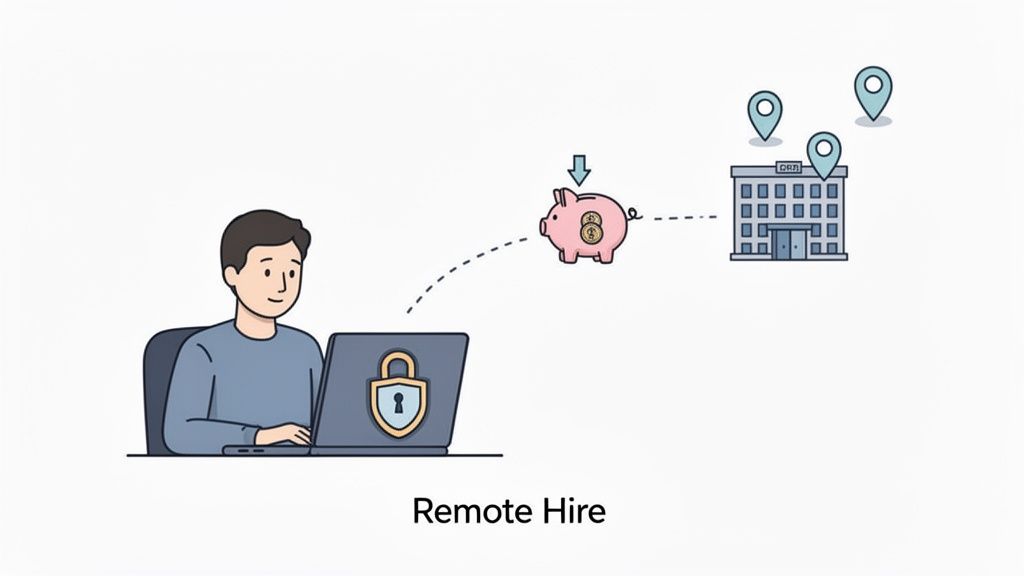
Let's be honest: your perfect hire probably doesn't live within a 20-mile radius of your office. By limiting your search to local candidates, you're fishing in a puddle and fighting every other local firm for the same handful of people. It’s a great way to overpay for someone who is merely "good enough."
Open your search to the entire country, and the talent pool explodes. You go from a few dozen local applicants to thousands of qualified professionals. Suddenly, you can find a paralegal with a decade of experience in your niche practice area, or a legal assistant who’s a certified wizard with your exact case management software.
Why settle for who’s available down the street when the perfect fit is just a video call away?
Now, let’s talk money. Hiring remotely isn’t just a talent strategy; it’s a financial one. Think about the overhead chained to every in-office employee: office space, equipment, utilities, snacks. It adds up faster than you think.
With a remote professional, those costs vanish. Better yet, you gain access to talent in markets with a lower cost of living, letting you offer a competitive rate that still saves your firm a fortune compared to big-city salaries. We've seen firms slash their payroll costs by up to 80% without losing an ounce of quality.
That’s not just saving money. That’s freeing up capital to reinvest in things that actually grow your firm.
The real win isn’t just saving on salary. It’s turning a fixed expense into a strategic investment that generates more revenue.
Ah, the classic objections. "How do I know they're working?" and "Is my client data safe?" A decade ago, these were real problems. Today, they’re excuses. Technology has already solved this.
Modern tools make managing a remote team surprisingly simple and secure:
The demand for skilled paralegals and legal assistants is insane. The Bureau of Labor Statistics projects around 39,300 openings each year, and with unemployment for these roles at a ridiculously low 2.0%, the talent is in the driver's seat. They expect remote work.
If you’re ready to join the 21st century, our guide on hiring a remote legal assistant will show you how to do it without screwing it up.
So, you’ve decided to handle hiring yourself. Hope you enjoy spending your afternoons fact-checking resumes and running interviews—because that’s now your full-time job. The DIY hiring approach is a massive gamble, a time-sucking, expensive bet that most firms can’t afford to lose.
A single bad hire will set you back tens of thousands of dollars. I'm not just talking about their salary. I'm talking about lost billable hours, pissed-off clients, and the sound of your firm’s momentum grinding to a halt.
We've all hired one. The candidate with the perfect resume who nails the interview. They talk a big game about their complex litigation experience and claim to be a guru in your case management software. You hire them, breathe a sigh of relief, and wait for the magic.
Except the magic never comes.
Suddenly, you're walking this "expert" paralegal through a simple motion to compel. You discover their "deep research skills" are just frantic Google searches, and their client communication skills are a malpractice suit waiting to happen. Now you’re not just paying their salary; you’re redoing all their work. That's worse than having no help at all.
This is the hidden tax of a bad hire. The direct cost is their paycheck. The indirect costs are what will kill you.
A bad hire is a productivity black hole. They don’t just fail to contribute; they actively drain the time, money, and morale of everyone around them.
The financial bleed comes from everywhere:
This turnover is a huge part of the cost, which is why you better know how to reduce employee turnover.
Making things worse is the current legal job market. "Competitive" doesn't do it justice. Demand for skilled legal support has exploded, with projections showing over 68,200 job postings for these roles in 2025 alone.
Meanwhile, unemployment for paralegals and legal assistants is hovering at an impossibly low 1.9% to 2.0%. You can see the brutal stats over at Prime Legal Staff. Finding great talent right now is less like fishing and more like hunting for a unicorn in a hurricane.
This hyper-competitive landscape makes the DIY hiring approach a genuinely terrible idea. You're not just competing with other firms; you're fighting a systemic talent shortage.
When you go it alone, you shoulder all the risk. You’re the recruiter, the screener, the interviewer, and the compliance officer. A weak vetting process lets unqualified candidates slip through. One mistake, like misclassifying a contractor, can bring a world of legal and financial pain.
Frankly, the whole thing is a massive opportunity cost. Every hour you spend trying to be a recruiter is an hour you’re not practicing law.
This is where a specialized platform completely changes the game. We’ve done the hard part. We handle the brutal vetting, the skills tests, and the background checks so you’re not flying blind. What you get is a pre-vetted shortlist of professionals who are ready to contribute from day one. Toot, toot!
We take the gamble out of hiring so you can get back to what you do best: winning cases.
You did it. You found a killer candidate. But don't start celebrating yet. The easiest way to ruin a great hire is to screw up the onboarding. A chaotic, sink-or-swim start is a surefire way to turn a star performer into a confused, frustrated, and short-term employee.
This isn't about micromanagement. It's about building a dead-simple system that plugs your new hire into your firm’s workflow so they can start being productive immediately.
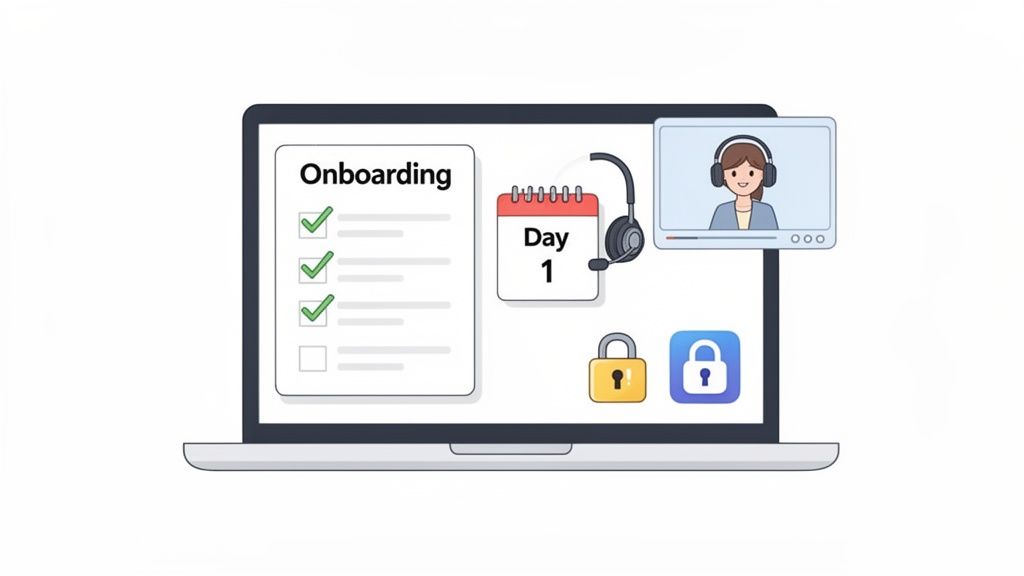
Before your new hire even logs on, their digital workspace must be ready. Nothing screams "we have no idea what we're doing" like a new team member who can't access the tools they need. It’s unprofessional and a massive waste of their first day.
Your pre-launch checklist should be ruthlessly simple:
Get this done ahead of time so their first day is about learning your firm, not waiting on IT.
This is where most firms drop the ball. Remote work runs on clarity, not assumptions. You can’t expect your new hire to just absorb your firm’s culture through osmosis. There is no osmosis. You have to spell it out.
Create a simple onboarding doc—a "Don't Make Me Think" guide to working at your firm.
The goal of onboarding isn't to control every action; it's to eliminate the guesswork. When your team knows the 'what' and 'why,' you don't have to micromanage the 'how.' That’s how you build an autonomous, high-performing team.
This isn’t a 50-page manual no one will read. It’s a quick-reference sheet covering:
These are the guardrails that give your new hire the confidence to act decisively. For a deeper playbook, check out our guide on how to onboard remote employees.
Finally, the serious part. Supervising remote paralegals and legal assistants carries the same ethical weight as supervising in-office staff. As the attorney, you are 100% responsible for their work product. End of story.
Your supervision protocols must be non-negotiable. Use your case management software to build in mandatory review stages. No substantive legal document, client communication, or research memo should ever go out the door without being reviewed and approved by a licensed attorney.
This isn’t about a lack of trust. It’s about professional responsibility. A well-defined review process protects your clients, your firm, and your new hire, empowering them to work independently within a safe, compliant framework.
Alright, let's hit the questions I get all the time from lawyers who are on the fence about this whole remote hiring thing.
Yes, absolutely. And if you're not, you're leaving a huge pile of money on the table. The ABA Model Rules are clear: you can bill for substantive paralegal work at market rates, as long as it's supervised by an attorney.
Where your paralegal sits has zero impact on the billability of their work. The ethics rules care about the substance of the work, not the location of the worker. Is it work an attorney would otherwise have to do? Is it documented correctly? Is the rate reasonable? If you check those boxes, you’re golden.
This is a core part of the financial strategy. You hire a top-tier remote paralegal at a smart rate, which lets you maintain a healthy profit margin on their billable hours while offering fair pricing to clients. It’s a new, sustainable revenue stream.
For the love of all that is holy, don't just post a job for "a paralegal." That's like going to the hospital and asking for "a doctor" when you're having a heart attack. The whole point of a national talent pool is to find a specialist.
Before you write a single word of a job description, get brutally specific.
The right person doesn't need six months to learn the basics. They should walk in (virtually) on day one asking smart questions about your firm's specific procedures, not about the fundamental work itself.
A generalist helps a little. A specialist becomes a force multiplier. Choose wisely.
This is the big one. I get it. But it's a completely solved problem. A well-structured remote setup can actually be more secure than a traditional office where sensitive documents get left on desks. It's about building a digital fortress.
First, your tech is your first line of defense. A cloud-based practice management system with role-based permissions is non-negotiable. This means your remote paralegal gets access only to the client files they need, and nothing more.
Next, get it in writing. A rock-solid remote work policy and an NDA are your best friends. Your policy should explicitly forbid using personal computers or unsecured public Wi-Fi for any client work. This isn’t micromanagement; it’s your ethical duty.
Finally, insist on secure, encrypted channels for all communication. Any professional remote paralegal understands this. They know client confidentiality is the bedrock of our profession, and that duty doesn’t change just because their office has a better view.
Let’s talk numbers, because this is where it gets interesting. A qualified US-based paralegal will run you $50,000 to $90,000+ per year. And that’s just salary, before you add benefits, payroll taxes, and office overhead.
Now, look south. A highly skilled remote paralegal from Latin America—fluent in English, experienced, and trained on US legal systems—often comes at a rate of $15 to $35 per hour. This isn't about finding "cheap" labor; it's about smart global economics.
For most firms, this translates to a payroll savings of up to 80% without sacrificing quality. On top of that, you get the massive advantage of working with professionals in US time zones. No more overnight email lag.
It's a straightforward business decision. You get access to a caliber of talent you might not otherwise be able to afford, at a price that frees up capital to reinvest in growing your firm. It's a no-brainer.


