

 21 minutes read
Let's be honest. The idea of a part-time remote attorney job isn't some niche fantasy anymore. It’s a dead-serious, strategic move for lawyers who want their lives back. And I’m not talking about temp gigs reviewing documents until your eyes bleed. These are high-stakes roles in business transactions, personal injury, and even litigation—a legitimate alternative to the old-school, soul-crushing firm model.
The traditional law firm track isn’t for everyone. Shocker, I know. The relentless pressure to bill, the commute that chips away at your soul, the office politics… it’s enough to make you question every life choice that led you to that Aeron chair. I’ve been there, staring at a timesheet at 10 PM, wondering if this was really it.
So, no. This isn't another generic guide telling you to "update your resume." This is my playbook, forged in the trenches, for sharp attorneys ready to reclaim their calendar with high-caliber, part-time remote work. We’re cutting the fluff. Let's get straight to what actually works.
The demand for flexible legal talent isn't a post-pandemic blip; it's a fundamental rewire of how legal services get delivered. Law firms and GCs finally realized they can tap into elite legal brains without mortgaging the office ping-pong table for a downtown lease. It's a win-win: they get specialized skills on demand, and you get to practice law without the parts that make you want to become a cheesemaker.
The proof is in the pudding—or, in this case, the job postings. The market is hot, especially in major legal hubs.

A quick search on any major job board will show you. You’ll see over 50 part-time, contract, and remote attorney positions in a market like California, with senior roles offering pay that’ll make your eyes water. This isn’t a secret.
This isn’t about downshifting. It’s about re-engineering your career for a better life—swapping the constant grind for focused, high-impact work.
Look, making this leap takes more than a decent Wi-Fi signal. It demands a whole new mindset. You're not an employee anymore; you're a legal consultant, a business of one. Your success now hinges on being a self-starter who can manage a project, communicate like a pro without ever shaking a hand, and deliver brilliant work without a partner breathing down your neck.
To truly thrive out here, increasing productivity at work is non-negotiable. Master your time, and the perks are huge:
This guide gives you the tactics that work. No theory, just the real stuff.
That leather-bound, meticulously formatted resume you perfected for a corner office? It’s a fossil. Hiring managers for remote roles are scanning for a completely different set of signals, and your old CV might be screaming, "I need an assistant to manage my calendar."
Let's fix that. This is a workshop for turning that static document into a magnet for the best part-time attorney jobs remote. We're not just adding "proficient in Microsoft Word." We're overhauling the whole machine to prove you’re a tech-savvy, self-sufficient operator who doesn’t need babysitting.
In a traditional firm, your resume says you can thrive within a rigid structure. For remote work, it has to prove you can thrive without one. The hiring manager’s biggest fear? Bringing on a ghost who misses deadlines and becomes a black hole of productivity. Your resume needs to vaporize that fear on sight.
So, re-read every bullet point through one critical lens: Does this prove I can work alone and get stuff done from anywhere? It's not just what you did; it’s how you did it. You need to spotlight the tools and processes you used to win. This is a big shift, and smart firms are already catching on. You should probably understand what skills-based hiring is to stay ahead.
The new currency isn't your old firm’s fancy letterhead. It's your demonstrated ability to manage a caseload, communicate asynchronously, and use modern legal tech without calling the IT guy every five minutes.
The market for remote talent is booming, but you have to speak the language.
And as this infographic shows, the career upside for skilled attorneys who go remote is very, very real.
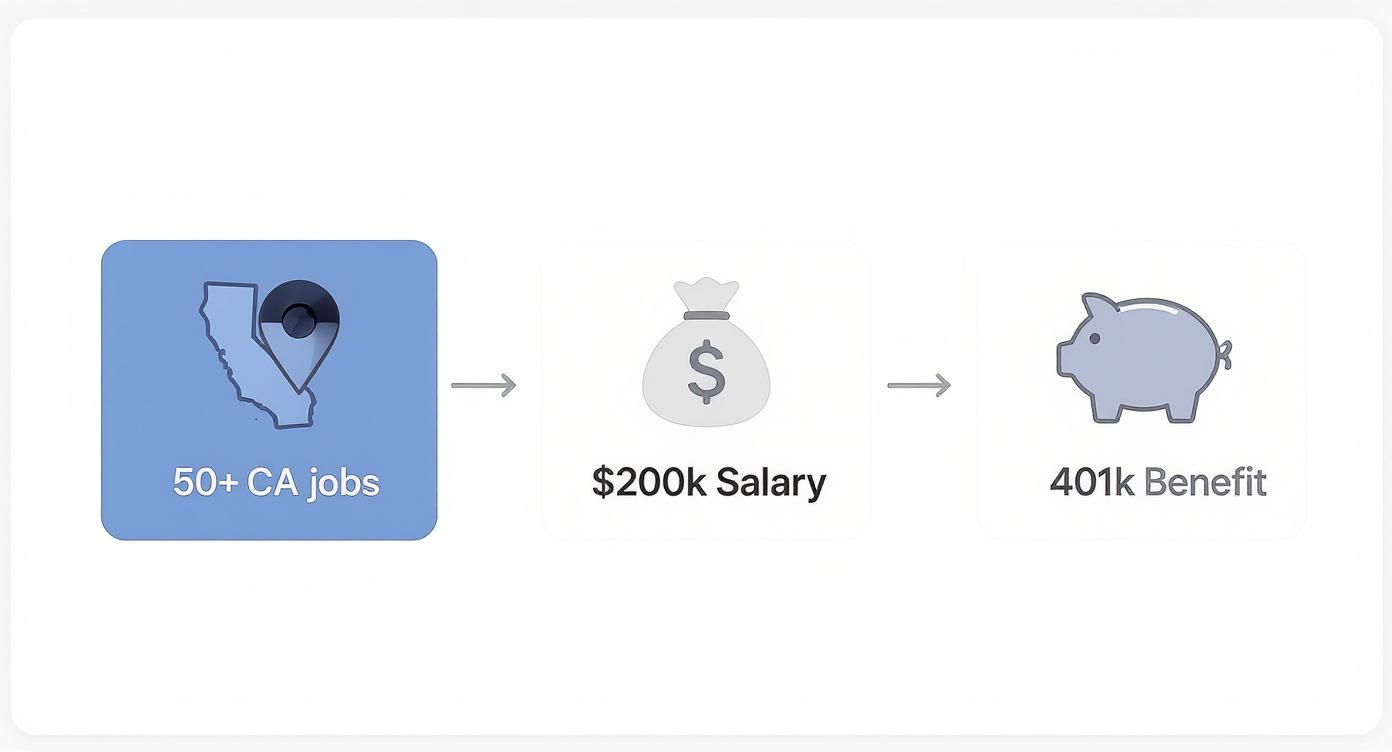
The takeaway? The money and benefits are there. You just have to market yourself correctly.
Hiring managers for remote roles are basically professional fact-checkers. Your goal is to make their job easy by feeding them the exact keywords their Applicant Tracking System (ATS)—and their own tired eyes—are looking for.
Let's translate your experience into the language of remote work.
| Traditional Phrasing | Remote-Optimized Phrasing | Why It Works |
|---|---|---|
| "Managed a high-volume caseload of 50+ litigation files." | "Independently managed a caseload of 50+ litigation files using Clio for task management and Asana for project tracking." | It screams independence and names the software, proving you’re tech-fluent and self-sufficient. No hand-holding needed. |
| "Collaborated with senior partners and paralegals on case strategy." | "Led case strategy via asynchronous communication channels (Slack, Microsoft Teams) and conducted remote depositions using Zoom." | It swaps vague "collaboration" for specific remote tools and shows you understand things like asynchronous communication. |
| "Responsible for all client communications." | "Maintained client relationships and provided status updates through a secure client portal and scheduled video conferences." | This shows you get modern, secure, remote-first client service. You’re not stuck in the age of the fax machine. |
See the difference? One is passive and assumes an office. The other is active, specific, and shouts "I’m ready for this."
Your LinkedIn profile shouldn’t be a digital dust collector. It needs to be your 24/7 marketing agent, pulling opportunities right to your inbox. Let's put it to work.
Make these changes, and you stop chasing jobs and start attracting the right kind of part-time attorney jobs remote. You’re no longer just another resume in the pile; you're the obvious, low-risk choice.
If your game plan is just hammering the 'apply' button on LinkedIn and Indeed, you’re missing 80% of the best roles. And congratulations, you've just signed up for a new full-time job: competing with a thousand other people for the same five openings.
The truth is, the A-list opportunities aren't on the front page of those giant job aggregators.
They’re hiding in plain sight—on niche platforms, inside private communities, and available through targeted outreach most people are too lazy to do. This isn't a spray-and-pray operation; it’s surgical. It's about finding the secret fishing holes where in-house counsel and boutique firms hunt for specialized talent.
Let’s be real about the market. Fully remote legal roles are still a minority. Even with a hot job market for attorneys, recent data shows only about 7% of new legal jobs were fully remote. Another 31% were hybrid, while a whopping 62% still chained you to a desk.
This means you have to be smarter than everyone else to land the truly great remote gigs. You can get the full, unvarnished picture by exploring the full report on remote work trends from Robert Half.
Forget the soul-crushing scroll. The real action is on platforms built for elite legal talent. These services aren't job boards; they're curators. They connect pre-vetted attorneys with serious companies for high-stakes, flexible roles. Think of it as a private club, not a public park.
Here are the players I’ve seen consistently deliver the goods:
A word of warning: getting on these platforms is a real process. Expect multiple interviews and rigorous reference checks. But the payoff is access to higher-quality, better-paying part time attorney jobs remote that you will never, ever find on Indeed.
The big job boards are a numbers game you will probably lose. Niche legal platforms are a quality game you can actually win. One gets you buried; the other gets you a conversation.
The chart below shows you the stark reality of the job market.
This data just proves my point: because fully remote roles are scarce, a targeted, surgical search on these platforms is the only way to play.
Some of the best gigs are never posted publicly. They're passed around in trusted circles—alumni groups, niche bar association forums, private Slack channels. This is the "hidden" job market, and it’s where the real magic happens.
Why? Because hiring is risky, and a warm referral is the single best way to de-risk it. When a GC needs a part-time contracts guru, her first move isn't posting a job ad. It's asking her network, "Anyone know a great tech transactions lawyer looking for 15 hours a week?"
Your job is to be in the room when that question gets asked.
The key is not to spam these groups with "I need a job!" posts. That’s a fast track to getting ignored. Be a valuable member, share insights, and build real relationships. Then, when you mention you’re open to flexible work, it sounds like an inside tip, not a desperate plea. It's a game-changer. You can find more strategies like this in our guide on how to discover remote law jobs.
Yes, you can reach out cold. But if you send a generic "Dear Sir or Madam" email with your resume attached, you deserve to have it sent straight to the trash folder. It screams lazy.
The secret is to make it about them, not you.
Find a company you actually admire, identify the right person (the GC or a managing partner), and send a hyper-personalized, value-first message.
The bad approach: "I am an experienced attorney seeking a part-time remote role. Please see my attached resume."
The good approach: "I've been following [Company Name]'s move into the EU market and know firsthand how brutal navigating GDPR can be. My practice is focused on data privacy for SaaS companies, and I've helped three others solve this exact problem. If you ever need specialized support on a flexible basis, I'd be happy to chat."
See? The second one proves you did your homework. You spotted their pain point and offered a specific solution. You're not asking for a job; you're starting a business conversation.

Alright, you made it. Your resume worked, your outreach landed, and you have an interview on the calendar. Don't pop the champagne just yet. The video interview is a different beast, and it’s where a lot of brilliant lawyers completely blow it.
Think about it. Your entire professional presence—your confidence, that sharp suit, your courtroom swagger—is now crammed into a tiny box on a screen. And tech gremlins are always lurking, waiting to freeze your face in a horrifying expression right as you're making your most important point.
This isn't just a meeting. It's a performance. You need a game plan.
You'd never walk into an interview with a wrinkled suit. Your tech setup is the digital version of that first impression. If your connection is choppy or you sound like you’re in a wind tunnel, you’re telling them you’re an amateur.
Here’s the bare minimum to look like a pro:
Get these four things right and you’re already ahead of half the candidates. I guarantee it.
Remote interviews aren't just about your legal chops. They're a stress test of your remote-readiness. The hiring manager is asking one question over and over: "Is this person going to be a self-sufficient pro, or a communication black hole I have to chase all day?"
You need specific, concrete examples that prove you’re autonomous.
Your job is to make hiring you feel like the easiest, safest decision they'll make all year.
Congrats, you got the offer. Now for the most important part: the negotiation. This is where you stop your dream part-time gig from becoming a full-time nightmare for part-time pay.
Your goal isn't just to agree on a rate. It's to define the battlefield. Scope, hours, expectations—get it all crystal clear before you sign. Vagueness is your enemy.
First, know your worth. Don't just take your old salary and cut it in half. Your part-time hourly rate should be higher to account for your flexibility and, if you're a 1099 contractor, self-employment taxes. Start with your full-time equivalent hourly wage, then add 25-50%.
Then, pivot straight to the scope of work. Use these lines:
Never be afraid to ask for perks. The worst they can say is no. By setting firm boundaries from day one, you build an arrangement that respects your expertise and your time. This conversation doesn't just seal the deal—it sets the tone for your entire working relationship.
You got the offer. Before you celebrate, it's time to put your lawyer hat back on and protect yourself. A vague contract can turn a great remote role into a mess of scope creep and late payments.
This isn't about being difficult; it's about being a pro. A solid contract sets clear expectations and prevents headaches down the road. Let's get into the nitty-gritty.
Don't even think about signing until you’ve put these clauses under a microscope. A handshake deal over Zoom is a recipe for disaster. Trust me. I've seen it get ugly.
Here’s my personal checklist. Ignore it at your peril.
In the remote world, speed matters. It's worth knowing how to electronically sign your documents to keep things moving.
Working remotely opens up a huge can of worms: the Unauthorized Practice of Law (UPL). Just because you can work from your mountain cabin doesn't mean you're licensed to practice there. This is the single biggest compliance risk for anyone in part time attorney jobs remote.
You must be crystal clear on which state's law you're practicing under and ensure you're compliant with ABA Model Rule 5.5. Your contract must state the governing jurisdiction for the agreement and your services.
Don’t assume your employer has this figured out. I’ve seen very smart companies get this wrong. It’s your license on the line. The buck stops with you. It’s your job to verify that the work you’re doing is permissible while you’re physically located in State Y.
The world of flexible legal work is growing up. We're past the idea that part-time remote work is just for freelancers. More organizations realize that to get top talent, they need to offer real, stable arrangements.
Many part-time remote attorney jobs now treat you like a full employee, with benefits to match. Companies are offering prorated salaries, paid time off, health insurance, and even retirement plans—perks that used to be a fantasy for part-timers. This shift is making remote work a sustainable career, not just a temporary gig. This isn't just an attorney thing, either; it's happening across all online legal jobs.
Your contract is the single most important document for this next phase of your career. Treat it with the same brutal diligence you would a client's nine-figure deal. Because it is one.
Alright, let's get to the questions that are probably bouncing around your head. These are the "what ifs" that stop people from pulling the trigger. Let's talk career growth, money, and how not to become a hermit.
Honestly? That’s entirely up to you. If you frame this as "downshifting," so will everyone else. But if you position it as a strategic move to deliver specialized, high-impact work flexibly, it becomes a career superpower.
The key is to keep your skills razor-sharp and get obsessed with results. I've seen attorneys use the focus of remote work to go deeper into a niche, making them way more valuable than a generalist just keeping a seat warm in an office.
The old model of "face time equals promotion" is dying a slow death. At any modern company, it's already dead. They measure what you accomplish, not how many hours your office light is on.
Your career is defined by the quality of your work, period. Not your zip code.
It varies wildly by practice area, experience, and how hard you negotiate. But do not make the rookie mistake of just taking your old salary and dividing by two. You’ll be leaving a pile of cash on the table.
For lawyers in hot fields like tech transactions or data privacy, you can command a premium hourly rate that blows a prorated salary out of the water.
Here’s a back-of-the-napkin formula to find your starting point:
Your best move is to do some real recon. Check out platforms like Axiom or Paragon Legal to see the going rates for your specialty. Don't guess. Get data.
It's not a standing desk or an ergonomic chair that costs more than my first car.
It’s rock-solid, high-speed internet. End of story.
This is the foundation of your entire remote career. Dropped calls, glitchy video, and slow file transfers are the fastest way to look like an amateur and demolish a client's trust. It just screams that you're not serious.
Pay for the best internet you can get, and have a mobile hotspot as a backup. Once that’s handled, get a decent external webcam and a dedicated microphone. The built-in junk on your laptop won't cut it. Clear audio and video are how you build credibility from a thousand miles away.
You have to be aggressive about this. The water cooler chat isn't going to magically happen. Hope is not a strategy.
First, be an active presence in your work channels like Slack or Microsoft Teams. Don't just pop in to ask for a file. Share a relevant article, ask a question in a general channel, or give a public shout-out to a colleague. Be a human being, not just a username.
Second, and this is the big one, you have to actually leave your house.
The goal is to build a network that exists outside of any single job. Your career is bigger than your current gig, and your network should be, too. This is the deliberate work that separates successful remote attorneys from the ones who feel like they're floating in space.


