

 21 minutes read
Let's get one thing straight: becoming a work at home attorney isn't about swapping a suit for sweatpants. It's a complete business and mindset overhaul. You're trading the illusion of stability at a traditional firm for the often-chaotic freedom of being your own boss. This isn't about a better commute; it’s about building an entirely new way to practice law, from the ground up.
And it’s not for everyone.

Let's face it, the traditional law firm model is on life support. It was built on soul-crushing overhead, mandatory face time, and a culture that measures your worth in hours clocked inside a stuffy office. The pull to escape that grind is powerful, and if you're feeling it, you're not alone.
The numbers don't lie. The legal world has permanently changed. A 2023 study from Epiq revealed that a mere 7% of associates and support staff have gone back to the office full-time post-pandemic. Think about that. Before 2020, most firms acted like remote work was a fireable offense.
This isn't a fluke. It's the new reality. Attorneys everywhere are realizing that a physical office isn't a prerequisite for delivering top-notch legal services. Turns out you don't need a mahogany desk to be a great lawyer.
Here’s the cold water. The second you go solo from home, you stop being just a lawyer. You instantly become the CEO, the marketing director, the IT help desk, and the janitor, all rolled into one. The "eat-what-you-kill" model from Big Law doesn't quite apply when you're also the one who has to set the table and do the dishes.

You're not just practicing law anymore; you're running a business. Your success now depends less on your legal brilliance and more on your ability to sell, manage operations, and build systems that don't implode.
This demands a complete rewiring of your professional identity. Your daily focus has to expand far beyond your casework to include things like:
It's a lot. I know. But the incredible freedom and control you get in return are worth the initial chaos. This guide is your playbook, built from real-world screwups, to help you sidestep the common pitfalls and build a practice that actually thrives from your home office.
And if you're looking for flexibility without building the whole thing yourself, the world of remote attorney jobs from home is bigger than ever. It's a great middle ground.
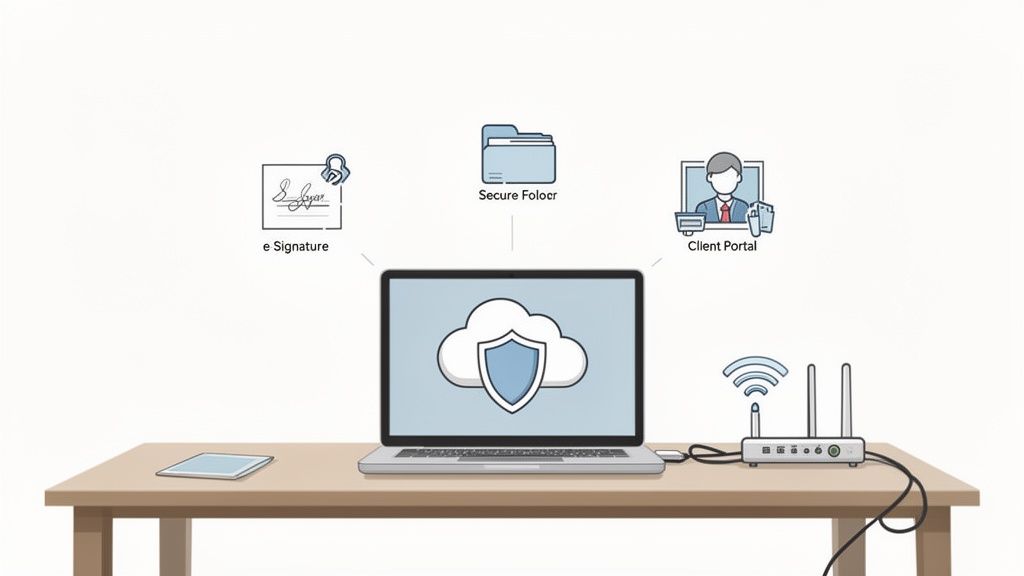
Forget those endless "Top 50" software lists. Most of that is bloat you’ll pay for and never use. When you’re running a law practice from home, your tech isn't just a set of tools—it's your entire office. It's your file room, your conference table, and your front door. It needs to be lean, secure, and absolutely bulletproof.
I’ve made the expensive mistakes so you don't have to. The goal isn't to have the most tech; it’s to have the right tech that works so seamlessly you forget it’s even there.
Here’s the no-fluff breakdown of what a modern, remote law practice truly needs to function.
| Tool Category | Top Contenders | Why It's Non-Negotiable |
|---|---|---|
| Practice Management | Clio, MyCase, PracticePanther | This is your firm's central nervous system. It connects client files, calendars, timekeeping, and billing. Running a practice without one is just malpractice waiting to happen. |
| Client Intake & CRM | Lawmatics, Clio Grow | Automates the messy process of turning a lead into a client. It stops people from falling through the cracks and makes you look like a pro from day one. |
| E-Signatures | DocuSign, HelloSign | Turns a week-long paper chase for an engagement letter into a ten-minute task. It provides a legally-binding, auditable trail for anything that matters. |
| Cloud Storage | Google Drive, Dropbox for Business | While your practice management software handles case files, you still need a secure place for business docs, templates, and marketing stuff. Get one with real security features. |
| Accounting Software | QuickBooks Online, Xero | Essential for managing money, tracking expenses, and handling trust accounting correctly. It integrates with most practice management systems, saving you from double-entry hell. |
This table covers your core needs. Start here, get comfortable, and then you can go chasing shiny new objects.
This is your anchor. If you're trying to patch together a system with Dropbox, Excel, and a prayer, you're not just being inefficient—you're being reckless.
A solid, cloud-based practice management system is the single source of truth for your entire firm. It’s where you manage clients, organize files, track your time, and send bills.
While platforms like Clio, MyCase, and PracticePanther are popular for a reason, you need to look past the marketing fluff. A slick interface can hide clumsy workflows or surprise fees. If you're weighing your options, our guide to the best legal case management software breaks down the pros and cons without the sales pitch.
The days of printing and mailing engagement letters are dead. For a remote practice, a smooth digital experience isn't a "nice-to-have"—it's the bare minimum.
Your client’s first impression of your firm is no longer your fancy lobby; it's your intake form and your client portal. If it's clunky, confusing, or looks sketchy, they'll assume your legal work is, too.
Now for the part everyone wants to ignore. That free router your internet provider gave you? It’s a liability. Your home network is now your firm's network, and you have an ethical duty to protect every byte of client data that passes through it.
Welcome to your new side hustle: part-time IT director.
Securing your network isn't rocket science, but it does require a few deliberate steps. At a minimum, you need to:
Choosing your tech is about making smart, deliberate choices that support how you want to practice. Start with these fundamentals, and you'll have a foundation that's more secure and efficient than the corner office you left behind.
The old playbook is dead. Forget sponsoring a hole at the local golf tournament or shaking hands at chamber of commerce mixers. When your office is your kitchen table, that whole strategy goes right out the window.
So, how do you actually land high-value clients without a physical address? You stop thinking like a local lawyer and start acting like a digital-first authority. It's not about being in the same room anymore; it’s about being the smartest voice in the online rooms where your ideal clients already live.
This is your new client acquisition bible. Time to unlearn everything you weren't taught about marketing in law school.
Let’s be brutally honest. If you market yourself as a "general practice attorney" online, you're basically screaming into the void. Trying to be everything to everyone means you're nothing special to anyone. The internet rewards specialists. Period.
Instead of casting a wide, ineffective net, find your specific pond and own it.
Pick a specific problem that plagues a specific type of person. This focus instantly sharpens your marketing and makes you the obvious choice for clients with that exact pain point. They won’t just be looking for an attorney; they'll be looking for you.
Here’s the secret weapon for every work-from-home attorney: content. You build trust and showcase your authority by answering your ideal client's most pressing questions before they even think about hiring you. This isn't about running cheesy ads; it's about being relentlessly helpful.
Think about what keeps your ideal client up at night. What are they frantically Googling at 2 AM? Your job is to create articles, short videos, or LinkedIn posts that answer those exact questions.
Your marketing goal is to become the go-to resource in your niche. When a potential client has a problem, your name should be the first one that comes to mind because you've already given them so much value for free.
This isn’t a quick fix. It's a long-term strategy that builds a powerful, sustainable client pipeline. You're not chasing leads; you're creating an ecosystem where the best leads come directly to you.
Once a potential client finds you, the experience has to be absolutely seamless. Nothing kills a great lead faster than a clunky, confusing intake process. Your digital front door needs to feel just as professional as any mahogany-trimmed corner office.
Here's a workflow that just plain works:
This isn't just about efficiency. It's about signaling that you are a modern, organized professional they can trust. A key challenge for any virtual practice is figuring out how to get law firm clients online, and a smooth intake process is a massive piece of that puzzle. It turns a curious stranger into a paying client who feels confident they made the right choice.
Let's have a frank conversation about the billable hour. For many attorneys, it feels like the only way, but in a remote setting, it’s a broken model. It’s a relic that actively works against efficiency and penalizes the very expertise your clients are paying for.
When you're a work at home attorney, your value isn't measured by how long you sit in a chair; it’s measured by the outcomes you produce. Clinging to the billable hour after you've cut the cord on a physical office is like paying rent on a conference room you never use. It's insane.
This is your chance to completely re-engineer your firm's financial engine. We’re moving from selling time to selling solutions. When you make that shift, you're not just changing how you get paid—you're fundamentally improving the attorney-client relationship.
Alternative Fee Arrangements (AFAs) aren't some trendy new concept, but they are tailor-made for the modern remote lawyer. This approach forces you to stop thinking like an employee punching a clock and start thinking like a business owner who sells a product. And your legal service is the product.
Why is this so critical for a remote practice? Because when you strip away the overhead and visual cues of a traditional firm—the mahogany desk, the law library—your value is distilled down to its purest form. Clients aren't paying for your impressive office lease; they are paying for your brain.
Here are a few models that I've seen work incredibly well:
The psychology here is powerful. With AFAs, you stop having to justify your existence with a six-minute increment timesheet. Instead, you're selling a solved problem, peace of mind, and a predictable cost. That is a value proposition clients can get excited about.
The simplified funnel below shows how you can attract and convert clients who are a great fit for this modern approach.
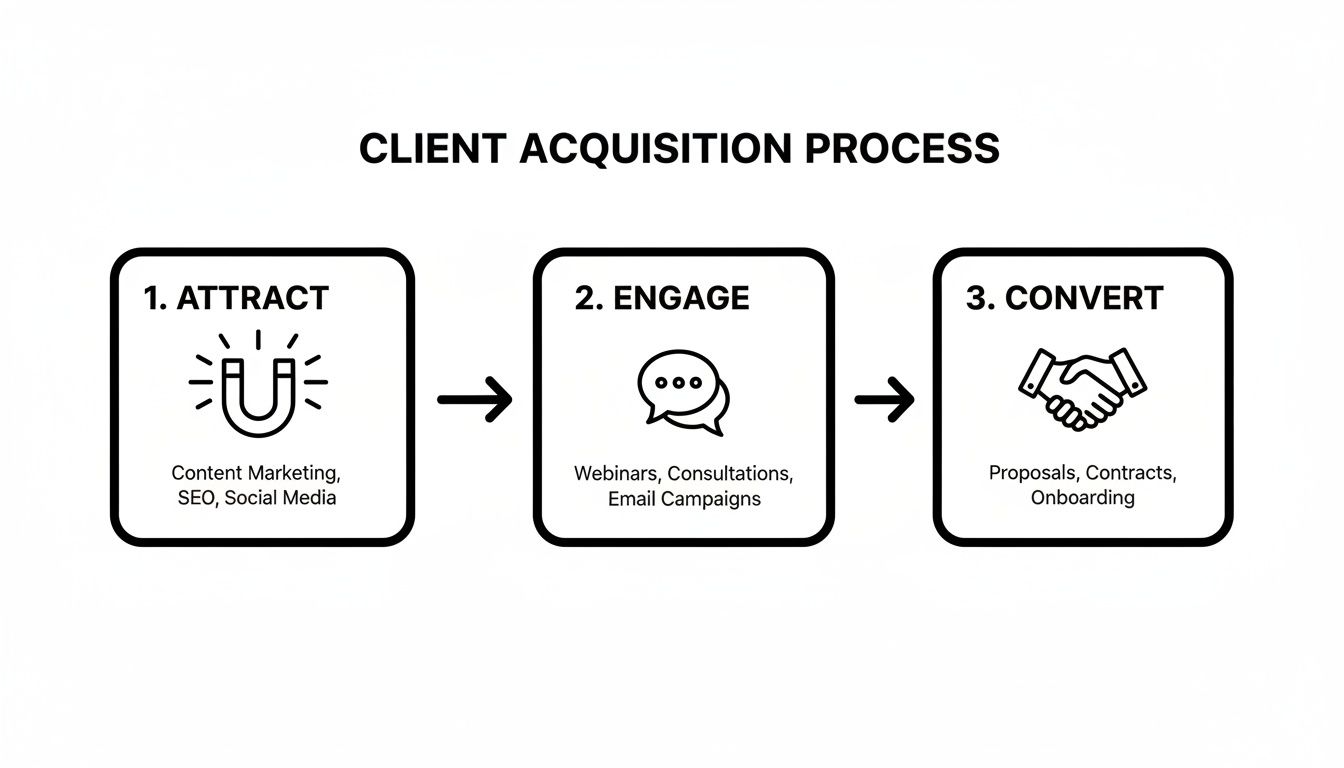
This process works because a value-based model puts the focus on clear outcomes from the very first conversation, simplifying the journey from a prospect to a signed client.
Once you've nailed down how you'll charge, you need a dead-simple way to get paid. I hope you don't enjoy chasing down checks and making trips to the bank, because that's a surefire way to squander the time you saved by going remote.
Your billing system has to be as modern as the rest of your practice. This means online invoicing and accepting credit card or ACH payments as standard. It's not a perk; it's a basic operational requirement.
Platforms like Stripe or the legal-specific LawPay integrate with most practice management software, letting you send a secure payment link right in your invoice email. The easier you make it for clients to pay you, the faster you get paid. It's that simple. In fact, studies show that law firms accepting online payments get paid 39% faster on average.
A modern payment process is key to building a stable cash flow. It’s what allows your remote practice to stop just surviving and start truly thriving.
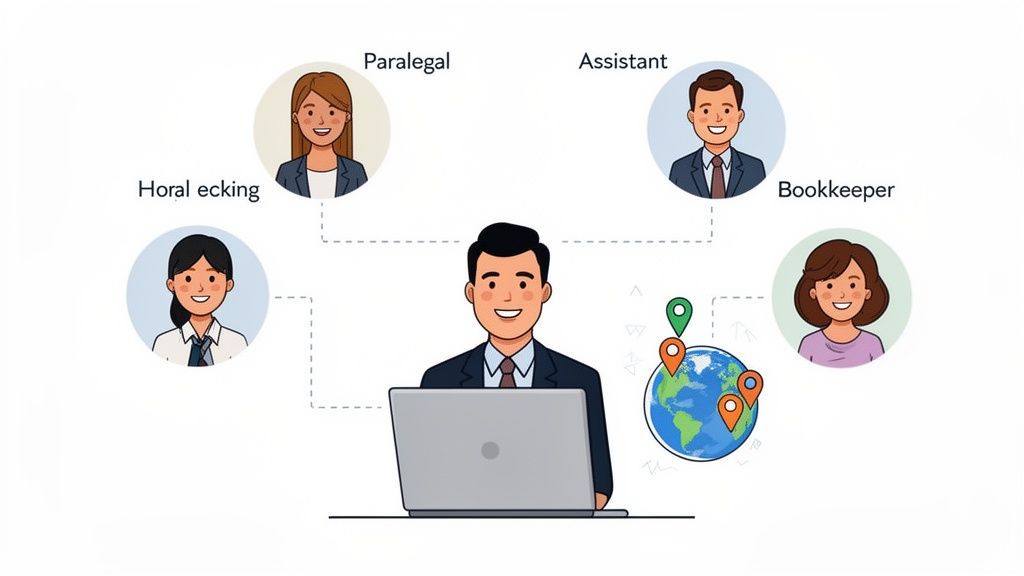
Here’s a hard truth: trying to do everything yourself isn't a badge of honor. It’s a one-way ticket to burnout. You didn't escape the tyranny of the billable hour just to become your own worst administrative assistant.
The real magic of a remote practice isn't just saving on rent; it's about leverage. Your talent pool is no longer confined to a 30-mile radius. It’s global. This is the moment you stop trading your time for money and start building a real, scalable business.
Forget everything you know about traditional hiring. Posting a job, sifting through a mountain of resumes, and conducting endless interviews… Hope you enjoy spending your afternoons fact-checking resumes and running interviews—because that’s now your full-time job.
That entire process is a soul-crushing time suck designed for companies with HR departments. For a solo attorney, it’s administrative quicksand.
You don't need employees in the traditional sense. You need on-demand access to vetted, experienced talent who can plug into your practice and start delivering value from day one. This isn't about filling a seat; it's about buying back your time.
Instead of moonlighting as a recruiter, your focus should be on your legal work. The smart move is to tap into specialized platforms that have already done the heavy lifting for you. (Yes, full disclosure, that's what we do. Toot, toot!)
Think of it this way: you wouldn't represent yourself in a complex trial, so why would you try to navigate the complexities of international hiring on your own?
A quality talent platform should handle the essentials:
This shift in mindset is powering massive growth for remote-first firms. Just look at Rimon Law, a virtual firm that saw its attorney headcount surge 16% in 2023. Their secret? They treat their attorneys like internal clients, providing robust back-office support—including recruiting and HR—which lets their legal team focus on what they do best.
So, you've hired a remote paralegal. Now what? How do you manage them without hovering? It all comes down to two things: clear systems and radical trust.
First, you need a bulletproof delegation workflow. Document your processes. A simple screen recording using a tool like Loom showing how you want a document filed is worth a dozen emails. Project management boards like Trello are your new best friends.
Second, communication has to be intentional. Daily check-ins via Slack or a quick morning video call can replace the casual "drive-by" conversations of a physical office. Set clear expectations for response times. A well-managed remote team often communicates more effectively than an in-person one because every interaction has a purpose.
If you're just starting, our guide on how to onboard remote employees is a great place to start building your own workflow.
This isn't just about saving money. It's about fundamentally changing how you operate. It’s about building a lean, efficient machine that allows you, the attorney, to spend your precious hours on the high-value work that actually moves the needle.
Alright, let's get into the part of running a virtual law firm that can feel a bit scary: the rules. Going remote doesn't mean you get a pass on your ethical obligations. If anything, it makes them even more critical. This isn’t some abstract concept from your Professional Responsibility course—this is the framework that protects your clients, your reputation, and your license.
In a traditional office, the physical environment did a lot of the heavy lifting. You had locked doors and secure file rooms. When you work from home, you have to build that secure environment yourself.
Client confidentiality is the absolute cornerstone of our profession. In an office, you just shut the door. At home, potential pitfalls are everywhere—from a family member overhearing a sensitive call to your smart speaker picking up privileged details.
This isn't about being paranoid; it's about being prepared.
The professional standard requires you to take "reasonable efforts" to protect client information. In a remote work context, "reasonable" means you're actively anticipating and preventing potential breaches. Your convenience can never outweigh your duty of confidentiality.
The state bars are slowly adapting to virtual law practices, but many rules still feel like they were written for a different century. It's 100% your responsibility to understand the regulations in every jurisdiction where you are licensed and where your clients are located.
Advertising is a common tripwire. Your website and social media profiles are all considered advertisements. They must be completely transparent about your physical location (or lack thereof) to avoid misleading a potential client. To build that essential client trust, implementing robust client data privacy best practices is fundamental for any modern virtual firm.
The Unauthorized Practice of Law (UPL) also gets much more complicated when your client is hundreds of miles away. Make sure you have a rock-solid understanding of the UPL rules for any state you're targeting. Pleading ignorance won't work as a defense; it’s a direct path to a malpractice claim. Getting compliance right isn’t just about avoiding a slap on the wrist—it’s about building a sustainable practice on a foundation of integrity.
Look, I get it. Trading a predictable office for your kitchen table feels like a huge leap. You’ve got questions—the practical, nitty-gritty ones that go beyond the usual fluff. Let's tackle some of the tough stuff you’re probably thinking about right now.
Absolutely, but not if you try to replicate your old firm's model. Success as a work-from-home attorney isn't about being a solo island; it’s about smart leverage.
The attorneys who fail are the ones who try to do everything themselves. The ones who thrive build systems and hire remote support to handle the administrative drag that kills profitability. You need to stop thinking like an employee and start acting like a CEO from day one.
It's different, not harder. You can't rely on a fancy lobby or a Main Street address to signal credibility anymore. Your "office" is now your website, your LinkedIn profile, and the quality of your content.
High-value clients are looking for expertise, not a mahogany desk. By niching down and proving your authority online, you can attract better clients than you ever did waiting for referrals to trickle in. They come to you because you're the expert, not because you're conveniently located downtown.
The big secret? Your biggest marketing asset isn't a fancy ad budget; it's your brain. Generously sharing your expertise online builds trust at a scale no physical office ever could.
They undervalue their services. When you strip away the massive overhead of a traditional firm, there's a temptation to immediately slash your rates. Don't. Do. It.
You should be pricing based on the value and outcome you deliver, not on your lower expenses. Cutting your fees is a race to the bottom that signals a lack of confidence. Instead, keep your rates premium and reinvest a portion of that saved overhead into better technology and smarter marketing to create a superior client experience.


