 19 minutes read
Let's be real. Can you even hire remote legal staff without your state bar having a complete meltdown?
Short answer: Yes, it’s 100% legal. But—and this is a big but—it’s like disarming a bomb. If you don't know exactly which wires to cut, things are going to get messy. We’re talking unauthorized practice of law, gnarly employee classification battles, and a whole lot of compliance traps you never saw coming.
Turns out there’s more than one way to hire elite legal talent without mortgaging your office ping-pong table. The firms winning at this aren't just getting lucky; they're treating remote hiring like a high-stakes M&A deal. They're obsessed with a few key areas:

Look, you can't eliminate risk. That’s a fantasy. The goal is to get so good at spotting the risks that you defuse them before they even become a problem. It's about being proactive, not cleaning up a mess later.
This guide is your brutally honest look at the real-world dangers of UPL, employee misclassification, and the beautiful chaos of cross-border hiring.
Think of this as the pre-flight checklist you desperately need before you even think about posting that job ad. We’re not here to sugarcoat it. We’re here to arm you with the intel to hire confidently and compliantly from day one.
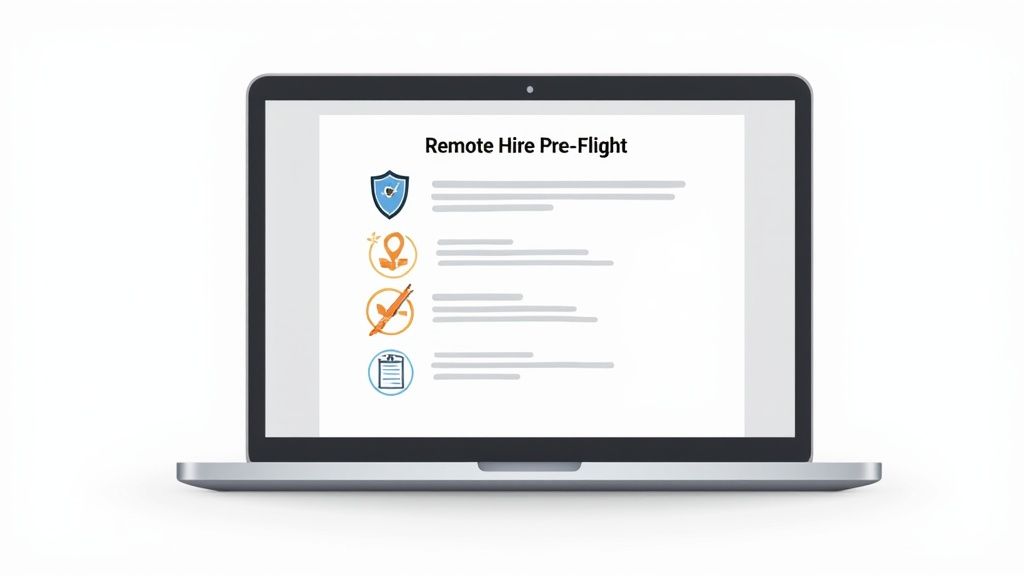
To do this right, you have to burn your old assumptions. This isn't 2010. The table below breaks down the biggest legal hurdles, contrasting the old-school, risky way of thinking with the sharp, modern strategy you need now.
| Legal Risk Area | The Outdated (and Dangerous) Approach | The Modern Compliant Strategy |
|---|---|---|
| Unauthorized Practice of Law (UPL) | "They know not to give legal advice." (AKA, hope as a strategy) | Ironclad contracts and task-based workflows that leave zero ambiguity. |
| Employee Classification | "Let's just call everyone a contractor. It's easier." | A rigorous, fact-based analysis of control and independence. No shortcuts. |
| Data Security & Confidentiality | "Our standard confidentiality clause is probably fine." | Mandatory, non-negotiable security protocols and device policies. Period. |
Nailing these isn't just about dodging fines; it’s about building a scalable, kick-ass remote team that becomes a genuine competitive advantage. It takes work, but the payoff is access to a global talent pool that your competitors are too scared to touch.
Alright, let's talk about the boogeyman in the room: the Unauthorized Practice of Law, or UPL. For most managing partners, this is the monster that keeps all the work locked inside the office walls. The fear? A remote paralegal, miles from supervision, accidentally gives legal advice and brings the whole firm down.
It’s a valid fear. It’s also completely misunderstood.
Here’s the truth: UPL has nothing to do with geography. The risk isn’t about whether your paralegal is in the next room or the next time zone. It’s about one thing and one thing only: the nature of the tasks they perform.
This isn't some fringe theory. It’s a reflection of how work gets done now. The legal services industry is seeing a massive shift to remote work. You can see it in the latest remote work statistics—we’re not the exception anymore.
A bulletproof UPL strategy is built on a single, bright line: the one separating administrative support from the actual practice of law. One side is safe for your remote team; the other is a minefield. Your job is to build a firewall between them.
Think of it like a surgeon and a surgical tech. The tech is critical. They set up the OR, hand over the right instruments, and keep things running. But the second they try to make an incision or offer a diagnosis, they've crossed a massive legal and ethical line.
Same deal with your remote legal team. Their job is to support the attorney, not to be the attorney.
Here’s the rule: If a task requires independent legal judgment, an attorney does it. If it's a procedural, administrative, or research task done under an attorney's direct supervision, it's perfect for a skilled remote paralegal. Simple.
So what does this look like in the real world? It's less about memorizing bar rules and more about building a dead-simple playbook. You can't just hire someone and hope they know where the lines are. You have to draw them in permanent marker.
Here’s a practical breakdown of tasks, split into "go for it" and "don't you dare" categories for your non-attorney staff.
By creating and ruthlessly enforcing these boundaries, you neutralize the UPL risk. It's not about handcuffing your team; it's about empowering your attorneys to focus on the high-value work only they can do.
Ah, the 1099 contractor. The siren song of simplicity. No payroll taxes, no benefits, no messy HR paperwork. Just find a great remote paralegal, send them money, and get back to winning cases. Right?
Wrong. That "shortcut" is one of the oldest—and most dangerous—traps in the book.
Misclassifying an employee as a contractor isn't a whoopsie. It's a high-stakes gamble that invites the IRS and the Department of Labor to come knocking, ready to hit you with back taxes, fines, and penalties that can cripple your firm. And with remote work, the lines get even blurrier.
Let’s cut the fluff. The government doesn’t care what you call someone in your contract. They care about one thing: control.
The question is always the same: Who dictates how, when, and where the work gets done? Your answer determines everything.
Forget the 20-factor IRS test. It boils down to a few gut-check questions:
If you just nodded your head to most of that, you’ve got an employee. Calling them a 1099 is a ticking time bomb.
With remote work, the temptation to go 1099 is huge. But the legal reality is stark. The big mistake isn't hiring a contractor; it's treating them like an employee.
Think of it this way: A contractor is a separate business you hire to provide a service. An employee is an integrated part of your business. If you're providing the laptop, the software licenses, and the daily to-do list, you're not hiring a contractor—you're hiring an employee and trying to skip the hard parts.
This decision tree shows the real distinction. It’s not about location; it’s about control.
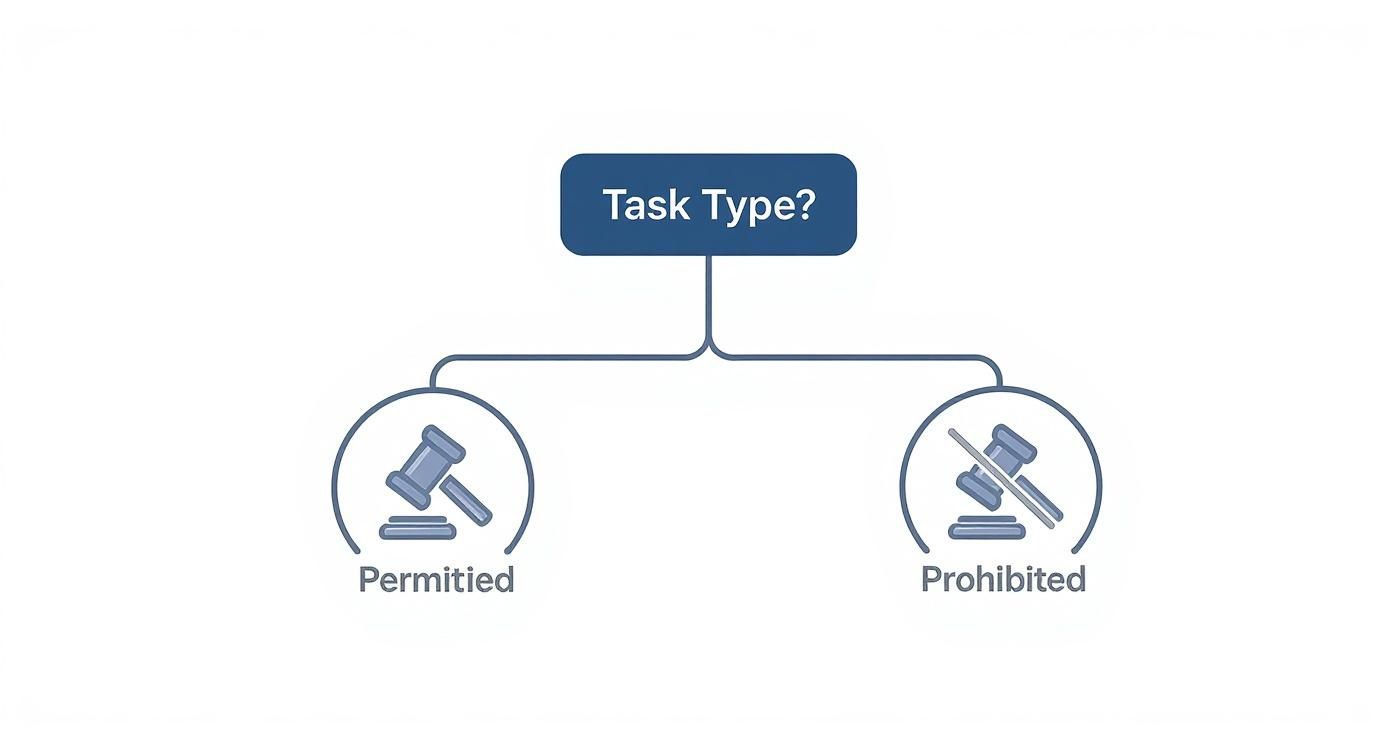
The key takeaway? Both permitted and prohibited tasks can be done remotely. The classification all comes down to how much you're managing the person versus managing the work product.
Getting this right isn't about legal theory; it's about setting clear operational boundaries from day one. If you truly want to hire a freelancer, you have to treat them like one. And that means giving up a level of control that makes most managers twitch.
Your checklist for a legit 1099 relationship:
This is a minefield, especially as firms build blended teams. For a deeper dive, our guide on what is contingent workforce management is essential reading. It's how modern firms scale without walking into a labor law buzzsaw.
So, you found a rockstar remote paralegal in Bogotá. They’re sharp, experienced, and ready to go. Awesome. Now what? If your plan involves just wiring them money every two weeks, you’re about to get a very expensive education in international compliance.
Hiring across borders isn't a minor tweak. It's a different sport with a different rulebook. Suddenly you're juggling foreign tax laws, mandatory bonuses, and labor codes you've never even heard of.
The explosion of online hiring has made global talent more accessible than ever—you can see these remote work trends here. But it also means more firms are sprinting headfirst into these challenges completely unprepared.
Let's get tactical. You have three ways to bring on talent from Latin America. Picking the wrong one is like showing up to a gunfight with a spork.
Direct Hire: You set up your own legal entity in their country and handle everything yourself—local payroll, taxes, benefits. It gives you total control, but it's wildly expensive and slow. Unless you're building a whole office there, this is insane overkill.
Independent Contractor: This looks like the easy button, but it's a trap. Misclassifying an employee in another country carries all the same risks as doing it here, plus the fun of an international labor dispute. Tread carefully.
Employer of Record (EOR): This is the answer. You partner with a company that legally employs the person on your behalf. They handle all the local HR, payroll, and compliance nightmares. You just manage the work. It’s the fastest, cleanest, and safest route.
We tried the contractor route. It was a disaster of weird invoices, currency conversion fees, and a constant, low-grade fear of breaking a law we didn't know existed. Switching to an EOR wasn't just better; it was a sanity-saver. It lets us focus on the work, not the paperwork.
Hiring in Latin America is not like hiring in the U.S. Labor laws are way more employee-friendly. If you think you can just offer a base salary and call it a day, you’re in for a shock.
You need a plan for a few key things:
This isn’t about being negative; it's about being a grown-up. The talent in Latin America is incredible. But tapping into it means respecting the local rules. Get it right, and you’ve unlocked a massive competitive advantage. Get it wrong, and you've just paid for a very expensive lesson in international law.
Let's be blunt: a data breach can kill your firm faster than a bad verdict. Back in the day, your security perimeter was the front door. Now, it's every single home Wi-Fi network, personal laptop, and cloud app your team uses.
Terrifying, right? Your reputation and your ethical duty to protect client data are on the line. But here’s the good news: building a secure remote setup isn't about buying a bunch of complex tech. It's about establishing a few powerful, non-negotiable rules that become part of your firm's DNA.
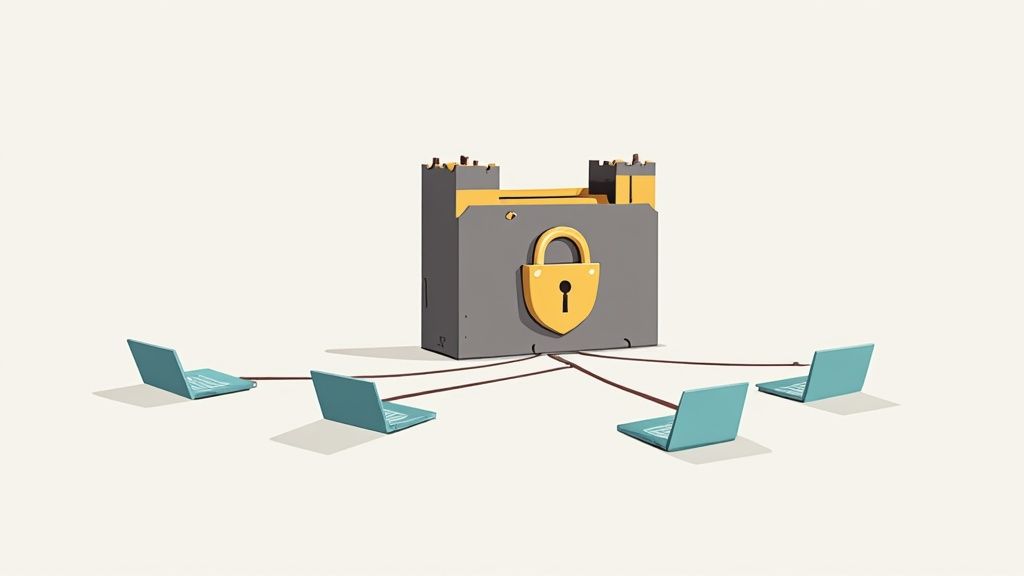
Forget the jargon. Real security comes down to controlling three things: how people connect, what devices they use, and who can access what. Get these right, and you've solved 90% of the problem.
The Connection: Someone logging in from a coffee shop's public Wi-Fi is a nightmare. Mandatory VPN (Virtual Private Network) usage is the absolute, no-exceptions baseline. A VPN creates a secure, encrypted tunnel from their device to your network. No VPN, no work. It’s that simple.
The Device: Personal laptops are a cesspool of security risks. You have no idea what malware is lurking on there. The gold standard is firm-owned, managed devices that you control. If that's not possible, a strict Bring-Your-Own-Device (BYOD) policy with mandatory antivirus and remote-wipe capability is the next best thing.
The Access: Don’t give a junior paralegal the keys to the kingdom. Implement the Principle of Least Privilege. This just means everyone only has access to the specific files and systems they absolutely need to do their job. This one move dramatically limits the damage if an account gets compromised.
You wouldn't give every employee a master key to the office, would you? So why give them universal access to every client file? Apply the same real-world logic to your digital world.
Your tech is only half the solution. Your operational rules are just as critical. Properly handling sensitive data is a core competency, not an afterthought. For a deeper look at building this out, check out our best practices on how to handle confidential information.
Think about it—the nature of online legal jobs is changing. Your team needs to be fluent in a whole new set of digital tools, and your security protocols have to keep up.
Overwhelmed? Don't be. Start here:
Building your own Fort Knox isn't about buying fancy tech; it's about smart, simple rules that everyone follows, every time. That's the difference between a minor hiccup and a firm-ending catastrophe.
Alright, enough theory. We’ve covered the risks and the rules. Now, let’s get down to brass tacks. You’re ready to hire a remote paralegal, but what do you actually do next?
This is the step-by-step checklist I wish someone had given me years ago. This is how you go from anxious and guessing to confidently bringing on a killer remote team member who makes an impact on day one.
Before you even think about an interview, you set the stage for compliance. Your job description isn’t just marketing; it’s your first line of defense.
Write a UPL-Proof Job Description: Be painfully specific. List the exact tasks: "Prepare initial drafts of discovery requests for attorney review." Then, state what they won't do: "This role does not involve providing legal advice or making strategic case decisions."
Vet for Remote Readiness, Not Just Skills: An in-office superstar can be a remote train wreck. Screen for self-discipline, proactive communication, and tech savvy. Ask questions like, "Tell me about a time you had to solve a technical problem on your own, under a deadline." Their answer tells you everything.
Your contract is your rulebook. A flimsy agreement is an invitation for disaster. It needs to be an ironclad document with zero room for interpretation.
Don't you dare download a generic contractor template off the internet. That’s the legal equivalent of using duct tape on a cracked foundation. Invest the time to get this right.
Your agreement must cover:
Getting the contract signed is just the start. How you bring them into the fold determines if they sink or swim. Those first few weeks are critical for setting expectations and integrating them into your firm's culture.
A sloppy onboarding is the fastest way to lose a great remote hire. For a detailed playbook, check out our guide on how to onboard remote employees. It’s full of the small details that make a massive difference.
Following this checklist transforms remote hiring from a source of anxiety into a strategic advantage. It’s not about finding loopholes; it’s about building a robust system that lets you access top-tier talent, wherever they are.
I get it. Even with the playbook, you've probably still got a few nagging questions. Let's hit the big ones we hear from managing partners who are still on the fence.
Are you kidding? Small firms stand to gain the most. It's a total game-changer.
Imagine needing an immigration paralegal with deep expertise in one specific visa type. Instead of being stuck with your local talent pool (and a full-time salary), you can find that specialist anywhere and hire them for exactly what you need. It completely levels the playing field, giving you access to talent that was once reserved for the big guys.
Fair question. The answer comes down to two things: ruthless vetting and active supervision.
First, your vetting process has to be relentless. This is non-negotiable. At HireParalegals, for example, we put every candidate through a rigorous four-step screening to validate their skills before you ever see a resume. (Toot, toot!) This weeds out most of the risk from the start.
Second, the supervising attorney is always the captain of the ship. Their remote status doesn't change your ethical duty to review their work. Your final review is the ultimate safety net, whether they're in the next office or the next country.
Let me be blunt: if your first thought is to track keystrokes and monitor screens, you've already lost. You’ll just become a digital babysitter instead of a lawyer.
The true measure of productivity isn't hours clocked; it's work completed. The best remote relationships are built on trust, clear expectations, and tangible results.
Shift your focus from activity to outcomes. Set concrete deadlines for tasks: "Draft initial discovery for the Smith case by EOD Wednesday." "Summarize the three depositions in the Jones file by Friday."
A true pro will hit those deadlines with high-quality work without you breathing down their neck. If they don't, you don't have a "remote work problem"—you have a performance problem. The best people thrive on this kind of trust and autonomy.