

 19 minutes read
You need legal help, and you needed it yesterday. Welcome to the Dallas legal staffing maze. It's a confusing landscape where every turn seems to lead to either a soul-crushing fee or a stack of questionable resumes. For Dallas-area law firms, the choice generally boils down to three paths: the old-school agency, the "try-before-you-buy" temp, and the modern on-demand platform.
Let's cut through the noise.
You're buried in discovery, and your go-to senior paralegal just put in their two weeks' notice. The familiar panic starts to creep in. You need skilled, reliable help, but diving into the Dallas hiring market feels about as appealing as prepping for another bar exam.
Let's be real—most of the available options are broken. You could dial up a traditional recruiter, brace yourself for a fee that could buy a decent used car, and then wait weeks for a shortlist of candidates they probably just scraped from LinkedIn. You know, the same place you would have looked first.
Or you could roll the dice with a temp-to-hire, crossing your fingers that the person who walks through the door can actually handle the workload without constant supervision. It's a gamble where your firm's billable hours are the stakes.
This decision tree maps out the common routes Dallas firms take when the pressure to hire is on.
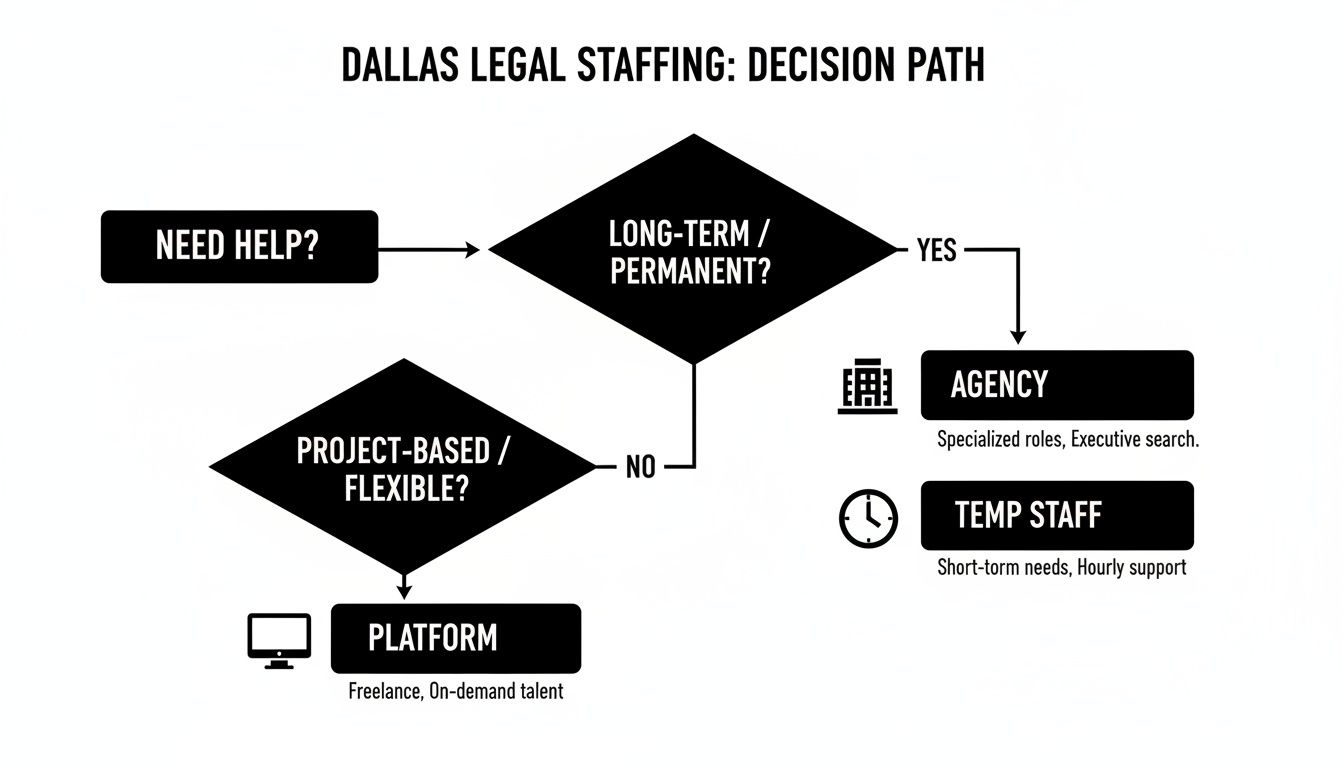
As the flowchart shows, the right approach isn't about defaulting to old habits. It’s about letting your firm's specific need—whether it's for a long-term role, a single project, or an urgent gap—guide your staffing strategy.
To help you see the differences more clearly, here’s a side-by-side comparison of the three main models. We're looking at the factors that matter most to a busy Dallas law firm: speed, cost, flexibility, and the quality of the talent pool.
| Factor | Traditional Agency | Temp-to-Hire | On-Demand Platforms |
|---|---|---|---|
| Speed to Hire | Slow (Weeks to months) | Moderate (Days to weeks) | Fast (Hours to days) |
| Cost Structure | High upfront placement fees (20-30% of salary) | Agency markup on hourly rate, plus conversion fee | Transparent hourly or project rates; no placement fees |
| Flexibility | Low; focused on permanent placements | Moderate; allows for a trial period before hiring | High; designed for project-based and short-term needs |
| Talent Pool | Established network but can be limited | Varies; often includes candidates between permanent jobs | Curated network of pre-vetted, experienced professionals |
| Admin Burden | High (interviews, onboarding) | Moderate (agency handles payroll, but firm manages) | Low (platform handles vetting, payroll, and admin) |
Each model has its place, but the table makes it pretty clear why on-demand platforms were built to address the agility and cost-efficiency that modern law firms demand.
The truth is, each model serves a purpose, but they come with vastly different price tags, timelines, and administrative headaches. And the demand for legal talent isn't slowing down. As of spring 2024, Texas employed over 104,000 people in legal services, a reflection of a boom that puts immense pressure on Dallas firms to find and hire quality candidates quickly.
Here’s the unfiltered breakdown of your choices:

This is about transforming hiring from a massive capital expense into a flexible, operational one. The goal is a solution that's not just faster and more cost-effective, but one that truly fits how law firms work today.
Ultimately, this decision isn't just about filling a seat. It's about finding a model that aligns with the fluid, project-based nature of modern legal work. Learning how to manage this new blend of permanent staff and flexible talent is a critical skill for growing firms. For a closer look at this strategy, see our guide on what contingent workforce management means for today's law practices. It's time to find a solution that actually supports your bottom line.
Let’s talk about the elephant in the room: the astronomical fees charged by traditional Dallas legal staffing agencies. They promise you the perfect candidate, slide a decent-looking resume across the table, and then hit you with an invoice that makes you wince.
It’s time to pull back the curtain on that industry-standard fee structure. You know the one I’m talking about.
The $21,000 Handshake.
That gut-punch of 20-30% of a candidate's first-year salary. Let that sink in. You decide to hire a talented paralegal at a competitive Dallas salary of $70,000. Before they’ve even learned where the coffee machine is, you’re cutting a check to the recruiter for up to $21,000. For what, exactly? An email introduction and a PDF they probably found on LinkedIn last week.
Is a recruiter’s contact list really worth more than a new associate’s signing bonus? That's a question more firms in Dallas need to start asking.
That huge check isn't just a "finder's fee"—it's an anchor dragging down your firm's finances. It's capital you could have plowed back into marketing, new case management software, or mortgaging your office ping-pong table. It represents the opportunity cost of clinging to a hiring model that's long past its prime.
But the sticker shock is just the beginning. The hidden costs are what really bleed your firm's momentum dry.
The real cost isn't just the fee; it's the momentum you lose. It's the cases that stall and the team that burns out while you wait for a candidate who may or may not be the right fit.
This isn't just a hunch; the entire legal staffing world is shifting beneath our feet. What was once a niche, relationship-driven business has exploded into a major commercial sector. The U.S. legal staffing market hit an estimated $1.53 billion in 2023 and is still climbing.
More importantly, how firms find talent is changing dramatically. The share of legal hires made through modern talent platforms is projected to jump from 18% to 27% in just two years. Why? Because firms are waking up to the fact that there are smarter, more efficient ways to build their teams. You can read more about the trends shaping legal staffing on Regentsrs.com.
Ultimately, clinging to the old way of hiring isn’t just expensive—it’s a strategic disadvantage. In a competitive legal market like Dallas, speed and agility are everything. The real question is, can your firm afford to keep paying for yesterday’s solution to solve today’s problems?
So, you've decided to handle the hiring yourself. A bold move. Hope you enjoy spending your afternoons fact-checking resumes and running interviews—because that’s now your full-time job. Sourcing and vetting legal talent in a competitive market like Dallas can quickly pull you away from billable work. It’s a grind.
This isn't about simply matching keywords on a resume to a job description. This is about how to genuinely evaluate a legal professional without losing your sanity. Before you can vet anyone, though, you need a solid pool of candidates. Great Dallas legal staffing starts with smart sourcing, so it’s worth brushing up on modern candidate sourcing strategies before you even think about posting that job opening.
Once the resumes start rolling in, the real work begins.
A polished resume is just the price of admission. It tells you what a candidate claims they can do, not what they've actually accomplished. Your job is to dig deeper to find the true performers among the professional interviewees.
Your goal is to uncover three critical things:
Stop asking tired questions like, "What's your biggest weakness?" You’ll get a canned answer, and it’s a waste of everyone's time. Instead, treat the interview like a practical exercise by running candidates through real-world scenarios they would actually face at your firm.
For more ideas on how to do this effectively, our guide on the best legal assistant interview questions can help you get real answers.
The point of an interview isn't just to hear the right answers; it's to see how a candidate thinks. Give them a hypothetical problem and watch them work through it. That’s how you spot your next great hire.
Ask them to walk you through a complex case they previously managed. What were the challenges? How did they organize discovery? Who did they have a conflict with, and how did they resolve it? The stories they tell—or the lack thereof—will reveal more than any rehearsed answer ever could.
To help structure your process, here's a checklist to keep you focused on what really matters when evaluating talent in the Dallas legal scene.
| Vetting Stage | Key Action | Essential Question to Ask |
|---|---|---|
| Resume Screen | Verify specific software and procedural skills mentioned. | "Does their experience directly align with our core practice areas and daily software use?" |
| Initial Call | Assess communication style and baseline interest. | "Why our firm specifically? What about this role caught your attention?" |
| In-Depth Interview | Present a real-world, hypothetical case problem. | "Walk me through how you would tackle this situation from start to finish." |
| Skills Test | Assign a short, practical task (e.g., proofread a document). | "Can they demonstrate the attention to detail required for this job?" |
| Reference Check | Go beyond confirming employment dates. | "Can you share an example of a time they handled high-pressure feedback?" |
Using a structured approach like this ensures you're comparing apples to apples and making a decision based on evidence, not just a gut feeling.
Finally, never, ever skip the reference checks. Don't just ask if they are eligible for rehire. Ask pointed questions that get you meaningful information, like, "What's one thing I'd need to know to manage this person effectively?" or "Can you give me an example of a time they went above and beyond without being asked?"
Sometimes, the hesitation on the other end of the line is more telling than the praise.
So, you’ve found the perfect freelance paralegal. You’re ready to hand off that chaotic case file and finally breathe. But wait. Before you can celebrate, the not-so-fun questions pop up. Who’s getting their W-9? Are you positive they qualify as a 1099 contractor?
Welcome to the administrative side of direct hiring. It’s the part of Dallas legal staffing that can quickly turn into a nightmare, especially when you get a notice from the Texas Workforce Commission.
This isn't just about filling out a few forms; it's a compliance landmine. And misclassifying an employee as an independent contractor is one of those classic mistakes that can cost you dearly.
In Texas, the line between a W-2 employee and a 1099 contractor can feel a bit fuzzy, but state regulators see it in black and white. If you get it wrong, you could be facing back taxes, steep penalties, and a whole lot of unwanted attention.
Here’s a quick gut check: If you are the one dictating how and when the work is done, providing the necessary tools, and setting their schedule, you probably have a W-2 employee. It doesn't matter what your contract says. Trying to force them into a 1099 category because it seems simpler is a recipe for disaster.
The administrative burden doesn't stop at classification. It's a relentless cycle of payroll taxes, liability insurance, and endless forms that land squarely on your desk—the one already overflowing with actual legal work.
When you hire a freelancer directly, you essentially become a mini-HR department. You're suddenly on the hook for withholding taxes, dealing with benefits (if any), and making sure every single hour is tracked and paid correctly. To keep compensation accurate and billing compliant, many firms turn to specialized time tracking software for lawyers, which just adds another system for you to manage.
Just think about the non-billable hours you’ll spend chasing invoices, wrestling with withholding calculations, and trying to keep up with ever-changing labor laws. It's an administrative black hole that sucks you away from what you actually need to be doing: practicing law and building your firm. For a closer look at these duties, our guide on what payroll compliance actually entails breaks it down further.
This is exactly why a managed solution, like a modern platform or even a traditional agency, makes so much sense. They shoulder the risk and take on the administrative grind by acting as the employer of record. They’re the ones managing payroll, taxes, and insurance, which frees you up to focus on your clients. Think of it as the ultimate cure for a compliance headache you never wanted in the first place.
So, when is the right time to move on from a traditional recruiter? For many Dallas firms, that time was yesterday. Sticking with old-school hiring methods in a fast-paced legal market is like using a rotary phone in the age of smartphones—it technically works, but it's slow, inefficient, and puts you at a disadvantage.
This isn't about ditching valuable relationships. It’s about adopting a more agile and intelligent way to build your legal team. Sometimes you need a specialist for a single, high-stakes task, not a permanent new addition to the payroll. While we might be a bit biased (toot, toot!), the facts speak for themselves.
Let’s look at some real-world scenarios where your current Dallas legal staffing approach might be holding your firm back.

Imagine a massive document dump just landed in your inbox. Your current team is fantastic, but they don't have the deep e-discovery experience to sift through it all without racking up enormous billable hours. A traditional agency might push you toward a permanent hire, a long-term commitment you simply don't need.
This is a classic use case for a modern, on-demand platform. You can find and engage a pre-vetted e-discovery expert for the precise duration of the project. You get the specialized skills you need, right when you need them, without any of the long-term overhead.
One month, you're buried under depositions and discovery requests; the next, you're focused on business development. If that sounds familiar, you know how tough this feast-or-famine cycle can be on a fixed payroll. When you rely only on full-time employees, you're either overstaffed during the slow periods or burning out your team during the surges.
A modern staffing platform lets you treat your support team like a flexible resource, not a fixed cost. You can scale your paralegal support up or down as needed, ensuring your expenses always align with your firm's current revenue.
This kind of agility offers a significant competitive edge. It gives you the confidence to take on that unexpectedly large case without having to immediately commit to a new salary you might not be able to sustain in six months.
Your star paralegal is about to go on maternity leave, or another key team member needs to take an unexpected medical leave. The case deadlines don't stop, but the traditional hiring process can take weeks or even months—time you just don’t have. You need someone competent who can step in and contribute from day one.
This is where an on-demand platform really proves its worth. You can find experienced, vetted legal professionals who are available to start in a matter of days, not months.
If these scenarios resonate with you, it’s a clear sign that the old way of hiring isn't just inefficient—it’s a strategic liability. It’s time to explore a solution that moves at the speed of your practice.
We get it. You’ve read through the options, weighed the costs, and you’re still trying to figure out the best path forward for your firm. It’s a big decision. Here are some straight, no-nonsense answers to the most common questions we hear from Dallas law firms wrestling with their staffing.
This is the million-dollar question, isn't it? If you go the traditional agency route, get ready for a marathon, not a sprint. The whole process can easily drag on for 4-8 weeks, and sometimes even longer. You’ll sit through endless meetings, sift through stacks of resumes, and then endure multiple rounds of interviews.
Temp-to-hire can sometimes cut that time down, but you’re still waiting days or weeks for them to find someone who’s actually available. On-demand platforms, on the other hand, are built for speed. Because the talent is already pre-vetted and ready to go, you can often be matched with qualified candidates in under a week—sometimes in as little as 24-48 hours.
Let’s talk brass tacks. An old-school agency is going to hit you with a massive upfront fee, usually 20-30% of the candidate's first-year salary. For a Dallas paralegal making $70k, that means you're writing a check for up to $21,000 before they’ve even started. It's a huge capital expense.
A modern platform flips that model on its head. There's no giant placement fee. Instead, you pay a transparent hourly rate that includes a smaller service fee. You only pay for the work you need, exactly when you need it. For any project-based or short-term need, it’s not even a contest—the platform is wildly more cost-effective.
It's the difference between buying the entire cow when all you needed was a steak. You get the specific expertise you need without the massive, long-term financial commitment.
This is a common misconception, and frankly, it’s a myth we love to bust. Yes, they are absolutely as qualified—and often, they're more specialized. Think about it: the best legal professionals today want flexibility and control over their careers. Many of them choose to work on a contract basis through modern platforms.
Reputable platforms (like ours!) put candidates through a much more rigorous vetting gauntlet than most recruiters do. We’re talking about:
The talent pool is often the same one recruiters are fishing in. The real difference is the business model and the technology used to connect you with that talent. We’re not saying we’re perfect. Just more accurate more often. When it comes to Dallas legal staffing, moving beyond the old Rolodex is the smartest decision you can make.


