

 19 minutes read
So, you’ve got a temporary staffing problem. What’s your move? Most law firms see two options: burn out your existing team or start the soul-crushing process of hiring someone new.
Turns out there’s a third way, and it's hiding in plain sight: the secondment. This is where a lawyer or paralegal from your firm temporarily works inside a client's business. Think of it as a strategic talent loan—one designed to forge unbreakable client relationships and give your team the kind of commercial experience they’d never get stuck behind a desk at your firm.

Let’s be honest. You probably see secondments as a favor you do for a big client when they’re in a jam. Or maybe it’s just a neat way to park a junior associate who’s between cases.
If that’s your take, you’re leaving a shocking amount of money on the table. Treating a secondment law firm strategy as just "lending out a lawyer" is like using a MacBook Pro as a doorstop. You're completely missing its power.
A killer secondment isn’t a favor; it’s a growth weapon. It’s about embedding your firm’s DNA directly into your client’s business. This one move transforms your relationship from "easily replaceable outside counsel" to "essential partner who actually gets it."
The biggest lie in the legal world? That secondments are only for the Goliaths—the Am Law 100s with armies of associates to spare. That's nonsense. For small to mid-sized firms, a smart secondment program isn't a luxury; it's your secret weapon.
Here's why the old thinking is so broken:
One of the most overlooked perks is how a secondment drives internal smarts by fostering cross-functional collaboration. Your secondee learns to talk to finance, marketing, and ops, bringing that 360-degree view back to your firm.

Forget the fluffy promises of "added value." A strategic secondment program is a direct pipeline to predictable, recurring revenue from clients who see you as mission-critical, not just a line item. It's a client-retention investment that pays for itself ten times over.
This isn’t about filling a seat. It’s about grabbing a competitive edge that your rivals can't touch. It’s time to stop whining about what a secondment costs and start calculating the fortune you've been leaving on the table.
Alright, so you’re ready to stop leaving money on the table. But jumping into a secondment without a clear plan is like buying a race car with no idea where the track is. A one-size-fits-all approach is a spectacular way to waste time, burn goodwill, and annoy both your client and your best associate.
Not all secondments are created equal. The "why" behind your decision will determine whether this is a masterstroke or a massive headache. This isn't a restaurant menu of options; it's a framework for picking the right tool for the right job.
Let's break down the three main flavors. Confuse them at your peril.
This is the one you know. The bread-and-butter move where you place one of your lawyers inside a client’s legal team. But here’s the million-dollar question: are you just plugging a hole, or are you on a mission?
Covering a maternity leave? Fine. But that’s a low-value play. A strategic client secondment is an intelligence-gathering operation. Your secondee is your ambassador, your listening post, and your best salesperson—all without a single cheesy pitch.
They’re not just drafting contracts; they’re mapping the client’s entire legal ecosystem, spotting future needs, and building relationships with decision-makers your partners can’t get a meeting with. This is how you go from being one of five firms on a panel to the only firm they call.
Now let's look inside your own four walls. You have a rising star associate who's getting bored. You know they're a retention risk. Hope you enjoy spending your afternoons fact-checking resumes and running technical interviews—because that’s now your full-time job if they walk.
An internal rotation is your counter-move. Instead of losing them to some in-house gig, you create your own. Move that litigator into your M&A practice for six months. Let that corporate lawyer see what the regulatory team actually does.
The benefits are huge:
This one’s the road less traveled, but for firms with guts, it’s a game-changer. A cross-firm placement means sending your associate to another law firm, usually one with a complementary practice or in a different city.
Sounds crazy, right? Sending your talent to the "enemy"? But think bigger. Got a boutique firm in a niche area that feeds you work? Sending them an associate for a few months cements that relationship far better than a referral fee ever could. It’s your Trojan horse for building a network that sends you high-value work for years. This requires smart talent management, almost like a form of contingent workforce management for law firms, to make sure you get as much back as you give.
To put it all together, think of these as different tools in your strategic toolkit. This table cuts through the noise.
| Secondment Type | Primary Goal | Best For | Biggest Risk |
|---|---|---|---|
| Client Secondment | Deepen client relationships and uncover new revenue streams. | Embedding your firm within a key client's operations; gaining invaluable business intelligence. | The secondee "goes native" and gets hired away by the client, or fails to integrate with their team. |
| Internal Rotation | Retain top talent and build versatile, multi-skilled lawyers. | Preventing burnout in high-potential associates; breaking down internal practice group silos. | Disrupting current team workflows; the associate feeling adrift without a clear "home base." |
| Cross-Firm Placement | Build strategic alliances and secure referral networks. | Solidifying relationships with referral-source firms in other jurisdictions or niche practice areas. | Potential conflicts of interest; inadvertently training a future competitor. |
Choosing the right strategy means asking what your firm really needs: Deeper client entrenchment? Stronger talent retention? Or powerful new alliances? Pick one, and execute it with ruthless purpose.

Sure, a happy client is great. It’s the baseline. But if that’s your only metric for success, you're leaving a mountain of cash on the table. It’s time to talk about the real, hard-nosed business benefits the glossy brochures skip.
This isn't a client relations expense; it's a core business strategy. When you start treating it like one, the returns are staggering. Let’s get past the fluff and talk about what a smart secondment law firm program actually delivers to your bottom line.
Project work is the feast-or-famine cycle that gives partners nightmares. One quarter you’re drowning in work, the next you’re wondering if you can make payroll. A strategic secondment is your ticket off that rollercoaster.
When your lawyer is embedded in a client's team, they aren't just putting out legal fires. They’re in the meetings where next year’s budget is planned. They hear the casual complaints that signal a future need for regulatory advice.
This proximity completely flips your revenue model. Instead of waiting for an RFP, you’re co-writing the scope of work before your competitors even know there's a problem. That’s how you turn unpredictable projects into a steady, reliable, high-margin revenue stream.
This isn’t a theory; it’s a fact. Citi’s Global Wealth at Work Law Firm Group reported an 11% revenue increase and nearly 13% inventory growth for Am Law 200 firms, often fueled by these exact strategies. Firms like RPC, which won 'Best Law Firm for Client Secondments', get it. You can read more about how firms are leveraging these strategies for insane growth.
Law schools are great at teaching theory. They’re terrible at teaching business. You end up with brilliant lawyers who can’t read a balance sheet and think "commercial awareness" just means knowing the client's name.
A secondment fixes that, fast. It’s the single best training for creating commercially lethal lawyers. After six months in-house, your associate returns with a totally new brain.
This experience is priceless. You get back a lawyer who anticipates needs, spots cross-selling opportunities, and gives pragmatic advice that builds trust. No amount of in-house training can replicate that.
Finally, let’s talk intel. While your rivals are buying a GC a stale sandwich, your secondee is in the trenches, gathering priceless information.
They’re not spies, but they are your inside source. They learn the internal politics, the key influencers, and the pain points the client would never admit to an outside firm. This gives you an edge that’s almost unfair. You’ll know about a potential acquisition or a looming regulatory headache months before it hits the news.
This is how you get proactive. You can prepare tailored proposals and position your firm as the partner who’s always one step ahead. That’s how you lock in a key client for life, leaving your competitors scratching their heads.
Alright, let's get into the weeds. This is where your brilliant strategy meets the cold, hard reality of contracts, compliance, and cash. Screw this up, and your plan turns into a legal and financial migraine.
Think of this as your pre-flight checklist—the brutally honest guide to avoiding the costly mistakes that keep managing partners awake at night. A handshake and a vague email chain won’t save you.
Your secondment agreement is your shield. A flimsy template is an open invitation for disaster. We're not just dotting i's; we're building a fortress around your firm, your client, and your lawyer.
Here are the non-negotiables:
Think of the secondment agreement as the prenup for your business relationship. It’s awkward to talk about the messy breakup upfront, but it’s the only thing that will save you when—not if—things get complicated.
Compliance is that boring thing that becomes incredibly exciting the moment a regulator sends you a nasty letter. A secondment law firm program touches several tripwires, and ignoring them is playing with fire.
The two biggest are professional indemnity insurance and employment status. Who's on the hook if your secondee messes up? Your firm’s policy might not cover work done under another company's direct supervision. You have to clarify, in writing, whether your policy extends to their work or if they’ll be covered by the host’s. Get proof.
Then there’s the murky question of employment status. Is your lawyer still your employee or have they become a de facto employee of the host? Get this wrong and you open a world of pain related to benefits, liability, and taxes. The agreement must state, without a shred of doubt, that the secondee remains your employee at all times.
Now for the fun part: who pays for what? This needs to be spelled out with excruciating clarity. A vague "we'll sort it out" is a guarantee that you'll end up footing an unexpected bill.
The money usually works one of two ways:
Whichever you choose, be crystal clear. Are bonuses included? What about travel or training costs? Put every single dollar sign in the agreement. Nailing this is critical, and a deep understanding of why payroll compliance is essential to avoid legal penalties will save you a fortune in headaches.
Getting these structures right isn’t just good practice—it's the foundation of a profitable secondment. It’s the boring work that makes the exciting work possible.
So, you’re sold. The strategy, the client lock-in, the talent development—it all makes sense. Now what? This is where good intentions go to die.
A successful secondment program is built on a repeatable process, not a burst of enthusiasm. I’ve seen firms wing it. It always ends badly. Here’s the step-by-step guide I wish I’d had.
Your first instinct might be to send your highest biller. Stop. The best secondee isn't always your best technical lawyer; they're your best ambassador.
You need someone with high emotional intelligence who can navigate corporate politics, build relationships, and listen. They need to be commercially minded enough to spot opportunities without acting like a used car salesman.
Just as critical is defining the mission before they leave.
A secondment without a clear mission is just an expensive field trip. You’re sending a highly paid employee to do a job you haven’t bothered to define. Don’t be that firm.
How you start sets the tone for everything. A sloppy launch creates friction that's almost impossible to fix. This is all about managing expectations for everyone—the client, the secondee, and your own firm.
The rise of secondments is part of a bigger shift. Taylor Root’s analysis shows these placements are no longer career detours but strategic moves. With Am Law 200 firms seeing an 8% surge in open roles and a 10% year-over-year jump in postings, competition for talent is brutal, and secondments are a key battleground. You can explore Taylor Root's insights on evolving legal career paths to see the data.
This flow chart breaks down the critical prep work before day one.
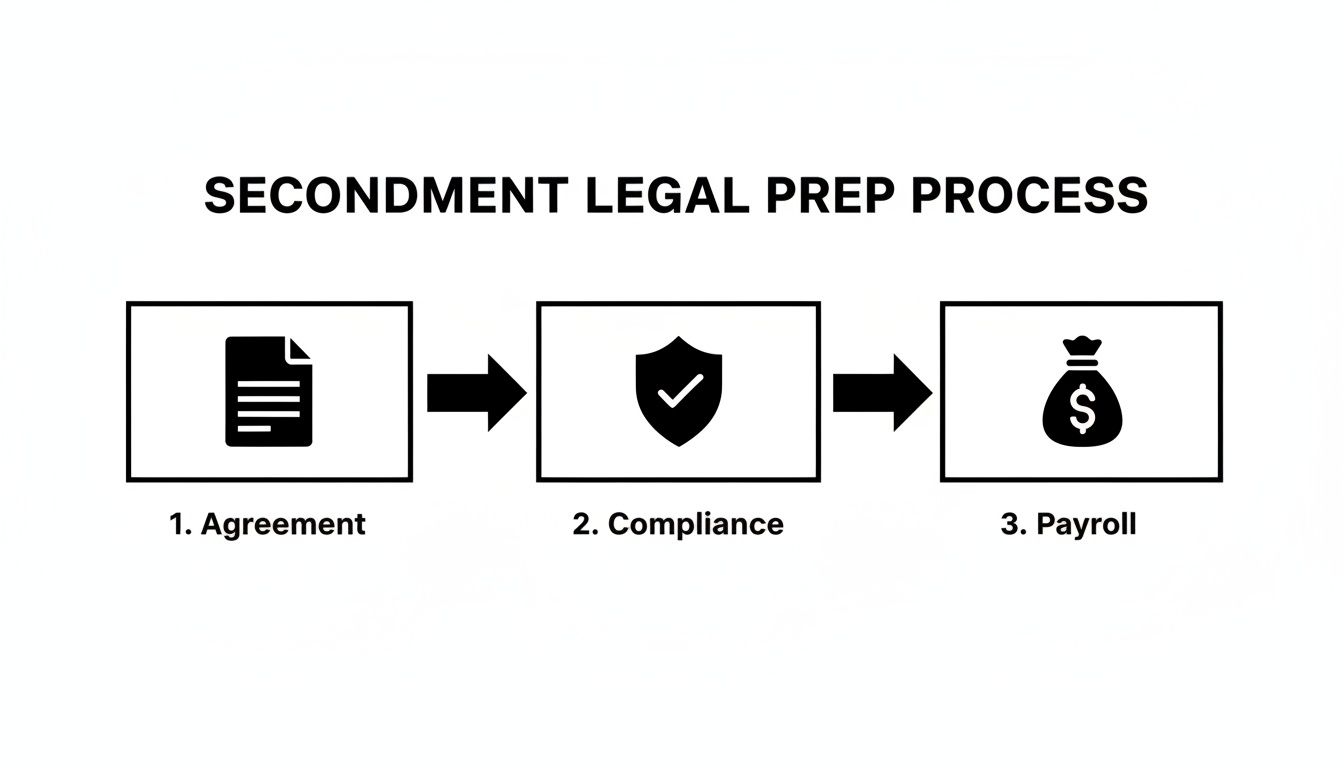
Get these three pillars—agreement, compliance, and payroll—locked down early, and you’ll dodge 99% of the bullets coming your way.
This is the step everyone forgets. Your star associate returns after six months, loaded with insider knowledge… and gets dumped back into their old caseload. It's a colossal waste.
You need a formal re-integration plan.
A botched re-integration sends a terrible message: that their experience wasn’t valued. It’s also how you lose your best people to an in-house role—because you failed to show them a path forward at your own firm.
Let’s be real. A six-month secondment can feel like using a sledgehammer to crack a nut. What if you just need niche expertise for a three-week project? Or you can’t afford to lose your best associate for a whole year? Mortgaging the office ping-pong table for a temporary fix is not a strategy.
This is where we need to think differently. It’s time to talk about a smarter, more flexible approach that gets the same results—client support, project fulfillment, revenue—with far more agility and way less overhead.
Think of it as "secondment-as-a-service." Instead of committing one of your own, you tap into a curated network of pre-vetted legal pros who can jump in on a project basis. This isn't about finding a temp; it’s about deploying elite talent exactly when and where you need it.
This model is a direct attack on the old way of doing things. Why take on the risk, the long-term commitment, and the administrative nightmare of a traditional secondment when you can get the specific skills you need, for the exact time you need them?
The legal world is moving toward flexible talent. This isn’t just an alternative; for many modern problems, it’s a superior strategy that offers precision, speed, and cost control that old models can't touch.
For many firms, this is already happening. An International Bar Association report found that 65% of law firms plan to increase international hiring, using secondments to place talent in key global hubs. This syncs perfectly with data showing an 8% rise in open roles at Am Law 200 firms, reflecting a focused expansion on high-demand secondees.
So, when does this nimble approach make the most sense?
This approach is a powerful way to manage capacity. For some needs, looking at outsourcing companies for administrative support can also be a hyper-efficient move. By integrating flexible talent, you can leverage specialized on-demand legal services to stay lean and serve clients better.
Alright, let's get down to brass tacks. You see the potential, but a few nagging questions are probably still bouncing around your head. Let's tackle what managing partners are really asking.
This is the elephant in the room. The fear that you’ll pour six months of training into a star associate, only for the client to poach them.
Look, it’s a valid concern, but it points to a bigger problem. If your firm’s culture and career path can’t compete with an in-house role, you don’t have a secondment problem—you have a retention problem. A great secondment makes your lawyers more valuable to you. They come back with an insider’s perspective you simply can't buy.
Don't kid yourself: this isn't "set it and forget it." Expect to put in real hours upfront to define the goals and hammer out the agreement.
Once it’s rolling, a weekly 30-minute check-in is the bare minimum. This isn’t micromanaging; it’s intelligence gathering. Skipping these calls is how a secondee goes "native" and forgets which team they're really on. The time you spend is an investment.
Flip that question. Can you afford not to have lawyers who truly get your top clients' business? Can you afford associates who only speak "legalese" and are lost when it comes to the language of business?
The temporary dip in billable hours might sting. But the long-term ROI is a rock-solid client relationship, a pipeline of future work, and a lawyer who returns with invaluable commercial savvy. It’s not a cost; it’s an investment that pays dividends for years.


