
 22 minutes read
Let's be honest. The legal world is finally catching up to a reality the rest of the business world figured out years ago. Instead of being handcuffed to the often-shallow talent pool in your immediate zip code, smart firms are now tapping into a global network of pre-vetted, ridiculously experienced legal professionals. This isn't about finding someone anymore. It's about finding the right one, no matter where they hang their hat.
Let’s get real for a moment: the old-school method of hiring legal assistants is a special kind of nightmare. It’s a slow, expensive, soul-crushing grind that forces you to sift through mountains of resumes from people who think "attention to detail" means using the right font. You post a job, wait weeks for a few lukewarm candidates to trickle in, and then torch billable hours interviewing people who wouldn't know a motion to compel if it hit them in the face.

This isn’t just a string of bad luck; the system itself is rigged against you. The traditional talent market isn't producing a new wave of skilled professionals. It’s just shuffling the same overpriced deck, and every shuffle costs you more in recruitment fees and signing bonuses. You’re left battling every other firm within a 20-mile radius for the same handful of people. Good luck with that.
The root of this mess is what I call the 'flat growth' paradox. The legal support field isn't actually growing, but the turnover rate is high enough to make your head spin. According to the U.S. Bureau of Labor Statistics (BLS), the profession is projected to see a whopping 0% overall employment growth through 2034. Zero.
But here's the kicker: the BLS also estimates that around 39,300 openings pop up each year. You can dig into the numbers yourself in the BLS report on the future of paralegal jobs.
That means nearly 10% of the entire workforce is on the move annually. They’re retiring, switching careers, or simply burning out from the madness.

This constant churn creates a hiring hamster wheel. You're always running, always recruiting, but never actually getting ahead. Your firm is stuck paying a premium for temporary solutions, patching leaks instead of building a solid foundation.
This high replacement rate leads to a constant stream of vacancies that feel impossible to fill reliably. The moment you finally get someone onboarded and up to speed, another person is sliding their two-weeks' notice onto your desk, and the exhausting cycle starts all over again. It’s a terrible way to run a business.
So, you're caught in this frustrating loop. But what is it really costing your firm? The price tag goes way beyond a salary. The hidden costs are the ones that bleed you dry:
This isn't just a temporary dip in the market; it's a deep, structural problem that demands a completely new strategy. The good news? The solution is already here, and it doesn't involve mortgaging your office ping-pong table to afford your next hire.
If your firm’s talent search is still limited to a 20-mile radius, you’re not just being old-fashioned—you're actively choosing to lose. It’s like fishing in a tiny, overfished pond while ignoring the vast ocean of talent just over the horizon. You're playing a game that's rigged from the start.
Let’s be honest: the real shift in legal staffing isn’t about flexible Fridays or a better coffee machine. It’s about ripping off the geographical blinders and embracing a global talent pool. Sticking to local-only hiring means paying bloated salaries for a resume that looks suspiciously like every other one you’ve seen this month.
For years, the conventional wisdom was clear: you need someone in the office. You needed a professional who could pop their head in for a "quick question," absorb the "firm culture" by osmosis, and be physically present for last-minute fire drills. It was a comforting idea, one that made perfect sense before cloud-based case management and instant video calls became table stakes.
Today, that mindset is a liability. By limiting your search to local candidates, you're competing with every other firm in town for the exact same handful of professionals. This creates an artificial scarcity that drives up costs and often forces you to settle for someone who is merely "good enough" instead of the absolute best person for the job.
The hard truth is your next superstar legal assistant probably doesn’t live down the street. They might not even live in your state. And frankly, why should they have to?
This isn't just about hiring "remotely" from another US city. That’s a good first step, but the real game-changer is looking just a bit further south to the massive, untapped talent pools in Latin America. And no, this isn't just a cost-cutting play, though the financial benefits are frankly absurd.
This is about accessing a different caliber of professional altogether. We’re talking about highly educated, incredibly motivated individuals who are often already trained in U.S. legal standards and procedures. Many have prior experience working for U.S.-based companies and possess a level of professional English fluency that will genuinely surprise you.
The biggest advantage? Time zone alignment. Your remote assistant in Colombia or Mexico is working when you’re working. No more sending an email at 5 PM your time and waiting until the next morning for a reply from a contractor halfway around the world.
This isn’t about offshoring tasks; it’s about nearshoring talent. It’s a strategic move that helps you build a responsive, integrated team that operates on your schedule, understands your professional culture, and brings a level of dedication that’s becoming rare to find locally. Finding the perfect fit is key, and understanding what to look for when hiring a legal assistant remote from your office is the first step.
I get it. The idea of hiring someone from another country sounds… complicated. You’re probably picturing payroll headaches, compliance nightmares, and a vetting process that feels like a full-time intelligence operation.
That’s the old way of thinking.
Modern talent platforms have completely solved this problem, turning what used to be a logistical nightmare into a simple, straightforward process. (And yes, full disclosure, this is exactly what we built HireParalegals to do. Toot, toot!)
These platforms handle all the dirty work for you:
Think of it as upgrading from a local classified ad to a curated, global talent marketplace. You get all the benefits of a worldwide search without any of the traditional risks. You’re no longer limited to who happens to be available in your zip code; you’re choosing from the best of the best, period.
Let's get straight to the point every managing partner really cares about: the numbers. I'm not talking about billable hours, but the cold, hard math that dictates your firm's growth. The cost difference between hiring a traditional, in-office legal assistant and bringing on a top-tier remote professional isn't just a rounding error—it's a fundamental shift in your entire financial strategy.
And this goes way beyond just the salary. We have to look at the fully-loaded cost, the number that includes every hidden expense that quietly drains your budget.
This breakdown shows just how much your hiring scope impacts both your access to talent and your bottom line.
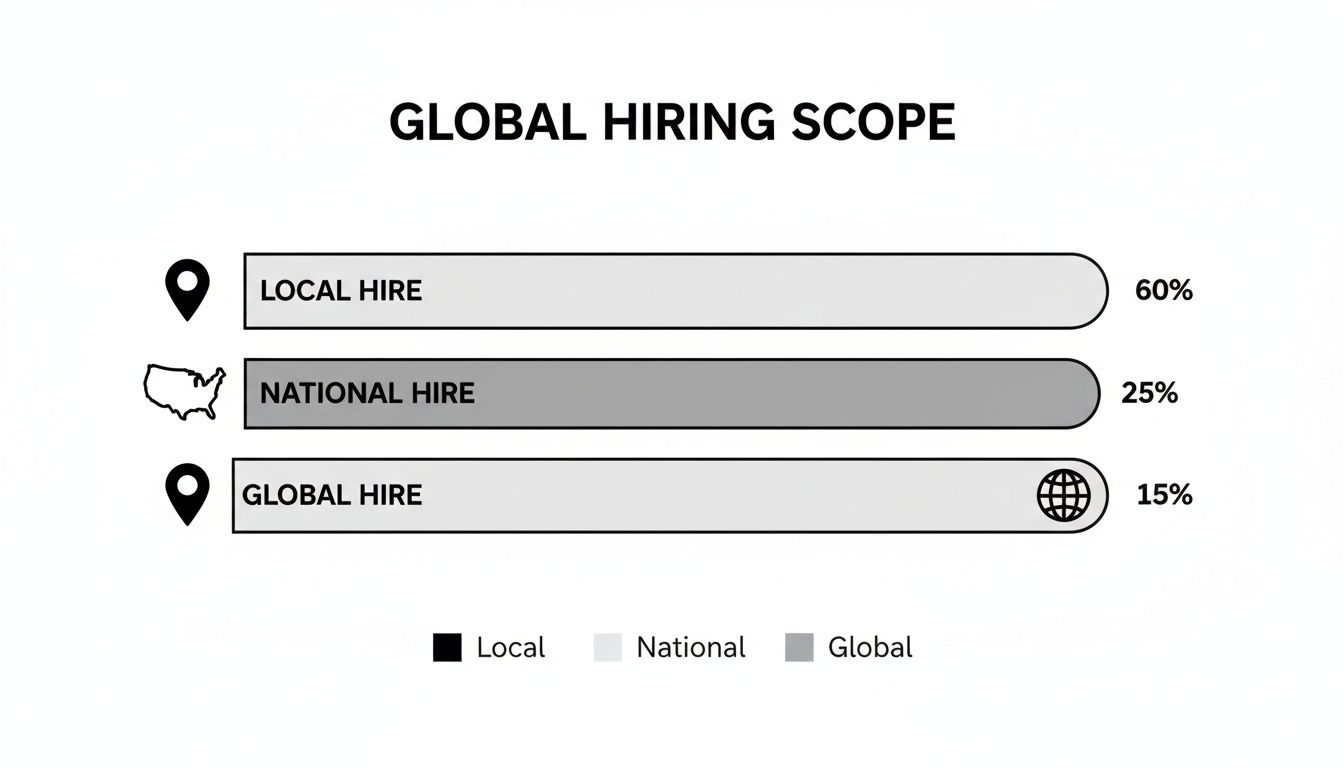
As you can see, simply expanding your search from local to national or global immediately broadens your talent pool. This gives you access to incredibly skilled professionals without paying a premium just because they live in a high-cost-of-living area.
When you hire a legal assistant in the U.S., you aren't just paying their salary. You're on the hook for the whole package, and those costs add up much faster than you think. This is the financial baggage that comes with every single W-2 employee.
Here's a quick, painful rundown of what I mean:
All of a sudden, that reasonable-sounding salary balloons into a six-figure liability. That's the "fully loaded" cost, and it's what keeps so many small and mid-sized firms from scaling effectively.
Now, let's look at the alternative. The median annual wage for a U.S. paralegal recently climbed to $61,010, which works out to about $29.33 per hour.
In stark contrast, highly skilled virtual legal assistants from talent-rich regions often have rates between $8–$10 per hour. By shifting key administrative or paralegal functions to qualified remote staff, a U.S. firm can slash its direct wage costs by an incredible 60–80%.
This isn't about finding "cheap labor." It's about leveraging global market dynamics to access professionals with 4+ years of experience for a fraction of the cost. It’s a strategic move that turns your support staff from a major cost center into a powerful force multiplier for your firm.
Beyond the immediate savings, think about the long-term financial health of your practice. A huge part of that is reducing employee turnover and boosting retention. When you can tap into a global pool of motivated professionals, you're not just cutting costs—you're finding dedicated people who are invested in long-term roles, which brings stability to your entire operation.
You can see a more detailed breakdown of virtual paralegal rates to understand how the numbers can work in your favor.
Let's put the numbers head-to-head. Forget abstract percentages; this is what the savings look like in plain dollars. The table below gives a direct comparison of the fully-loaded annual cost of a traditional U.S. hire against a pre-vetted remote professional sourced through a platform model.
| Cost Factor | Typical U.S. Legal Assistant | HireParalegals Remote Professional |
|---|---|---|
| Median Annual Salary | $61,010 | $20,800 ($10/hr) |
| Payroll Taxes (FICA) | ~$4,667 | $0 (Handled by platform) |
| Health/Benefits | ~$8,000 | $0 (Independent Contractor) |
| Office Space/Utilities | ~$5,000 | $0 (Works remotely) |
| Recruitment Fees | ~$12,200 (20%) | $0 (Included in service) |
| Total Annual Cost | ~$90,877 | ~$20,800 |
| Annual Savings | ~$70,077 |
The math doesn't lie. For less than what you'd pay a recruiter for a single U.S. hire, you can fund a top-tier remote professional for an entire year. That’s not just an improvement—it’s a completely different and more sustainable way to build and scale a modern law firm.
So, you’re sold on the idea. The math makes sense, the talent pool is huge, and you’re ready to ditch the insane premium you pay for local hires. Now what?
Hope you enjoy spending your afternoons fact-checking resumes and running technical interviews—because that’s now your full-time job.
Just kidding. That’s the old, painful way of doing things. The new approach is brutally efficient, but only if you know the playbook. Here’s our insider guide to finding, vetting, and onboarding a top-tier remote legal assistant without the usual headaches.
The first mistake I see firms make is getting hung up on the resume. They scan for a certain number of years of experience, check for specific software, and call it a day. In the remote world, that’s a recipe for a bad hire. A resume tells you what someone has done, not how they’ll actually perform when they’re not in the office next to you.
Here’s what you should be obsessed with instead:
The best remote legal assistants aren’t just task-doers; they are problem-solvers who take real ownership. They operate like a true extension of your team, just from a different zip code.
Switching your focus from static credentials to dynamic capabilities is the single biggest key to a successful remote hire.
Once you’ve got a shortlist, the virtual interview is where you separate the contenders from the pretenders. Forget the generic questions like, "What are your greatest strengths?" They’re useless. Your goal is to simulate the remote work environment and see how they handle a bit of pressure.
You’re really testing for those soft skills we just talked about. We’ve actually put together a full list of the best legal assistant interview questions that get to the heart of this, but here are a few of my favorites to get you started.
The Scenario Test:
"Imagine a partner gives you an urgent, vaguely defined research task at 4 PM on a Friday, then immediately becomes unreachable. What are your next three steps?" This immediately shows you their problem-solving process and communication instincts.
The Tech Glitch Test:
Start the video call with your camera off or pretend your mic isn't working for the first 30 seconds. See how they react. Do they get flustered and freeze up, or do they calmly start troubleshooting on their end? It’s a small, slightly cheeky way to test their tech composure.
The Prioritization Test:
"You have three new tasks land on your desk at once: one is urgent but low-impact, one is important but not due for a week, and one is from a senior partner but the instructions are unclear. How do you decide what to tackle first?" This gives you a direct window into how they manage workflow and expectations.
These aren't gotcha questions. They're designed to see how candidates think on their feet—which is exactly what the job requires every single day.
Look, you can do all of this yourself. You could post your job on a dozen different boards, spend weeks filtering out unqualified applicants, and try to figure out how to run background checks on someone in another country.
Or, you can let a specialized platform do it for you.
Platforms built specifically for hiring remote legal support (like ours, of course) exist for a reason. We’ve already spent years refining this exact process so you don't have to.
A good platform should handle all the tough stuff for you:
Building a world-class remote team isn't about suddenly becoming a global HR expert. It's about using the right tools to get access to top talent efficiently and with minimal risk.
So, you’ve done it. You hired a top-tier remote legal assistant and are already dreaming of all those reclaimed billable hours. Fantastic.
Now for the hard part.
Hiring is just the first step. The real magic—or the spectacular failure—happens during integration. If you think you can just forward a login and expect flawless work to start rolling in, you’re in for a rude awakening.

This isn’t just about someone “working from home.” It’s about building a distributed, high-performance legal support engine. And that requires a plan, the right tools, and crystal-clear expectations from day one.
Forget about breaking the bank for a new server. Your tech stack doesn't need to be expensive, but it absolutely must be secure, centralized, and intuitive. If it takes a 40-page manual to navigate, you've already lost.
Here’s the core setup that works every time:
The widespread adoption of video platforms and cloud repositories since 2020 has been the single "biggest trend" for legal assistants. It turned what was once a novelty into standard operating procedure and cemented online legal assistant jobs as a scalable, long-term staffing strategy.
This is where you earn your leadership stripes. Vague instructions are the kryptonite of remote work.
"Can you look into this?" is a terrible request.
On the other hand, "Please research opposition counsel's last three motions for summary judgment in similar cases, summarize their main arguments in a one-page memo, and have it to me by 3 PM tomorrow" is a great one.
The goal isn't to micromanage; it's to eliminate ambiguity. Your remote assistant wants to deliver exactly what you need. Help them do it by being ridiculously specific about deliverables and deadlines.
Successfully integrating a remote assistant hinges on implementing effective remote team management strategies. It’s a skill set, not an accident.
We’ve onboarded hundreds of remote assistants, and we've refined the process down to a science. The objective is to get a new hire productive in hours, not weeks. Feel free to steal our playbook.
This isn’t rocket science. It's about being intentional. A little structure upfront prevents a world of confusion down the line, ensuring your new hire doesn't just work remotely—they thrive as a genuine part of your team.
You've got questions about bringing on remote legal talent, and I've got answers. After talking with hundreds of law firms wrestling with this decision, I've heard every possible concern. Let's cut through the noise and tackle the big ones head-on, because frankly, waiting is likely costing you money.
Yes, and it's not even a fair fight. But if you're only looking at the hourly rate, you're missing half the story.
When you hire a full-time employee here in the U.S., their salary is just the tip of the iceberg. On top of that, you're paying payroll taxes, covering health insurance, matching 401(k) contributions, and footing the bill for their physical office space, computer, and supplies. It all adds up, fast.
A remote professional, especially one you find through a dedicated platform, is just a single, predictable expense. Their rate is their rate. That ~$70,000 in annual savings we mentioned earlier? That's not a made-up number; it's the new reality for firms smart enough to embrace online legal assistant jobs.
This question always gets a smile out of me. It implies you know what your in-office staff is doing every single minute of the day. You don't. You manage them based on the quality of their work, not by hovering over their shoulder.
The exact same logic applies to remote talent, but with even better visibility.
The great thing about remote work is that it's all about results. You assign a task with a clear deadline. It either gets done on time and to your standard, or it doesn't. There’s no hiding behind "looking busy."
Modern tools make this incredibly simple. With shared task lists in a platform like Asana or project boards in Trello, you get a live view of what’s being done without ever having to interrupt and ask, "What's the status on that?" This setup naturally creates a level of accountability that's often missing in a traditional office.
This is a completely valid concern, and one we take extremely seriously. But let me be direct: your biggest security threat probably isn't a vetted remote professional. It’s more likely an employee in your own office clicking on a phishing email or leaving a sensitive client document sitting on the printer.
When you hire a remote legal assistant through a reputable service, you're actually adding layers of protection:
In many ways, your confidential information is safer being accessed by a disciplined remote pro through a secure portal than it is floating around your office on sticky notes.
Let's pause and think about what "firm culture" really means. Is it about Friday morning bagels and forced small talk by the coffee maker? Or is it a shared drive to produce exceptional legal work, be hyper-responsive to clients, and run an efficient, profitable practice?
If your culture is built on that second definition, a great remote assistant doesn't hurt it—they supercharge it.
By taking the soul-crushing administrative tasks off your local team's plate, they free up your people to focus on the high-value, strategic work they were actually hired to do. That's a bigger boost to morale and a better defense against burnout than any office perk. When they're integrated properly with tools like Slack and included in video calls, they become a seamless part of the team, all pushing toward the same goal. The only real difference is their commute is much, much better.