 18 minutes read
Let's get one thing straight. A proper remote legal internship isn't just a line on your resume. It's a structured, paid gig where you do real legal work—research, drafting, case analysis—with actual mentorship. It's a job, not a back-door way for a firm to get free admin help while you fetch your own coffee.
Let's be brutally honest. The term "remote legal internship" can conjure up images of glorified data entry done from your couch. And yes, some firms absolutely see it as a way to get cheap labor for the mind-numbing tasks no one else wants to do. If you enjoy spending your afternoons fact-checking citations and organizing digital folders—because that’s now your full-time job—then by all means, have at it. But that's not the experience you want.
A real remote legal internship is a different beast entirely. It's an apprenticeship, not an admin gig. It's your shot at doing meaningful work that builds tangible skills you can put on your CV without cringing. We're talking about the kind of experience that makes a hiring partner nod in approval, not just glance over.
The difference between a career-building opportunity and a total waste of your summer comes down to one thing: substantive tasks. You should be drafting memos, conducting legal research for live cases, and even sitting in (virtually) on client meetings. This is where you learn how the law is actually practiced, not just theorized in a textbook.
This infographic breaks down what a high-value remote legal internship really looks like.
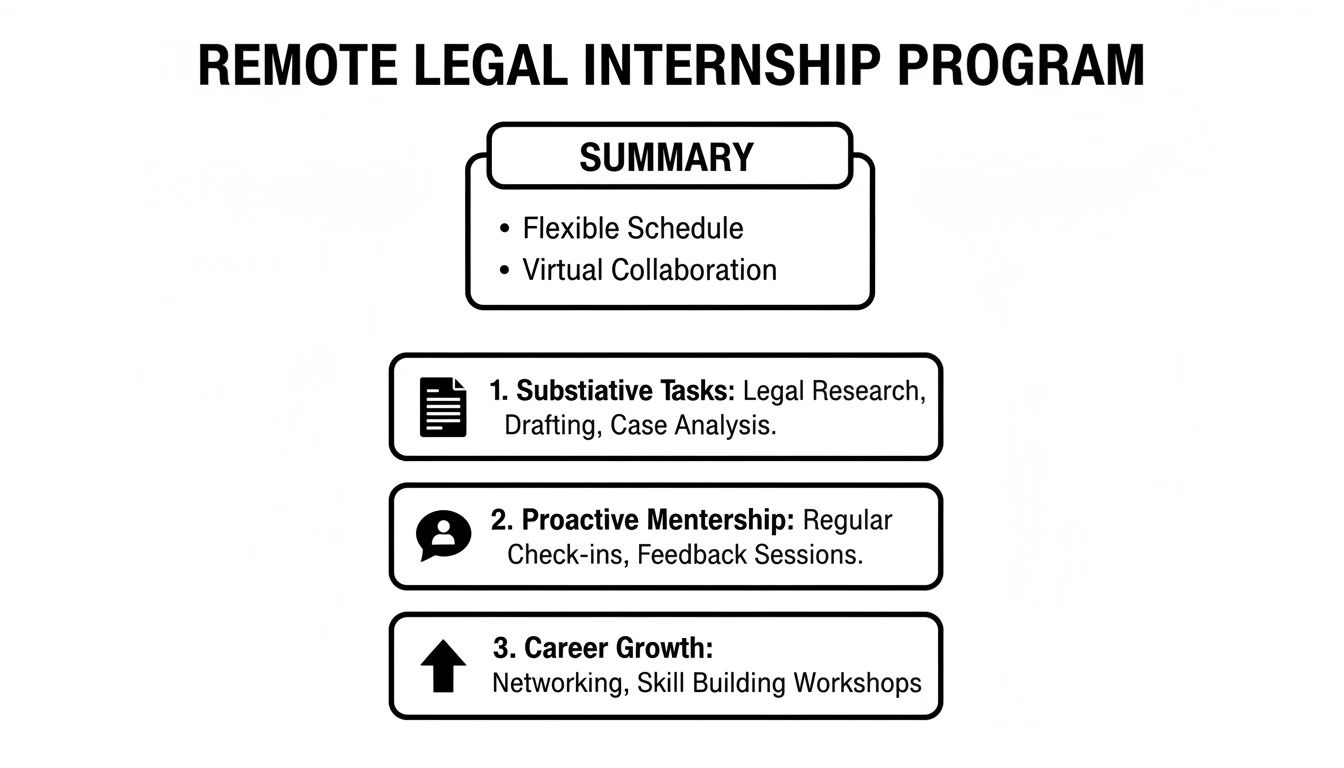
As you can see, it boils down to three things: real work, real mentorship, and a real path forward. Anything less is a warning sign.
The pandemic was the great equalizer here. When COVID-19 hit, 40% of companies suddenly rolled out virtual internships, forcing even the most old-school law firms to adapt. This shift blew the doors open for law students everywhere, proving that high-level legal work could be done effectively from anywhere with an internet connection. Turns out there's more than one way to find elite talent without mortgaging the office ping-pong table.

A great remote internship isn’t defined by location, but by integration. You should feel like part of the team, contributing to real outcomes, not like a ghost who just emails documents back and forth.
This means you’ll be expected to get comfortable with the firm’s tech stack, and fast. To get a sense of the digital tools you might be using, it’s worth checking out this guide on essential cloud-based law firm software. Becoming fluent in these platforms shows you’re a self-starter.
The goal is to do work that's nearly identical to what a first-year associate would handle. This often involves a ton of legal research. If you want to dive deeper into what that work really involves, our guide on remote legal research jobs offers some great insights.
You have to know how to spot a genuinely valuable opportunity from one that will just eat up your time. This table breaks down the key differences.
| Characteristic | The Good Stuff (High-Value) | The Red Flags (Low-Value) |
|---|---|---|
| Tasks Assigned | Drafting memos, legal research for active cases, contributing to briefs. | Data entry, organizing digital files, transcribing meetings, administrative support. |
| Mentorship | A designated attorney provides regular feedback, guidance, and weekly check-ins. | Vague instructions via email; little to no direct contact with a supervising attorney. |
| Compensation | Paid at a fair hourly rate, reflecting the value of your work. | Unpaid, "for experience only," or a small, non-negotiable stipend. |
| Team Integration | You're invited to virtual team meetings, social events, and client calls. | You work in a silo with minimal interaction with the rest of the firm. |
| Career Path | Clear discussions about performance, feedback for growth, and potential for future employment. | No mention of long-term opportunities; the role is treated as temporary help. |
Ultimately, you’re looking for a role where you’re treated as a future professional, not just a temp. If the internship description reads more like an admin assistant's duties, do yourself a favor and keep looking.
If you're just typing "legal jobs" into a search bar and endlessly scrolling, you're not really looking for an internship. You're just giving yourself a new, unpaid job: sifting through digital noise. That's a surefire way to spend your afternoons tweaking a resume nobody will ever read.
Let's get real. The best opportunities are rarely the most visible. They're usually tucked away, waiting for someone who knows how to look beyond the obvious. It’s time to stop the doomscrolling and start a more strategic hunt.
Mass-market job sites are a black hole for applications. You're fighting algorithms, expired listings, and a flood of other applicants. The key is to shift your focus to niche platforms where serious firms are looking for serious candidates.
Think legal-specific job boards and professional communities. These are curated spaces, which means the quality of the listings is much higher and the competition is more focused. You're no longer competing with every single person on the internet who's passed the bar.
These hubs are also great for just getting a feel for the industry. You can learn a lot by looking at the broader market for remote law jobs and seeing which firms are consistently hiring remotely. It's an effective way to build a target list of firms that are already comfortable with a distributed team.
Here's a strategy that makes most people nervous but works like a charm when done right: targeted outreach. I’m not talking about spamming every firm in a 50-mile radius. I'm talking about identifying a partner at a boutique firm whose work you genuinely find interesting and sending them a direct, personal email.
This is not a spray-and-pray numbers game. You are not blasting out 100 generic templates. You are sending five, maybe ten, extremely well-researched and thoughtful messages.
Here’s what that looks like:
Instead of asking, "Do you have any internships?" frame it with more confidence: "I've been following your firm's work in appellate advocacy and would value the opportunity to contribute remotely this summer. Would you be open to a brief 15-minute call to discuss how I could support your team?"
It's a bold approach, but it shows initiative that a standard application just can't. Partners at smaller firms, in particular, often appreciate this kind of hustle—it's how they built their own practices. Your only job is to prove you respect their time.
Let's get one thing straight: your standard-issue, boilerplate resume isn’t going to cut it for a remote legal internship. Sending out a generic application is the professional equivalent of showing up to court in sweatpants. It tells the hiring manager you haven’t bothered to understand what they actually need.
They aren't just looking for someone with a decent GPA. They’re looking for a self-starter they won’t have to chase down on Slack to see if a memo is finished. Your application has one job: prove you're that person.
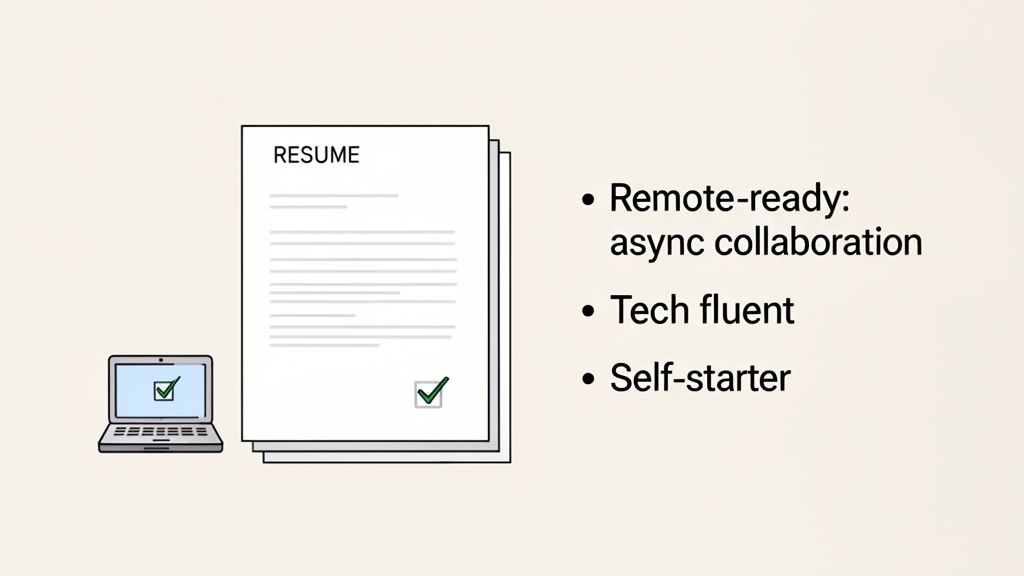
Hiring managers for remote roles are scanning for specific keywords, and "attended weekly meetings" isn't one of them. The trick is to reframe your experience through a remote-first lens. It’s not about making things up; it’s about translation.
Think about the how behind your accomplishments. Did you just "attend meetings"? Or did you collaborate with a team across three time zones using Asana to track project milestones? See the difference? One is passive. The other screams autonomy and tech fluency.
Here’s how you can make that swap:
Instead of: "Assisted with research projects."
Try: "Independently managed legal research assignments using Westlaw and LexisNexis, delivering annotated findings ahead of schedule via a shared digital workspace."
Instead of: "Participated in team discussions."
Try: "Contributed to case strategy by providing written analysis and feedback through asynchronous communication channels."
This isn’t just semantics. It’s about proving you understand how productive teams operate when they aren’t sharing an office coffee machine.
Listing "Proficient in Microsoft Word" on your resume today is like bragging that you know how to use a fork. It’s a given. You need to highlight your comfort with the specific tools that power modern legal work.
Your application should subtly signal that you're already part of this world. Name-dropping specific platforms is a powerful shortcut to building credibility.
Don't just list the software. Weave it directly into your accomplishments. Saying you "managed client intake files using Clio" is ten times more impactful than just having "Clio" in a generic skills section. It’s proof you’ve applied the skill, not just watched a YouTube tutorial.
This focus on practical skills is incredibly important, especially as the legal field's demographics shift. For instance, women now make up 53.1% of all law interns, a significant majority that is reshaping the future workforce. Firms looking to attract this top talent for a remote legal internship know that modern candidates expect a tech-forward environment. You can learn more about these demographic shifts in legal internships to better understand the landscape you're entering.
Think of your cover letter as more than a summary of your resume. It’s your one real shot to speak directly to the hiring manager and address their biggest fear: hiring an intern who goes radio silent after day one.
Dedicate a full paragraph to why you are uniquely suited for remote work. Talk about your discipline, your proactive communication style, and your ability to manage your own time. This is where you connect the dots for them, showing you’ve thought deeply about what it takes to succeed outside a traditional office.
This is your audition piece. Make it count.
The virtual interview is where so many promising candidates fall apart. Think of it as a performance, and you're the director, producer, and star. Forget the tired advice about good lighting and a clean background—that’s the bare minimum. We're going way beyond that.
Nailing an interview for a remote legal internship isn't just about giving the right answers. It's about showing you're competent and self-sufficient through a screen. The interviewer's biggest fear is hiring someone who needs constant hand-holding. A disorganized, shaky video call is a massive red flag that confirms all their worst assumptions.
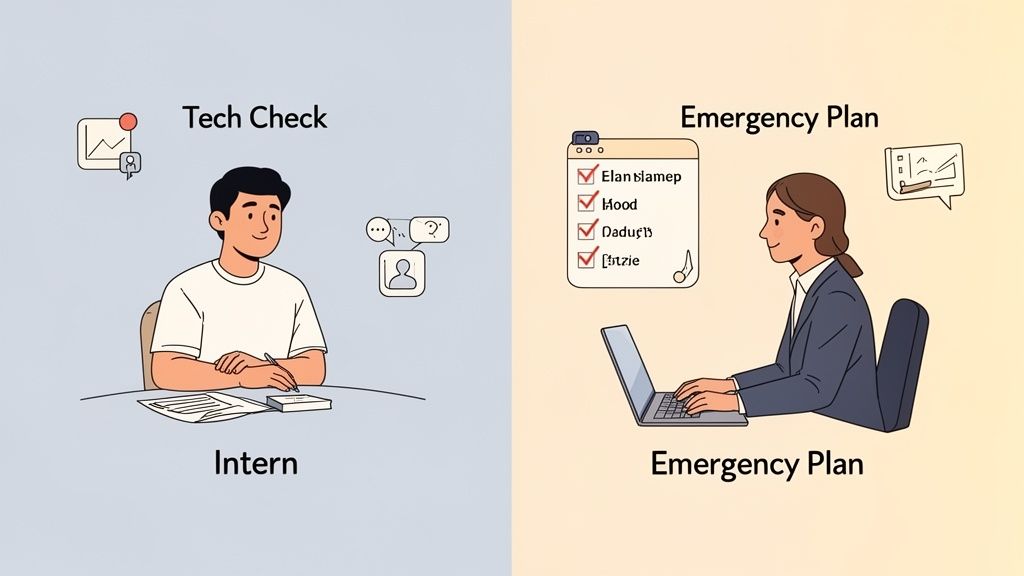
When it comes to technology, hope is not a strategy. You need a rock-solid game plan for when things go wrong. Don’t just check your connection; stress-test it. Do a full dry run with a friend the day before—same time, same room, same software.
This isn't just about preventing a technical meltdown. It’s about building your own confidence. When you know your tech is solid, you can stop worrying about it and focus on what actually matters: connecting with the interviewer.
Of course, beyond the virtual setup, you still need to know how to answer common interview questions confidently. Have your key accomplishments ready to go. For legal-specific roles, it’s also smart to review common legal assistant interview questions to get a sense of what might be coming.
Have a Tech Glitch Emergency Plan. Seriously. Write it down. It should include the interviewer's phone number and a pre-drafted, calm email you can fire off immediately if your internet dies. Having it ready shows you’re a planner, not a panicker.
In a remote interview, your on-camera presence is your handshake, body language, and professional attire all rolled into one. You can't rely on the energy of an in-person meeting to build rapport; you have to create it.
Here’s how to take control:
Remember, every interview for a remote legal internship is an audition for your ability to work independently. Your performance on that call is the most direct evidence you can give them. Show them you’re the low-risk, high-reward candidate they’ve been looking for.
You landed the internship. Fantastic. Now you have to avoid becoming a ghost in the firm's virtual hallways.
The first month of any remote legal internship sets the tone for the entire experience. This is your chance to prove you add real value, even from a distance.
Not sure where to start? Think of your first month as a strategic launch. Every interaction, every update, every piece of work you submit is building your reputation. No pressure, right? Let's dive in.
You can't just pop into a supervisor’s office and ask, “How am I doing?” You have to create those opportunities yourself. Schedule regular check-ins—even a quick 15-minute call or a Slack huddle makes a huge difference.
Instead of waiting for them to tell you what's next, ask specific, thoughtful questions.
For example:
Consistent feedback means fewer surprises and more opportunities to impress.
Get into the habit of updating your supervisor when you finish a task. A simple message asking, “Did this hit the mark?” shows you’re engaged and not just waiting around.
Out of sight is out of mind. That's why tools like Slack and Asana aren’t just nice-to-haves; they’re essential for showing you're on top of your work.
Here are a few tactics that work:
These small, consistent signals build your reputation as a reliable contributor. Before you know it, your name becomes synonymous with getting things done.
In an office, you'd build relationships during coffee breaks. Remotely, you have to be more intentional. Set up casual virtual coffees—just send a calendar invite for a "15-minute brainstorm" or a quick chat.
Offer to review a brief for a junior associate. Pitch a quick idea in a team chat. These small gestures remind the attorneys you’re not just an avatar, but a real part of the squad.
A few other ideas:
These simple actions go a long way in humanizing you behind the screen.
Templates are your best friend. A quick weekly check-in, dropped in an email or Slack message every Friday, is a game-changer.
Here's a simple Weekly Check-in template you can adapt:
Subject: Week 1 Check-In
This Week I Completed:
What’s Next:
Roadblocks:
Questions for Supervisor:
Sending this every Friday highlights your wins and flags obstacles before they become major problems. It also saves your supervisor from having to guess what you're working on.
By day 30, you should have a solid list of tangible contributions. Don't be shy about highlighting these. Reference specific numbers, like completing two memos, attending one client meeting, or having zero missed deadlines.
You can even summarize your impact in a simple table:
| Metric | Count |
|---|---|
| Memos Drafted | 3 |
| Client Calls Supported | 1 |
| Tasks Completed Early | 4 |
| Feedback Sessions Held | 2 |
This isn’t overkill—it’s concrete proof that you’re an indispensable part of the team. Crush your first 30 days, and you'll set yourself up for a successful internship.
Alright, let's cut to the chase and tackle the questions that are probably on your mind. No legal jargon or corporate fluff here—just straight answers.
It’s a mix, but any reputable for-profit firm understands that top talent deserves compensation. A paid internship is a huge green flag. It shows they're investing in your growth, not just hunting for free labor.
My advice? If the main selling point is "valuable exposure," you should probably keep looking. Ask about compensation early in the conversation to make sure you're not wasting your time—or theirs.
You don't need a command center in your apartment, but a solid tech setup is non-negotiable.
Here’s the essential checklist:
The firm will give you access to their specialized software, but you’re responsible for the basics. More than that, you need to be comfortable with the standard tools of remote work—Zoom, Microsoft Teams, Slack, and maybe a project management platform like Asana. Showing you can navigate these from day one makes you a much more attractive candidate.
Your tech setup is your new office. The best remote interns don’t just use the technology; they use it to stay visible and prove their value. Treat it with that level of professionalism.
This one is on you. In an office, mentorship might happen by the coffee pot. Remotely, it almost never happens by accident. You have to be intentional.
Once you start, identify a senior attorney whose work you admire. Send them a polite message asking for a 15-minute virtual coffee. Prepare a few thoughtful questions. The goal is to make it easy for them to say yes and to help you. Keep your requests short, be prepared, and always be mindful of their time.
Yes, absolutely. I’d even argue it’s one of the best ways to land a full-time role.
Put yourself in the firm’s shoes. If you demonstrate that you’re productive, professional, and a great communicator without someone looking over your shoulder, you instantly become a low-risk hire. They’ve already seen you perform in the exact environment you’d be working in full-time.
Firms feel much more confident extending an offer to an intern who has already proven they can succeed in a remote legal internship. Think of it as a months-long job interview, because that’s exactly what it is.