 18 minutes read
A killer legal pa job description does more than just list tasks. It’s a sales pitch. It paints a picture of the role, highlighting the real duties, essential skills, and necessary qualifications in a way that speaks directly to top-tier talent. Think of it as your first, and most important, filter in the hiring process—the one that separates the pros from the pretenders.
Let's be brutally honest. You post a job for a Legal PA, and your inbox is instantly flooded with résumés. The problem? Most of them look like they were written by a very confused committee, and half the applicants probably think "discovery" is what Columbus did.
Sound familiar? It’s because your job description is a copy-and-paste relic from a decade ago. It’s a bland, uninspired list of generic duties that attracts anyone with a pulse and a vague familiarity with Microsoft Word.
This isn’t just a minor annoyance; it's a colossal waste of your most precious resource: time. Every minute you spend sifting through unqualified candidates is a minute you're not billing clients. A boring, boilerplate description is a one-way ticket to spending the next three months interviewing people you would never, ever hire.
I've seen this predictable, soul-crushing pattern play out countless times—and I'll admit, I've fallen for it myself. You're desperate for help, so you grab an old job description, give it a quick once-over, and throw it online. What comes back is a pile of applications from people who don't even grasp the difference between a paralegal and a legal assistant. (If you need a refresher on that, you're welcome.)
This frustrating cycle is a straight line from a weak job description to a pool of bad candidates. It’s a self-inflicted wound.
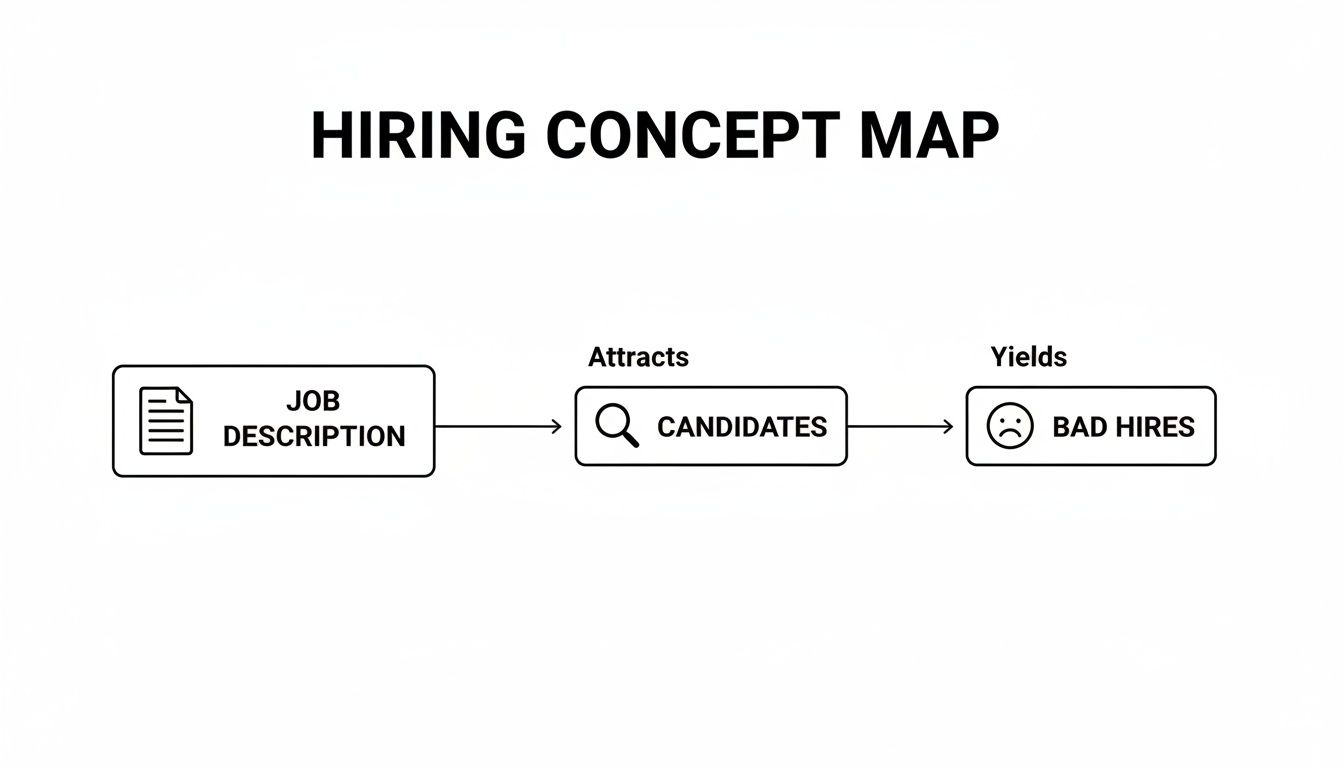
The takeaway here is simple but crucial: the effort you put into the job description dictates the quality of your applicants. Shocking, I know.

The goal isn't just to fill a seat; it's to find someone who makes your entire practice run smoother. A generic job description is like fishing with a net full of holes—you’ll be busy, but you won't catch anything worthwhile.
So, how do we fix this disaster? We stop writing laundry lists of "responsibilities" and start defining outcomes.
The problem is that most job descriptions are written from the firm's perspective, listing a series of demands instead of presenting an opportunity. Top-tier candidates aren't just looking for another job; they're looking for a place where their skills will make a tangible impact. This is your first shot to show them they can do that at your firm.
Let's look at how a simple shift in language can completely change the game.
| Generic Phrase (The Old Way) | Impactful Statement (The Smart Way) |
|---|---|
| "Manages calendars." | "Proactively owns attorney schedules, anticipating conflicts and strategically organizing meetings to maximize billable hours." |
| "Answers phones and handles correspondence." | "Serves as the primary gatekeeper for partners, professionally managing all incoming communications to protect their time and focus." |
| "Files documents with the court." | "Ensures 100% accurate and on-time e-filing of critical court documents, meticulously adhering to all judicial procedures." |
| "Assists with billing." | "Drives the monthly billing cycle by preparing and editing client invoices, ensuring accuracy and timely submission to improve cash flow." |
See the difference? One is a passive task; the other is an active, results-driven contribution.
This is tough love for your hiring process. By making these changes, we’re setting the stage for an overhaul that will save you time, money, and a whole lot of aspirin down the road.

First things first, let's banish the phrase "administrative tasks" from our vocabulary. It’s a lazy catch-all that tells a top-tier Legal PA absolutely nothing. Use it, and you'll get résumés from people whose most relevant skill is organizing their spice rack alphabetically.
A true rockstar Legal PA isn't just an admin; they're the operational backbone of the practice. They don't just do tasks. They anticipate needs, solve problems before you even know they exist, and protect your billable hours with the ferocity of a guard dog.
Your job description has to reflect this reality. This isn’t about data entry and answering phones—it’s about high-impact responsibilities that directly contribute to your firm's bottom line and your own sanity.
Instead of a boring laundry list, think in terms of core functions. This is what separates the pros from the amateurs. A great Legal PA doesn't just manage a calendar; they own it, strategically defending your time from pointless interruptions. They don't just "handle documents"; they ensure every single filing is flawless and submitted long before the deadline panic can set in.
Here’s what that actually looks like on the ground:
And for goodness sake, stop using a one-size-fits-all job description. The daily reality for a PA in a high-volume litigation practice is a world away from one supporting a corporate M&A partner. One is juggling discovery deadlines and deposition schedules; the other is managing virtual deal rooms and coordinating signatures across multiple time zones.
Your legal PA job description must be specific to the practice area. A litigation PA needs to understand the rhythm of a case, while a corporate PA needs to be an expert in transaction logistics. Vague descriptions attract generalists, but you need a specialist.
It's also worth thinking beyond the traditional duties. A modern Legal PA might be expected to navigate complex needs, like sourcing legal document translation solutions for international cases. Including these kinds of specific, nuanced responsibilities shows candidates you’re looking for a true professional.
When you articulate these duties with this level of clarity, you’ll attract candidates who read your listing and think, "Finally, a firm that actually gets it."
Alright, let's talk about the skills section. If you’re still listing “Proficient in Microsoft Office,” I have some news for you. That’s not a skill anymore; it’s a pulse check. You might as well ask if they can breathe unassisted.
It's time to get specific about the abilities that actually predict success in a high-pressure legal environment. We need to move beyond the obvious and dig into the real game-changers—the skills that separate a competent admin from an indispensable partner.
This also means tossing out vague requirements that do more harm than good. I'm looking at you, "bachelor's degree required." Why? You're automatically filtering out candidates with a decade of real-world experience for someone who spent four years learning theory. It's a pointless gatekeeper that shrinks your talent pool for no good reason.
First up, the technical stuff. These are the table stakes—the skills a candidate must have from day one. There's no "learning on the job" for these.
This isn’t just about making your life easier; it's about mitigating firm risk. A PA who fumbles with technology or misses a critical grammatical error is a liability waiting to happen.
Now for the real magic. These are the traits that don’t always show up on a résumé but make all the difference. These are what you should be actively probing for during an interview.
I’d hire a radically proactive PA with average software skills over a tech genius with zero initiative any day of the week. You can teach someone how to use Clio. You can't teach them how to care.
Look for evidence of these traits in their past experiences:
The legal support field is insanely competitive. Projections show around 39,300 paralegal and legal assistant job openings emerge each year. And with the unemployment rate for the role hovering at a razor-thin 1.9%, the competition for top talent is fierce. You can read more about the current legal hiring trends here.
Focusing your legal PA job description on these core competencies will act as a magnet for the pros.
Alright, enough theory. Let’s get into the nuts and bolts of writing a legal PA job description that actually gets results. And no, this isn't about some soul-crushing template you found online. This is a framework for persuasion and clarity.
We're going to build a job description that sells your firm just as much as it defines the role. Why? Because the best PAs aren't just looking for a paycheck. They're looking for a place where they can truly make an impact. Your first task is to show them why your firm is that place.
Most job descriptions lead with a dry paragraph about the firm that reads like a Wikipedia entry. Scrap that immediately.
Instead, start with a compelling intro that speaks directly to the candidate. What's in it for them? The chance to be the right hand to a partner in a high-profile practice? An opportunity for real mentorship? Or maybe it’s the fact that you offer a sane work-life balance (and you actually mean it). Lead with your strongest selling point before you mention a single responsibility.
Let's talk about the elephant in the room: money. Hiding the salary range is an outdated practice that wastes everyone’s time. In today's market, transparency is your single biggest competitive advantage.
Post a competitive salary range. Plain and simple. It immediately signals that you respect a candidate's time and aren't trying to lowball them.
While the paralegal job market isn't projected to grow much, an average of 39,300 jobs still open up each year. The median annual salary hovers around $61,010, so use that as a baseline to stay competitive. You can explore more paralegal job market insights on ParalegalEdu.org.
A job description without a salary range is like a dating profile without pictures. It just feels sketchy. You’ll get fewer applicants, but the ones you do get will be far more serious and qualified.
This is my secret weapon for setting crystal-clear expectations. Instead of just listing what they'll do, tell them what they’ll achieve. A "Success in 90 Days" section gives candidates a tangible vision of what it means to excel.
Here’s a quick example:
This simple shift transforms the job description from a list of chores into a clear career path. It shows high-performers exactly how they can win.
So, you’ve done the hard part. You’ve crafted a killer legal PA job description that’s sure to attract the best of the best. You post it, lean back, and wait for the perfect candidate to land in your inbox.
Hold on. Hope you enjoy spending your afternoons fact-checking résumés, because that’s now your full-time job.
What if there was a way to bypass that entire circus? A way to perfect the job description and then sidestep the messy, time-consuming process of posting, screening, and interviewing altogether? This is where a bit of an insider tip comes in handy.
Forget the traditional job post. Imagine having access to a curated, on-demand pool of over 10,000 pre-vetted legal professionals. It’s less like posting a job ad and more like picking exactly what you need from a catalog of elite talent without having to mortgage your office ping-pong table.
The reality is, finding top-tier legal support is getting tougher. Consistent annual openings and a razor-thin 1.9% unemployment rate create a real scarcity of qualified candidates. This talent crunch is pushing savvy firms to explore smarter, more efficient hiring models.
That's why we built a system to cut through the noise. (Toot, toot!) Here’s a peek behind the curtain at our four-step vetting process, designed to make sure you only ever see the absolute best candidates.
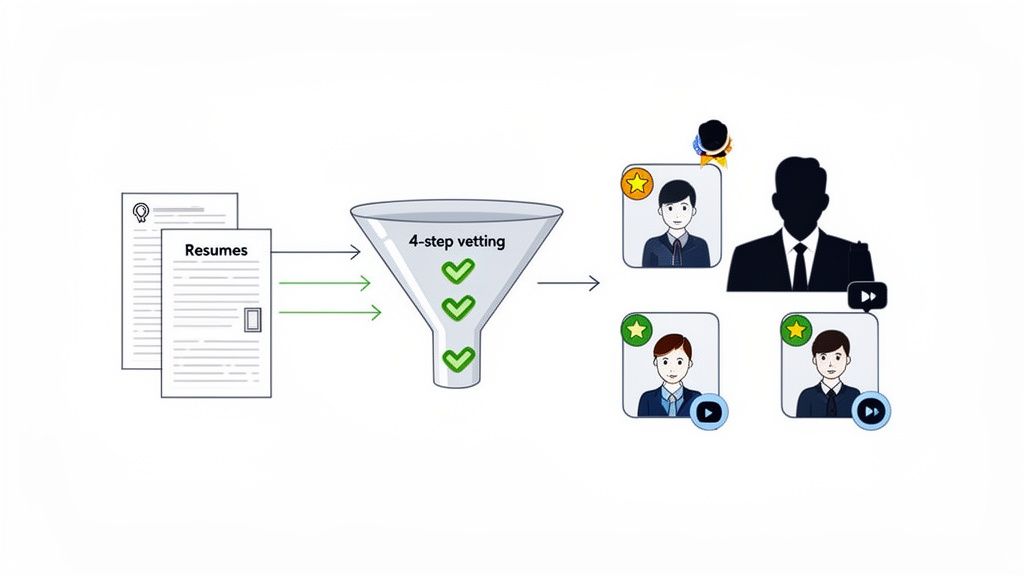
We're obsessive about this process—sourcing, interviewing, running background checks, and validating skills—so every single professional you see is already in the top percentile. We’re not saying we’re perfect. Just more accurate more often.
What does this mean for you? It means getting a custom shortlist of candidates, complete with video introductions, that can shrink your hiring timeline from months to as little as 24 hours. No more résumés from people who can't spell "subpoena." If you're looking to fine-tune your internal process even further, there are great resources on how to hire people effectively that can help.
But here’s the real kicker: by tapping into a global talent pool, firms are slashing their payroll costs by up to 80%. This isn't just a theory. It's how smart firms—from solo practitioners to large corporate legal departments—are scaling their operations without breaking the bank.
This is about more than just filling a seat. It's about getting the right person faster and for a fraction of the cost. You can learn more about how our virtual paralegal services are changing the game for law firms all over the country.
It's the ultimate shortcut to getting the help you need, without the hiring headaches you don't.
Alright, let's tackle some of the questions that always pop up when firms are looking to hire a Legal PA. After helping countless partners navigate this process, I’ve found that the same handful of queries come up time and time again.
Think of this as a quick-fire round to address those lingering doubts.
This is the big one, and getting it wrong is a costly mistake. The roles seem similar, but they serve fundamentally different functions.
A paralegal is a fee-earner who performs substantive legal work under an attorney's supervision. They're deep in the weeds of legal research, drafting pleadings, and managing case files. Their work is often billable.
A Legal PA, on the other hand, is the operational backbone for a partner or a team. They manage the complex logistics—calendars, travel, client communications, billing—that allow lawyers to actually practice law. Their value is in efficiency and support, not billable hours. Confusing the two in a job description will attract the wrong people and frustrate everyone.
Honestly? No. Making a degree a hard requirement is a surefire way to screen out some of the best candidates.
You're not hiring for academic theory; you're hiring for practical, real-world skills. An experienced PA who has successfully managed the calendars of three demanding litigation partners is far more valuable than a recent graduate with zero law firm experience.
Focus on proven experience and technical skills. The ability to navigate law firm politics and manage competing deadlines isn't taught in a classroom—it's earned in the trenches.
Absolutely, and it's a brilliant strategy for managing workflow. Many firms bring on Legal PAs on a contract or temporary basis to handle the intense administrative load of a major trial, a large M&A deal, or end-of-year billing pushes.
This approach gives you access to top-tier support precisely when you need it, without the long-term commitment of a full-time hire. It's a flexible, cost-effective way to scale your support team up or down based on your actual caseload.
The million-dollar question. Well, hopefully not quite a million. Legal PA salaries vary significantly based on location, firm size, and experience. The key is to be competitive for your specific market.
Don't hide the salary range in your job post. Top candidates know their worth and won't waste time on a listing that isn't transparent about compensation. Do your research, decide on a fair range, and put it in the legal PA job description.
Remember, you're investing in someone who will directly protect your time and boost your team's productivity. A top-tier PA is an investment that pays for itself many times over.
We've covered the big questions, but you might have others. Here's a quick rundown of a few more common queries.
| Question | Answer |
|---|---|
| How long should the hiring process take? | A typical hiring process for a Legal PA can take anywhere from 2 to 6 weeks, from posting the job to the final offer. This timeline can be shorter for contract roles. |
| Should we use a skills test during the interview? | Yes, a practical skills assessment is highly recommended. Simple tests for typing speed, proofreading, and proficiency in Microsoft Office Suite can reveal a lot about a candidate's real-world capabilities. |
| What's the most important soft skill to look for? | Proactivity. You don't want someone who just waits for instructions. The best Legal PAs anticipate needs, solve problems before they arise, and are always thinking one step ahead. |
| Is it better to hire from a competitor firm? | Not necessarily. While experience at a similar firm is a plus, a great candidate can come from any professional legal environment. Focus on transferable skills and adaptability rather than a specific firm's name on a resume. |