 15 minutes read
Let's cut to the chase. The whole paralegal vs. legal secretary debate is a mess of confusing titles, but it all boils down to one thing: a paralegal does substantive, billable legal work, and a legal secretary runs the administrative machine that keeps your firm from imploding. One is a force multiplier for your attorneys. The other is the air traffic controller for your entire practice. Get it wrong, and you're either burning cash or courting malpractice. Simple as that.
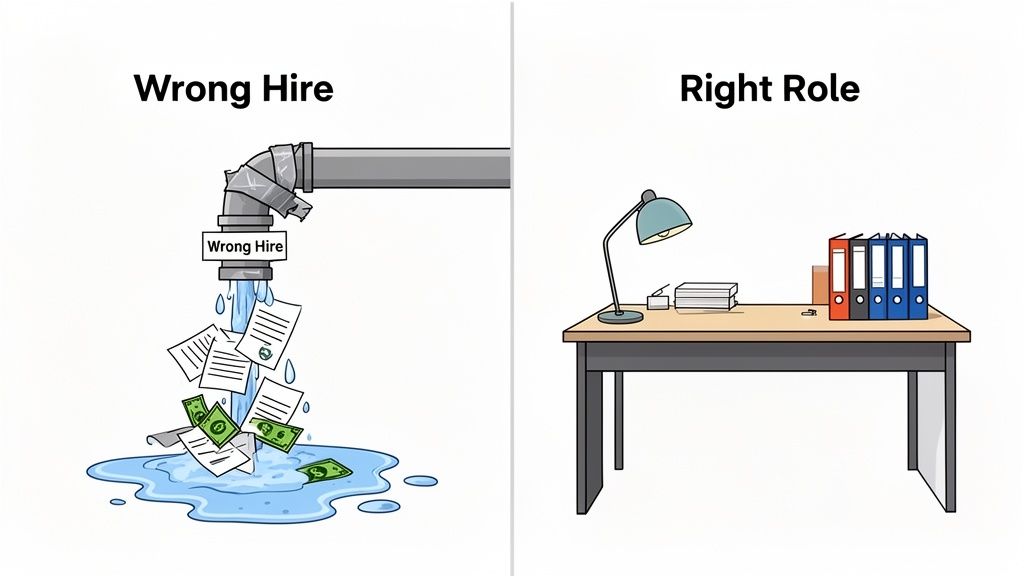
You're swamped. I get it. We've all been there. But hiring out of desperation is like slapping duct tape on a burst pipe—a temporary fix that guarantees a much, much more expensive mess later. Too many firms, especially the smaller ones, toss the titles 'paralegal' and 'legal secretary' around like they're interchangeable.
Let me be blunt: this is a catastrophic mistake.
Blur these lines, and you do one of two things: you overpay a highly-skilled paralegal to play calendar Tetris, or you ask a legal secretary to handle complex discovery requests they aren't trained for. One path just hemorrhages money; the other is basically begging for a malpractice claim.

This isn't just about job titles; it's about profitability and your own sanity. You're not just filling a seat. You're making a strategic bet on either billable hours or operational stability.
The chasm between these roles starts with their training. Paralegals usually have an associate’s or bachelor's degree in paralegal studies, which sets the stage for real legal work—research, drafting pleadings, and taming discovery. Legal secretaries often start with a high school diploma and build their expertise in the trenches. The Bureau of Labor Statistics offers more detail on these educational distinctions, if you're into that sort of thing.
Here’s the quick-and-dirty breakdown:
| Aspect | Paralegal | Legal Secretary |
|---|---|---|
| Core Function | Substantive legal support (billable) | Administrative & procedural support (overhead) |
| Primary Focus | Case-specific tasks, research, drafting | Firm ops, scheduling, client comms |
| Value Prop | Directly increases attorney's legal output | Increases the firm's operational efficiency |
Time to cut the fluff. Let’s get into what these roles actually look like so you can make a smart hire, not a desperate one.
Forget the abstract job descriptions. Let's talk about a Tuesday morning. What does it really look like when you’re wrestling with the paralegal vs. legal secretary question?
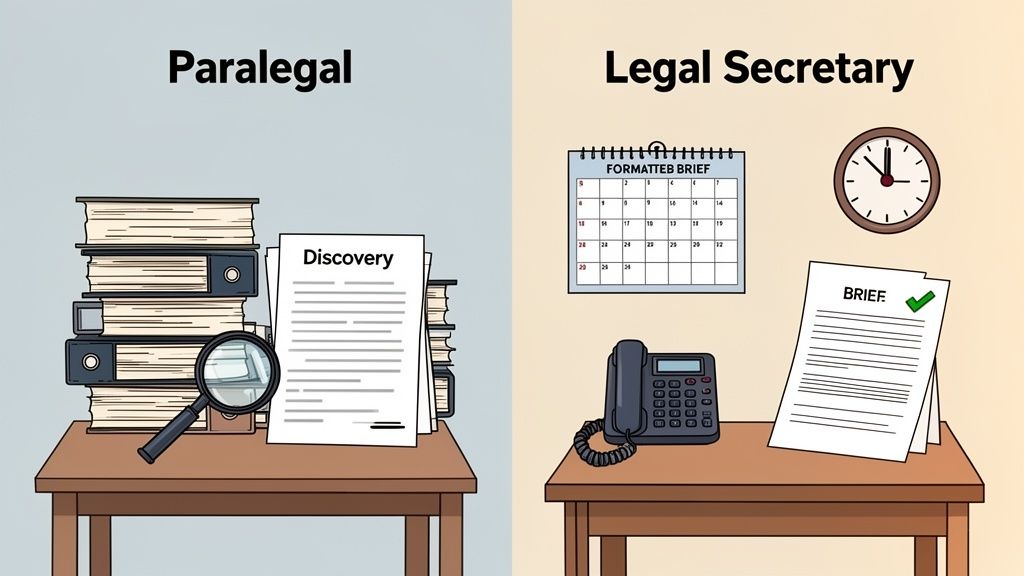
Your paralegal is buried neck-deep in discovery, drafting interrogatories, or turning a five-hour deposition into two pages of pure gold. They're an extension of the attorney, living in the weeds of a case, hunting for that one precedent that will turn everything on its head.
Meanwhile, your legal secretary is the firm's mission control. They're juggling three attorneys’ chaotic calendars, fielding calls from anxious clients who need an update right now, and formatting a 100-page brief to meet the court's ridiculously specific standards. They are the gatekeepers of order, making sure a filing doesn't get bounced because you used the wrong font size.
The real difference snaps into focus with complex legal tasks. A paralegal might be deep in a legal due diligence checklist, which demands a real grasp of legal mechanics. A legal secretary is laser-focused on procedural perfection.
Asking your paralegal to chase down a signature or reformat a document is like asking your star quarterback to handle ticket sales. Sure, they can do it. But at what cost? You're paying a premium for a specialized skill and pointing it at a low-value task. It’s not just inefficient; it’s a brilliant way to burn out your best people.
To make it painfully clear, here's a breakdown of what they actually do all day.
This table shows how the two roles operate in completely different orbits, even on the same case. One is about the "what" of the law; the other masters the "how" of the practice.
| Area of Responsibility | Paralegal (Substantive Legal Work) | Legal Secretary (Administrative & Procedural Support) |
|---|---|---|
| Document Handling | Drafts pleadings, motions, and discovery from scratch. | Formats, proofreads, and finalizes documents to meet court rules. |
| Client Interaction | Conducts initial client interviews, gathers facts, and gives case updates. | Is the first point of contact, schedules meetings, and handles routine calls. |
| Case Management | Manages case files, tracks discovery deadlines, and organizes evidence. | Manages attorney calendars, dockets court dates, and organizes the actual files. |
| Research | Does legal research, investigates facts, and summarizes case law. | Confirms court procedures, finds contact info, and coordinates with vendors. |
See? Misaligning these roles isn't some minor HR oopsie. It's a direct torpedo to your firm's efficiency and profit. Your paralegal’s time should create billable hours, not just more overhead.
For a deeper dive into the administrative side, our guide on the job responsibilities of a legal secretary lays it all out. The differences are stark, and knowing them is step one to building a team that actually helps you grow.
Hiring isn't about filling a seat; it's about buying a specific set of capabilities. Let's be brutally honest about what you're paying for when you hire a paralegal versus a legal secretary. This isn't a minor budget line item—it's a core investment in either billable output or operational sanity.
A paralegal’s value is locked in their specialized training. We’re talking about someone with a degree or an ABA-approved certificate who gets legal theory, not just office procedures. They're trained to think critically, navigate complex research databases, and understand the substance of a legal argument.
They are, quite simply, a force multiplier for your attorneys.
Think of a paralegal as your offense. Their skills directly push cases forward and, ultimately, pump up your firm's revenue.
A legal secretary, on the other hand, is your defense—the foundation that stops the whole operation from collapsing into chaos. Their value is in procedural mastery and administrative excellence. Their skills are just as vital, but they serve a totally different purpose.
You're not just hiring for a title; you're investing in an outcome. Are you buying more billable hours, or are you buying fewer missed deadlines? One isn't better, but confusing them is a recipe for disaster.
Their expertise is focused on:
So, the paralegal vs. legal secretary decision comes down to ROI. Need to increase your capacity for substantive legal work? That’s a paralegal. Trying to plug operational leaks and make your day-to-day less insane? That’s a legal secretary. To get a better feel for the training involved, you can learn more about the common requirements for paralegal jobs and see how they shape the role.
Alright, let's talk money. Because at the end of the day, payroll is a cold, hard reality. The salary gap between a paralegal and a legal secretary isn't random; it reflects their function and the value they bring to the table.
Hiring for one when you need the other is a classic rookie mistake. It's like paying a chef's salary to someone who only knows how to use a microwave. One is a billable asset designed to generate revenue; the other is an operational necessity—a critical one, but an overhead cost.
A paralegal's work translates directly into billable hours. They can, and should, pay for themselves and then some. A legal secretary’s value is measured in the chaos they prevent and the time they save you. This isn't about being cheap; it's about being smart. You have to stop asking, "How much do they cost?" and start asking, "What's my return on this investment?"
Let's look at the data. The national average salary for a jumbled "Paralegal Legal Secretary" role is a useless $49,480. But when you split them up, the real story emerges.
Paralegals pull a median salary of around $61,010, and in hot markets like NYC, that can easily clear $65,000. Legal secretaries, while essential, typically land in a lower bracket. You can check out more salary data from ZipRecruiter to see how the numbers shift by location.
This gap is the market pricing specialized legal skills against top-tier administrative support. One expands your legal capacity; the other protects it.
Don’t get hung up on the salary number. The real math is net cost. A paralegal billing at $150/hour for just 15 hours a week generates $117,000 in annual revenue. They more than cover their salary and directly pad your bottom line.
Now, what if you could get the billable output of a top-tier paralegal without mortgaging your office ping-pong table for the overhead? This is where the game changes.
Hiring a vetted, experienced remote paralegal lets you tap into a national talent pool without paying for office space, benefits, or big-city salary markups. We’ve seen firms slash their payroll costs by up to 80% with this model. You get a pro with 4+ years of experience who can start cranking out billable work from day one. Toot, toot!
Dive deeper into what paralegals charge per hour to see how the numbers pencil out for your firm. This isn’t just cost-cutting; it's about making your firm leaner, meaner, and more profitable.
Theory is nice, but your firm is bleeding time and money right now. The question isn't which role is "better." It's about diagnosing the specific pain point that's slowly killing your practice.
Forget the official job descriptions. Take a hard look at your operations and answer one question: what's the biggest bottleneck holding you back?
Are your attorneys drowning in case prep, buried under non-billable hours spent drafting routine docs or summarizing depositions? That's a workload problem. Or is the chaos more foundational—missed deadlines, calendars in disarray, and a constant feeling of fighting fires? That's an operational problem. The distinction is everything because each demands a totally different fix.
This dead-simple decision tree should help.
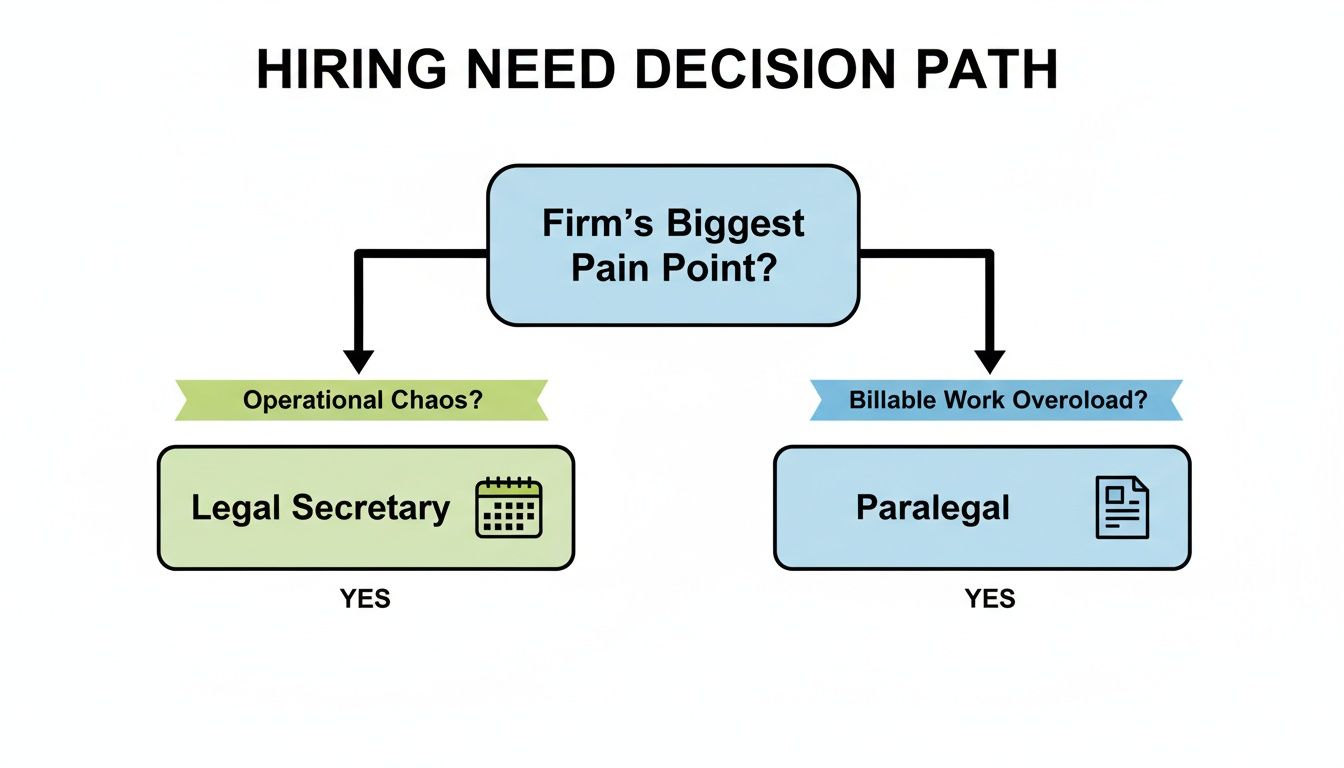
It boils down to this: you hire a legal secretary to fix operational chaos, and you hire a paralegal to crush a billable work overload.
If your attorneys are buried under a mountain of substantive work, hiring a legal secretary is like bringing a squirt gun to a house fire. Wrong tool. You need someone who can jump into the legal trenches on day one and start generating billable hours.
It's time to hire a paralegal if:
On the flip side, if your office is a vortex of missed calls, disorganized files, and scheduling nightmares, throwing a paralegal at it is a criminal misuse of their expensive skill set. You don't need another legal mind; you need an organizational dynamo to restore order.
Hiring a paralegal to manage your calendar is like asking a top surgeon to handle appointment scheduling. Yes, they can do it, but you're burning through money and talent that should be focused elsewhere.
A legal secretary is the right hire when:
For a solo shop, maybe you can find a unicorn who does both. But for a growing firm, trying to merge these roles into one "do-it-all" position is a recipe for burnout and mediocrity. Diagnose the real problem first, then hire the right specialist.
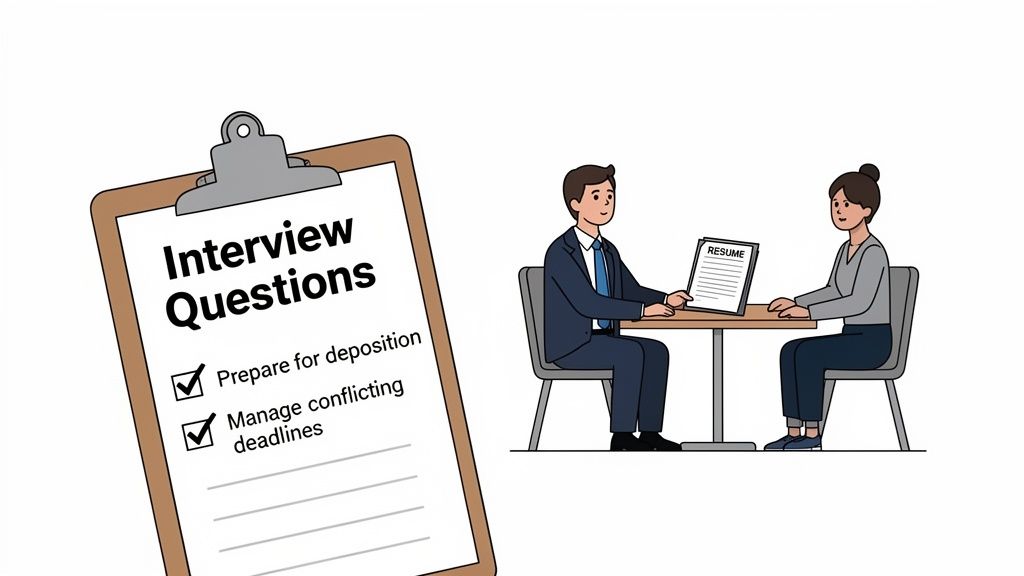
Let's be real: a bad hire is a firm-wide disaster. It's not just the lost salary. It's the drained morale, the wasted partner time, and the slow-burn damage to your client relationships. And most of this pain comes from one source: lazy, generic interview questions.
If you’re still asking candidates about their "greatest weakness," you’re not interviewing. You’re hosting a bad improv show. It's time to drop the script and ask questions that force people to show you what they can do, not just tell you.
The goal isn't to play "gotcha." It's to see how a candidate's mind actually works under pressure. The only way to do that is with situational questions.
Here’s how to stop asking dumb questions and start getting real answers.
When Interviewing a Paralegal:
The second question is a world apart. It forces them to explain their workflow and reveals if they have enough experience to anticipate common mistakes—the mark of a true pro.
When Interviewing a Legal Secretary:
This digs into their real-world ability to manage chaos, communicate under pressure, and exercise professional judgment. These are the skills that actually matter. And if you really want to get good at this, learning how to conduct effective interviews is non-negotiable.
A great interview doesn't feel like an interrogation. It feels like a collaborative problem-solving session where you actually see their brain at work.
Your interview starts with the job description. A vague, copy-pasted post attracts vague, generic candidates. Be brutally specific about the outcomes you need.
Example: A Strong Paralegal Job Description Snippet
Must have demonstrable experience managing discovery for complex commercial litigation, including drafting and responding to interrogatories. The ideal candidate can independently prepare deposition summaries and manage a case calendar in Clio without hand-holding.
Example: A Strong Legal Secretary Job Description Snippet
Seeking a highly organized pro to manage scheduling, client intake, and e-filing across federal and state courts for three busy trial attorneys. Deep proficiency with the ECF/Pacer system is non-negotiable.
Stop hiring blind. A sharp job description attracts the right talent, and sharp questions confirm they have the skills. This is the difference between a strategic hire and a six-month headache.
Alright, let's hit a few of the questions that always pop up when firms are stuck in the paralegal vs. legal secretary mud.
Short answer: Yes. But should they? Hard no. It's an expensive misuse of their billable skills.
Assigning admin work to a paralegal is like asking a surgeon to file paperwork. They’re capable, but it’s a massive waste of their expertise and your money. For any firm that's serious about growing, dedicated roles are just more cost-effective. You're not just paying a premium for someone to manage your calendar; you're investing in a professional who can generate revenue.
Ah, the classic point of confusion, mostly because the industry loves using titles interchangeably. Traditionally, a paralegal has formal training and does substantive legal work. A legal assistant is a broader term that often blends paralegal duties with the administrative work of a legal secretary.
My advice? Forget the title and focus on the duties. When you write the job description, be painfully clear. If the role requires legal research, case analysis, and drafting, it’s a paralegal function, no matter what you call it.
Hiring someone you've never met in person is a different game. Hope you enjoy spending your afternoons fact-checking resumes and running technical interviews over Zoom—because that’s now your full-time job. Or… there’s a better way.
The real trick to remote hiring isn't just finding candidates; it's vetting them. You need a rock-solid process that validates their skills long before they hit your inbox.
Using a specialized service that does the heavy lifting is the only sane option for a busy firm. Platforms with a rigorous vetting process—skills validation, background checks, even personality assessments—can hand you a curated shortlist of experienced, US-based remote paralegals. It saves you dozens of hours and dodges the very real risk of a bad hire. We're not saying we're perfect. Just more accurate more often.