 15 minutes read
Most advice about career paths for paralegals is stuck in a beige conference room somewhere around 2012.
It still treats the role like a tidy ladder. Start as a junior. Stay loyal. Learn the filing system. Maybe become a senior paralegal if you keep your head down and survive enough partner mood swings. Nice story. Wrong market.
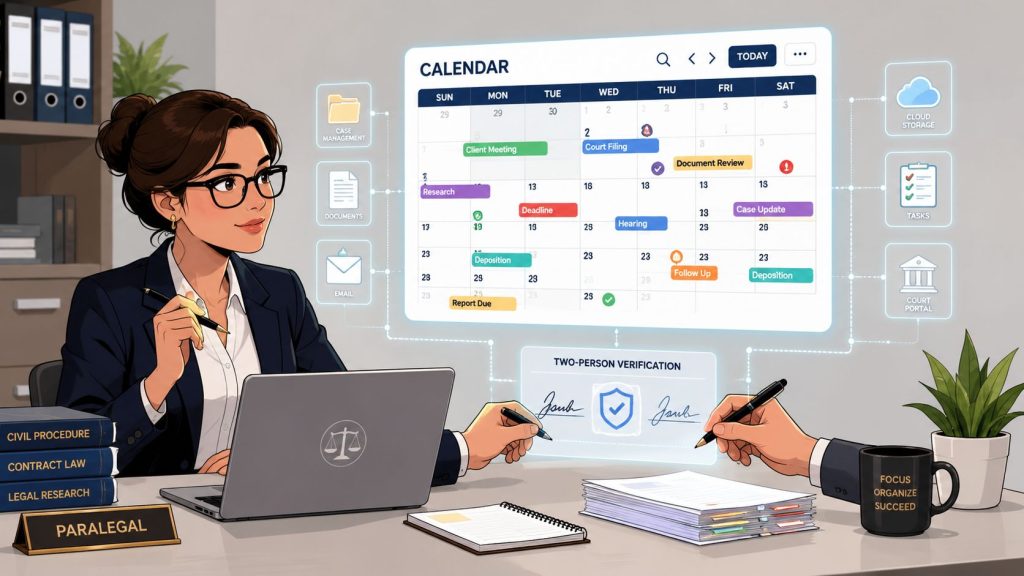
If you're a law firm partner, this matters more than you think. A paralegal is no longer just a support seat you fill and forget. The strongest ones are operators, specialists, workflow builders, client-service stabilizers, and, increasingly, the people who keep your matters from dissolving into deadline soup. Firms that understand this maximize their effectiveness. Firms that don't keep overpaying attorneys to do work a sharper support model could handle better.
Let's kill the old model first.
The classic image of the paralegal was the reliable in-office generalist who stayed put for years, knew where every document lived, and held the place together with equal parts grit and color-coded folders. That person still exists. But treating that as the default career path now is like insisting fax machines are a growth strategy.

The story is more interesting. The Bureau of Labor Statistics says paralegal and legal assistant employment is projected to show “little or no change” from 2024 to 2034, yet it still expects about 39,300 openings each year on average and reports a median annual wage of $61,010 in May 2024. It also notes that most paralegals enter the occupation with an associate's degree or certificate, while some employers prefer a bachelor's degree, according to the BLS paralegal occupation outlook.
That tells you something important. This isn't a flimsy role riding hype. It's a durable one. The market is stable, the openings keep coming, and the work keeps evolving.
Paralegal value used to be measured by obedience and availability. Now it's measured by specialization, process judgment, and tool fluency.
A modern paralegal might spend one phase of their career in litigation support, then shift into contract lifecycle management, then move into legal operations or compliance. Another might stay in a firm but become the person who owns e-discovery workflows, vendor coordination, and reporting. Same legal foundation. Different trajectory.

Practical rule: If your firm still thinks of paralegals as static support staff, you're not running lean. You're running dated.
This isn't career counseling. It's staffing strategy.
When you understand how paralegal careers develop, you stop making bad hiring decisions. You stop hiring a generic “legal assistant/paralegal/admin hybrid” and hoping chemistry solves everything. You start hiring for the bottleneck that is hurting the firm right now.
That shift is where margin lives. Not in motivational posters. Not in another awkward all-hands meeting. In role design.
The smartest firms don't hire “a paralegal.” They hire a litigation paralegal, a corporate paralegal, an immigration paralegal, an IP paralegal, or someone with compliance and e-discovery depth. Big difference.
That difference shows up in speed, accuracy, attorney's effectiveness, and client confidence. Generalists are useful. Specialists are profitable when the work demands them.

The workforce itself reflects that broader spread. In 2024, the U.S. paralegal and legal assistant workforce reached 471,684 people, with private law firms as the largest employers, while corporations and government also employ many professionals in the field, according to Data USA's paralegal workforce profile.
Here's the menu firms should be ordering from:
Litigation paralegal
This person keeps cases moving. Discovery coordination, exhibit prep, deadline management, document organization, and trial support all live here. If your litigators are chasing attachments at midnight, you don't need another associate. You need a stronger litigation paralegal.
Corporate paralegal
Corporate work punishes sloppiness. Entity management, governance records, closing checklists, board materials, and filing coordination require someone who likes precision more than drama. If you need a clearer picture of that role, this guide on what a corporate paralegal does lays out the day-to-day work well.
Immigration paralegal
Immigration is process-heavy, deadline-sensitive, and emotionally loaded for clients. A sharp immigration paralegal doesn't just move forms around. They reduce chaos and keep communication from collapsing.
Some of the most valuable support roles don't get enough oxygen:
| Specialization | What they protect |
|---|---|
| IP paralegal | Patent, trademark, and copyright workflows that protect client assets |
| Compliance-focused paralegal | Regulatory process, documentation discipline, and internal consistency |
| E-discovery support | Searchable data handling, platform coordination, and review efficiency |
| Real estate paralegal | Titles, leases, closings, and transaction flow |
If your work is drifting toward regulation, audits, internal controls, or risk review, start watching the broader market for LatoJobs legal compliance roles. Not because you need to abandon the paralegal lane, but because compliance hiring patterns show where legal support work is getting more specialized.
A specialization isn't a vanity label. It's your answer to a recurring operational headache.
The firms that win here don't collect random resumes. They map recurring matter types, identify the work attorneys shouldn't be doing, and hire the specialist who closes that gap.
Linear promotion paths make HR people comfortable. They don't describe how good paralegal careers actually work.
A junior paralegal may become a mid-level generalist. Sure. But the stronger path often includes side moves that look strange on paper and brilliant in practice. A litigation paralegal picks up e-discovery tools. A corporate paralegal starts handling contract workflows. A senior paralegal begins building process documentation, reporting, and training. Suddenly you're not looking at support staff. You're looking at legal infrastructure.

Recent career guidance makes this plain. Paralegal skills transfer directly into corporate legal departments, compliance, HR, and real estate, according to Oregon State's overview of paralegal career paths.
The traditional steps haven't vanished. They just aren't the whole story.
That's still useful. But if you stop there, you'll lose ambitious talent to better-designed roles elsewhere.
The high-value transition usually starts when the person moves from task execution into workflow ownership.
This is how it appears in plain English:
Stop asking, “Can this paralegal do more?” Ask, “What business function are they already halfway running?”
That framing changes retention too. People leave when the only reward for being excellent is more of the same work. They stay when you give them scope.
Don't wait for titles to magically organize themselves. Create a progression model that recognizes lateral capability.
A useful internal map looks like this:
| Stage | Focus |
|---|---|
| Foundation | Research, drafting support, document handling, case or matter management |
| Specialization | Litigation, corporate, immigration, IP, compliance, or another practice niche |
| Optimization | Systems use, workflow cleanup, training, reporting, cross-team coordination |
| Expansion | Legal ops, compliance, contract management, team leadership |
The best career paths for paralegals aren't ladders you climb politely. They're structures you move across strategically.
If you want stronger paralegal talent, don't hand people a vague promise of “growth.” That's corporate wallpaper. Give them a roadmap with skills, tools, and visible ownership.
NALA's career-advancement framework is one of the more practical models out there. It maps a progression from foundational legal work in Year 1, to legal tech in Year 2, process mapping and reporting in Year 3, and vendor RFPs plus AI tool testing by Years 4 and 5, creating a path toward a Legal Operations Specialist role, as described in NALA's career advancement competencies.
Year 1 should be boring in the best way. The paralegal needs repetition in the fundamentals: legal research, document preparation, ethics, case or matter management, and clean communication.
Then comes Year 2, where too many firms drop the ball. This is when the person should learn the tools that make them more than a pair of hands.
That means exposure to things like:
If your team says it values advancement but never gives access to the systems, it doesn't value advancement. It values cheap labor.
This is the pivot year.
The paralegal should start understanding process mapping, data reporting, and formalized improvement work. They should be able to explain where a workflow breaks, not just complain that it's annoying.
Credentials can also help here, particularly if they match the direction of travel. NALA points to certifications such as CEDS or CP® as part of this progression. Certifications won't rescue a weak operator, but they can sharpen a strong one.
A paralegal becomes hard to replace when they can document a process, improve it, and teach it to someone else.
One more thing. Technical growth isn't enough if the person can't present ideas with confidence. If you're mentoring talent into cross-functional work, give them support on stakeholder communication too. Something as simple as this guide on boosting professional speaking confidence can help a capable operator sound as solid as they already are.
By this stage, the paralegal shouldn't just be completing legal tasks. They should be touching the business side of delivery.
That includes work like:
Vendor RFP coordination
Useful for legal ops, procurement-heavy environments, and firms juggling multiple tools.
Renewal and contract workflow support
This builds muscle for contract management and in-house transitions.
AI tool proof-of-concept work
Not AI theater. Real testing. Does the tool help? Where does it fail? What needs human review?
Dashboard and metrics ownership
If they can report on cycle times, backlog, intake, or process bottlenecks, they're no longer just supporting legal work. They're helping manage it.
That is how career paths for paralegals turn into power-player paths.
A lot of law firm leaders still talk about remote legal support like it's a temporary concession. It isn't. It's a staffing model.
The question isn't whether remote and freelance paralegals are “real.” The question is whether your firm wants access to specialized talent without limiting itself to one commuting radius and one compensation logic.

The pay conversation is changing with the work itself. The median U.S. paralegal wage is $61,010, and legal-service delivery is moving toward skill-based value instead of simple location-based assumptions, as noted in this discussion of paralegal legal career paths and virtual work.
Partners usually raise the same three concerns.
| Objection | Real answer |
|---|---|
| Confidentiality | Use controlled access, documented workflows, and role-based permissions |
| Supervision | Manage outputs, deadlines, and communication standards instead of chair time |
| Time zones | Hire for overlap where needed, and use asynchronous updates for everything else |
None of these are imaginary concerns. They are manageable ones.
A sloppy remote setup is bad. So is a sloppy in-office setup, except you pay rent to watch it happen.
Remote paralegals are especially useful when the work is process-heavy, deadline-driven, or specialist-based.
Think:
If you're still unsure what remote legal support can look like in practice, this breakdown of whether paralegals can work from home is worth a read.
Firms that insist every capable paralegal must sit in the office are choosing geography over capability.
Use in-office hires when physical presence is part of the job. Use remote talent when specialization, flexibility, or coverage matters more than badge swipes.
Don't romanticize “culture” as an excuse for weak role design. People don't become better at deadline control because they share a snack drawer.
Remote support isn't a compromise anymore. It's a strategic option, and in plenty of firms, it's the cleaner one.
Hiring remote talent sounds easy until you try doing it properly. Then suddenly you're screening resumes, testing communication, checking experience, comparing tools exposure, and wondering why your Tuesday disappeared.
Hope you enjoy your new side gig as a recruiter.
A better approach is to build a process that filters for remote readiness, not just legal knowledge. Strong paralegals can still fail in remote roles if they need constant prompting, write vague updates, or panic when priorities shift.
Start with four filters.
Written communication
Ask for a short status update based on a mock matter. If they can't explain progress, blockers, and next steps clearly, the job gets harder fast.
Tool comfort
You don't need a software magician. You do need someone who can adapt to systems without acting like every new platform is a human rights violation.
Workflow judgment
Give a scenario with competing deadlines and see how they prioritize. Good remote talent doesn't just complete tasks. They surface risk early.
Professional reliability
Check whether they can manage meetings, follow instructions, and close loops without chasing.
Interviews are useful. Trial work is better.
A short paid assignment can reveal:
That's far more useful than another pleasant video call where everyone says they're “detail-oriented.”
Hire for signal, not charm. Charm doesn't update case trackers.
Most firms sabotage remote hires during onboarding. They toss over logins, mention a few matter names, and hope instinct fills the gaps.
Use a simple onboarding pack with:
If you're building a fully virtual legal support model, this guide to virtual paralegal employment covers the operating realities well.
You can also borrow hiring cues from other distributed employers. Reviewing how established remote companies structure remote work can sharpen your own screening and onboarding standards.
You can run all of this internally. Plenty of firms do. It just takes time, consistency, and someone who owns the process.
Or you can use a specialized option such as HireParalegals, which connects U.S. law firms with remote legal support professionals and handles screening plus candidate shortlisting. That's not magic. It's just operational delegation, which is often the smarter move when partners should be practicing law instead of drowning in hiring admin.
The old advice says hire a paralegal, plug them into the office, and hope they grow into whatever you need.
That advice is lazy.
Modern career paths for paralegals are broader, more technical, and more mobile than most firms admit. The best talent doesn't just climb upward. They specialize, move laterally, pick up tools, own workflows, and step into adjacent roles that make a legal team run better.
If your staffing model still assumes every paralegal is a permanent in-office generalist, you're not preserving tradition. You're narrowing your options and paying for the privilege.
So make the decision cleanly.
Audit the work your attorneys shouldn't be doing. Identify where specialization would protect margin, speed, or client service. Build roles that reflect actual business needs. And if remote talent gives you better coverage, better flexibility, or better expertise, use it.
The firms that adapt will build legal support teams with real advantage.
The firms that don't will keep calling the same bottlenecks “just part of the business.”
Your next move is simple. Stop thinking about hiring one paralegal. Start designing the support system your firm will need to stay efficient, resilient, and hard to out-execute.